Autonomous Tier-1 Resolution: How a Customer Service AI Agent Resolves Repetitive Tickets
A customer service AI agent can close routine tier-1 tickets on its own when it has clean answers to draw from and access to the systems that hold order, account and billing data.
This guide explains which tickets qualify, what resolution rates companies report, and how to set a target for the tickets you choose to automate.
1. The Short Answer
Autonomous tier-1 resolution means a customer service AI agent closes routine tickets without a person. To get there, pick the repetitive ticket types, ground the agent in approved answers, connect it to live data, and set strict handoff rules for everything else.
Set your target on the tickets you choose, not on your whole queue. Gartner predicted in March 2025 that agentic AI will resolve 80% of common customer service issues without human help by 2029. That is a forecast, not a measured result, and the word “common” matters.
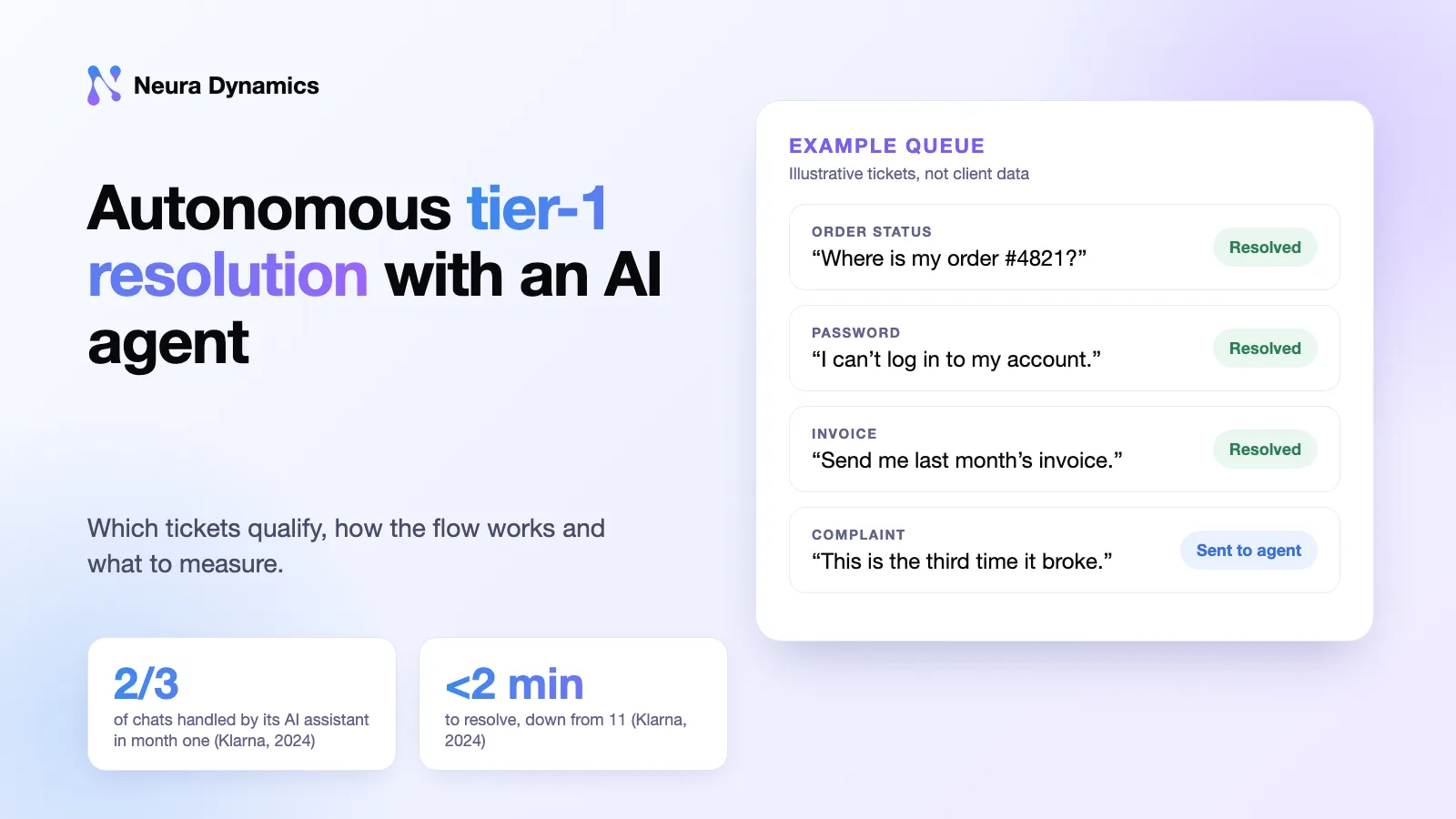
Four example tickets (illustrative), and what the AI agent does with each:
- Order status: “Where is my order #4821?” Resolved by AI.
- Password: “I can’t log in to my account.” Resolved by AI.
- Invoice: “Send me last month’s invoice.” Resolved by AI.
- Complaint: “This is the third time it broke.” Sent to a person.
Key takeaways
- Set the target on tickets you choose to automate, not on your whole queue.
- A ticket qualifies when it recurs, has one correct answer, and the answer or action is reachable by the AI.
- Klarna’s assistant handled two-thirds of chats in its first month, and customers resolved errands in under 2 minutes against 11 before (Klarna, 2024).
- Track resolution, not deflection, and measure time to resolution from the first message.
- Keep a clear route to a person. In a Gartner poll of 163 service leaders, 95% planned to keep human agents alongside AI (2025).
2. What Counts as a Tier-1 Inquiry?
Tier 1 is the first line of support. It covers questions with a known answer or a fixed process: where is my order, how do I reset my password, what is your refund policy. Tier 2 needs product knowledge or judgment. Tier 3 needs engineering or specialist access.
A ticket is a good candidate for autonomous resolution when it passes three tests. It recurs often. The correct answer does not depend on opinion. And either the answer is in your help content or the action can be done through an API. This is how automated customer support starts to pay off: on the tickets that pass all three.
Note: “Deflection” and “resolution” are different. Deflection means the customer did not reach a person. Resolution means the problem was solved. Track resolution, or a frustrated customer who gives up looks like a success.
3. Which Tickets Can an AI Agent Resolve on Its Own?
Sort your ticket types into three groups. Only the first group goes into your autonomous resolution target. This is the scoping step for AI agents for customer support: decide what the agent owns before you decide how well it must do.
- Automate fully: lookups and simple actions. Order status, password resets, invoice copies, plan details, opening hours, policy questions. Needs: approved content and read or write API access.
- Automate with checks: rule-bound changes. Address changes, cancellations within policy, refunds under a set amount. Needs: an identity check and clear policy limits.
- Keep with people: judgment calls. Complaints, exceptions to policy, bugs, legal or safety issues, high-value accounts. The AI’s role: classify, summarize and route.
Check how your own volume is spread across ticket types, and start with the ones that recur most. A ticket type you cannot connect to data this quarter belongs in the second group, even if it is frequent.
For a worked example of one ticket type, see our guide on how to automate “Where is my order?” tickets.
4. How Does Autonomous Tier-1 Resolution Work?
Each conversation with a customer support AI agent runs through five stages. Lookup questions can be answered quickly when the data is a single API call away, because no stage has to wait for a person.
- Classify the request. The agent identifies the intent, such as order status or password reset, and checks whether it is in the automation scope.
- Verify the customer. For account actions it confirms identity through login state, email match or a one-time code.
- Retrieve the answer or data. It searches approved help content or calls the order, billing or CRM API for live data.
- Act and confirm. It completes the action, such as resending an invoice, then tells the customer what changed.
- Close or hand off. If confidence is low, the request is out of scope or the customer asks for a person, it transfers with a summary.
Tip: Measure time to resolution from the customer’s first message to the confirmed fix, not time to first reply. An instant reply that asks three clarifying questions is not a fast resolution. Our guide to reducing first response time covers the first-reply side.
5. Rule-Based Bot vs AI Agent vs Human Agent
Most help desks run some mix of the three. The difference is which one takes the first message. An AI help desk setup usually puts the AI agent first and keeps people for the rest.
- Understands. Rule-based bot: keywords and button clicks. AI agent: free-text questions in context. Human agent: everything, including tone.
- Takes actions. Rule-based bot: fixed flows only. AI agent: yes, through your APIs. Human agent: yes.
- Time to resolve. Rule-based bot: fast if the flow fits. AI agent: fast for lookups. Human agent: depends on the queue.
- Best for. Rule-based bot: menus and simple routing. AI agent: repetitive tier-1 tickets. Human agent: tier 2 and 3, complaints.
- Main risk. Rule-based bot: dead ends when the flow breaks. AI agent: confident wrong answers if content is thin. Human agent: backlogs at peak times.
This is our assessment of typical setups, not a survey.
For the difference in more detail, read chatbots vs customer support automation.
6. What Resolution Rates Do Companies Report?
The best-documented case is Klarna. Its OpenAI-powered assistant went live globally in early 2024, and the company published results after one month.
- 2.3 million conversations in the first month.
- Two-thirds of all customer service chats.
- Under 2 minutes to resolve, down from 11 minutes.
- 25% drop in repeat inquiries.
Klarna also reported customer satisfaction on par with human agents. These are the company’s own figures, from its February 2024 press release. In 2025, CX Dive reported that Klarna wants customers to always have the option to speak with a human. That is the right design for any tier-1 agent.
Headline cases are not a target for your own queue. Your rate will depend on your content and your ticket mix, so measure it on your own past tickets before you promise a number.
From our own work: Paymate is an omnichannel AI customer support system we built for voice, email and web chat. It answers from the company’s product documentation, checks its own confidence, and hands the case to human support with context. For high-confidence email queries, first response time went from hours to under one minute.
Want to know which of your tier-1 tickets an AI agent could close? We can review a sample with you. Book a 30-minute call.
7. How to Set Up Tier-1 Resolution in 7 Steps
- Tag 500 recent tickets by type. Count volume per type and note which system holds the answer.
- Pick your automation scope. Choose the ticket types that pass the three tests. Set your target on these only, after you have tested the agent.
- Fix the content first. Rewrite help articles for the scoped types so each has one clear, current answer.
- Connect the data. Give the agent read access to orders and accounts, and write access only for approved actions.
- Write the handoff rules. Define low-confidence thresholds, out-of-scope topics and the summary passed to agents.
- Test on past tickets. Replay 200 resolved tickets and compare the AI’s answers with what your agents did.
- Launch on one channel and review weekly. Read a sample of AI conversations every week, fix gaps, then add channels and ticket types.
Step 3 decides much of your resolution rate. Our guide to agentic RAG for customer service automation explains how to ground an AI agent in your own documents. For the ticket side of the setup, see helpdesk automation for support tickets.
8. Which Metrics Show It Is Working?
- Autonomous resolution rate. Share of scoped tickets solved with no human touch. This is your headline number.
- Median time to resolution. From first message to confirmed fix.
- Reopen and repeat-contact rate. Customers who come back within 7 days. A rising rate means wrong answers.
- CSAT on AI conversations. Compare with human-handled tickets of the same type, not with your overall score.
Plan for your team to change shape, not disappear. In Gartner’s October 2025 survey of 321 service leaders, only 20% had reduced agent headcount because of AI, and 55% kept staffing stable while handling more volume. We cover the wider outlook in AI agents for customer support in 2030, and the limits in what AI cannot yet solve in customer service.
Warning: Do not let the agent improvise on refunds, account security or anything regulated. Give it exact policy wording to quote, and send exceptions to a person.
9. Frequently Asked Questions
What is autonomous tier-1 resolution?
It means an AI agent fully resolves first-line support tickets, such as order status or password resets, without a human agent. The AI understands the request, finds the answer or takes the action through your systems, confirms the result, and hands off anything outside its scope.
Is an 80% tier-1 resolution rate realistic?
It is a forecast, not a measured result. Gartner’s March 2025 prediction is that agentic AI will resolve 80% of common issues by 2029. Klarna reported two-thirds of chats handled in its first month. Your own rate depends on which tickets you automate and how good your content is, so test on past tickets before you set a target.
How fast can an AI agent resolve a ticket?
Lookups and simple actions can be fast, because each stage is a system call rather than a wait for a person. Klarna reported an average of under 2 minutes across its AI chats in 2024, compared with 11 minutes before. Multi-step or verification-heavy requests take longer, so measure your own median time to resolution.
What is the difference between deflection and resolution?
Deflection counts customers who did not reach a human. Resolution counts problems actually solved. A customer who gives up is deflected but not resolved. Track resolution with a reopen or repeat-contact check so the metric reflects real outcomes.
Will autonomous resolution replace support agents?
Current survey data points the other way. Gartner’s October 2025 survey of 321 service leaders found only 20% had cut agent headcount because of AI, while 55% kept staffing stable and handled more volume. In our view, the work of agents shifts toward the tickets the AI hands off and the quality of its answers.
10. Conclusion
Autonomous tier-1 resolution works when a customer service AI agent handles a defined set of repetitive tickets with good content and live data behind it. This week, export 500 recent tickets, tag them by type, and mark which ones pass the three tests in section 2. That list is your automation scope and the base for your target.
To build it with us, see our AI customer support automation services. Or book a 30-minute call and we will walk through it.
Author