Customer Support in 2030: How AI Agents Will Change Support Teams
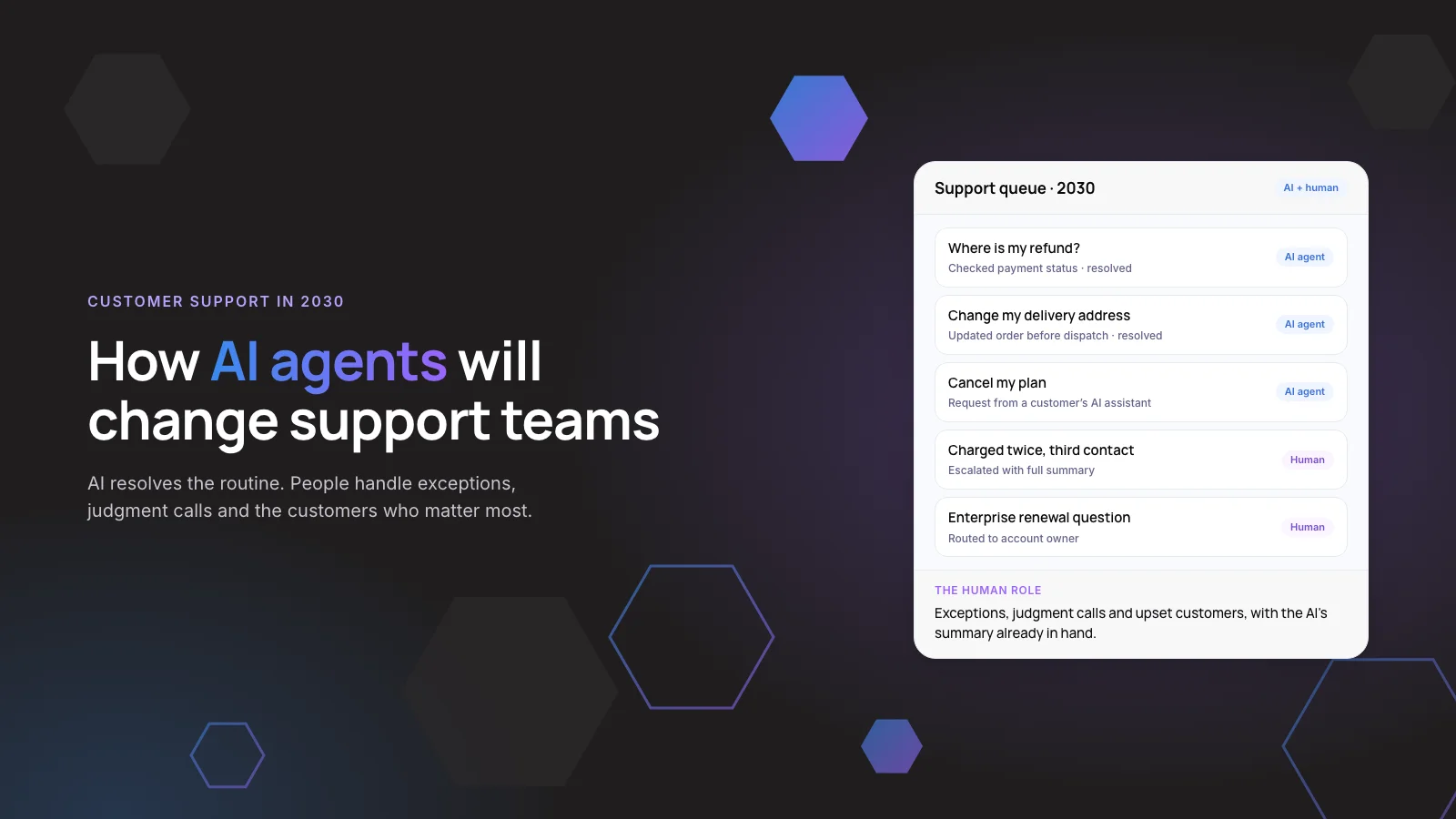
By 2030, AI agents will resolve most routine support requests on their own. Support teams will be smaller per ticket, but not empty.
This guide covers what the research predicts, which human roles grow, what Klarna learned going AI-first, and seven steps to prepare your team.
1. The Short Answer
AI agents for customer support will take over most routine, well-defined requests by the end of the decade. Gartner predicted in March 2025 that by 2029, agentic AI will resolve 80% of common customer service issues without human help, cutting operating costs by 30%.
The same firm expects humans to stay. Support teams will shift from answering tickets to handling exceptions, training the AI and owning the customer relationship.
Key takeaways
- Gartner predicts agentic AI will resolve 80% of common customer service issues by 2029.
- Human agents stay: none of the Fortune 500 will fully drop human service by 2028, Gartner says.
- Agent work shifts to exceptions, AI supervision, knowledge ownership and key accounts.
- Klarna’s AI handled two-thirds of chats in 2024, and Klarna still rehired people in 2025.
- Start with a ticket audit and one pilot, measured on resolved issues, not headcount.
2. What Will AI Agents Handle by 2030?
An AI agent is different from a chatbot. A chatbot answers questions. An agent can also act: check an order, issue a refund within policy, change a booking or update the CRM. Gartner describes these as systems that complete tasks on their own, not just generate text.
In practice, the work splits into three bands. Where a request sits depends on how clear the rules are and what a mistake would cost.
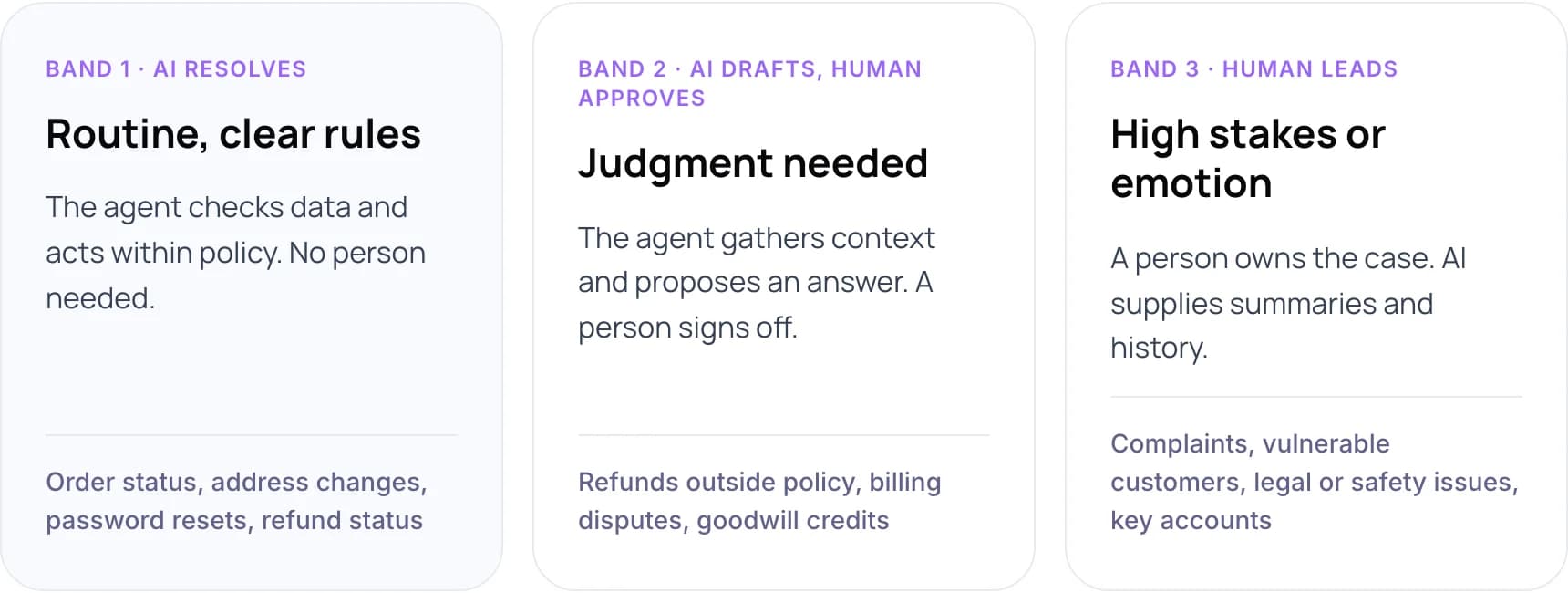
- Band 1 · AI resolves (routine, clear rules): the agent checks data and acts within policy. No person needed. For example, order status, address changes, password resets and refund status.
- Band 2 · AI drafts, human approves (judgment needed): the agent gathers context and proposes an answer. A person signs off. For example, refunds outside policy, billing disputes and goodwill credits.
- Band 3 · Human leads (high stakes or emotion): a person owns the case. AI supplies summaries and history. For example, complaints, vulnerable customers, legal or safety issues and key accounts.
Gartner also expects a new kind of inbound traffic: machine customers. These are AI assistants acting for a customer, for example one that contacts your support line to cancel a subscription or negotiate a delivery date. Your team will need rules for how to serve them.
Note: Gartner’s 80% figure covers common issues, not all contacts. Complex, high-value and emotional cases sit outside it.
3. What Will Human Support Agents Do?
The shift has started. In a Gartner survey of 321 service leaders, published in December 2025, 55% reported stable staffing while handling higher volumes, and 42% were hiring for new AI-focused roles. Only 20% had cut agent headcount because of AI.
In our view, four roles will grow on most support teams by 2030. Job titles will vary, but the work is already visible.
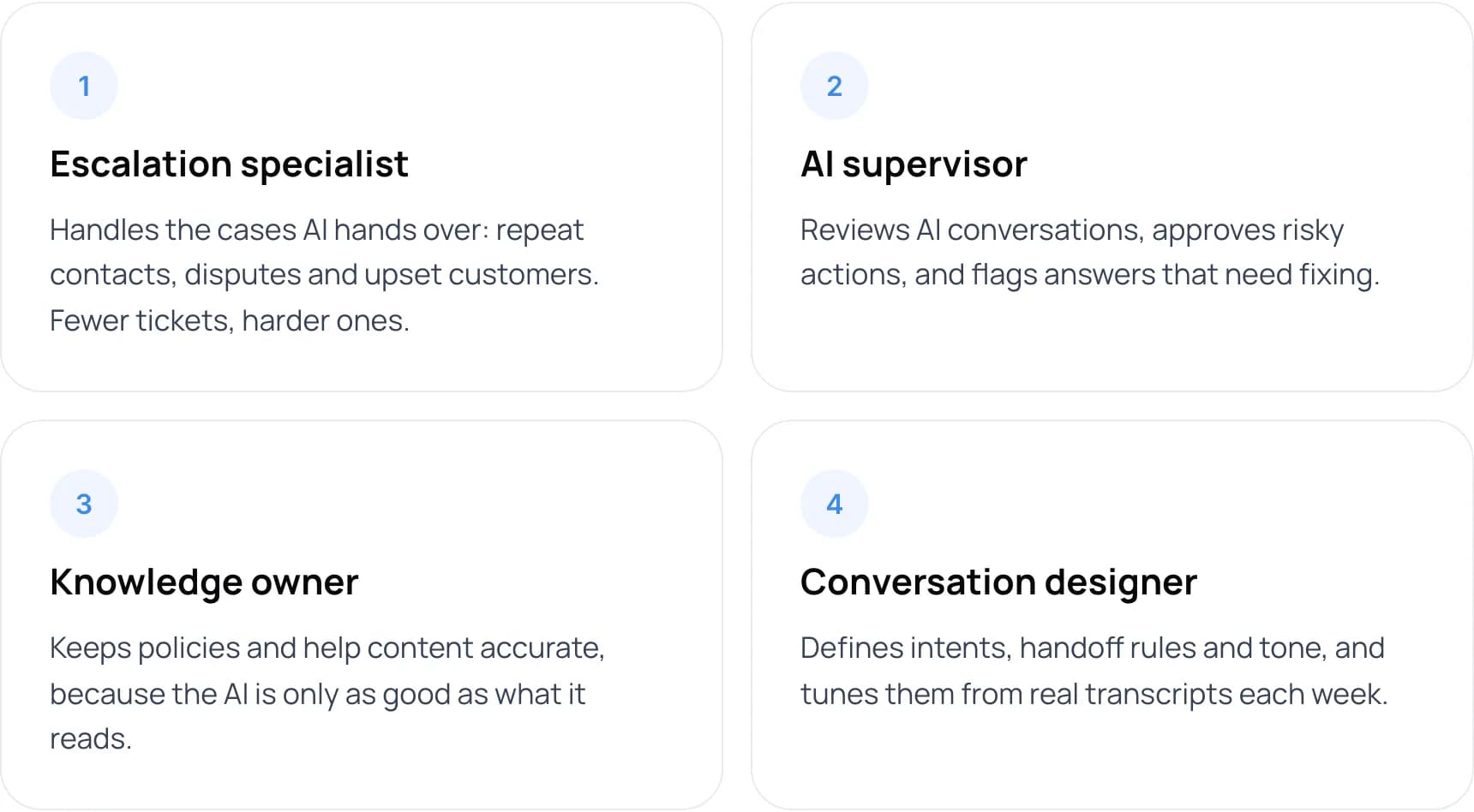
- Escalation specialist: handles the cases AI hands over: repeat contacts, disputes and upset customers. Fewer tickets, harder ones.
- AI supervisor: reviews AI conversations, approves risky actions, and flags answers that need fixing.
- Knowledge owner: keeps policies and help content accurate, because the AI is only as good as what it reads.
- Conversation designer: defines intents, handoff rules and tone, and tunes them from real transcripts each week.
Tip: Your best current agents are your best future AI supervisors. They already know which answers are risky and which customers need a person.
4. Support Teams Today vs in 2030
The comparison below is our projection, based on the research cited in this guide.
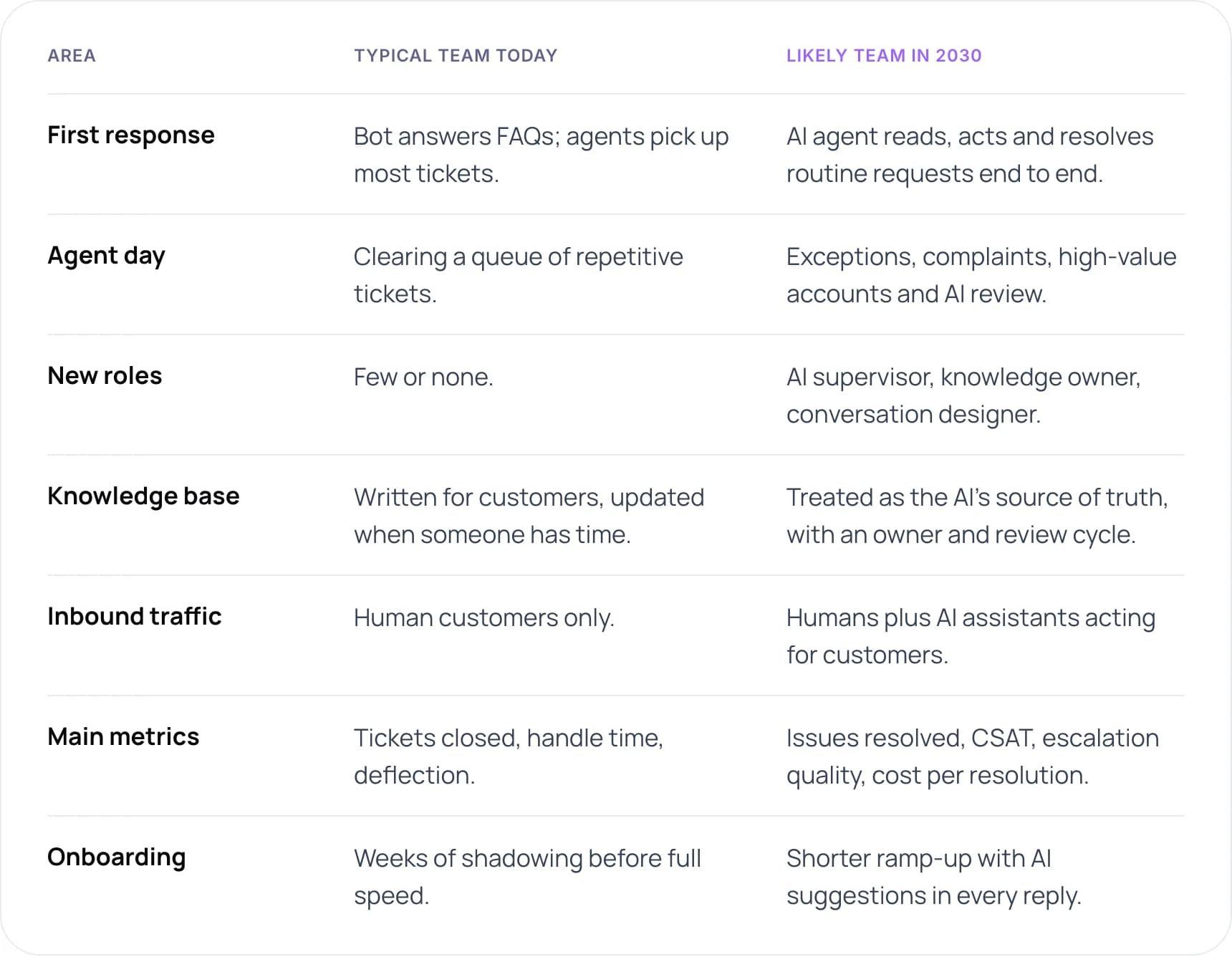
- First response: today, a bot answers FAQs and agents pick up most tickets. In 2030, an AI agent reads, acts and resolves routine requests end to end.
- Agent day: today, clearing a queue of repetitive tickets. In 2030, exceptions, complaints, high-value accounts and AI review.
- New roles: today, few or none. In 2030, AI supervisor, knowledge owner, conversation designer.
- Knowledge base: today, written for customers and updated when someone has time. In 2030, treated as the AI’s source of truth, with an owner and review cycle.
- Inbound traffic: today, human customers only. In 2030, humans plus AI assistants acting for customers.
- Main metrics: today, tickets closed, handle time and deflection. In 2030, issues resolved, CSAT, escalation quality and cost per resolution.
- Onboarding: today, weeks of shadowing before full speed. In 2030, shorter ramp-up with AI suggestions in every reply.
5. What Happened When Klarna Went AI-First?
Klarna is the most quoted example, and both halves of its story matter. In February 2024 it reported that its AI assistant handled two-thirds of service chats in its first month, 2.3 million conversations.

- 2.3M conversations in the first month.
- 700 full-time agents’ worth of work, by Klarna’s estimate.
- Under 2 minutes to resolve, down from 11 minutes.
- 25% fewer repeat inquiries.
By 2025, Klarna was recruiting human agents again, and its CEO said customers should always know a person is there if they want one. The lesson is not that the AI failed. It handled volume well, and the company still needed people for the cases that decide whether a customer stays.
AI makes newer agents better fastest
A study of 5,179 support agents by Brynjolfsson, Li and Raymond found an AI assistant raised resolutions per hour by 14% on average and by 34% for novice and low-skilled agents. It was first released as an NBER paper in 2023 and published in the Quarterly Journal of Economics in 2025. For team planning, this means AI shortens ramp-up time as much as it cuts volume.
On our own AI email support build for e-commerce, replies are drafted from live order data and approved by an agent before they go out. That is the human-in-the-loop model most teams will start with.
6. Will AI Agents Replace Customer Support Teams?
Not fully, according to the research. Gartner predicts that by 2028, none of the Fortune 500 will have fully eliminated human customer service. It also predicts that by 2027, half of organizations that planned major support cuts will drop those plans. In the March 2025 poll behind that prediction, 95% of 163 service leaders planned to keep human agents alongside AI.
Cost is a big reason. A Gartner analyst told The Register in June 2025 that leaders often underestimate the total cost of ownership of generative AI. Integrations, content upkeep, monitoring and escalation handling all cost money, and a ticket the AI gets wrong usually costs more than one it never touched.
Warning: Plan AI around resolved issues and customer satisfaction, not a headcount target. Cutting staff before the AI proves itself is the pattern Gartner expects half of companies to reverse.
Want to know which of your tickets an AI agent could resolve today? Book a free AI consultation.
7. How to Prepare Your Support Team for AI Agents
- Audit last month’s tickets. Tag each as routine, judgment or relationship. This tells you how much an AI agent can take on.
- Pick one band-1 use case. Choose something frequent with a clear right answer, such as order status or refund tracking.
- Fix the knowledge first. Assign an owner to policies and help content. The agent should answer only from approved sources and live data.
- Write the handoff rules. Define when the agent stops: low confidence, repeat contacts, negative sentiment, money above a limit, or any request for a person.
- Name an AI supervisor. Give one experienced agent time each day to review AI conversations and correct them.
- Measure resolution, not deflection. Track issues resolved, CSAT, reopen rate and escalation quality, compared against your human baseline.
- Expand band by band. Add use cases only when the current ones hold their numbers for a month. Move to band 2 with human approval in place.
Step 3 decides answer quality. Our guide to agentic RAG for customer service automation explains how to ground an agent in your own documents and data.
8. Where AI Agents Fit, and Where They Don’t
Good fit
- High-volume requests with clear rules.
- Tasks that need data lookups across systems.
- 24/7 coverage and multiple languages.
- Drafting replies for agents to approve.
- Summaries and context for every handoff.
Keep a person in charge
- Complaints and customers at risk of leaving.
- Vulnerable customers, health, legal or safety issues.
- Refunds or credits above a set limit.
- Enterprise accounts and renewals.
- Any case where the customer asks for a person.
New to the topic? Start with what customer support automation is and how it works.
9. Frequently Asked Questions
Will AI agents replace customer support teams by 2030?
Not entirely. Gartner predicts none of the Fortune 500 will have fully eliminated human customer service by 2028, and that half of companies planning big support cuts will drop those plans by 2027. Expect smaller teams per ticket, with people focused on complex and high-value cases.
What is the difference between an AI agent and a chatbot?
A chatbot mainly answers questions from scripts or a knowledge base. An AI agent for customer support can also take actions, such as checking an order, issuing a refund within policy or updating a booking, and decides which steps to take. Both need clear handoff rules to a person.
What percentage of customer service will be automated?
Gartner’s March 2025 prediction is that agentic AI will resolve 80% of common customer service issues without human help by 2029. That covers routine issues, not every contact. Complex, emotional and high-value cases will still need people, so the share of total work automated will be lower.
What skills will support agents need in 2030?
Judgment on exceptions, handling upset customers, reviewing AI output, and keeping knowledge accurate. Comfort with data and with tuning AI behavior from transcripts will matter more. Gartner found 42% of service organizations were already hiring for new AI-focused roles in late 2025.
How should a mid-size company start with AI customer support?
Audit a month of tickets, pick one frequent and well-defined request, and run a pilot with human review. Fix the knowledge base first and name someone to supervise the AI. Measure resolved issues and CSAT against your current baseline before expanding to more use cases.
10. Conclusion
AI agents for customer support will change what your team does more than how many people it has. Start this quarter: tag last month’s tickets as routine, judgment or relationship, and pilot an agent on the routine band with one senior agent as its supervisor.
Tip: Put your ticket volume and cost per ticket into our free AI ROI Calculator before you set targets.
To build it with us, see our AI customer support automation services or AI agent development. Or book a free AI consultation.
Author