Why Customers Hate Chatbots (and How to Build One They Don’t)
Customers rarely hate the idea of a customer service chatbot. They hate bots that loop, guess, and stand between them and a person.
This guide covers the five reasons bots fail, two public failures, and a seven-step way to build one that solves problems and steps aside when it should.

1. The Short Answer
Customers dislike customer service chatbots that cannot solve their problem and will not let them reach someone who can. In a 2024 Gartner survey, 64% of customers said they would prefer companies did not use AI for service. Their top worry was that it would make reaching a person harder.
That complaint is about design, not about the technology. A bot that answers from real data, says what it cannot do, and hands over early is a very different experience.
Key takeaways
- Customers mostly hate bots that block access to a person, not AI itself.
- The five failures: loops, confident wrong answers, no memory, forced bot-first, and a cheerful tone with upset customers.
- Ground every answer in approved content and live data, and say plainly when the bot cannot help.
- Make “talk to a person” work at any point, and pass the full chat to the agent.
2. Why Do Customers Hate Chatbots?
Almost every complaint about a support chatbot falls into one of five patterns.
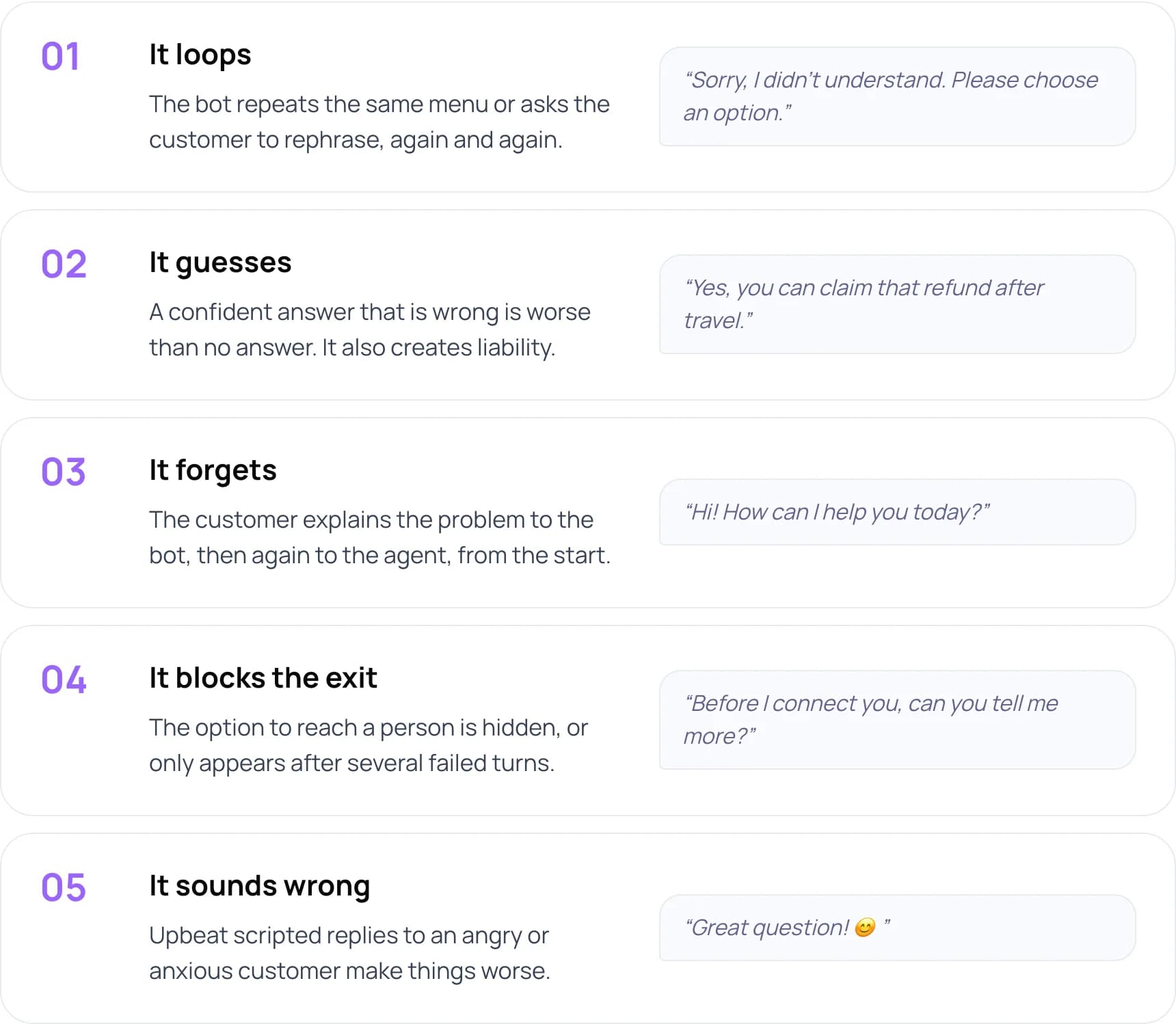
- It loops. The bot repeats the same menu or asks the customer to rephrase, again and again. Typical line: “Sorry, I didn’t understand. Please choose an option.”
- It guesses. A confident answer that is wrong is worse than no answer. It also creates liability. Typical line: “Yes, you can claim that refund after travel.”
- It forgets. The customer explains the problem to the bot, then again to the agent, from the start. Typical line: “Hi! How can I help you today?”
- It blocks the exit. The option to reach a person is hidden, or only appears after several failed turns. Typical line: “Before I connect you, can you tell me more?”
- It sounds wrong. Upbeat scripted replies to an angry or anxious customer make things worse. Typical line: “Great question! 😊”
Note: A rule-based chatbot follows fixed menus and keywords. An AI customer service bot uses a language model to understand free text. Many of the worst experiences come from rule-based bots asked to handle open questions.
3. Two Public Chatbot Failures
Air Canada: the bot invented a policy
Air Canada’s website chatbot told a grieving customer he could claim a bereavement fare after booking. The real policy said otherwise. In February 2024, a British Columbia tribunal held the airline responsible for its chatbot’s answer. The fix is grounding: the bot answers only from approved policy text.
DPD: the bot had no guardrails
In January 2024, a customer looking for a missing parcel got DPD’s chatbot to swear and criticize the company. DPD disabled part of the bot after the exchange spread online. The customer never found the parcel through the bot either.
Warning: Your chatbot’s answers count as your company’s answers. Treat every reply it can give as something you would put in writing.
4. Bad Bot vs Good Customer Support Chatbot
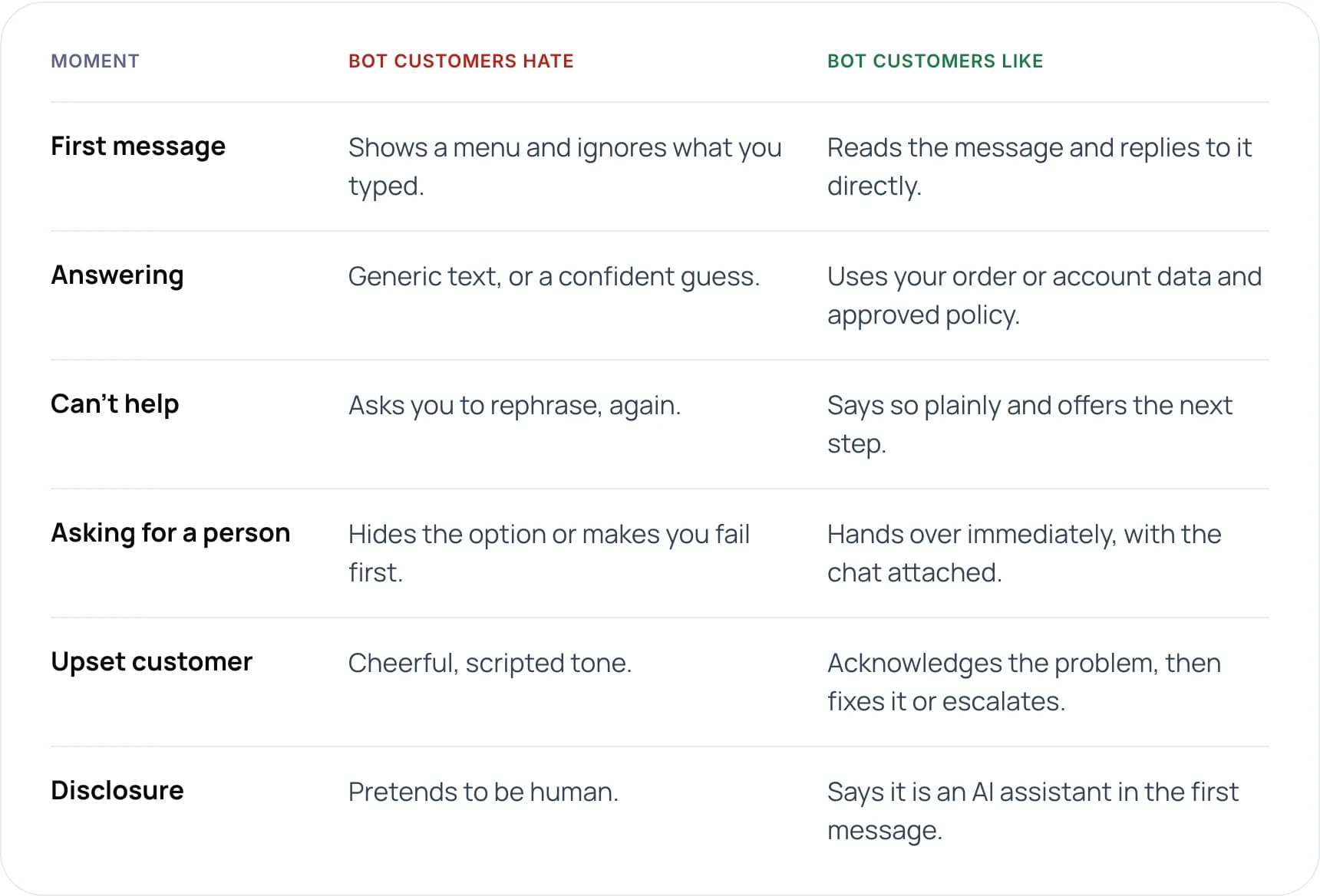
- First message: the bad bot shows a menu and ignores what you typed. The good bot reads the message and replies to it directly.
- Answering: generic text, or a confident guess. The good bot uses your order or account data and approved policy.
- Can’t help: the bad bot asks you to rephrase, again. The good bot says so plainly and offers the next step.
- Asking for a person: the bad bot hides the option or makes you fail first. The good bot hands over immediately, with the chat attached.
- Upset customer: a cheerful, scripted tone. The good bot acknowledges the problem, then fixes it or escalates.
- Disclosure: the bad bot pretends to be human. The good bot says it is an AI assistant in the first message.
5. Same Question, Two Bots
Here is how a menu-driven bot and a well-built AI customer service bot answer the same four customer messages. Messages and order details are illustrative.
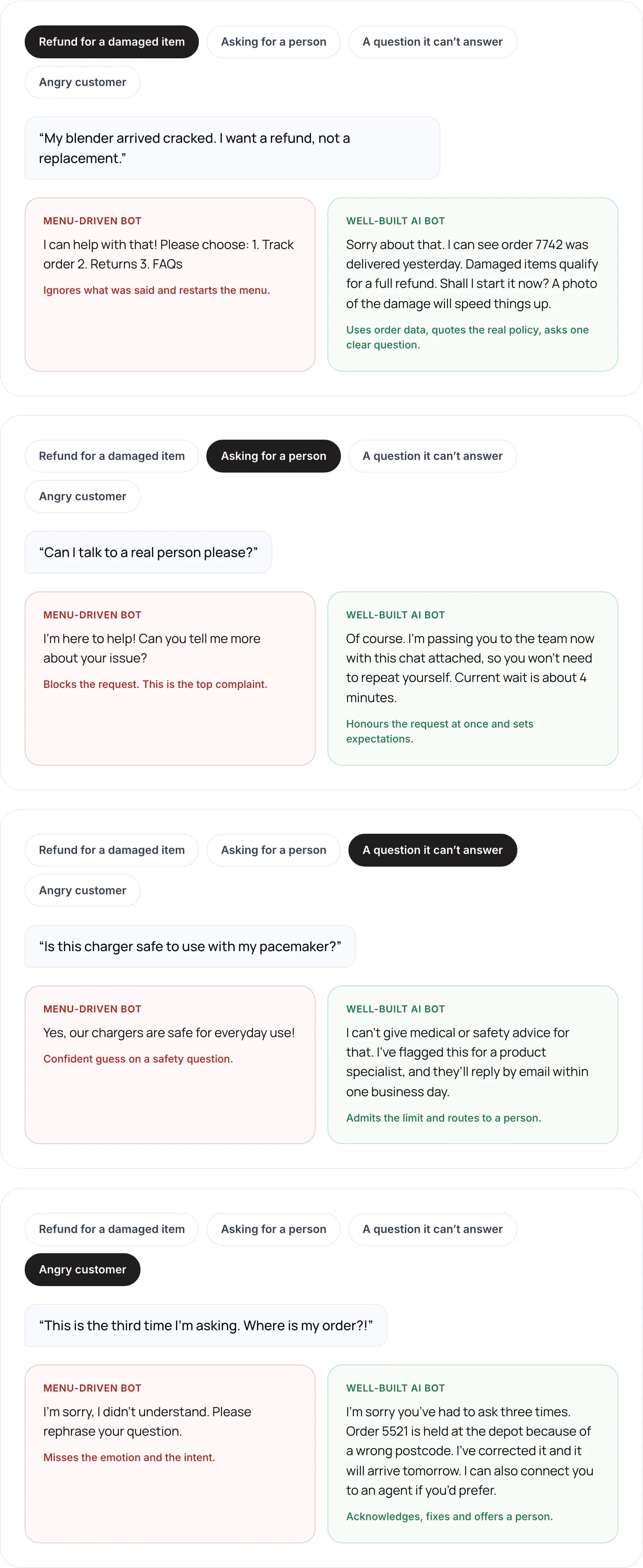
Refund for a damaged item
Customer: “My blender arrived cracked. I want a refund, not a replacement.”
- Menu-driven bot: “I can help with that! Please choose: 1. Track order 2. Returns 3. FAQs” It ignores what was said and restarts the menu.
- Well-built AI bot: “Sorry about that. I can see order 7742 was delivered yesterday. Damaged items qualify for a full refund. Shall I start it now? A photo of the damage will speed things up.” It uses order data, quotes the real policy and asks one clear question.
Asking for a person
Customer: “Can I talk to a real person please?”
- Menu-driven bot: “I’m here to help! Can you tell me more about your issue?” It blocks the request. This is the top complaint.
- Well-built AI bot: “Of course. I’m passing you to the team now with this chat attached, so you won’t need to repeat yourself. Current wait is about 4 minutes.” It honors the request at once and sets expectations.
A question it can’t answer
Customer: “Is this charger safe to use with my pacemaker?”
- Menu-driven bot: “Yes, our chargers are safe for everyday use!” A confident guess on a safety question.
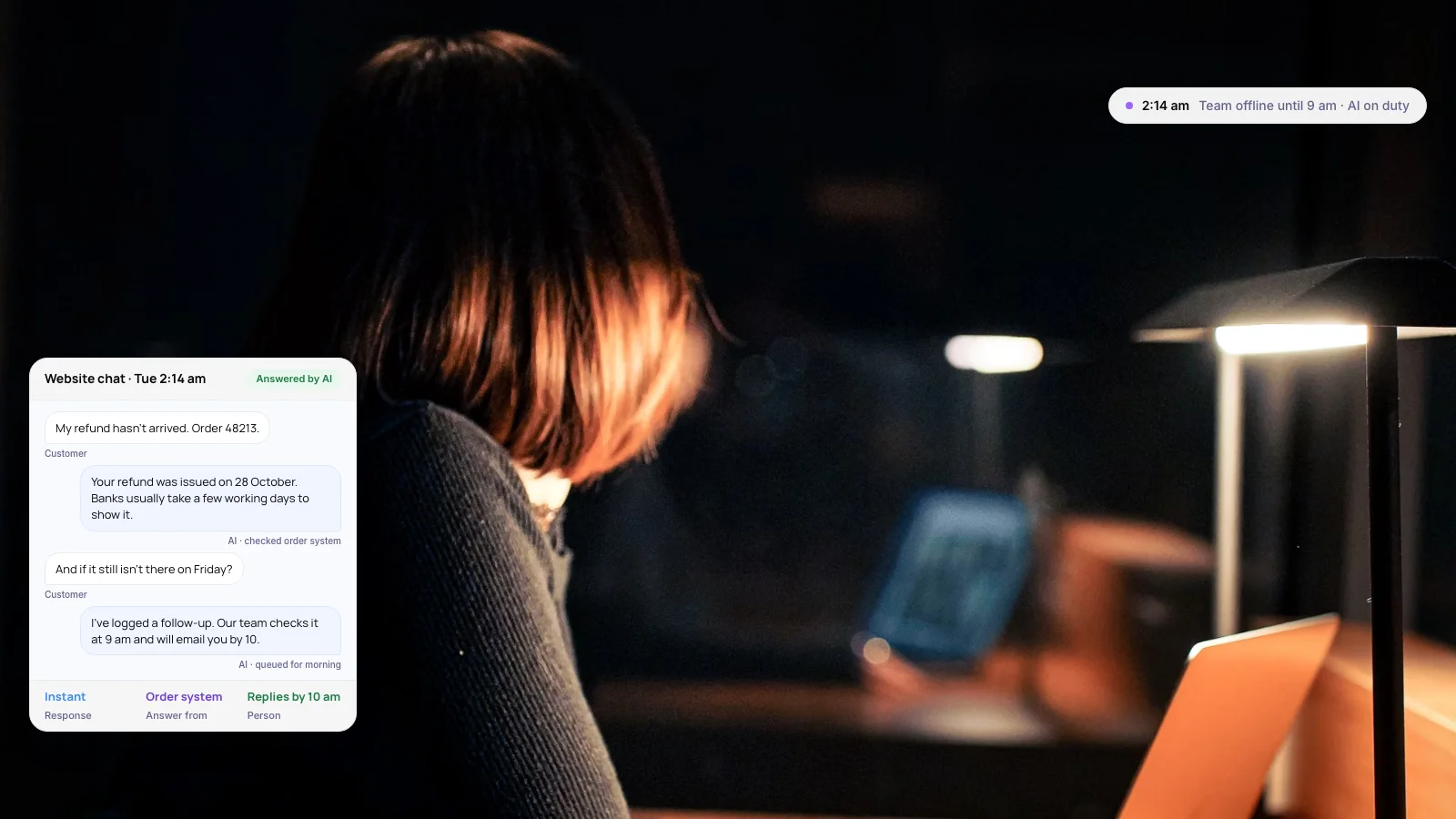
- Well-built AI bot: “I can’t give medical or safety advice for that. I’ve flagged this for a product specialist, and they’ll reply by email within one business day.” It admits the limit and routes to a person.
Angry customer
Customer: “This is the third time I’m asking. Where is my order?!”
- Menu-driven bot: “I’m sorry, I didn’t understand. Please rephrase your question.” It misses the emotion and the intent.
- Well-built AI bot: “I’m sorry you’ve had to ask three times. Order 5521 is held at the depot because of a wrong postcode. I’ve corrected it and it will arrive tomorrow. I can also connect you to an agent if you’d prefer.” It acknowledges, fixes and offers a person.
6. How to Build a Customer Service Chatbot People Don’t Hate
- Start from your transcripts. Read a few hundred real chats or emails. Pick the 10 to 20 intents that are frequent and have a clear right answer.
- Say it is an AI, and what it can do. One line in the first message sets expectations and builds trust.
- Ground every answer. The bot answers only from approved help content and live order or account data. If it cannot find an answer, it says so.
- Make the human exit always visible. “Talk to a person” should work at any point, in plain words, with no hoops.
- Escalate early on clear signals. Repeated rephrasing, negative sentiment, sensitive topics, payments outside policy and low confidence all trigger a handoff.
- Pass the full context. The agent sees the conversation, the data already checked and a short summary, so the customer never repeats themselves.
- Review failures every week. Read handoffs and abandoned chats, fix the content or rule behind each one, and track resolution, not deflection.
Step 3 is where most of the quality comes from. Our guide to agentic RAG for customer service automation explains how to ground answers in your own documents.
Want a second opinion on your current bot? Book a free AI consultation.
7. What Does a Good Chatbot Look Like in Practice?
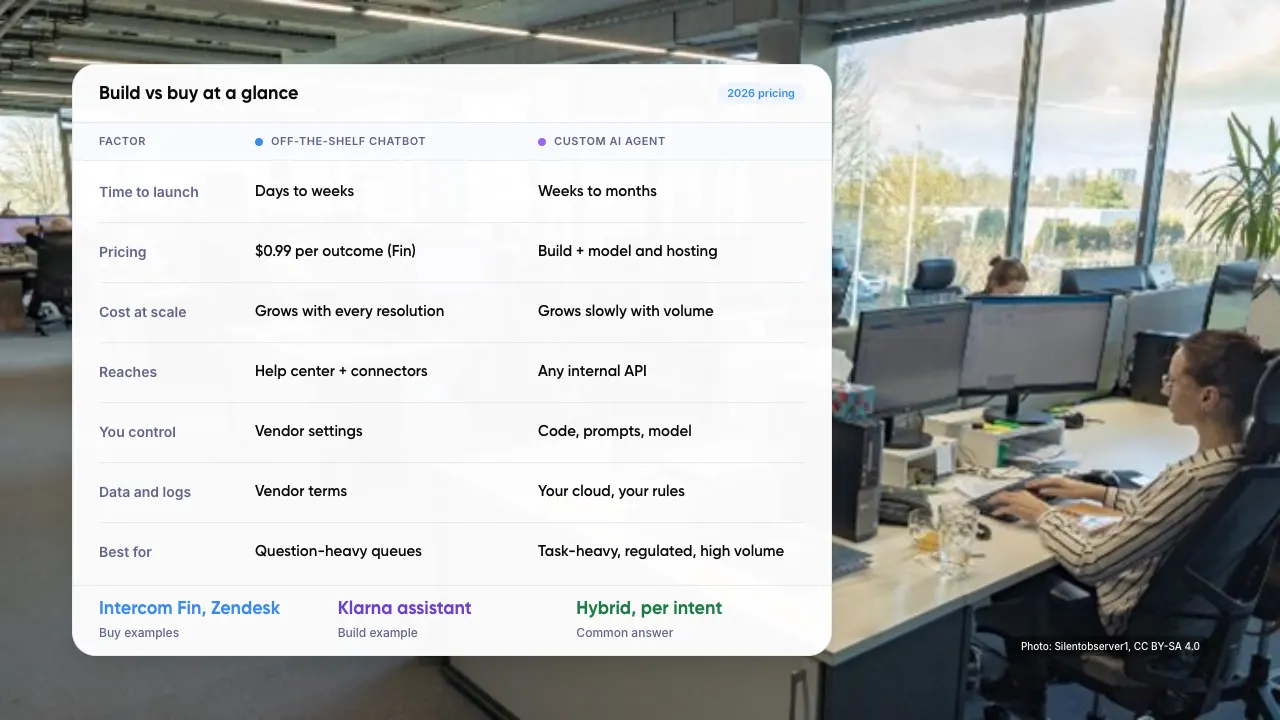
Klarna reported in February 2024 that its AI assistant handled two-thirds of service chats in its first month, with customer satisfaction on par with human agents. In 2025 it also began recruiting human agents again so customers could always reach a person. Both halves matter.
A good bot also makes agents better. A 2023 NBER study of 5,179 support agents found an AI assistant raised issues resolved per hour by 14% on average and improved customer sentiment.
On our own AI email support build for e-commerce, replies are drafted from live order data and approved by an agent before they go out.
8. Chatbot Do’s and Don’ts
Do
- Tell customers they are talking to an AI.
- Answer from real order and account data.
- Offer a person whenever they ask.
- Match tone to the customer’s mood.
- Measure resolved chats and CSAT, not deflection.
Don’t
- Force every customer through a menu first.
- Let the bot answer policy questions from memory.
- Hide the human option behind failed turns.
- Make customers repeat themselves after handoff.
- Launch on every intent at once.
New to the topic? Start with what customer support automation is and how it works.
9. Frequently Asked Questions
Why do customers hate chatbots?
Mostly because many bots cannot solve the problem and make it hard to reach a person. Loops, wrong answers and repeated questions add to it. Gartner’s 2024 survey found 64% of customers would prefer companies did not use AI for service, with access to a person as the top concern.
Are AI customer service bots better than rule-based chatbots?
For open questions, usually yes. AI bots understand free text and can use live data, while rule-based bots rely on fixed menus and keywords. AI bots need grounding and guardrails, though, or they can give confident wrong answers, as Air Canada’s 2024 case showed.
When should a chatbot hand over to a human?
Whenever the customer asks, and early when the bot is unsure, the customer repeats themselves, sentiment turns negative, or the topic is sensitive, such as payments, health or legal issues. The agent should receive the full conversation and any data already checked.
What makes a good customer service chatbot?
It answers common questions correctly from your own content and data, says plainly what it cannot do, lets customers reach a person at any time, and passes context on handoff. It is measured on resolved conversations and satisfaction, not on how many chats it deflected.
Should a chatbot say it is a bot?
Yes. Telling customers in the first message that they are talking to an AI assistant sets expectations and builds trust. Some laws also require disclosure. California’s bot disclosure law, in force since July 2019, covers bots that pose as people to drive a sale or influence a vote, and the EU AI Act includes transparency rules for chatbots.
10. Conclusion
Customers do not hate every customer service chatbot. They hate the ones that waste their time. Read 50 of your bot’s recent conversations that ended in a handoff or an abandoned chat, and fix the most common failure first.
Tip: Before you rebuild, put your chat volume and cost per ticket into our free AI ROI Calculator to see what a better bot is worth.
To build it with us, see our AI customer support automation services. Or book a free AI consultation.
Author