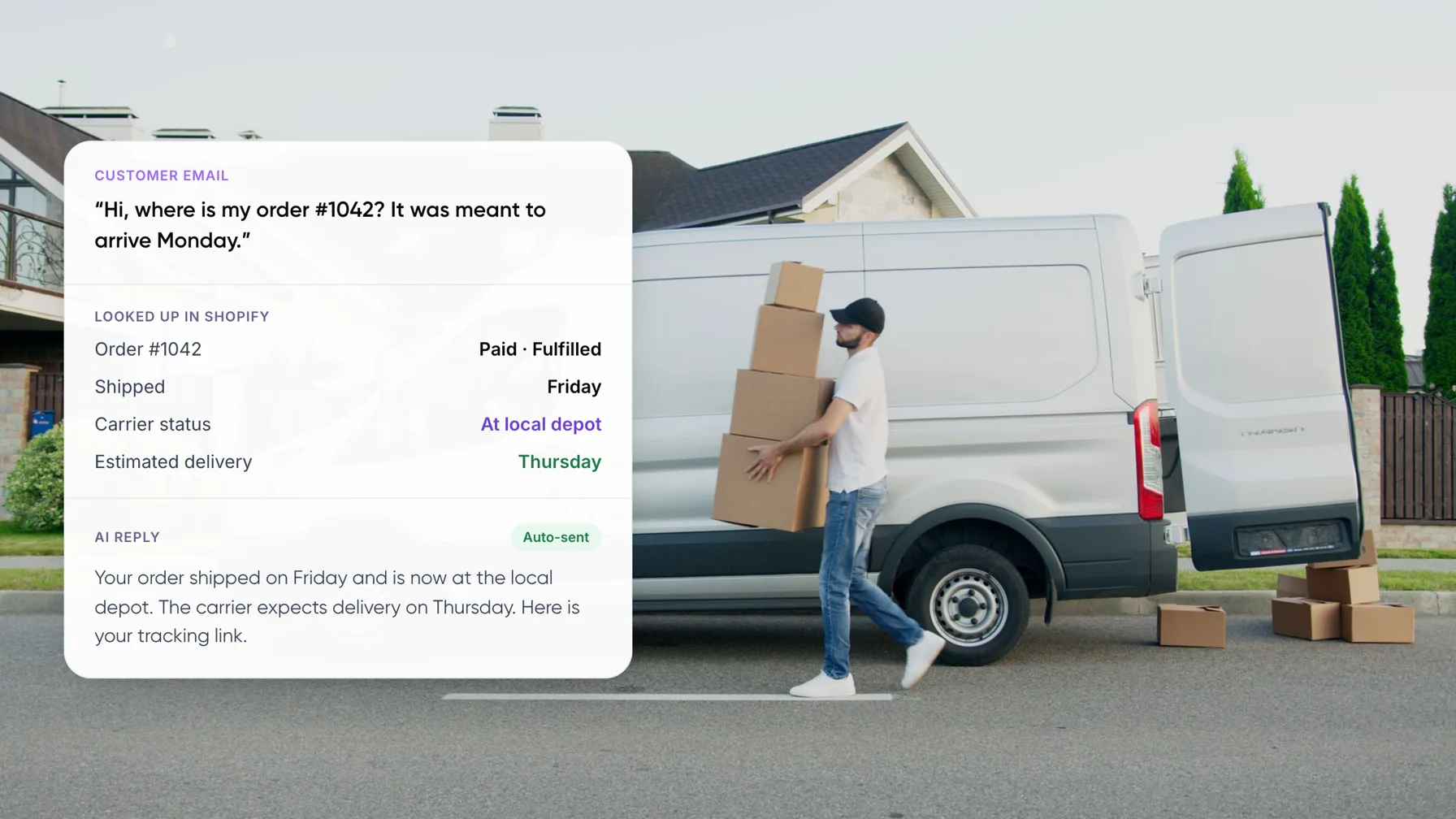
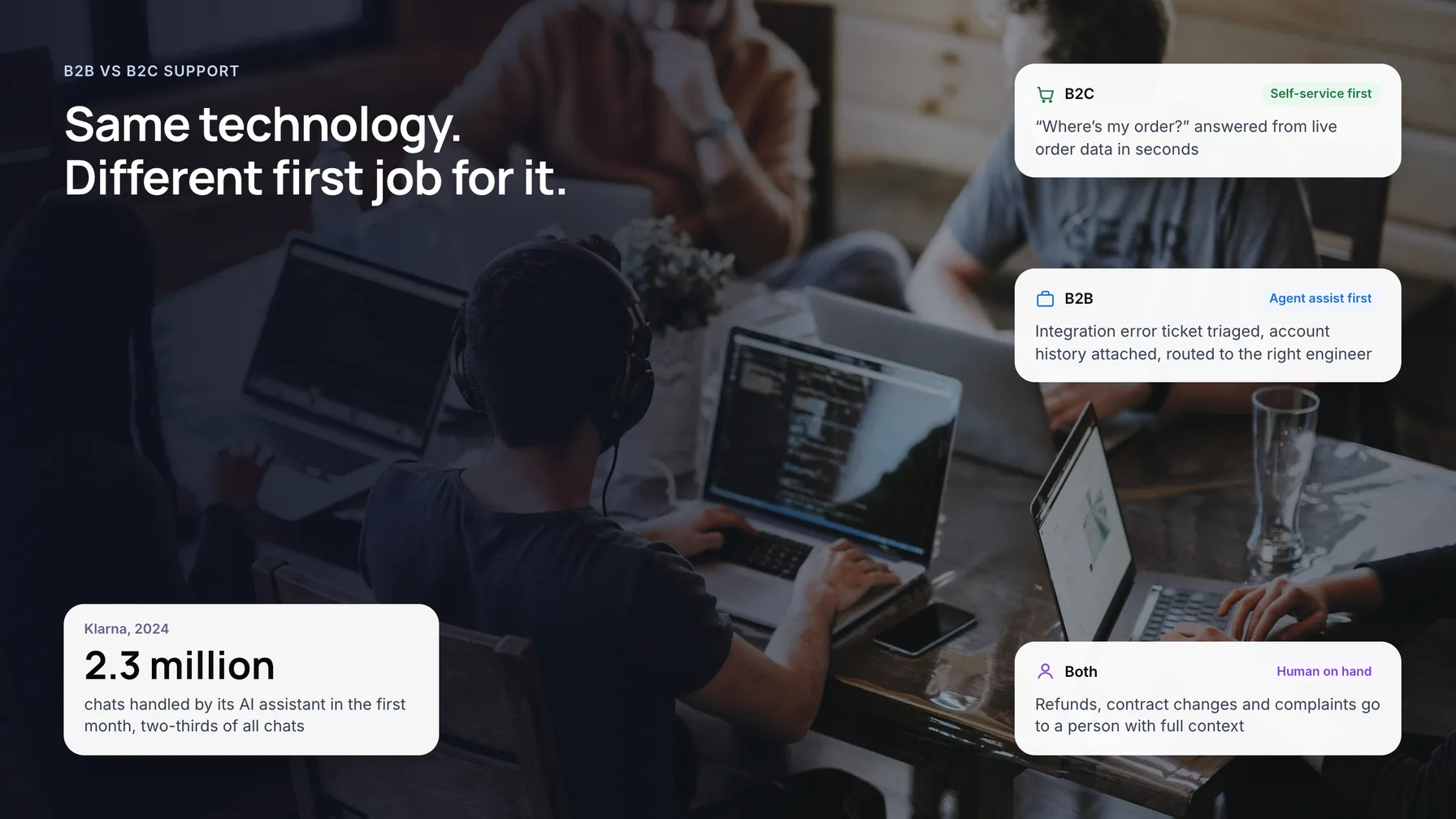
Does Your Chatbot Need to Say It’s AI? The EU AI Act Article 50 Explained
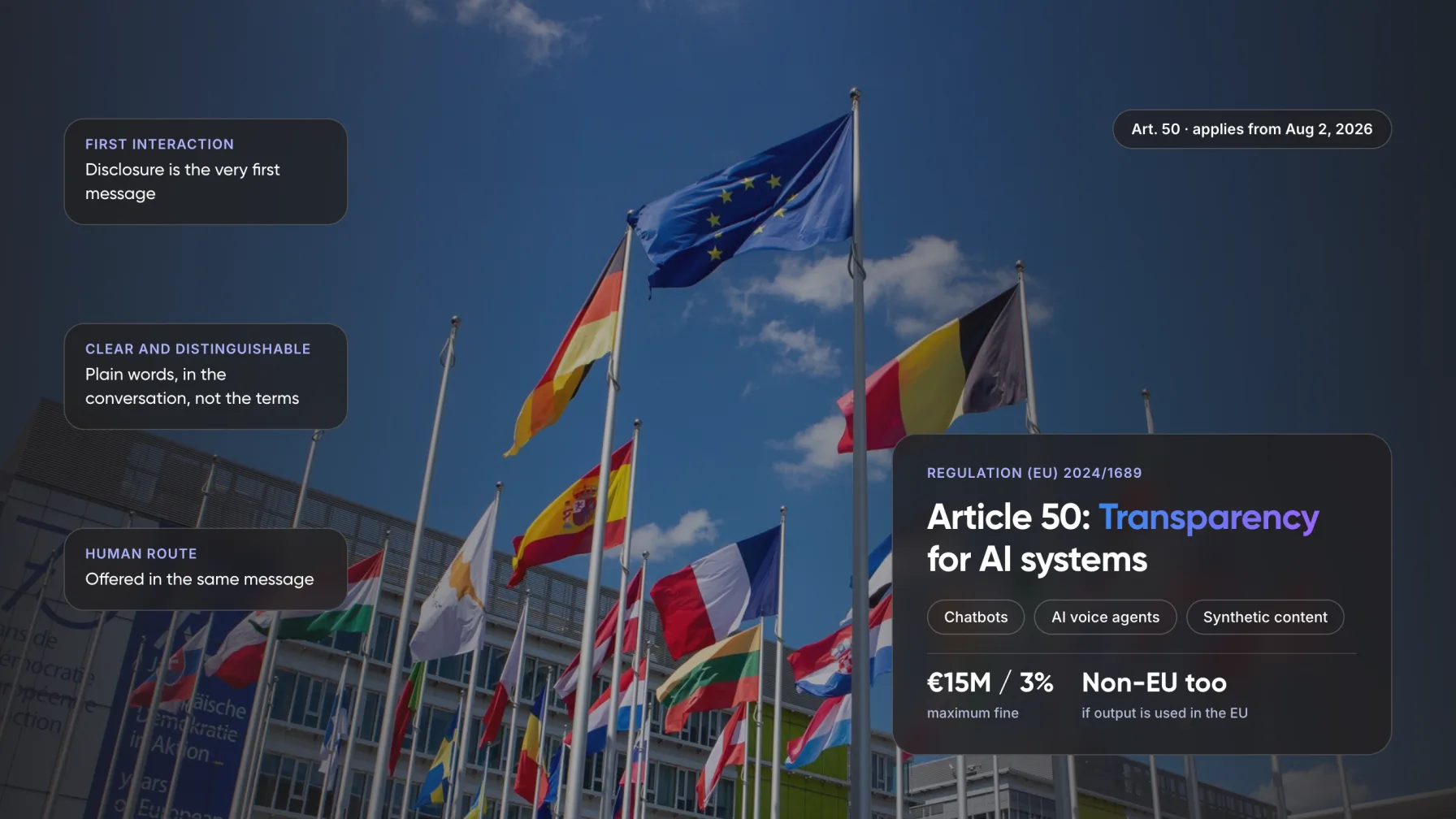
Yes, if people in the EU talk to it. Since August 2, 2026, EU AI Act Article 50 has required providers to design chatbots and AI voice agents so users are told they are dealing with AI, unless that is already obvious. Breaches can cost up to €15 million or 3% of worldwide annual turnover.
This guide explains what Article 50 asks for, who it covers, how to word and time the disclosure on chat, voice and WhatsApp, and how it compares with US rules.
1. What Does EU AI Act Article 50 Require?
Key takeaways
- Article 50(1) requires providers to design AI systems that interact directly with people so those people are told it’s AI, at the latest at the first interaction.
- It applies to non-EU companies too, when their system’s output is used in the EU.
- The “obvious” exemption is narrow. For customer service bots, disclose anyway.
- Synthetic audio, images, video and text carry a separate marking rule under Article 50(2), and deepfakes a disclosure rule under Article 50(4).
- Fines reach €15 million or 3% of global turnover, whichever is higher. For SMEs and small mid-caps, whichever is lower.
Article 50 is the AI Act’s transparency article. It sets four separate duties, and they fall on different parties. The provider is whoever develops the AI system and puts it on the market or into service under its own name. The deployer is the business that uses it, for example with customers.
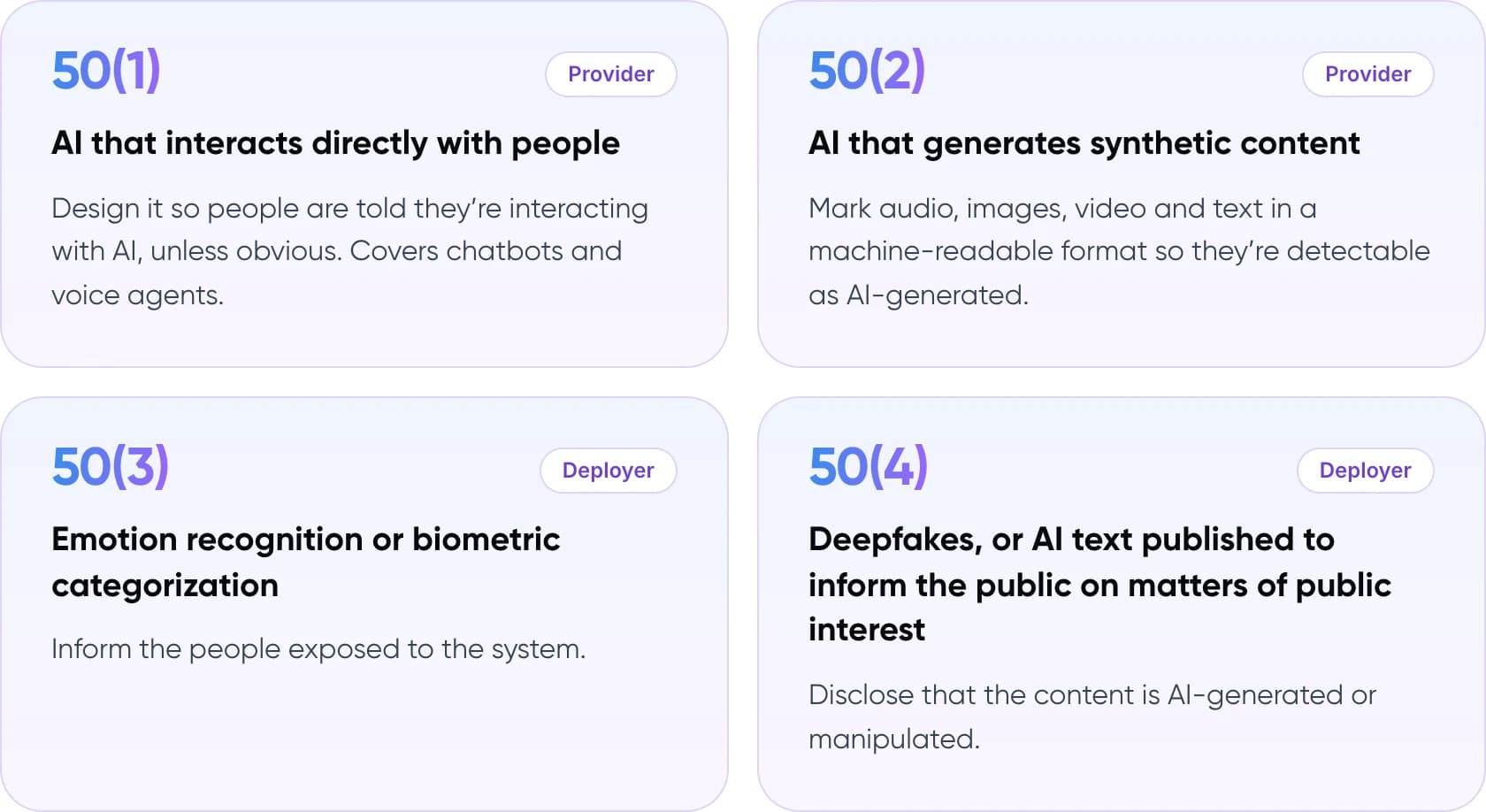
- 50(1), provider: AI that interacts directly with people. Design it so people are told they’re interacting with AI, unless obvious. Covers chatbots and voice agents.
- 50(2), provider: AI that generates synthetic content. Mark audio, images, video and text in a machine-readable format so they’re detectable as AI-generated.
- 50(3), deployer: emotion recognition or biometric categorization. Inform the people exposed to the system.
- 50(4), deployer: deepfakes, or AI text published to inform the public on matters of public interest. Disclose that the content is AI-generated or manipulated.
Paragraph 5 adds the delivery rules. The information must be clear and distinguishable, given at the latest at the first interaction or exposure, and meet accessibility requirements. For a customer service AI chatbot, 50(1) is the one that matters most. If the bot also speaks with a synthetic voice, 50(2) and possibly 50(4) come into play too.
2. Who Does Article 50 Apply To, and Does It Cover Non-EU Companies?
The AI Act reaches beyond EU borders. Article 2(1) covers providers placing AI systems on the EU market wherever they’re based, and providers and deployers in third countries where the system’s output is used in the EU.
In practice, a SaaS company in Bengaluru, Austin or Dubai is in scope if its chatbot answers customers in Germany. So is a US retailer whose voice agent takes calls from French shoppers.
If you buy a chatbot platform, the vendor is usually the provider and must design it so users are told they’re talking to AI. If you build custom AI agents in-house and put them into service under your own name, you are likely the provider yourself.
Note: Article 50 applies whether or not the system is “high-risk”. A low-risk FAQ bot is still covered.
3. When Is It “Obvious” That You’re Talking to AI?
Article 50(1) exempts cases where AI use is obvious to a reasonably well-informed, observant and circumspect person, taking into account the circumstances and context of use. Systems authorized by law to detect, prevent, investigate or prosecute crime have their own exemption.
Regulators will make that judgment after the fact. In our view, a text-only bot in a widget labeled “AI assistant” may pass. A voice agent with a natural human voice and a human name almost certainly won’t.

- Likely obvious: a text widget titled “AI assistant” with a bot avatar and no human name.
- Unclear: a chat with a first name like “Sam” and a generic “Support” header.
- Not obvious: a voice agent with a natural human voice and a human name.
Our view: for customer service, don’t rely on the exemption. A one-line disclosure costs nothing. A Gartner survey of 5,728 customers, published in July 2024, found 64% would prefer companies didn’t use AI for service. Hiding that a bot is a bot is more likely to deepen that distrust than avoid it.
4. How Should a Chatbot or AI Voice Agent Disclose It’s AI?
The law sets the outcome, not the wording. Three requirements from paragraph 5 shape the design: timing (no later than the first interaction), clarity (clear and distinguishable) and accessibility.
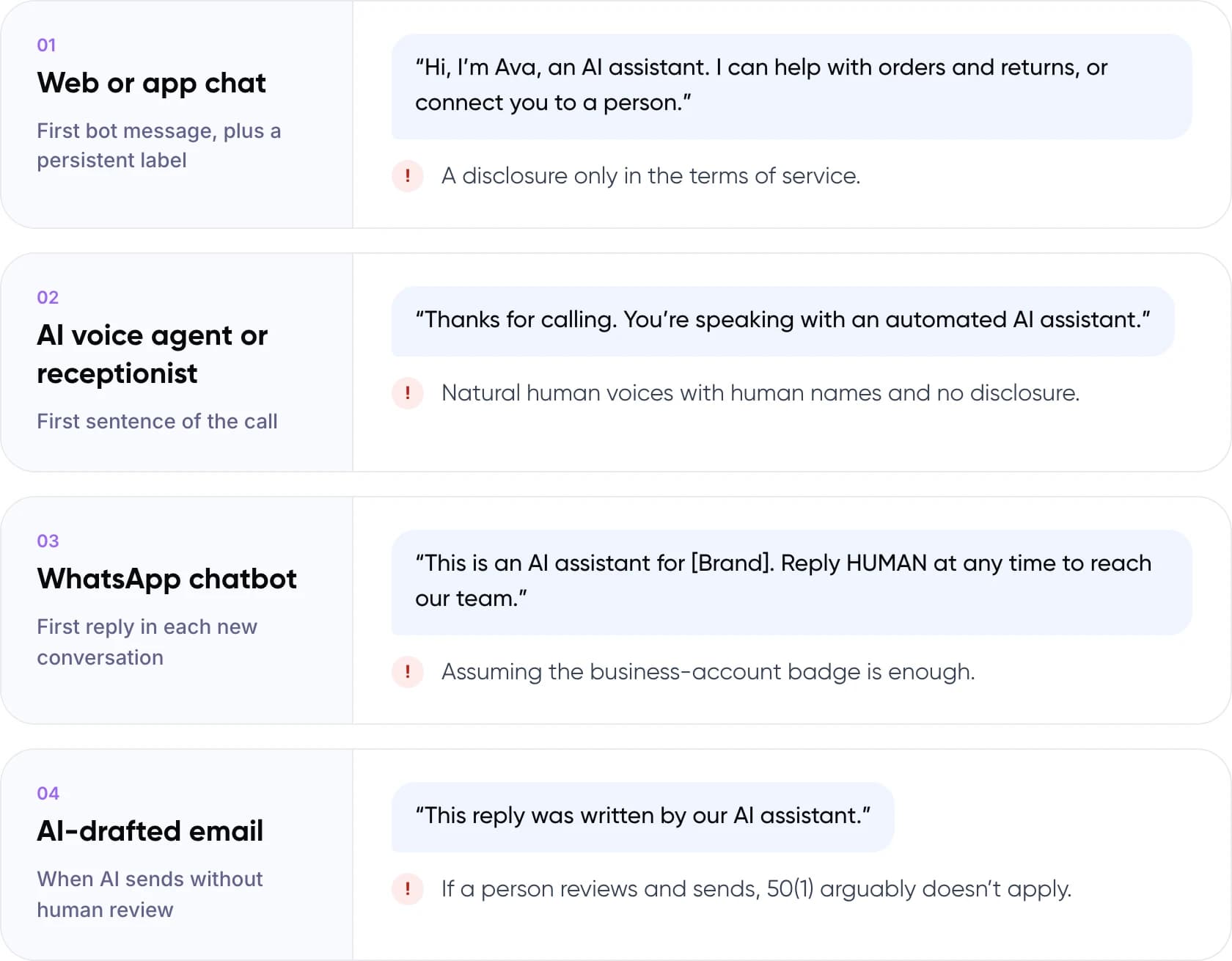
Web or app chat
When: first bot message, plus a persistent label. Example: “Hi, I’m Ava, an AI assistant. I can help with orders and returns, or connect you to a person.” Watch out for: a disclosure only in the terms of service.
AI voice agent or receptionist
When: first sentence of the call. Example: “Thanks for calling. You’re speaking with an automated AI assistant.” Watch out for: natural human voices with human names and no disclosure.
WhatsApp chatbot
When: first reply in each new conversation. Example: “This is an AI assistant for [Brand]. Reply HUMAN at any time to reach our team.” Watch out for: assuming the business-account badge is enough.
AI-drafted email
When: when AI sends without human review. Example: “This reply was written by our AI assistant.” Watch out for: if a person reviews and sends, 50(1) arguably doesn’t apply.
For an AI phone agent or AI receptionist, the disclosure has to be spoken. A text notice on a website doesn’t reach the caller. Keep it to one sentence before the agent asks anything.
Tip: Pair the disclosure with the way out. “I’m an AI assistant. Say ‘agent’ to reach a person” covers both. A Gartner survey reported in August 2026 found 87% of customers say it is essential for companies to offer a way to reach a human agent when they use generative AI.
Want a second pair of eyes on your bot’s greeting and handoff flow? Book a free AI consultation.
5. What About AI-Generated Voices, Images and Text?
Article 50(2) puts a separate duty on providers of generative systems. Synthetic audio, images, video and text must be marked in a machine-readable format and detectable as AI-generated, as far as technically feasible.
This mostly lands on model and platform vendors, such as the text-to-speech provider behind your voice agent. Your job as a buyer is to check that the vendor supports marking and that you don’t strip it out.
Two dates matter here. The Commission published a voluntary Code of Practice on marking and labeling AI-generated content on June 10, 2026. And the Digital Omnibus on AI (Regulation (EU) 2026/1744) gives providers whose generative systems were already on the market before August 2, 2026 until December 2, 2026 to meet Article 50(2). There is no such extension for the chatbot disclosure in 50(1).
If your agent uses a cloned voice that resembles a real person and could pass as that person, it may count as a deep fake under the Act’s definition. Article 50(4) then requires the deployer to disclose that the audio is artificially generated.
6. What Are the Penalties for Breaking Article 50?
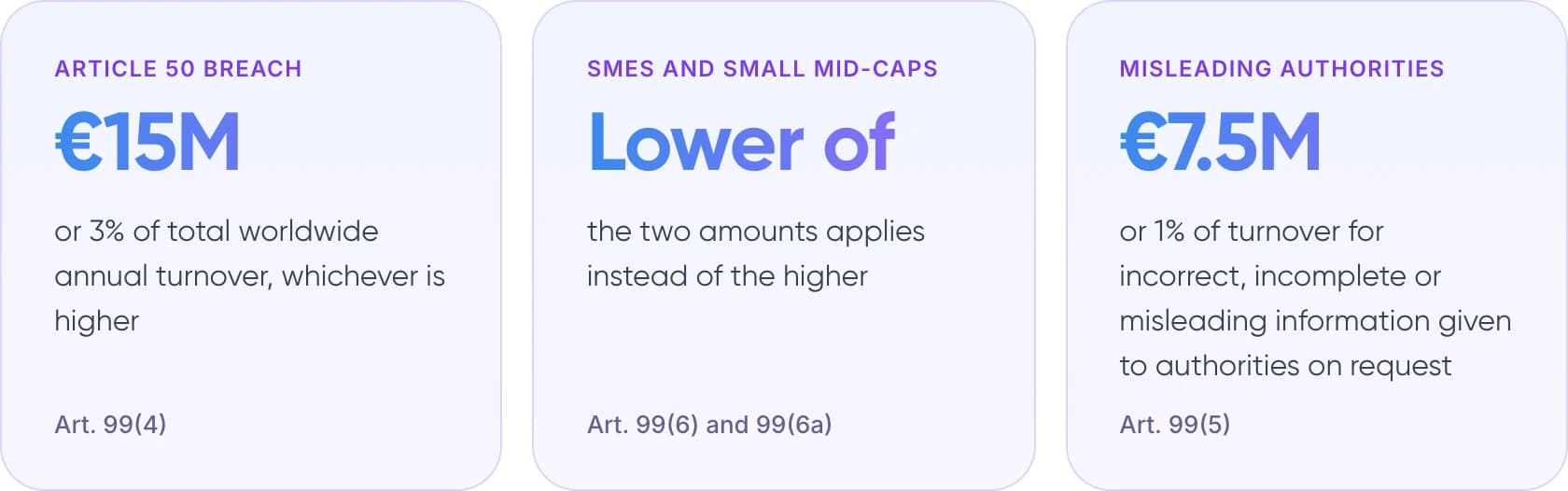
- Article 50 breach: up to €15 million or 3% of total worldwide annual turnover, whichever is higher (Art. 99(4)).
- SMEs and small mid-caps: the lower of the two amounts applies instead of the higher (Art. 99(6) and 99(6a)).
- Misleading authorities: up to €7.5 million or 1% of turnover for incorrect, incomplete or misleading information given to authorities on request (Art. 99(5)).
National market surveillance authorities enforce Article 50, and each member state designates its own. For SMEs, including start-ups, Article 99(6) applies whichever amount is lower. The Digital Omnibus added Article 99(6a), which does the same for small mid-cap companies.
7. How Does Article 50 Compare With US and Other AI Disclosure Laws?
Many companies serving EU customers also serve the US. The rules overlap, but the triggers differ.
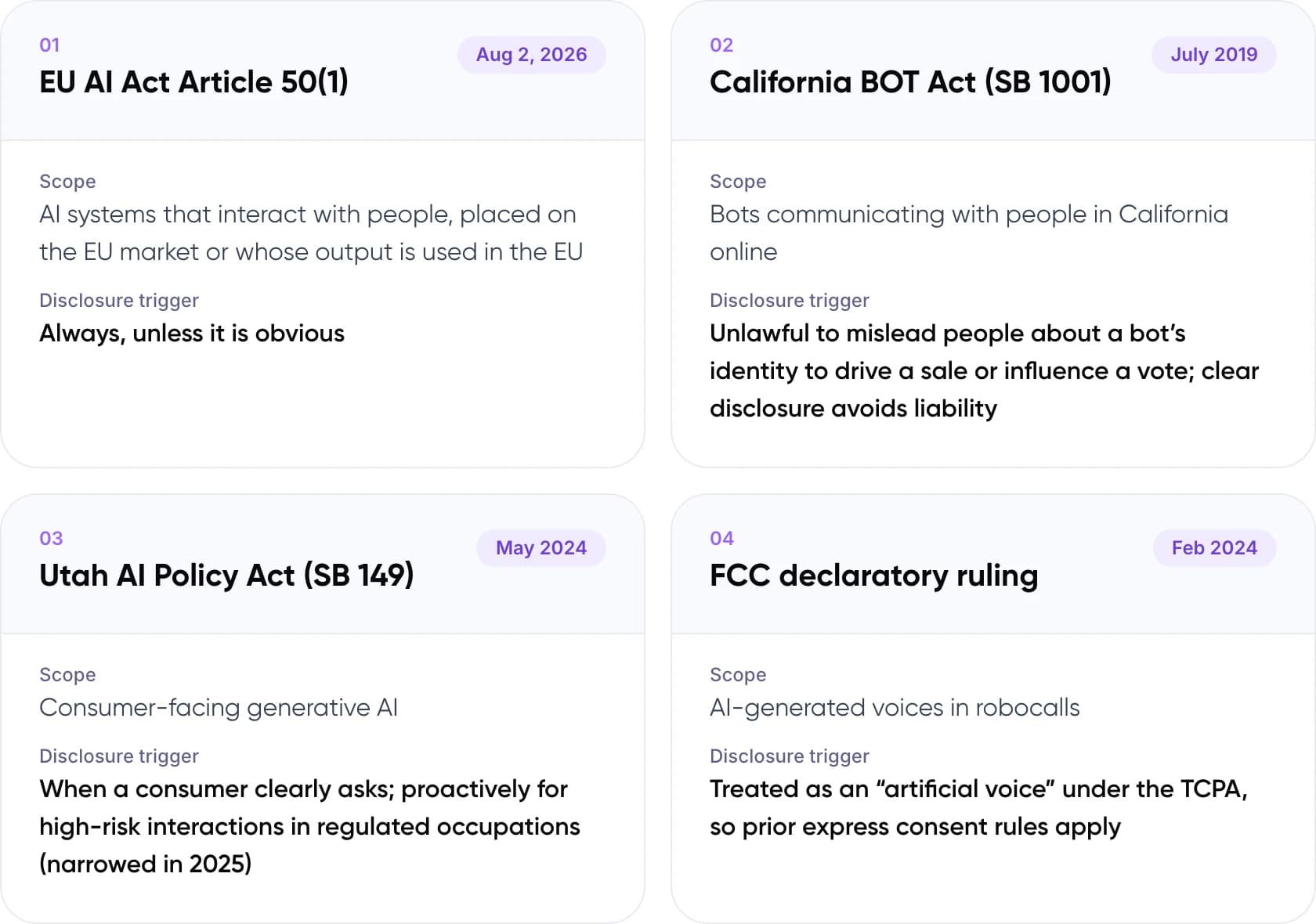
- EU AI Act Article 50(1) (August 2, 2026). Scope: AI systems that interact with people, placed on the EU market or whose output is used in the EU. Trigger: always, unless it is obvious.
- California BOT Act (SB 1001) (July 2019). Scope: bots communicating with people in California online. Trigger: it is unlawful to use a bot that misleads people about its identity to drive a sale or influence a vote; a clear disclosure avoids liability.
- Utah AI Policy Act (SB 149) (May 2024). Scope: consumer-facing generative AI. Trigger: when a consumer clearly asks, and proactively for high-risk interactions in regulated occupations, as narrowed in 2025.
- FCC declaratory ruling (February 2024). Scope: AI-generated voices in robocalls. Trigger: they are treated as an “artificial voice” under the TCPA, so prior express consent rules apply.
Our recommendation is to design to the EU standard. In our view it’s the broadest of these, and one disclosure flow is easier to maintain than four.
8. What Do Real Cases Teach About AI Disclosure?
Google Duplex, 2018
When Google demoed its AI booking calls, the assistant sounded human and didn’t identify itself. After public criticism, Google said Duplex would disclose that it was automated. It’s an early case of a voice agent being changed because people felt misled.
Moffatt v. Air Canada, 2024
Air Canada’s website chatbot told a customer he could claim a bereavement fare refund after traveling. The policy said otherwise. British Columbia’s Civil Resolution Tribunal held the airline responsible for what its chatbot said and ordered it to pay. Disclosure is the minimum. You are still liable for what the bot says.
9. How Do You Make Your Customer Service Chatbot Article 50 Compliant?
Run through these steps before launch, and again when you change models or vendors.
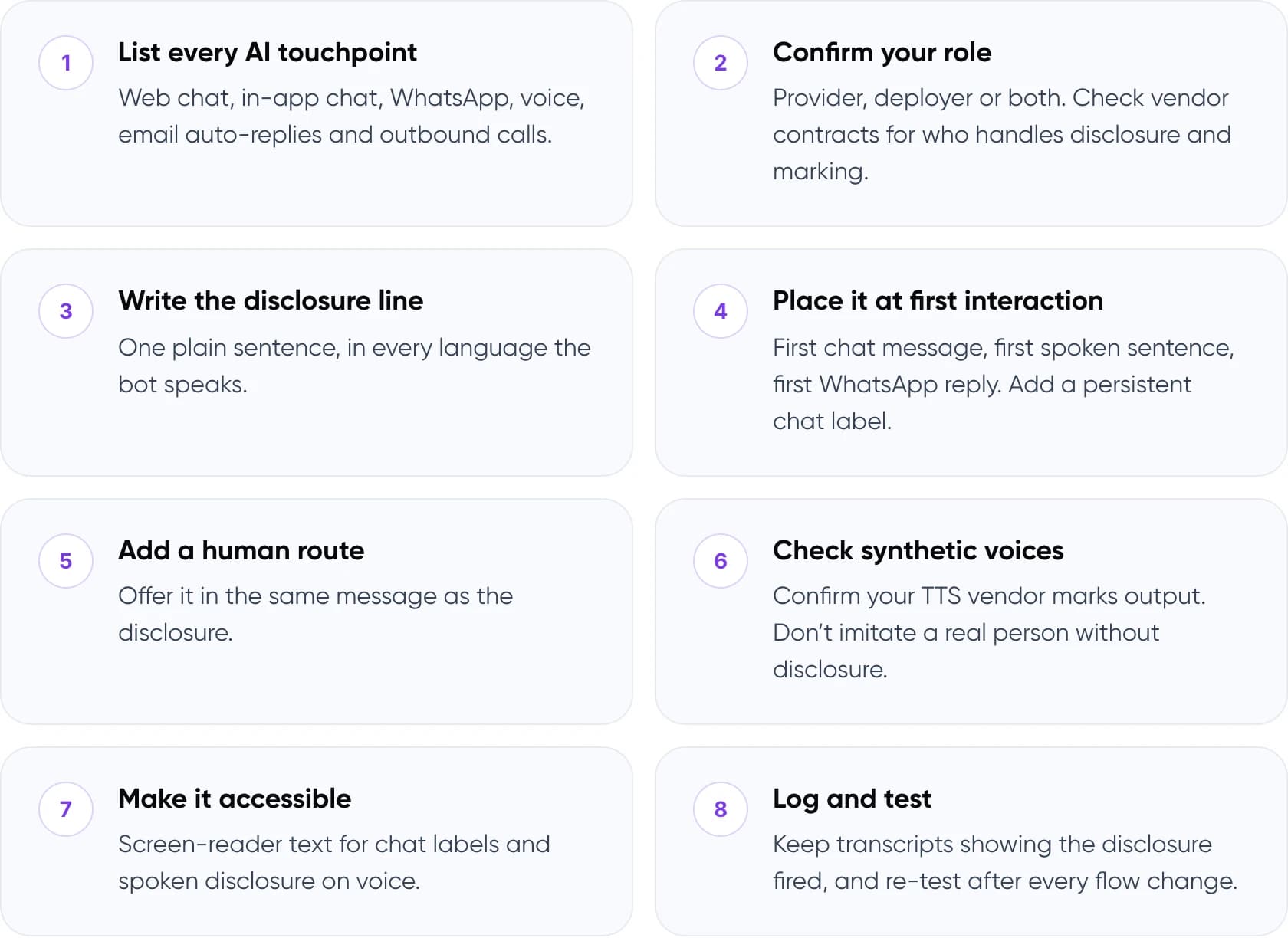
- List every AI touchpoint. Web chat, in-app chat, WhatsApp, voice, email auto-replies and outbound calls.
- Confirm your role. Provider, deployer or both. Check vendor contracts for who handles disclosure and marking.
- Write the disclosure line. One plain sentence, in every language the bot speaks.
- Place it at first interaction. First chat message, first spoken sentence, first WhatsApp reply. Add a persistent chat label.
- Add a human route. Offer it in the same message as the disclosure.
- Check synthetic voices. Confirm your TTS vendor marks output. Don’t imitate a real person without disclosure.
- Make it accessible. Screen-reader text for chat labels and spoken disclosure on voice.
- Log and test. Keep transcripts showing the disclosure fired, and re-test after every flow change.
Warning: Don’t hide the disclosure behind a “Learn more” link or a privacy policy. Paragraph 5 asks for clear and distinguishable information.
10. One Bot, Several Channels: An Example From Our Work
For Paymate, we built a support system that answers across voice, email and chat in English, Spanish and French, with escalation to a person when confidence is low.
A setup like that has a separate first interaction on every channel and in every language, which is why the checklist above starts with listing every touchpoint.
11. Frequently Asked Questions
Do chatbots have to disclose they are AI under EU law?
Yes, in most cases. Article 50(1) of the EU AI Act requires providers to design AI systems that interact with people so those people are informed they’re dealing with AI. The only general exception is when it’s obvious from context. The rule has applied since August 2, 2026, for low-risk bots as well as high-risk ones.
Does the EU AI Act apply to companies outside the EU?
Yes. Article 2 covers providers placing AI systems on the EU market wherever they’re established, and providers and deployers in third countries when the system’s output is used in the EU. An Indian, US or UAE company whose chatbot serves EU customers needs to meet Article 50 for those interactions.
When does Article 50 apply?
Article 50 has applied since August 2, 2026, two years after the AI Act entered into force on August 1, 2024. There’s no separate grace period for chatbot disclosure under 50(1). The Digital Omnibus on AI gave providers of generative systems already on the market before August 2, 2026 until December 2, 2026 to meet the machine-readable marking rule in 50(2).
Do AI voice agents and AI receptionists need to disclose?
Yes. A voice agent interacts directly with people, so Article 50(1) applies, and a natural human-sounding voice makes the “obvious” exemption very hard to claim. The disclosure should be spoken in the first sentence of the call. If the voice imitates a real person, the deepfake rules in Article 50(4) may also apply.
What are the fines for not disclosing AI?
Up to €15 million or 3% of total worldwide annual turnover, whichever is higher, under Article 99(4). For SMEs, start-ups and small mid-caps the lower of the two amounts applies. National market surveillance authorities in each member state enforce the rule and decide fines case by case.
Is a disclosure in the terms of service enough?
Probably not. Article 50(5) requires the information to be clear and distinguishable and given at the latest at the first interaction. A clause in terms users rarely read doesn’t meet that. Put the disclosure in the conversation itself: the first chat message, or the first sentence of a call.
12. Conclusion
EU AI Act Article 50 asks for something simple: tell people when they’re talking to AI, at the start, in plain words. The work is in doing it consistently across every channel and language your bot uses, and in making sure synthetic voices and generated content are marked too. Start by listing your AI touchpoints this week and checking each greeting against the checklist above.
See our AI customer support automation services and custom AI agent development.
This article is general information, not legal advice. Check your obligations with qualified counsel.
Author