How Much Does an AI Customer Support Agent Cost to Build? (Pricing, Timeline and What Drives the Cost)
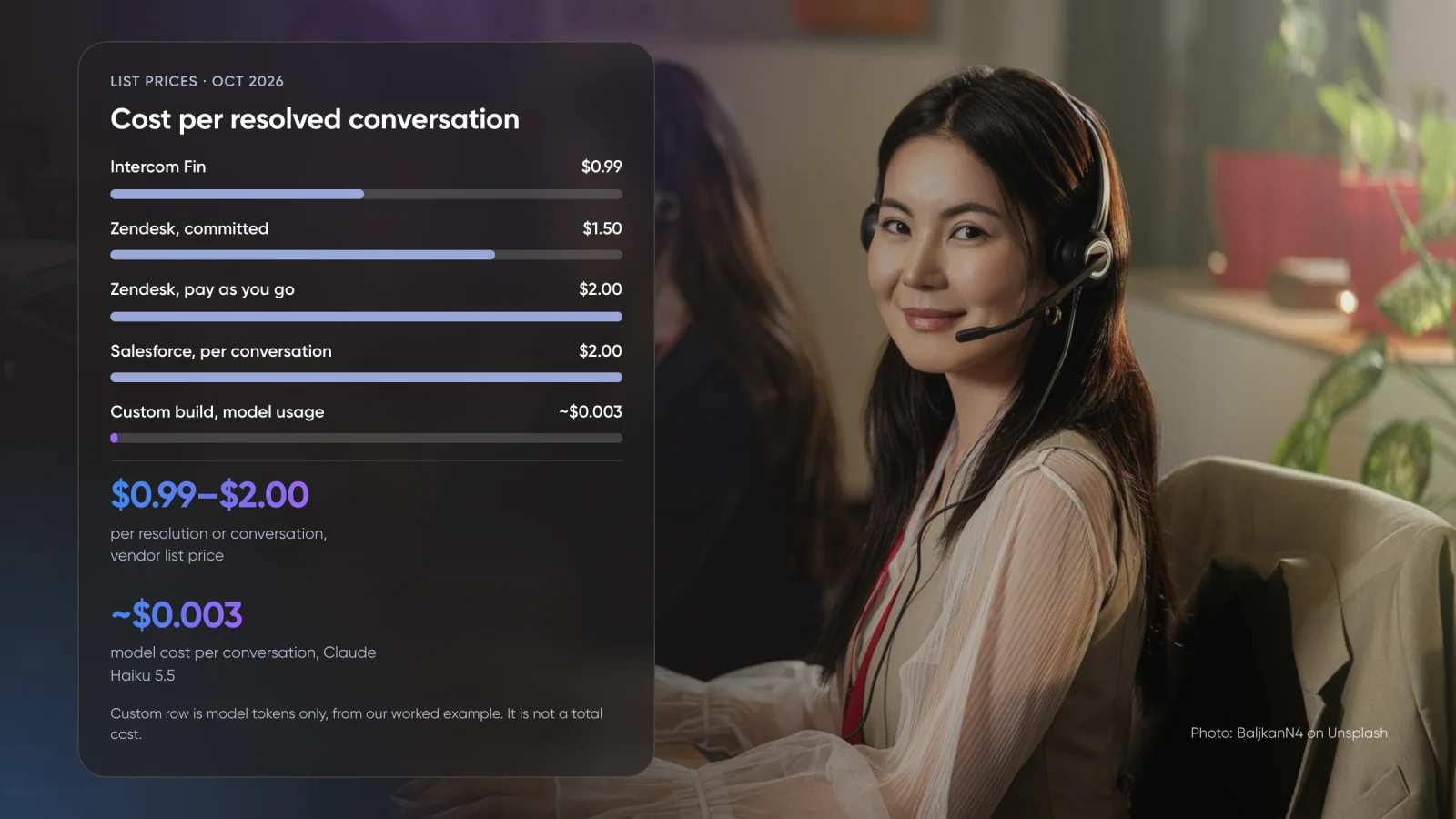
An AI customer support agent costs less to start than most people expect, and more to run than most business cases show. Platform vendors charge about $0.99 to $2.00 per resolved conversation at list price. A custom build swaps those fees for an engineering project and a monthly running bill.
This guide splits the cost into four layers, prices each from published sources and shows how to estimate your own volume. Gartner’s January 2026 forecast says generative AI cost per resolution will pass $3 by 2030, so check the numbers before you sign.
1. The Short Answer
Expect three kinds of cost. You pay once to build the agent, every month to run it, and every time a customer talks to it. Vendors fold all three into a per-resolution fee. A custom build keeps them separate, which is why quotes for the same project can differ so widely.
For a buy-side reference point, Intercom lists its Fin agent at $0.99 per outcome, and Zendesk lists $1.50 per automated resolution on committed volume.
Key takeaways
- Price an AI customer support agent in four layers: build, model usage, channel and platform fees, and running costs. Many quotes show only the first.
- Vendors list roughly $1 to $2 per resolved conversation. Salesforce Agentforce charges $2 per conversation instead.
- Model tokens are the smallest line. In our worked example a conversation costs about $0.003 on Claude Haiku 5.5 and $0.055 on Sonnet 5.5.
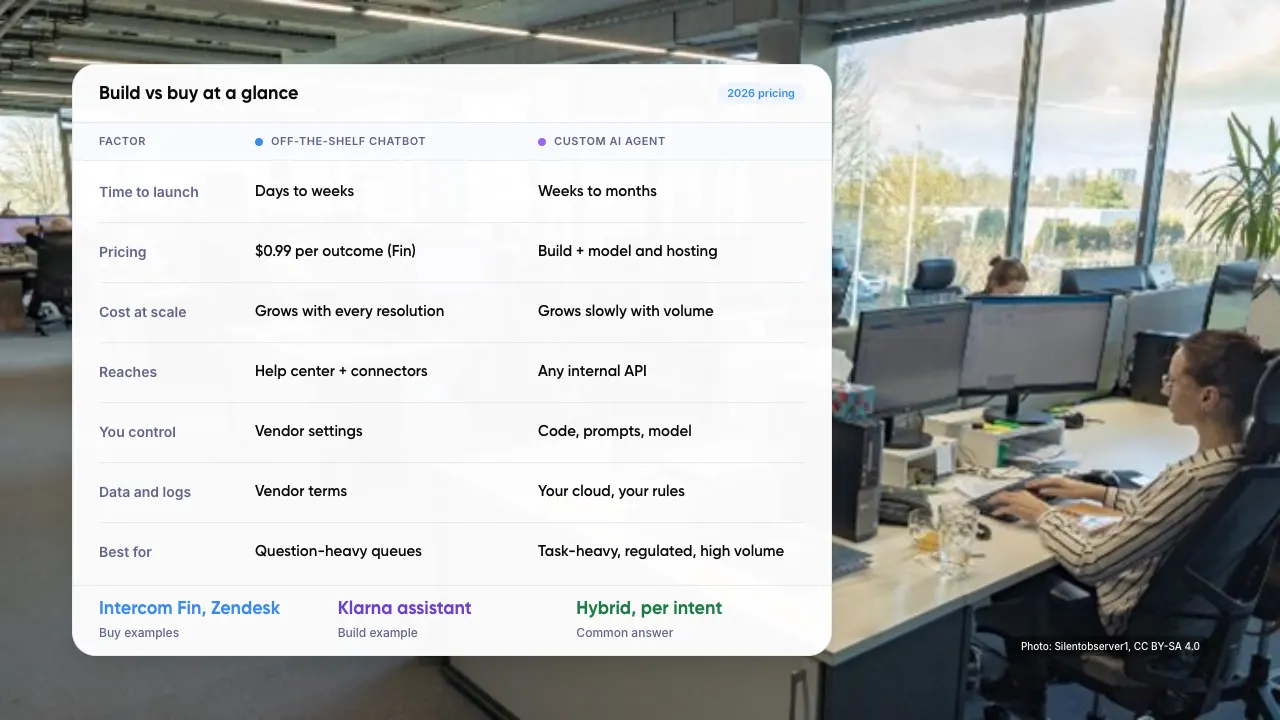
- Build custom when volume, languages or data rules do not fit a vendor. Otherwise, buying is cheaper to start.
2. What Does an AI Customer Support Agent Actually Cost?
Every quote hides four layers. Ask for each one separately, because they grow at different speeds.
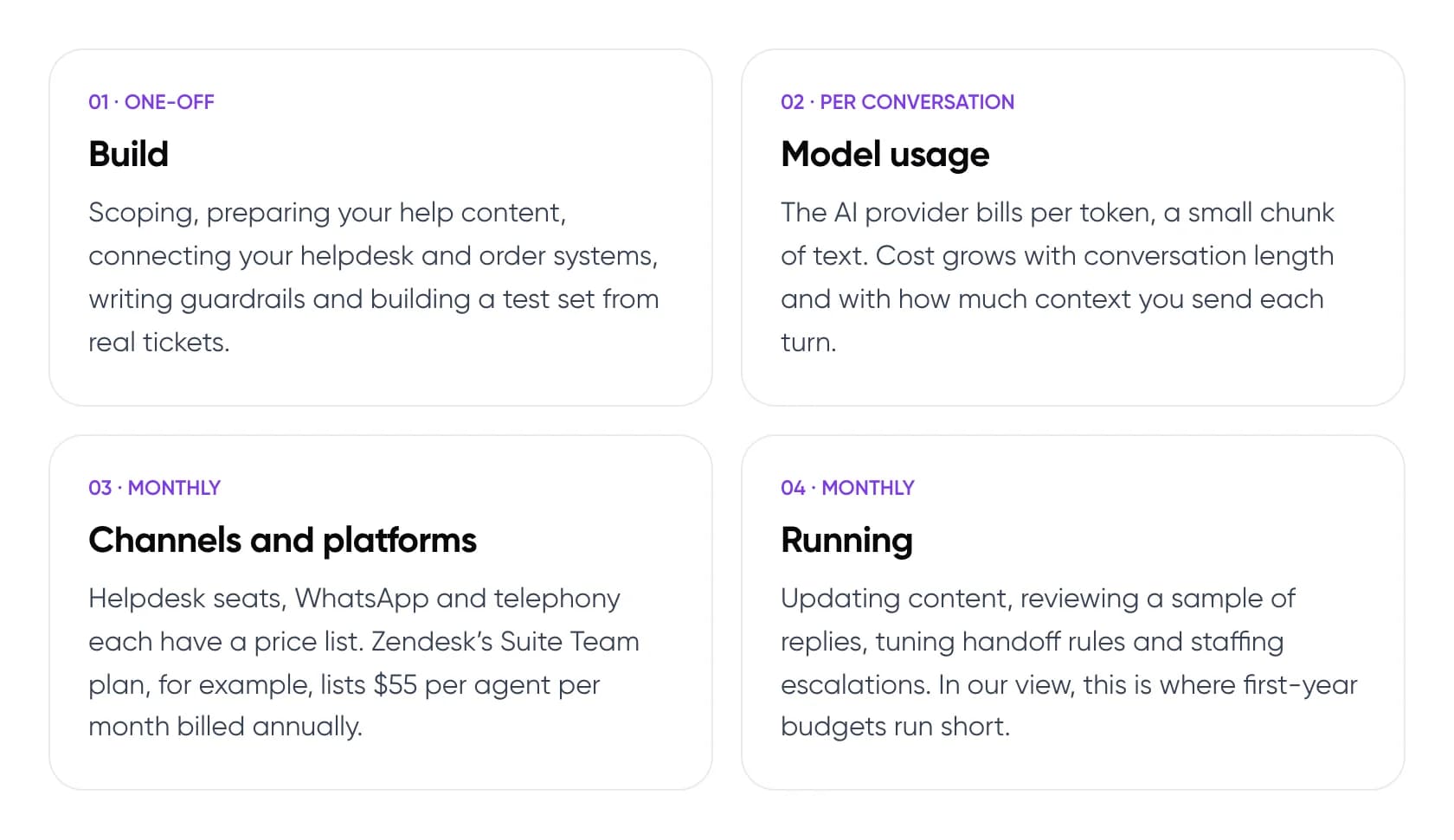
- Build (one-off): scoping, preparing your help content, connecting your helpdesk and order systems, writing guardrails and building a test set from real tickets.
- Model usage (per conversation): the AI provider bills per token, a small chunk of text. Cost grows with conversation length and with how much context you send each turn.
- Channels and platforms (monthly): helpdesk seats, WhatsApp and telephony each have a price list. Zendesk’s Suite Team plan, for example, lists $55 per agent per month billed annually.
- Running (monthly): updating content, reviewing a sample of replies, tuning handoff rules and staffing escalations. In our view, this is where first-year budgets run short.
Channel fees deserve a second look. Meta’s WhatsApp pricing documentation says it bills per delivered message. From October 1, 2026, service replies are free only for the first 1,000 per business phone number each month. Meta also runs a separate policy for AI providers, so check with Meta or your provider which category your setup falls under.
3. How Much Do Vendor AI Agents Charge Per Resolution?
Buying an AI agent for customer support is the baseline you compare a custom build against. These are list prices from each vendor’s own pages in October 2026.
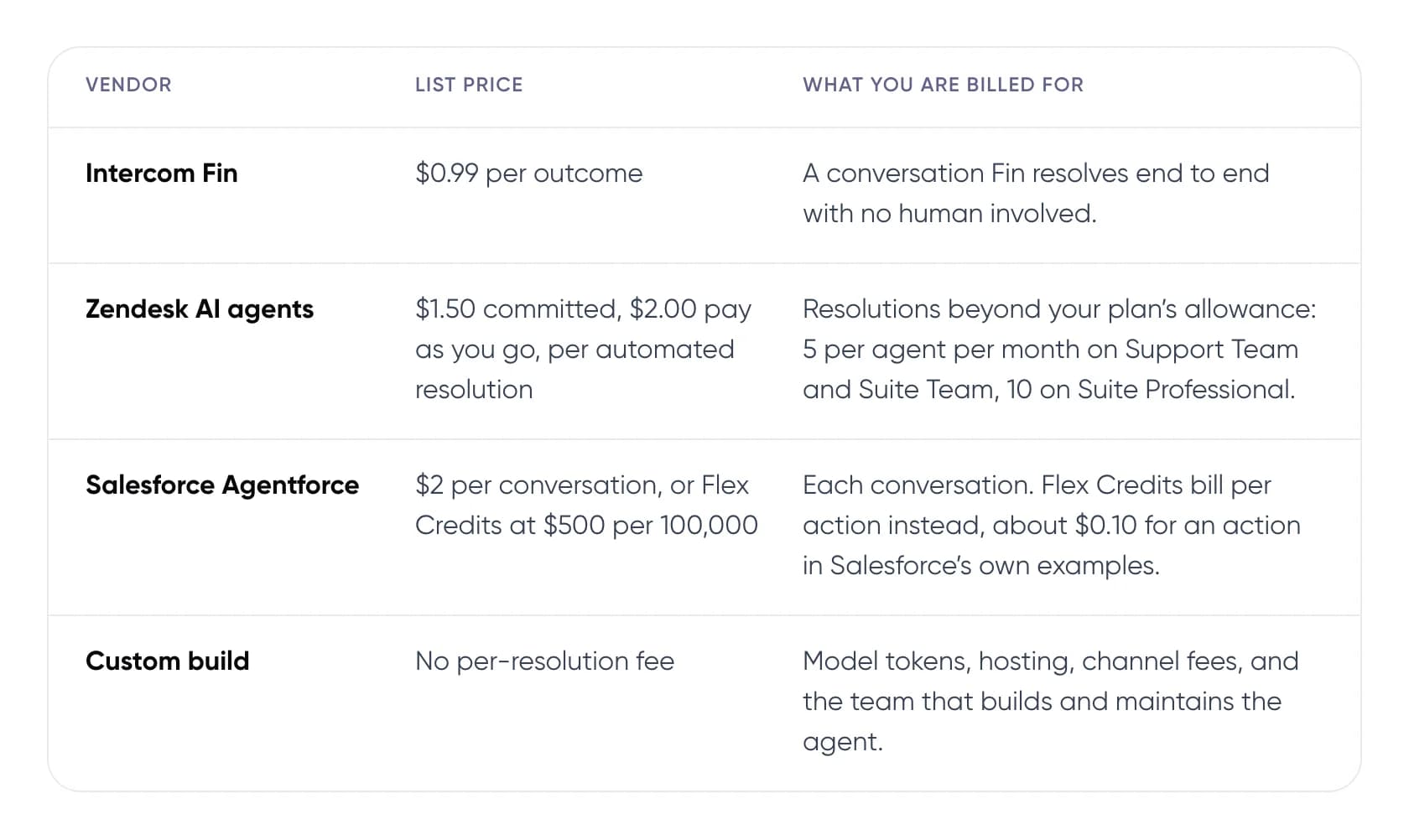
- Intercom Fin: $0.99 per outcome. Billed for a conversation Fin resolves end to end with no human involved.
- Zendesk AI agents: $1.50 committed, $2.00 pay as you go, per automated resolution. Billed for resolutions beyond your plan’s allowance: 5 per agent per month on Support Team and Suite Team, 10 on Suite Professional.
- Salesforce Agentforce: $2 per conversation, or Flex Credits at $500 per 100,000. Flex Credits bill per action instead, about $0.10 for an action in Salesforce’s own examples.
- Custom build: no per-resolution fee. You pay for model tokens, hosting, channel fees, and the team that builds and maintains the agent.
Warning: These are list prices. Committed volume, annual contracts and seat fees change the real number, and vendors revise their pages. Each row comes from that vendor’s own page, including Salesforce’s Agentforce pricing.
In our view, per-resolution pricing is the right start below a few thousand conversations a month, because you pay little until the agent works. A custom build starts to win in three cases. Volume is high, your policies do not fit a vendor’s workflow, or data must stay in your own systems.
Tip: To find your break-even month, divide the build cost by the monthly saving. The saving is the vendor fees you would pay minus the monthly running cost of the custom agent. If the answer is longer than you can plan for, buy.
4. How Much Do AI Model Tokens Cost per Conversation?
Model usage is the layer people worry about and the one that matters least. Anthropic’s published pricing shows why. We use it here as an example; other providers publish similar per-token price lists.
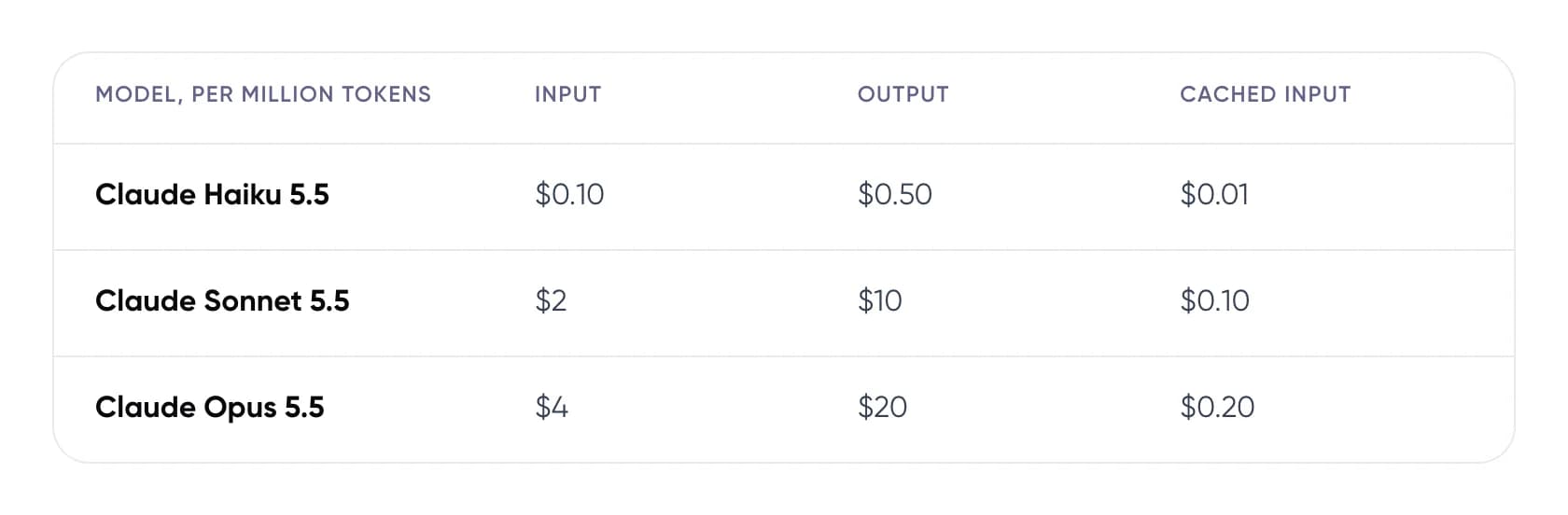
- Claude Haiku 5.5: $0.10 input, $0.50 output, $0.01 cached input, per million tokens.
- Claude Sonnet 5.5: $2 input, $10 output, $0.10 cached input, per million tokens.
- Claude Opus 5.5: $4 input, $20 output, $0.20 cached input, per million tokens.
Take a five-turn conversation where each turn sends about 4,000 tokens of instructions, history and help articles, and gets a 300-token answer. That is 20,000 tokens in and 1,500 out. These are our assumptions, not a benchmark, so measure your own logs.
At the prices above, that conversation costs about $0.003 on Haiku 5.5, $0.055 on Sonnet 5.5 and $0.11 on Opus 5.5. Even the most expensive of the three sits far below the $0.99 to $2.00 a vendor charges per resolution. The gap is what you pay a vendor to build and run for you.
Token prices can move. Gartner’s 2026 forecast links rising cost per resolution to several things. AI vendors are moving from subsidized growth to profitability, data center costs are higher, and use cases consume more tokens. Our view: keep the model behind a thin layer of your own code so a price change never traps you.
5. What Would an AI Support Agent Cost at Your Volume?
Start with your monthly volume, the share of conversations the agent resolves without a person, and a model. The numbers use the list prices above. The resolution rate is an input you choose, not a benchmark.
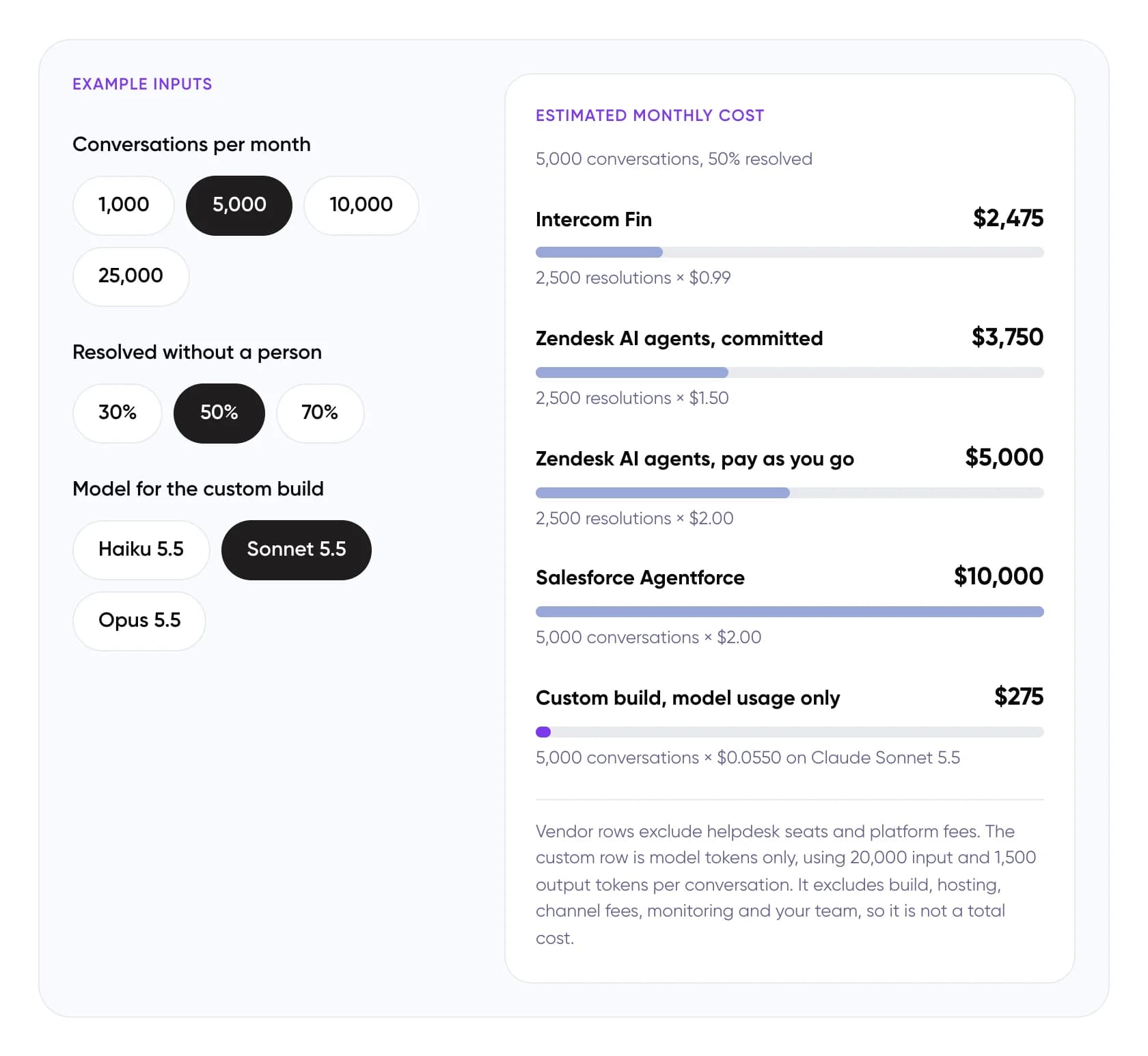
Example: 5,000 conversations a month, 50% resolved without a person, Claude Sonnet 5.5
- Intercom Fin: $2,475 (2,500 resolutions × $0.99).
- Zendesk AI agents, committed: $3,750 (2,500 resolutions × $1.50).
- Zendesk AI agents, pay as you go: $5,000 (2,500 resolutions × $2.00).
- Salesforce Agentforce: $10,000 (5,000 conversations × $2.00).
- Custom build, model usage only: $275 (5,000 conversations × $0.055 on Claude Sonnet 5.5).
To use your own numbers, multiply resolved conversations by the vendor’s per-resolution price, or all conversations for Salesforce. For the custom row, multiply all conversations by the per-conversation token cost from section 4.
Note: Vendor rows exclude helpdesk seats and platform fees. The custom row is model tokens only, using 20,000 input and 1,500 output tokens per conversation. It excludes build, hosting, channel fees, monitoring and your team, so it is not a total cost.
Planning an AI customer support agent? Neura Dynamics offers this as a service. See how our AI customer support automation service works, or book a free AI consultation.
6. What Drives the Cost of an AI Support Agent Up?
For most AI agents for customer support, these four choices move the budget more than the model does. They are our view from scoping work, so treat them as a checklist for your own quotes.
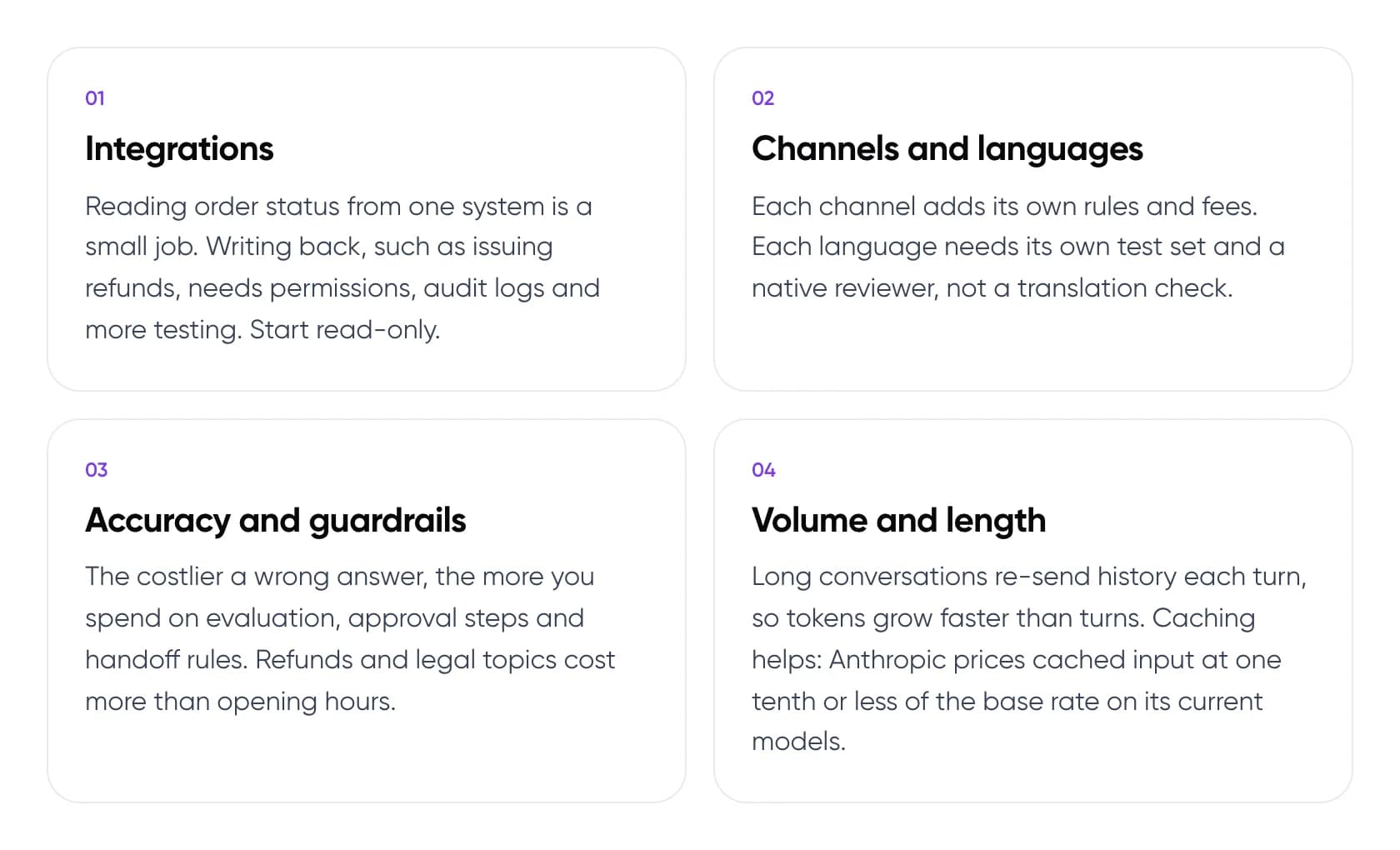
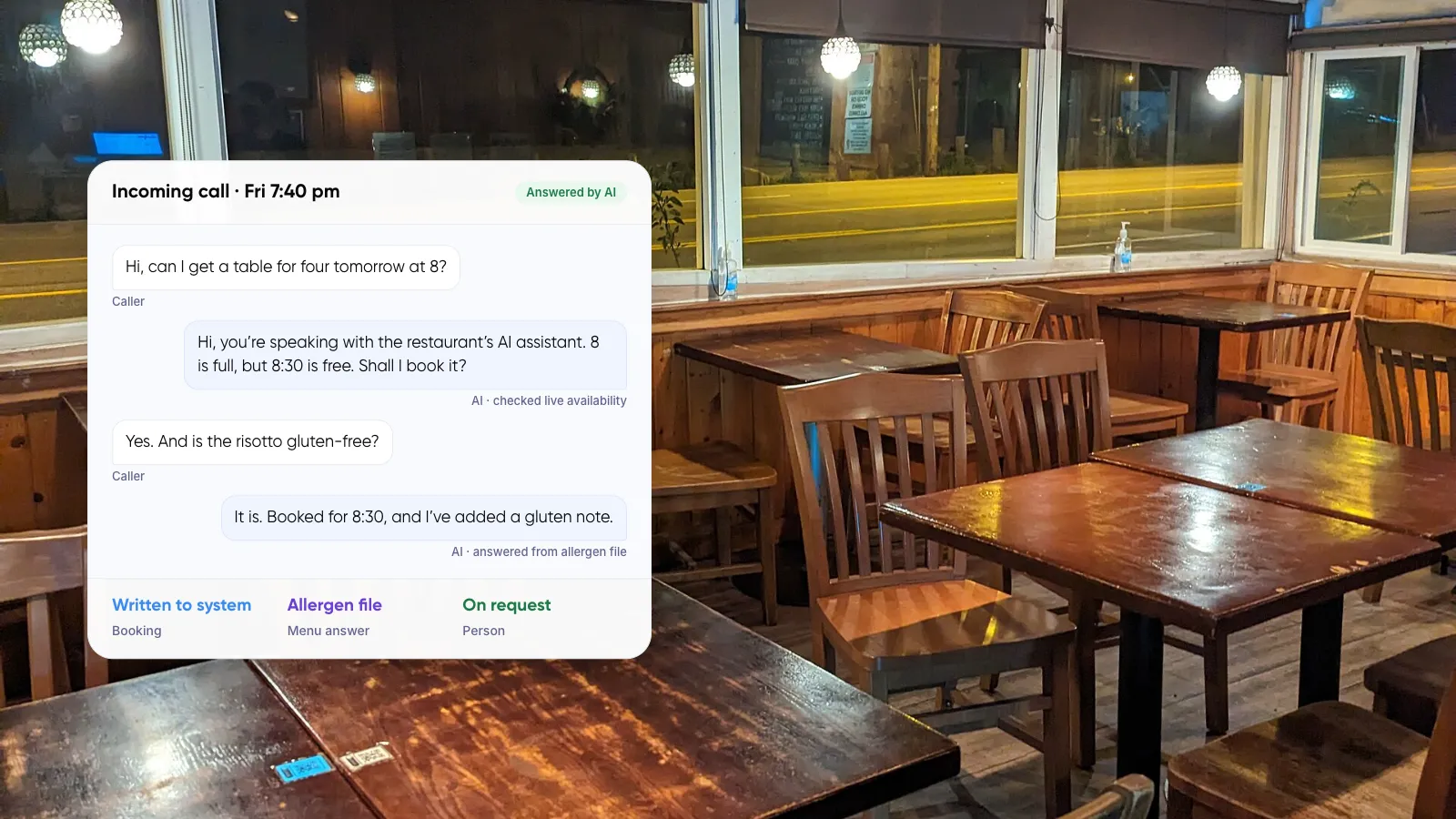
- Integrations: reading order status from one system is a small job. Writing back, such as issuing refunds, needs permissions, audit logs and more testing. Start read-only.
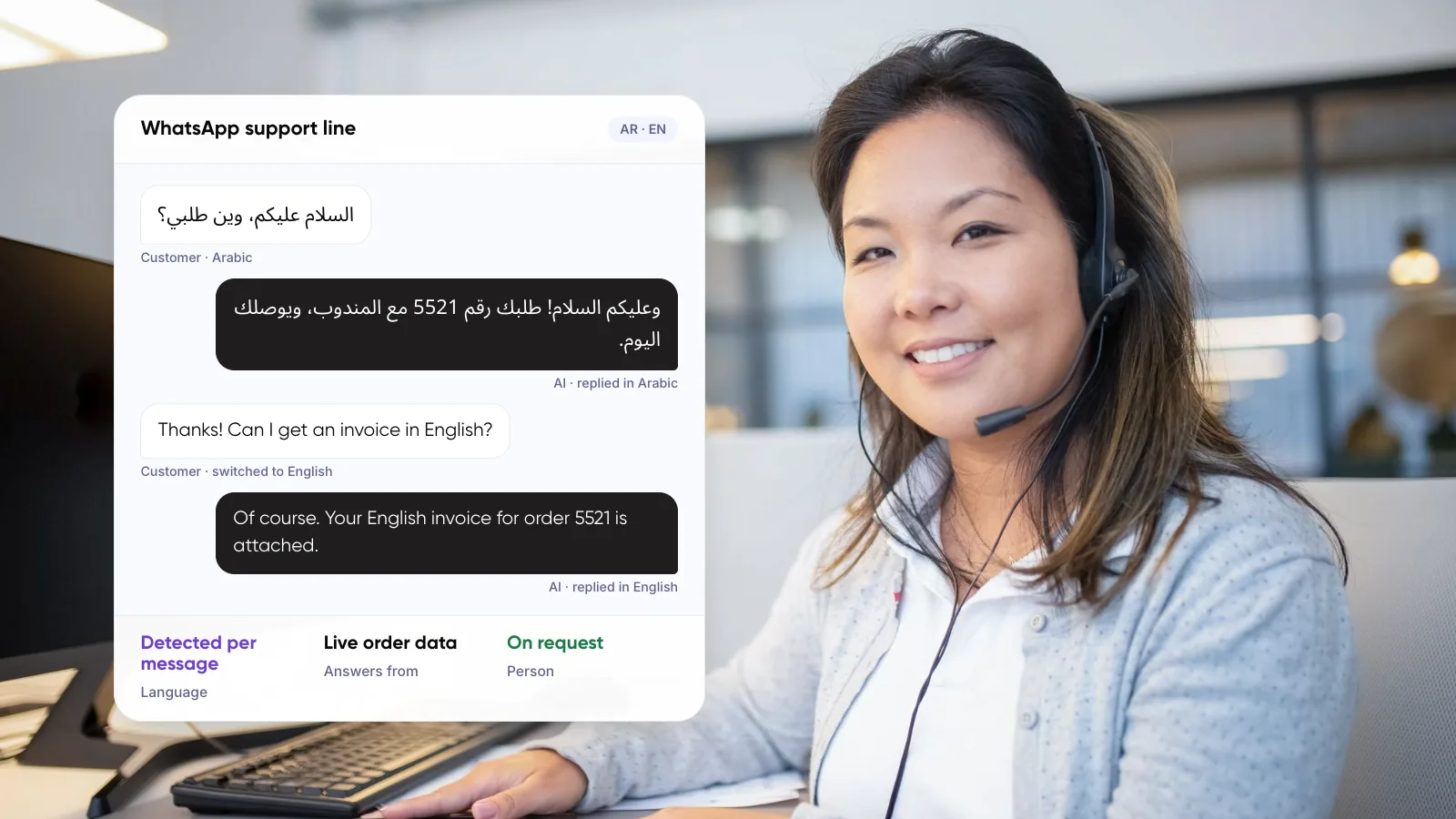
- Channels and languages: each channel adds its own rules and fees. Each language needs its own test set and a native reviewer, not a translation check.
- Accuracy and guardrails: the costlier a wrong answer, the more you spend on evaluation, approval steps and handoff rules. Refunds and legal topics cost more than opening hours.
- Volume and length: long conversations re-send history each turn, so tokens grow faster than turns. Caching helps: Anthropic prices cached input at one tenth or less of the base rate on its current models.
Grounding answers in your own documents also affects cost and accuracy. Our guide to agentic RAG for customer service automation explains how that works.
7. How Long Does It Take to Build an AI Support Agent?
In our view, the answer depends on your data more than on the AI model. Most calendar time goes to preparing content and testing against real tickets.
- Choose one use case. Pick question types that are frequent, factual and low risk, such as order status or opening hours.
- Prepare your content. Clean the help articles and policies the agent will answer from. Gaps here become wrong answers later.
- Connect systems read-only. Give the agent order, booking or account data without write permissions.
- Build a test set. Collect real past tickets with the correct answers, then score every version of the agent against them.
- Pilot in draft mode. Your agents approve each AI reply before it is sent, for a set period.
- Go live on one channel. Switch the safest topics to automatic replies, then add channels and languages.
Tip: Be wary of a fixed timeline quoted before anyone has looked at your tickets. It is a guess, however confident it sounds.
8. Should You Build or Buy an AI Support Agent?
Both routes work, whether you buy a customer service AI agent or commission custom AI agents. The right one depends on volume and on how unusual your support rules are.
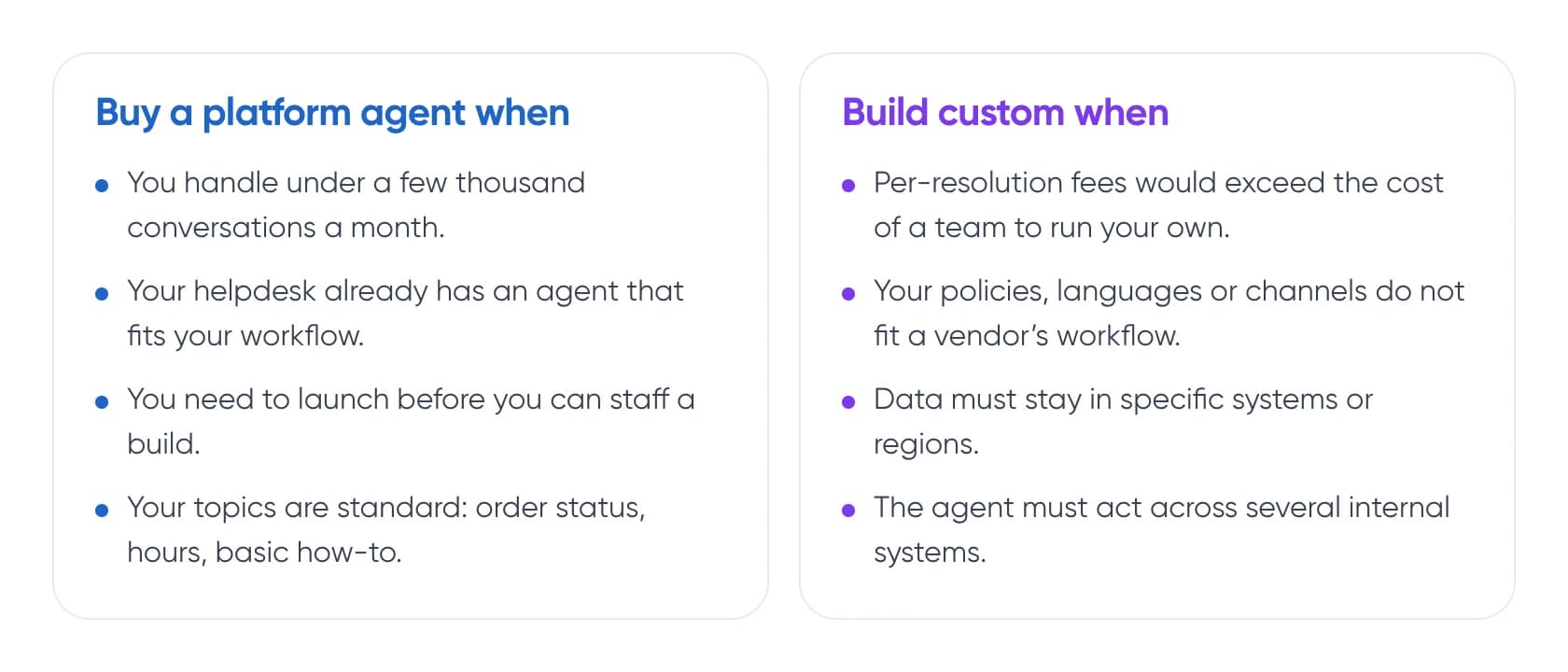
Buy a platform agent when
- You handle under a few thousand conversations a month.
- Your helpdesk already has an agent that fits your workflow.
- You need to launch before you can staff a build.
- Your topics are standard: order status, hours, basic how-to.
Build custom when
- Per-resolution fees would exceed the cost of a team to run your own.
- Your policies, languages or channels do not fit a vendor’s workflow.
- Data must stay in specific systems or regions.
- The agent must act across several internal systems.
Either way, budget for people. In a March 2025 survey of 163 customer service leaders, Gartner found that 95% plan to keep human agents. It predicted that half of the organizations planning deep staff cuts will drop those plans by 2027.
Projects also fail on cost. Gartner’s June 2025 forecast says over 40% of agentic AI projects will be canceled by the end of 2027. On the other side, Customer Experience Dive reported in May 2025 that Klarna’s AI assistant handled about two-thirds of inquiries. Its cost per transaction fell from $0.32 to $0.19 over two years.
For a channel-by-channel view of how routine questions are answered and complex cases routed, see our AI customer support automation service, where Neura Dynamics designs, builds and runs these agents for you.
9. Common Budget Mistakes
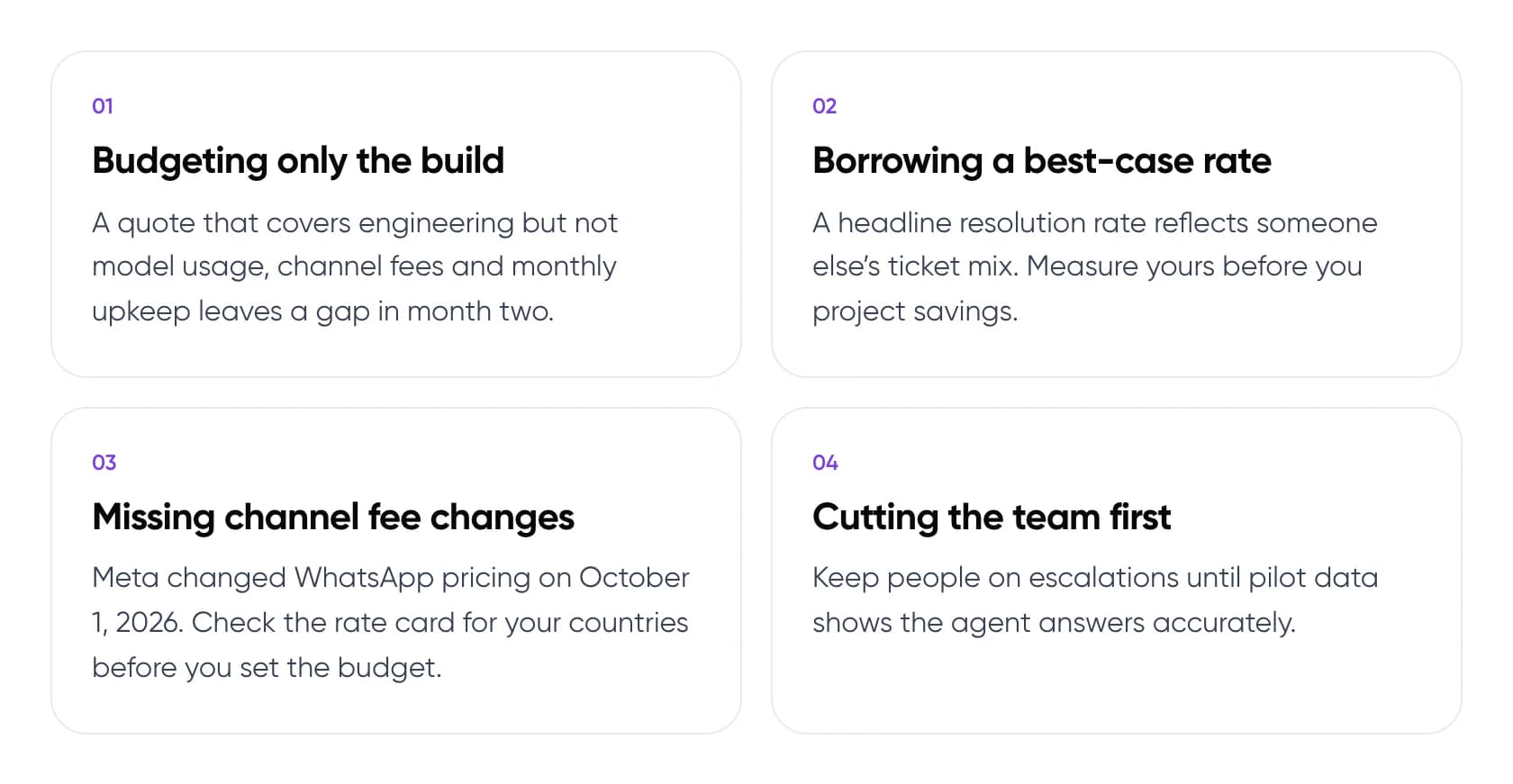
- Budgeting only the build. A quote that covers engineering but not model usage, channel fees and monthly upkeep leaves a gap in month two.
- Borrowing a best-case rate. A headline resolution rate reflects someone else’s ticket mix. Measure yours before you project savings.
- Missing channel fee changes. Meta changed WhatsApp pricing on October 1, 2026. Check the rate card for your countries before you set the budget.
- Cutting the team first. Keep people on escalations until pilot data shows the agent answers accurately.
New to the topic? Start with what customer support automation is and how it works.
10. Frequently Asked Questions
How much does it cost to build an AI customer support agent?
It depends on integrations, channels, languages and volume, so no single number is honest. Vendors list $0.99 to $2.00 per resolution. A custom build adds engineering and running costs. Ask any provider to price build, usage, channel and running costs separately.
Is it cheaper to build or buy an AI customer support agent?
Buying is cheaper to start, and the bill grows with every resolution. Building costs more upfront but has low per-conversation costs, so it wins at high volume or with unusual requirements. Compare monthly fees at your volume, then divide the build cost by the monthly saving.
How much do AI model tokens cost per support conversation?
In our example of 20,000 input and 1,500 output tokens, a conversation costs about $0.003 on Claude Haiku 5.5. It costs $0.055 on Sonnet 5.5 and $0.11 on Opus 5.5, at Anthropic’s October 2026 prices. Your figure depends on conversation length and how much context you send.
How long does it take to build an AI customer support agent?
Expect stages: one use case, read-only integrations, a test set from real tickets, then a draft-mode pilot before any automatic replies. Readiness of your help content and ticket data sets the pace.
Will an AI customer support agent replace my support team?
Not in most plans. Gartner’s March 2025 survey of 163 customer service leaders found 95% plan to keep human agents. It also predicts half of the firms planning deep cuts will drop them by 2027. The agent takes routine questions, so budget for escalation staffing.
11. Conclusion
An AI customer support agent is cheap to try and easy to underbudget. Price all four layers before you commit. Start with your own conversation volume and the example in section 5. Then ask each vendor or builder for build, usage, channel and running costs on separate lines. If you want a second opinion, our AI customer support automation service includes a review of your volume and a build-versus-buy comparison.
Tip: Once you know your monthly conversation volume, our free AI ROI Calculator estimates the hours saved and the payback period.
Have a project in mind? Bring a spec, a half-formed idea, or a vision, and we’ll map out what it takes to ship. Book a free AI consultation.
Author