How an AI Voice Agent Handles Restaurant Bookings, Menu Questions and Opening-Hours Calls
An AI voice agent answers your restaurant’s phone, books tables straight into your reservation system, answers menu and allergy questions from an approved menu file, and reads opening hours from your live schedule.
This guide covers the three call types, how the agent works on a call, published results, rollout steps and call recording consent.
1. The Short Answer
An AI voice agent is software that answers phone calls, understands what the caller wants, and completes the task in your own systems. For a restaurant, that means bookings, menu questions and opening hours, with a transfer to staff when needed.
People still phone. In a 2025 Harris Poll of 2,065 US adults, commissioned by AI phone vendor Hostie, 63% said calling is their preferred way to contact a restaurant.
Key takeaways
- Most restaurant calls are bookings, menu questions or opening hours. Each needs a different data source.
- Published deployments report 70–75% of calls fully handled, with every call answered.
- Bookings only work if the agent writes into your reservation system, such as OpenTable or Zonal.
- Tell callers the call is answered by AI and may be recorded.
- Start with one site and one call type, then expand.
2. Why Do Restaurants Miss So Many Calls?
Calls arrive when staff are busiest. AI phone vendor Maple analyzed more than 1.2 million restaurant calls and found that 68% came during lunch and dinner service. That is exactly when the host is seating guests.
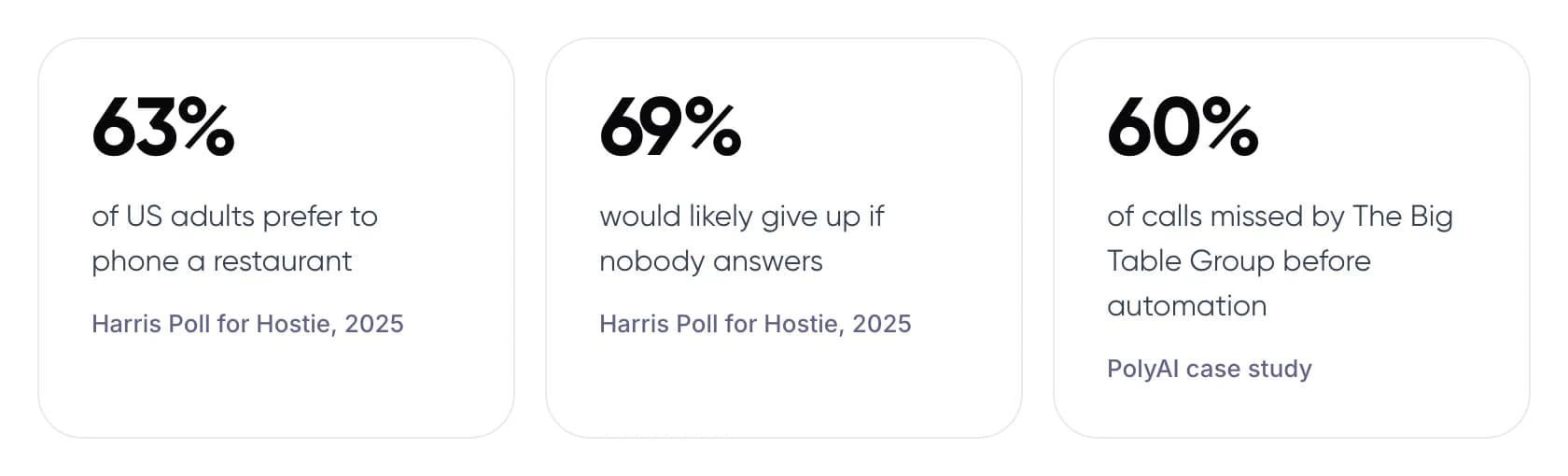
- 63% of US adults prefer to phone a restaurant (Harris Poll for Hostie, 2025).
- 69% would likely give up if nobody answers (Harris Poll for Hostie, 2025).
- 60% of calls missed by The Big Table Group before automation (PolyAI case study).
Before automation, UK operator The Big Table Group was missing 60% of incoming calls. A UK pub restaurant chain missed 30%.
Note: Vendor-commissioned surveys are useful but not neutral. Pull two weeks of your own call logs before you build a business case.
3. What Can an AI Voice Agent Handle for a Restaurant?
Most calls are one of three jobs. Each fails in a different way, so plan them separately.
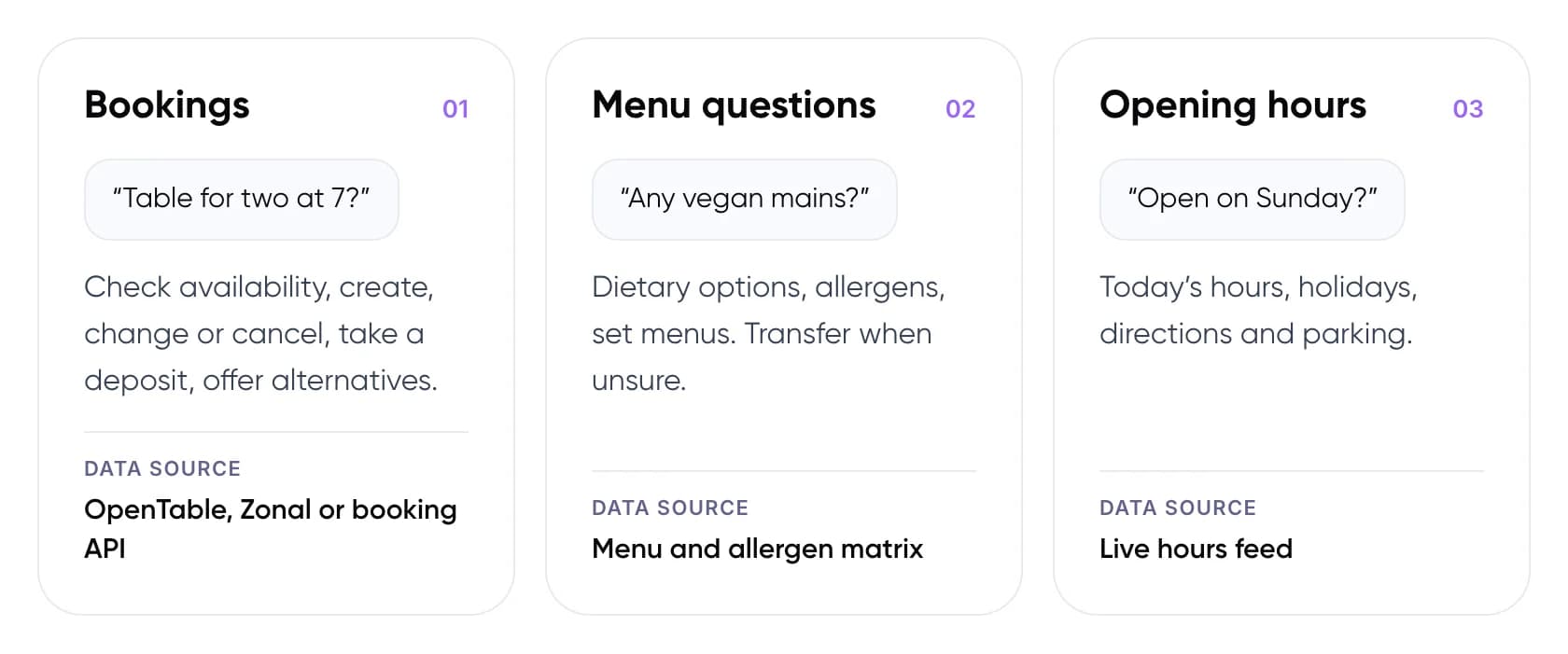
- Bookings (“Table for two at 7?”): check availability, create, change or cancel, take a deposit, offer alternatives. Data source: OpenTable, Zonal or booking API.
- Menu questions (“Any vegan mains?”): dietary options, allergens, set menus. Transfer when unsure. Data source: menu and allergen matrix.
- Opening hours (“Open on Sunday?”): today’s hours, holidays, directions and parking. Data source: live hours feed.
The Melting Pot’s agent, “Judy”, answers location, hours and menu questions, and creates, edits or cancels bookings with a deposit. When no table is free, Big Table Group’s agent offers another time or location and records allergy notes on the booking.
Warning: Allergen answers must come from the same allergen matrix your kitchen uses. If the agent cannot find a clear answer, it should transfer the call.
4. How Does an AI Phone Agent Work on a Call?
The agent transcribes the caller, works out the request, checks the right system and speaks a reply. Here is each step, then five sample calls and what the agent detects and does. Calls are illustrative.
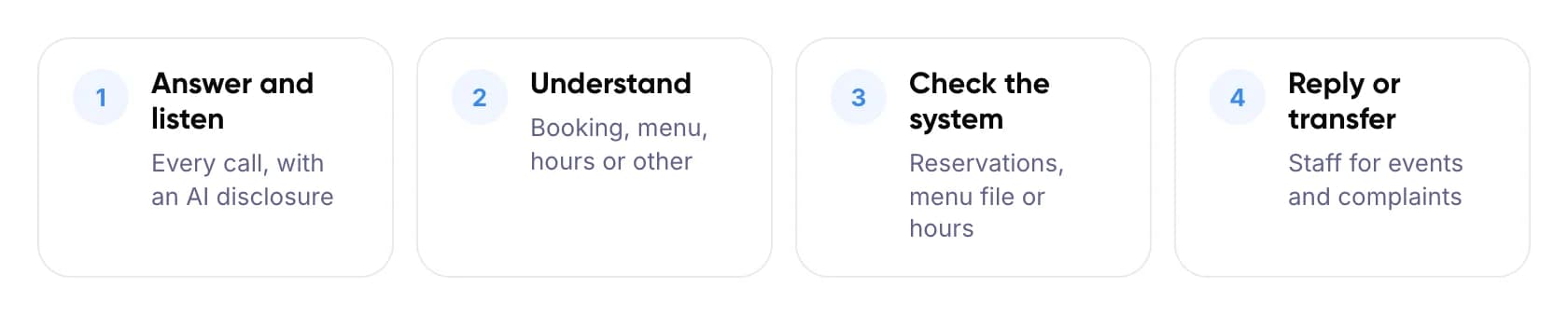
- Answer and listen. Every call, with an AI disclosure.
- Understand. Booking, menu, hours or other.
- Check the system. Reservations, menu file or hours.
- Reply or transfer. Staff for events and complaints.
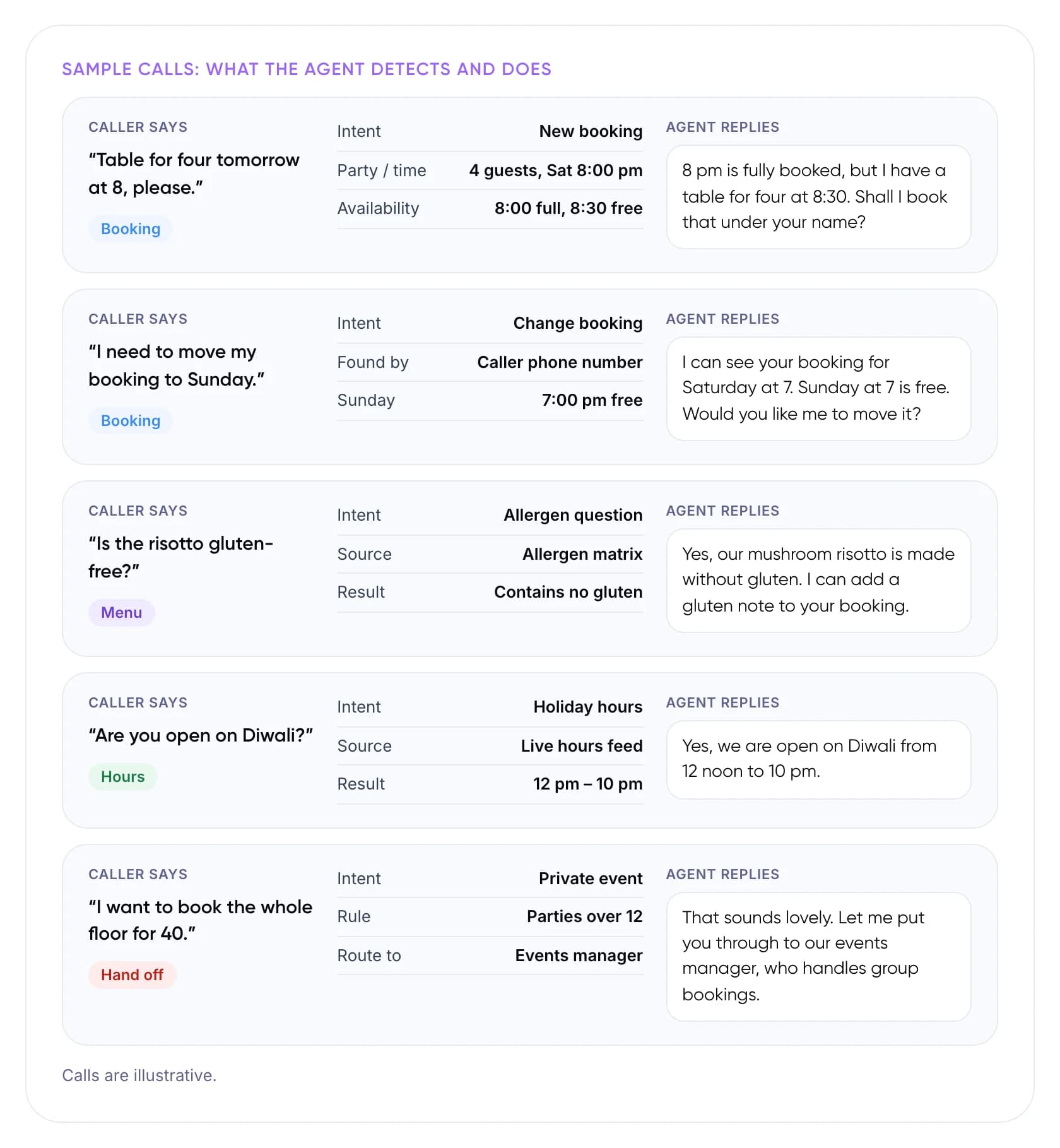
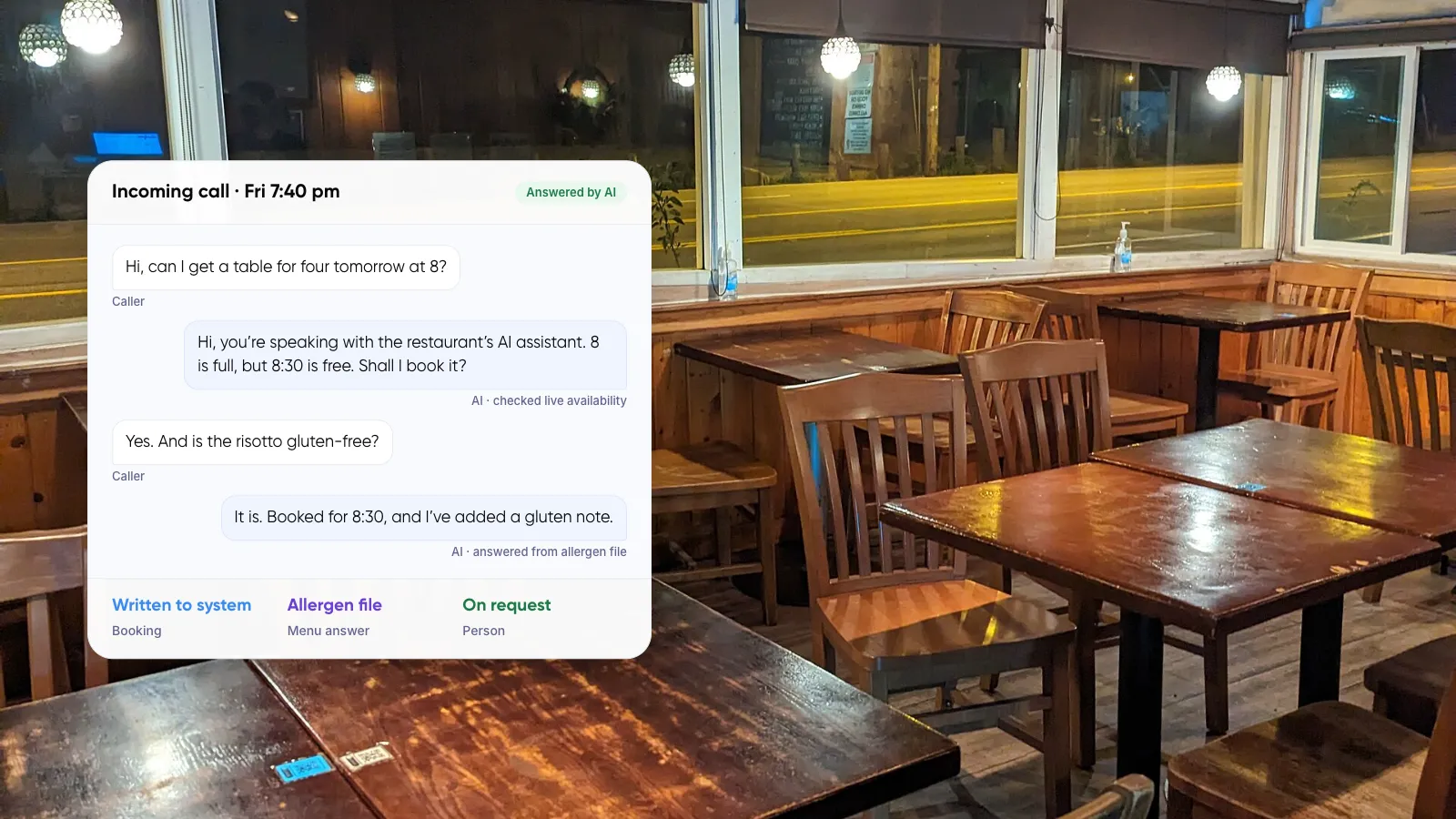
- “Table for four tomorrow at 8, please.” (Booking) New booking, 4 guests, Sat 8:00 pm; 8:00 full, 8:30 free. Reply: “8 pm is fully booked, but I have a table for four at 8:30. Shall I book that under your name?” It checks the live reservation system and offers the nearest slot.
- “I need to move my booking to Sunday.” (Booking) Change booking, found by the caller’s phone number; Sunday 7:00 pm free. Reply: “I can see your booking for Saturday at 7. Sunday at 7 is free. Would you like me to move it?” It finds the existing reservation and amends it in place.
- “Is the risotto gluten-free?” (Menu) Allergen question, checked against the allergen matrix: contains no gluten. Reply: “Yes, our mushroom risotto is made without gluten. I can add a gluten note to your booking.” It answers only from the approved allergen file.
- “Are you open on Diwali?” (Hours) Holiday hours, from the live hours feed: 12 pm to 10 pm. Reply: “Yes, we are open on Diwali from 12 noon to 10 pm.” It reads the same hours feed as your Google Business Profile.
- “I want to book the whole floor for 40.” (Hand off) Private event; rule: parties over 12 go to the events manager. Reply: “That sounds lovely. Let me put you through to our events manager, who handles group bookings.” Large parties and events always go to a person.
The hard part is rarely the model. It is the integrations and the rules: covers per slot, when a deposit applies, which questions always go to a person. In our view, these rules deserve more design time than the voice, because that is where most failed calls start.
Tip: Write a short “always transfer” list before go-live: complaints, large parties, private events, and any allergen question the menu file does not cover.
5. AI Voice Agent vs AI Receptionist vs Answering Service
An AI receptionist or AI answering service usually takes messages or books into a calendar. A restaurant AI voice agent writes into your reservation system, so phone bookings appear on the floor plan straight away.
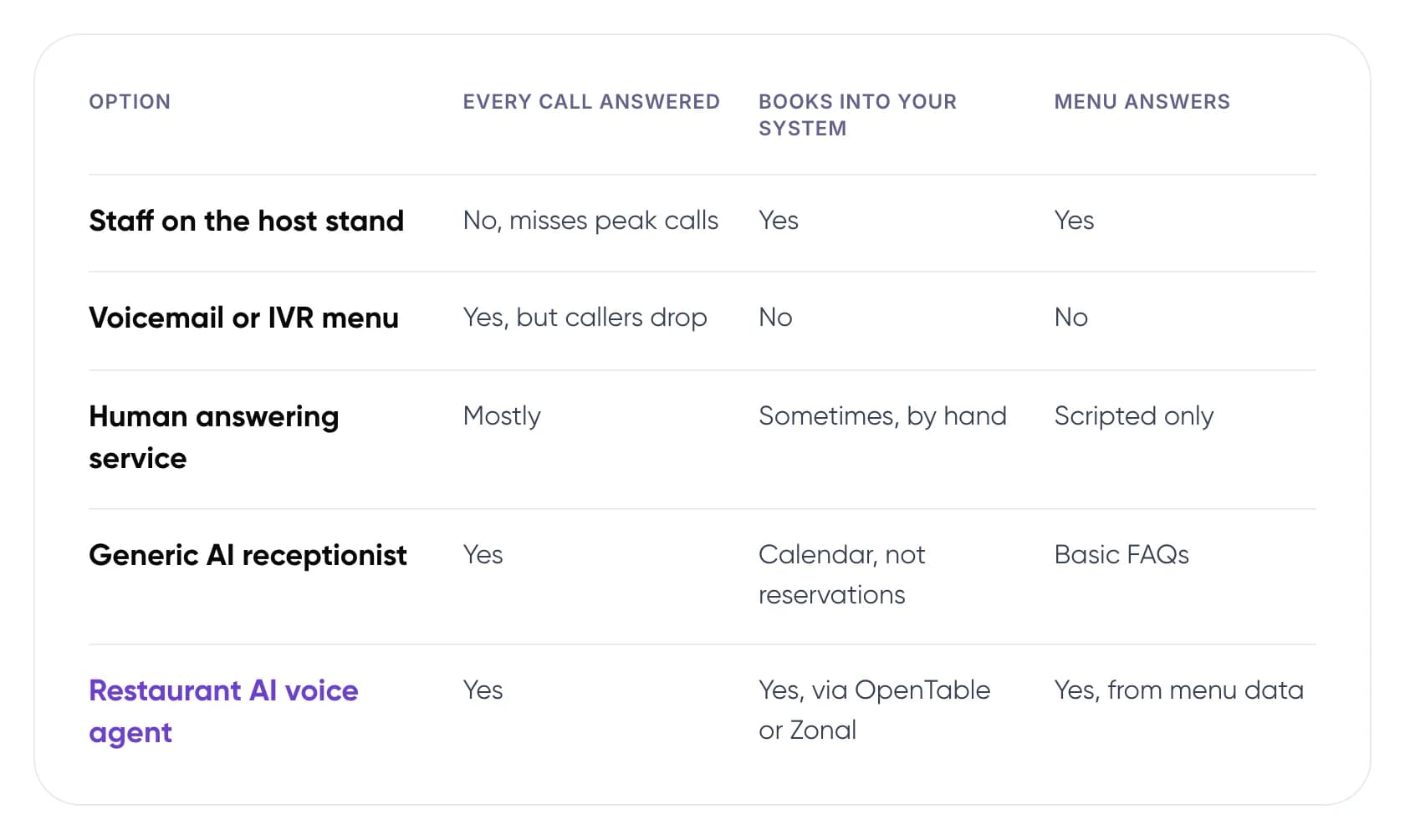
- Staff on the host stand: misses peak calls; books into your system: yes; menu answers: yes.
- Voicemail or IVR menu: answers every call, but callers drop; books: no; menu answers: no.
- Human answering service: mostly answered; books: sometimes, by hand; menu answers: scripted only.
- Generic AI receptionist: every call answered; books into a calendar, not reservations; menu answers: basic FAQs.
- Restaurant AI voice agent: every call answered; books via OpenTable or Zonal; menu answers from menu data.
Our assessment of typical setups, not a survey.
6. What Results Have Restaurants Reported?
The Big Table Group runs Bella Italia, Café Rouge and Las Iguanas and receives more than 2.5 million calls a year. It connected a PolyAI voice agent to its Zonal booking platform.
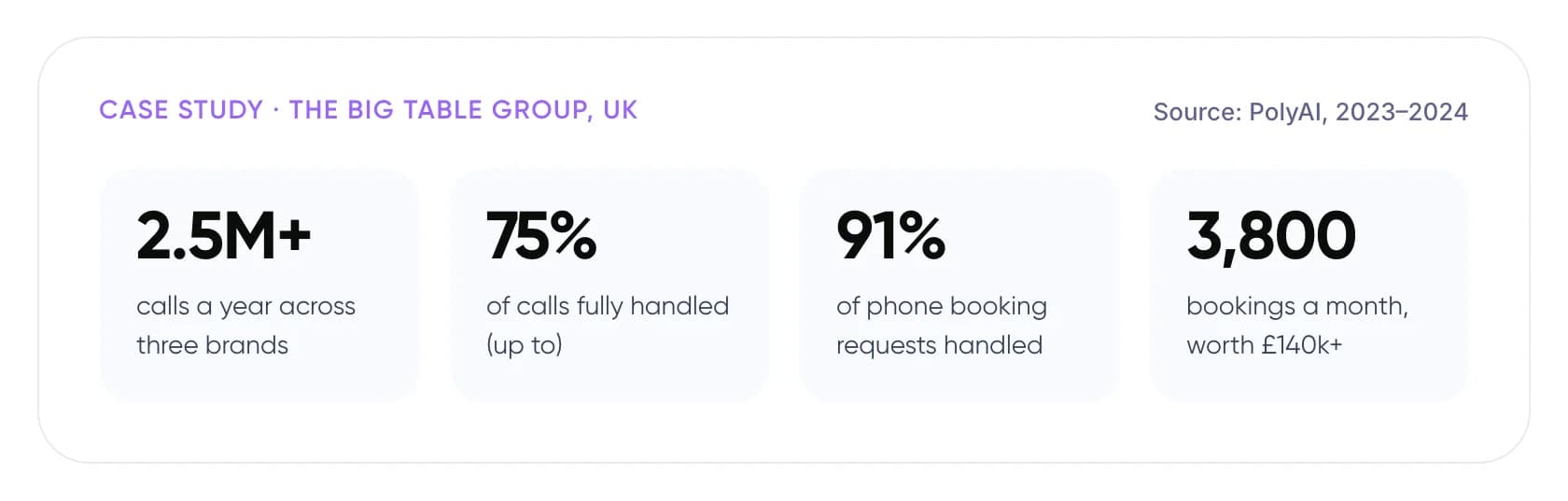
Case study: The Big Table Group, UK (source: PolyAI, 2023–2024)
- 2.5M+ calls a year across three brands.
- Up to 75% of calls fully handled.
- 91% of phone booking requests handled.
- 3,800 bookings a month, worth £140k+.
The agent now runs in 130 locations across three brands. A separate UK pub chain reports 70% of calls fully handled and bookings taken around the clock. These are vendor case studies, so treat them as best-case figures.
On our side, we stabilized and extended an AI voice platform for inbound and outbound calls, with a knowledge base and calendar and CRM actions. It is not a restaurant project, but the same parts decide whether calls succeed: clean source data, actions in real systems and a route to a person.
Planning a voice agent for your restaurant group? Book a free AI consultation.
7. How to Roll Out an AI Voice Agent
- Audit two weeks of calls. Tag each call as booking, change, menu, hours or other. This is your baseline.
- Fix your data first. Update the hours feed, the allergen matrix and booking rules for deposits and party sizes.
- Connect the reservation system. Confirm the agent can read availability and write bookings through the official API.
- Write the handoff rules. Decide what transfers to a person and what becomes a callback.
- Add the AI and recording notice. Put it in the greeting, then check it with counsel for each state or country.
- Pilot one site for four weeks. Track answer rate, calls fully handled, bookings created and transfers.
- Expand by call type, then by site. Multi-site groups can run it like call center automation: one agent, local data per branch.
Menu and policy answers stay accurate when the agent retrieves them from your own documents. Our guide to agentic RAG for customer service automation explains how that works.
8. Do You Need Consent to Record AI-Answered Calls?
Plan for it. In August 2025 a US federal court denied ConverseNow’s motion to dismiss in Taylor v. ConverseNow Technologies. The plaintiff alleged her Domino’s phone order was routed through the vendor’s servers and recorded without consent, under California’s Invasion of Privacy Act.
Do
- Say in the greeting that the caller is speaking with an AI assistant and the call may be recorded.
- Document what the vendor stores, where, and for how long.
- Check consent rules in every state or country you take calls from.
Don’t
- Let the vendor train on your calls without a written agreement.
- Read card numbers into the transcript; use a secure payment link.
- Bury the recording notice in website terms.
The case is unresolved. This is general information, not legal advice.
9. Common Mistakes
- Launching on stale data. Wrong holiday hours or an old menu make the agent confidently wrong.
- No booking integration. An agent that only takes messages still leaves staff to call guests back.
- Guessing on allergens. Any answer not in the allergen file should go to a person.
- Hiding the human option. Offer a transfer in the greeting. Callers who cannot reach a person hang up.
New to the topic? Start with what customer support automation is and how it works.
10. Frequently Asked Questions
Can an AI answer restaurant phone calls?
Yes. An AI voice agent can answer every call, take and change bookings, and answer menu and hours questions. The Big Table Group reported up to 75% of calls handled fully by its agent in PolyAI’s 2023 announcement. Complaints and private events should still transfer to staff.
Is an AI receptionist the same as an AI answering service?
Not quite. An AI answering service usually takes messages or books into a calendar. An AI receptionist adds FAQs and routing. A restaurant voice agent writes directly into your reservation system, such as OpenTable or Zonal, so a phone booking appears on the floor plan straight away.
Do restaurant callers mind talking to AI?
Many are open to it. A 2025 Harris Poll commissioned by Hostie found 89% of US adults open to using an AI agent for restaurant tasks. That survey came from an AI vendor, so test with your own guests and offer a clear route to a person.
Is it legal to record restaurant calls with AI?
It depends on where callers are. In 2025 a California federal court let a privacy claim proceed against restaurant voice AI vendor ConverseNow over call recording. Disclose recording at the start of the call, check consent rules where you operate, and confirm what your vendor stores.
How long does setup take?
It depends mainly on your data and booking integration, not the AI. Melting Pot’s CTO said in a vendor case study that locations can go live quickly with a pre-trained agent. Plan for data clean-up, integration testing and a one-site pilot first.
11. Conclusion
An AI voice agent pays off when it writes into your booking system and reads clean menu and hours data. Tag two weeks of calls at your busiest site; the split between bookings, menu and hours questions tells you where to start.
Tip: Once you know your monthly call volume, our free AI ROI Calculator estimates the hours saved and payback.
To build it with us, see our AI customer support automation services, or book a free AI consultation.
Author