How to Handle After-Hours Customer Support Without a Night Shift
You cover the night with three lanes instead of a staffed shift: automated customer support answers routine questions instantly, a named on-call person is woken only for urgent issues, and everything else waits in a morning queue with a promised reply time.
This guide covers the options, how the triage works, published results, setup steps and the rules for night work in India.
1. The Short Answer
You don’t need people awake all night. You need every overnight message to land in the right lane. Routine questions get an instant answer from your own data. Urgent issues wake one named person. The rest wait for the morning team, with a reply time the customer can see.
Customers do expect someone to be there. In Zendesk’s CX Trends 2026 report, 74% of consumers said that, because of AI, they now expect customer service to be available 24/7. That expectation is about getting an answer, not about who gives it.
Key takeaways
- Split overnight contacts into three lanes: answer now, wake on-call, morning queue.
- Let AI answer only from your own systems and documents, and only on routine requests.
- Page one named person for outages, payment failures and security issues.
- Tell queued customers exactly when a person will reply.
- Measure your own off-hours volume before you choose an option.
2. What Do Customers Expect After Hours?
They expect a response at any hour, and they expect a way to reach a person. Those two findings sit side by side, and your overnight design has to satisfy both.
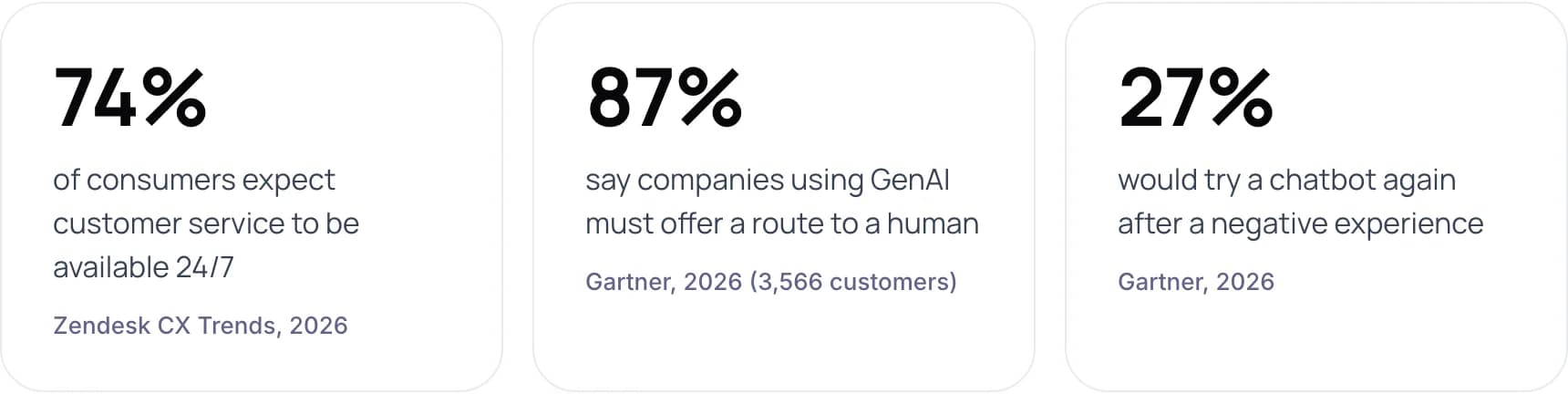
- 74% of consumers expect customer service to be available 24/7 (Zendesk CX Trends, 2026).
- 87% say companies using GenAI must offer a route to a human (Gartner, 2026, 3,566 customers).
- 27% would try a chatbot again after a negative experience (Gartner, 2026).
Gartner’s 2026 survey of 3,566 customers found 50% say service is easier when companies use GenAI. Yet 87% said companies must offer a way to reach a human. A separate Gartner release found only 27% would try a chatbot again after a bad experience.
Note: Industry surveys tell you what customers want in general. Before you design anything, export 30 days of tickets and calls and count how many arrive outside your working hours, and for what.
3. Why Not Just Hire a Night Shift?
A night shift pays for presence, not for conversations. If 15 messages arrive between midnight and 6 am, you still staff all six hours. In our view, that is the main reason mid-size teams look for another model.
There is a people cost too. The International Agency for Research on Cancer classified night shift work as “probably carcinogenic to humans” (Group 2A) in its 2020 monograph. The group grades how strong the evidence is, not how large the risk is. Still, it is a fact your HR team will weigh.
In India, state law adds conditions. Under Maharashtra’s Shops and Establishments Act, 2017, women may work between 9:30 pm and 7 am only with consent, door-to-door transport and at least three women on the shift. The 2018 Rules add an annual undertaking to the Facilitator.
Warning: Each Indian state has its own Shops and Establishments law, and the UAE and US have their own rules. Check with counsel before you schedule night work. This is general information, not legal advice.
4. What Are the Ways to Cover the Night?
There are five common models. Follow-the-sun means handing the queue to a team in a time zone where it is daytime. For an Indian team serving the US, that happens naturally: 9 am in Mumbai is 11:30 pm the previous evening in New York during US daylight time.
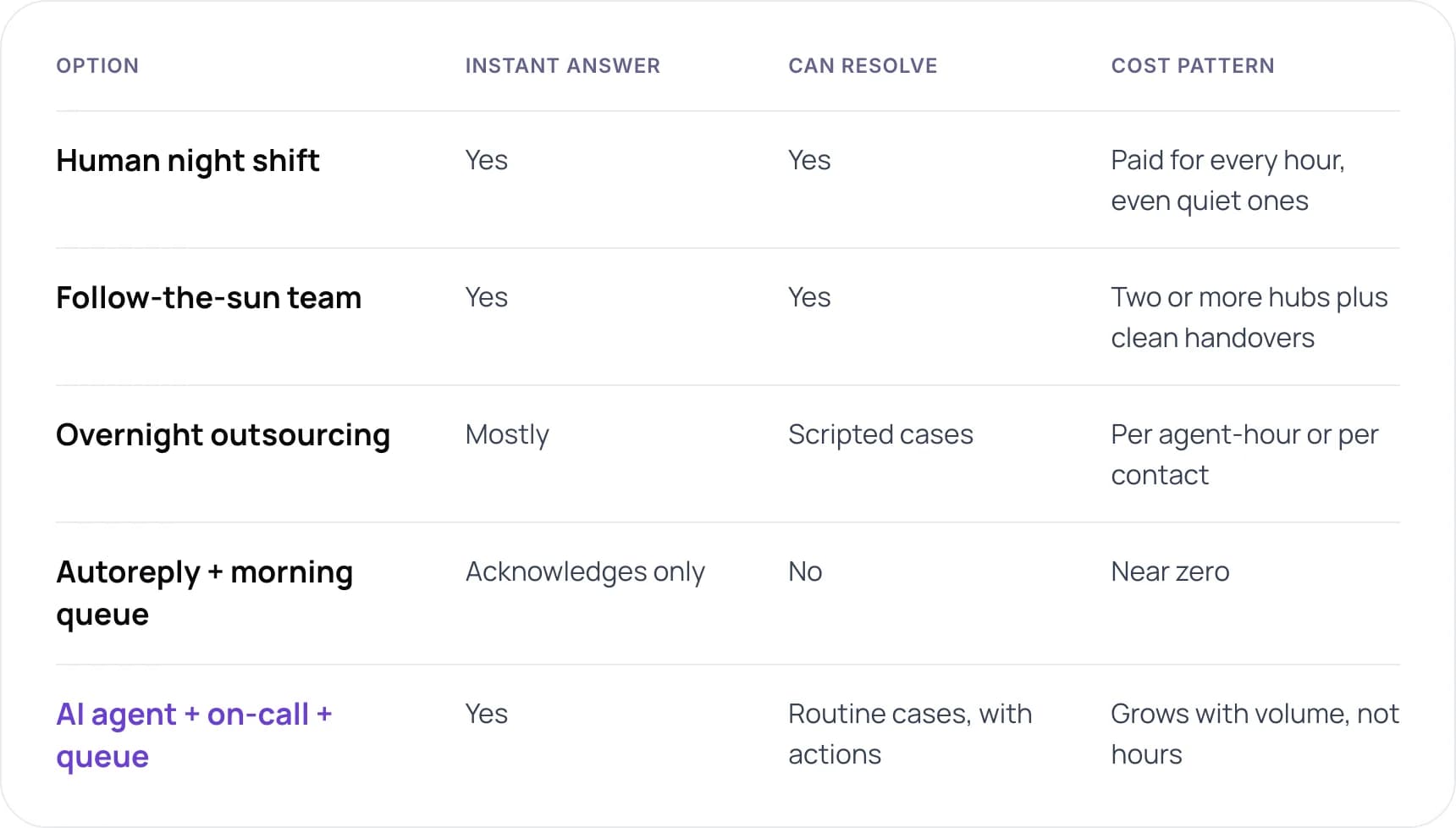
- Human night shift: instant answer, yes. Can resolve, yes. Cost: paid for every hour, even quiet ones.
- Follow-the-sun team: instant answer, yes. Can resolve, yes. Cost: two or more hubs plus clean handovers.
- Overnight outsourcing: instant answer, mostly. Can resolve scripted cases. Cost: per agent-hour or per contact.
- Autoreply + morning queue: acknowledges only. Can’t resolve. Cost: near zero.
- AI agent + on-call + queue: instant answer, yes. Can resolve routine cases, with actions. Cost: grows with volume, not hours.
Our assessment of typical setups, not a survey.
We usually recommend the last row for teams with modest overnight volume: an AI agent for routine requests, one on-call person for emergencies and a morning queue. It keeps humans on the cases that need judgment. If your overnight volume is high and complex, follow-the-sun or outsourcing may still be the better fit.
5. How Does an AI Agent Triage Overnight Messages?
The agent reads the message, works out the intent, checks the right system and picks a lane. Every message goes through four steps.

- Answer: every message, at any hour.
- Triage: routine, urgent or can wait.
- Act or escalate: resolve, or page on-call.
- Morning handoff: summaries, not a pile.
Here is what the agent detects and does for five sample messages. Messages are illustrative.
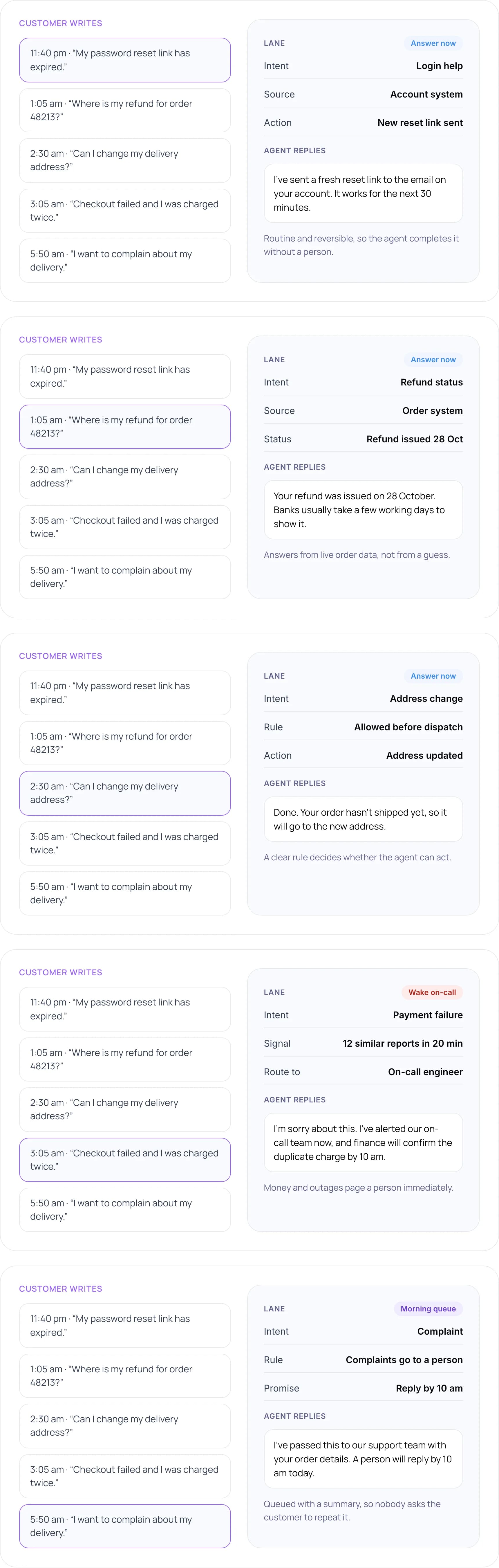
- 11:40 pm, “My password reset link has expired.” (Answer now; login help; account system.) Reply: “I’ve sent a fresh reset link to the email on your account. It works for the next 30 minutes.” Routine and reversible, so the agent completes it without a person.
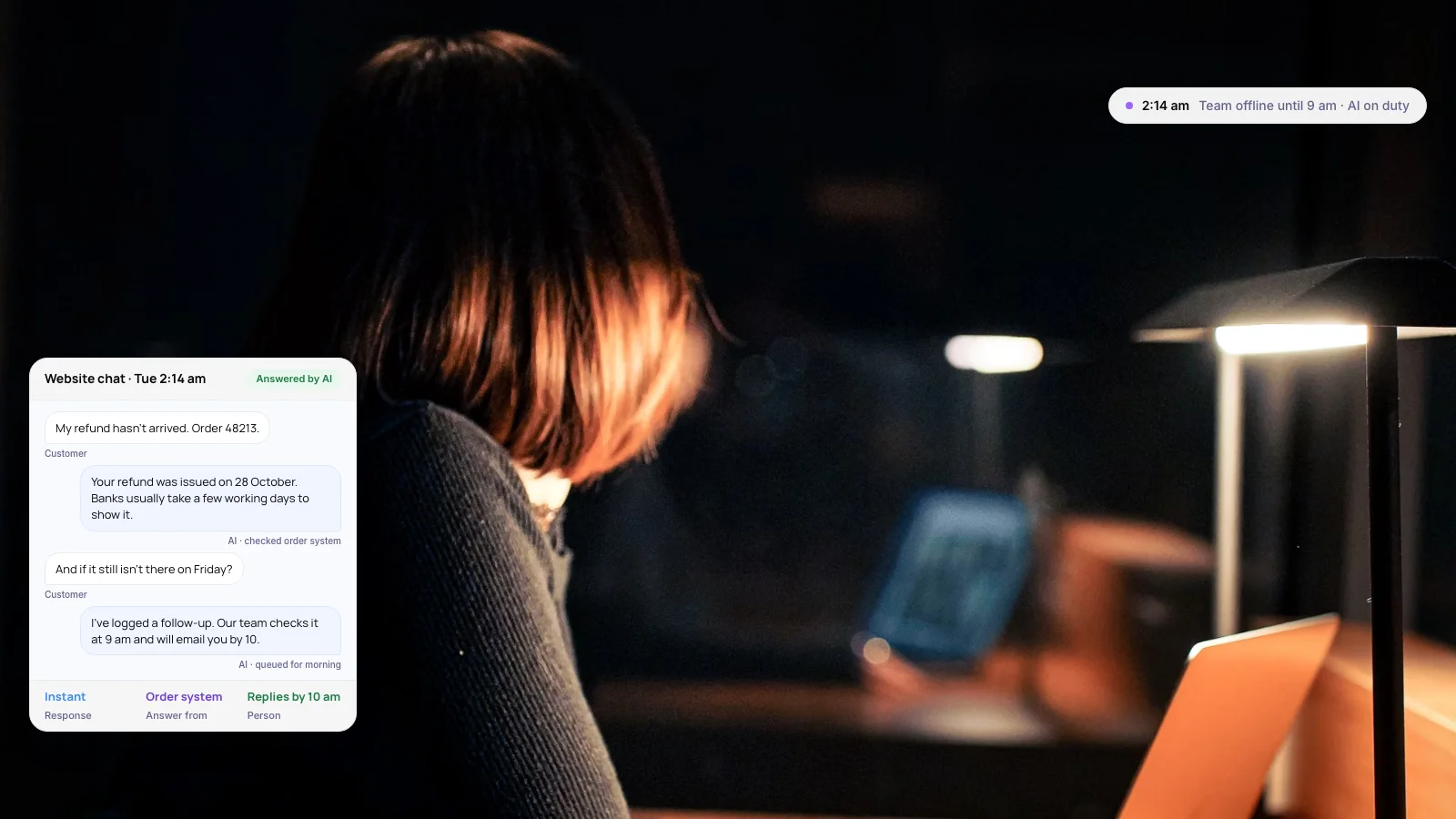
- 1:05 am, “Where is my refund for order 48213?” (Answer now; refund status; order system.) Reply: “Your refund was issued on 28 October. Banks usually take a few working days to show it.” Answers from live order data, not from a guess.
- 2:30 am, “Can I change my delivery address?” (Answer now; allowed before dispatch.) Reply: “Done. Your order hasn’t shipped yet, so it will go to the new address.” A clear rule decides whether the agent can act.
- 3:05 am, “Checkout failed and I was charged twice.” (Wake on-call; 12 similar reports in 20 minutes.) Reply: “I’m sorry about this. I’ve alerted our on-call team now, and finance will confirm the duplicate charge by 10 am.” Money and outages page a person immediately.
- 5:50 am, “I want to complain about my delivery.” (Morning queue; complaints go to a person.) Reply: “I’ve passed this to our support team with your order details. A person will reply by 10 am today.” Queued with a summary, so nobody asks the customer to repeat it.
Answers stay accurate when the agent retrieves them from your own documents and systems instead of general model knowledge. Our guide to agentic RAG for customer service automation explains how that retrieval works.
Tip: Set the agent to escalate on low confidence, not just on keywords. A message that doesn’t match any known intent belongs in the morning queue, not in a guessed answer.
6. What Should Never Wait Until Morning?
Every overnight message goes into one of three lanes. Write the rules down before go-live, because the lane decides who acts and how fast.
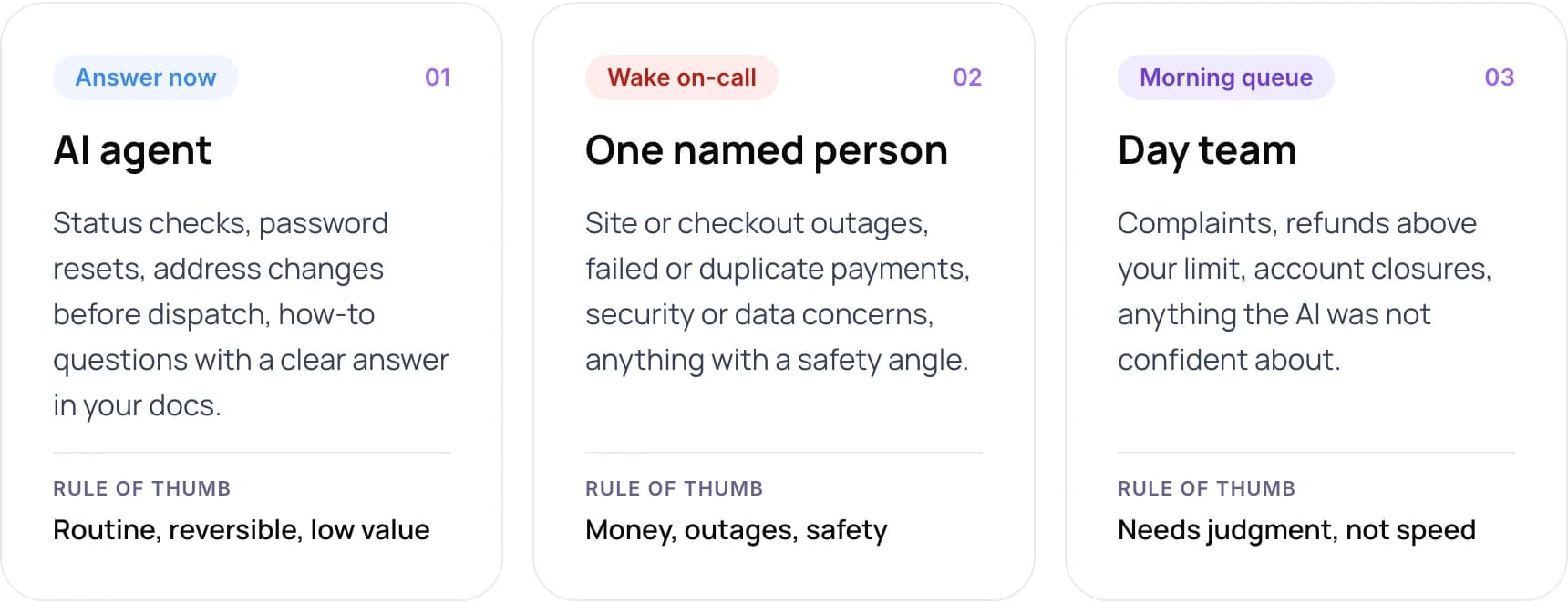
- Answer now (AI agent): status checks, password resets, address changes before dispatch, how-to questions with a clear answer in your docs. Rule of thumb: routine, reversible, low value.
- Wake on-call (one named person): site or checkout outages, failed or duplicate payments, security or data concerns, anything with a safety angle. Rule of thumb: money, outages, safety.
- Morning queue (day team): complaints, refunds above your limit, account closures, anything the AI was not confident about. Rule of thumb: needs judgment, not speed.
Warning: You are responsible for what your bot says at 3 am. In Moffatt v. Air Canada (2024), a British Columbia tribunal held the airline liable for its chatbot’s wrong fare-policy answer. Policy questions without a clear source answer belong in the morning queue.
7. What Results Have Companies Reported?
Klarna’s in-app assistant is the best-documented example at scale. Its figures cover all hours, not just nights, but they show what an AI agent handles when it never closes.
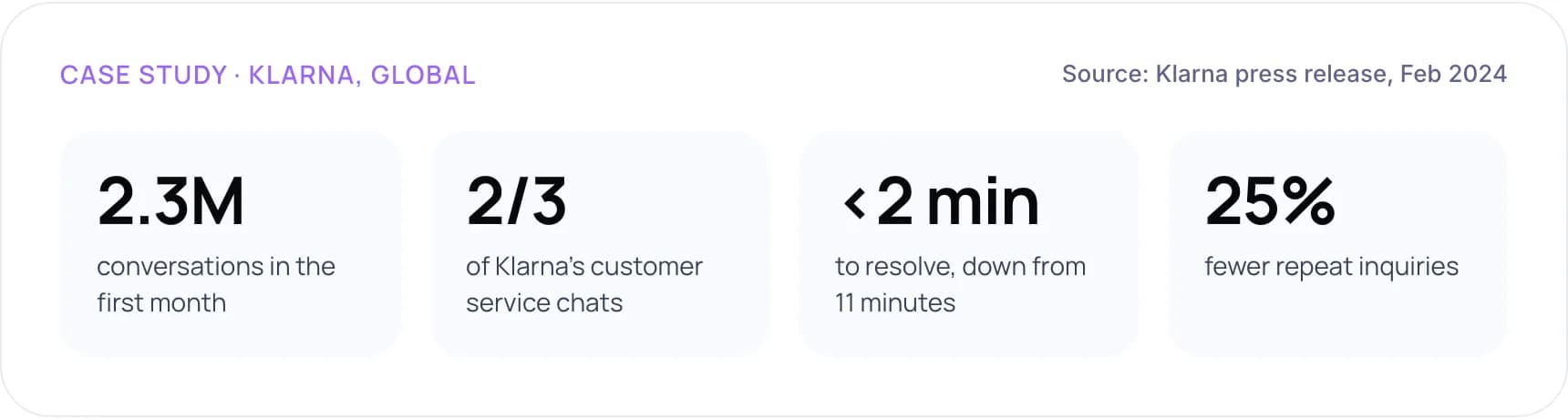
- 2.3M conversations in the first month.
- 2/3 of Klarna’s customer service chats.
- Under 2 minutes to resolve, down from 11 minutes.
- 25% fewer repeat inquiries.
These are company-reported figures from Klarna’s February 2024 press release. By 2025, Klarna was recruiting human agents again, and its CEO said customers should always know a person is there if they want one. The lesson for after-hours design: automate the routine, keep a person reachable.
We built Paymate’s support system across voice, email and chat in English, Spanish and French. It validates each answer before sending and escalates after three low-confidence attempts. For high-confidence email queries, first response time fell from hours to under one minute. The AI Voice Assistant platform we stabilized and enhanced answers inbound calls beyond business hours, books appointments into connected calendars and updates the CRM.
Want overnight coverage without adding a shift? Book a free AI consultation.
8. How to Set Up After-Hours Coverage
- Measure your off-hours volume. Export 30 days of tickets and calls, bucket them by hour in your customers’ time zones and tag each by reason.
- Define the three lanes. Write down which reasons the AI may answer, which wake someone and which wait for morning.
- Connect the AI to real data. Give it read access to orders, bookings and accounts, and retrieval over your help docs.
- Write the overnight promise. State when a person replies, in the customer’s time zone, for example “by 10 am IST”.
- Set up the on-call path. Alert rules for outages, payments and security, with one named person per night on a rota.
- Build the morning handoff. Each queued item arrives with a summary, what the AI already said and the next step.
- Review daily for two weeks. Read every escalation and every “talk to a human” request, then fix the content behind them.
Tip: In India and the UAE, many customers message on WhatsApp first. Run the same three lanes there, so a 1 am WhatsApp message gets the same treatment as a 1 am web chat.
9. Common Mistakes
- Calling a bot “24/7 support”. Say what is automated overnight and when a person picks up. Customers forgive limits; they don’t forgive surprises.
- Queuing without a time. “We’ll get back to you” at 2 am reads as “never”. Give a specific reply time.
- Hiding the human route. Even at night, show how to reach a person, even if that person replies at 9 am.
- No owner for the morning queue. If nobody owns the first hour, the day team spends it sorting instead of replying.
New to the topic? Start with what customer support automation is and how it works.
10. Frequently Asked Questions
What is automated customer support?
Automated customer support uses software to answer or resolve customer requests without an agent writing each reply. After hours, that usually means an AI agent answering routine questions from your systems and documents, alerting an on-call person for urgent issues, and queuing the rest for your team with a clear reply time.
Can an AI answering service handle after-hours calls?
Yes, for routine calls. A voice agent can answer, look up an order or booking, schedule an appointment and transfer or log anything it can’t handle. The AI Voice Assistant platform we worked on answers inbound calls beyond business hours and books into connected calendars. Urgent calls should still reach a person.
Is follow-the-sun support better than AI after hours?
It gives full human coverage, but only if you can staff two or more hubs and keep handovers clean. For many mid-size teams, AI plus an on-call rota covers routine volume at lower cost. Teams in India serving US customers often get US night coverage naturally during the Indian working day.
Can women work night shifts in support teams in India?
It depends on the state law. Maharashtra’s Shops and Establishments Act, 2017 allows women to work between 9:30 pm and 7 am with consent, safe transport and at least three women on the shift. Other states have their own rules, so check before you schedule anyone.
Do customers mind getting an AI answer at night?
Many don’t, as long as it helps. Gartner’s 2026 survey found 50% of customers say service is easier when companies use GenAI, but 87% said a route to a human is essential. Answer routine requests instantly, and make the human option visible.
11. Conclusion
Automated customer support covers the night well when it answers from real data, wakes a person only for real emergencies and hands the rest to your team with a clear promise. Start by exporting 30 days of contacts and counting what arrives after hours. That split tells you which lane to build first.
Tip: Once you know your overnight volume, our free AI ROI Calculator estimates the hours saved and payback.
To build it with us, see our AI customer support automation services. Or book a free AI consultation.
Author