EU AI Act Compliance Checklist for Customer Support Teams: Which Rules Apply to Your Chatbot?
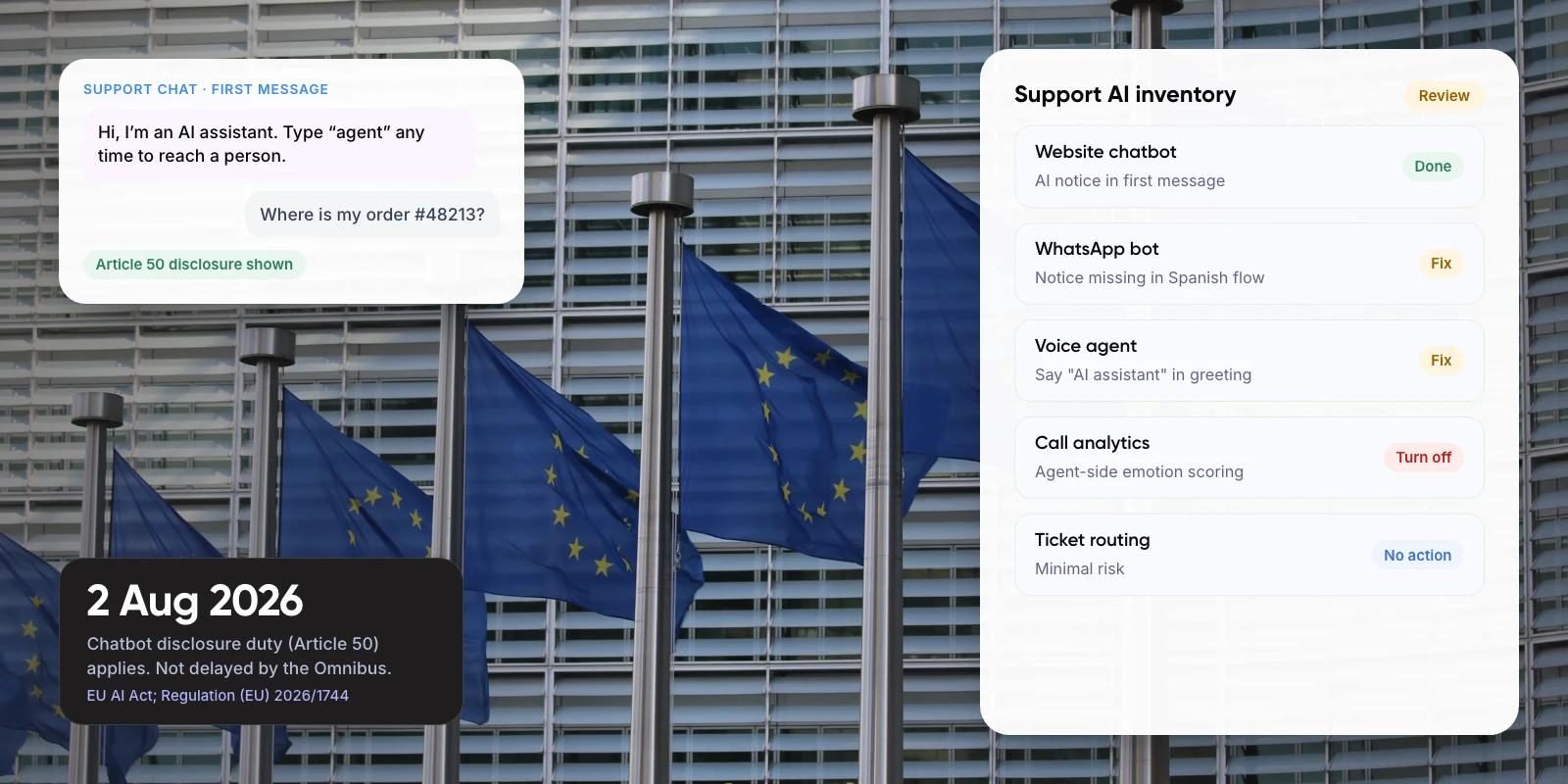
For most customer support chatbots, the EU AI Act asks for one thing: tell people they are talking to AI, clearly and from the first message. That rule, in Article 50, has applied since 2 August 2026. The 2026 Digital Omnibus delayed other parts of the Act but did not delay this one.
This EU AI Act compliance checklist shows which rules reach a support team, when a bot moves into a higher risk tier, and the ten checks to run on your chatbot and voice agents.
1. The Short Answer
The EU AI Act sorts AI systems by risk. A chatbot that answers order, account and product questions usually sits in the “limited risk” tier. Its main duty is transparency: people must know they are dealing with AI. Your team also needs basic AI training, and some uses are banned outright, such as reading your agents’ emotions from their voice.
A support bot only becomes “high-risk” if it does something listed in Annex III of the Act, for example deciding who gets credit or pricing life and health insurance. Those duties now start on 2 December 2027.
Key takeaways
- Most customer support chatbots fall under the Act’s transparency rules: tell people they are talking to AI, from the first message.
- That duty (Article 50) has applied since 2 August 2026. The Digital Omnibus delayed most high-risk rules to December 2027, but not this one.
- It reaches companies outside the EU when their bot serves customers in the EU.
- Using AI to read your agents’ emotions from voice or video has been banned since February 2025.
- A bot that decides on credit or insurance pricing can become high-risk. Keep those decisions with a person.
2. Which EU AI Act Rules Apply to a Customer Service Chatbot?
The Act has four risk tiers. The table maps each one to tools a support team actually uses, with the date it applies.
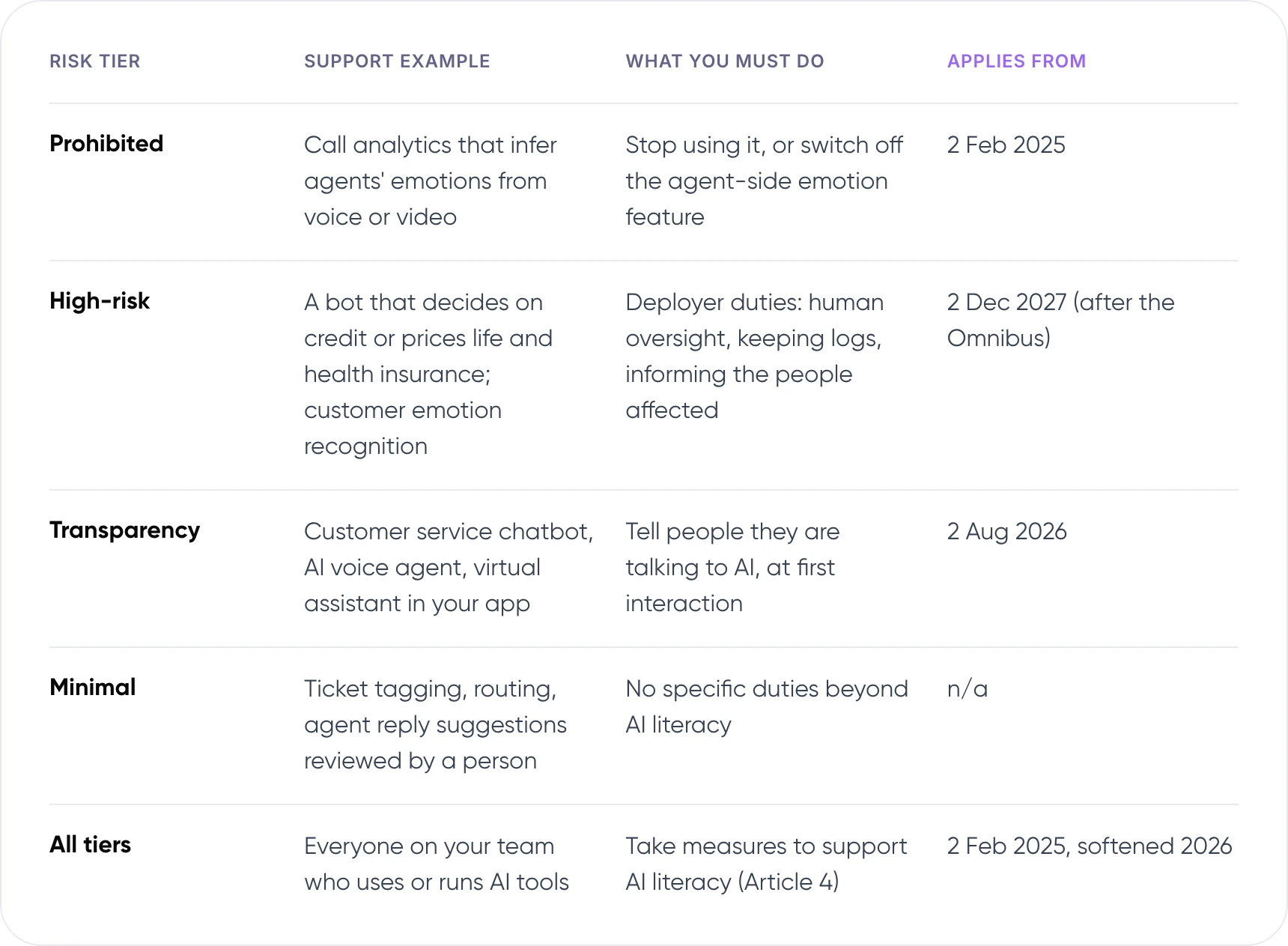
- Prohibited — Support example: Call analytics that infer agents’ emotions from voice or video. What you must do: Stop using it, or switch off the agent-side emotion feature. Applies from: 2 Feb 2025.
- High-risk — Support example: A bot that decides on credit or prices life and health insurance; customer emotion recognition. What you must do: Deployer duties: human oversight, keeping logs, informing the people affected. Applies from: 2 Dec 2027 (after the Omnibus).
- Transparency — Support example: Customer service chatbot, AI voice agent, virtual assistant in your app. What you must do: Tell people they are talking to AI, at first interaction. Applies from: 2 Aug 2026.
- Minimal — Support example: Ticket tagging, routing, agent reply suggestions reviewed by a person. What you must do: No specific duties beyond AI literacy. Applies from: n/a.
- All tiers — Support example: Everyone on your team who uses or runs AI tools. What you must do: Take measures to support AI literacy (Article 4). Applies from: 2 Feb 2025, softened 2026.
Sources: EU AI Act, Regulation (EU) 2024/1689, Articles 4, 5, 50 and Annex III; Commission guidelines on prohibited AI practices (2025); Digital Omnibus on AI, Regulation (EU) 2026/1744.
Note: The Digital Omnibus (Regulation (EU) 2026/1744) has been in force since 27 July 2026. It moved the Annex III high-risk duties to 2 December 2027. It left the bans, the Article 50 transparency rules and the general-purpose model rules on their original dates. The only Article 50 change is a transition to 2 December 2026 for machine-readable marking of AI-generated content, which most support bots do not need. It also softened Article 4: companies must now take measures to support AI literacy, rather than ensure a sufficient level of it.
3. Does the EU AI Act Apply If You Are Outside the EU?
Often, yes. Article 2 covers providers that place AI systems on the EU market wherever they are based. It also covers providers and deployers outside the EU when the AI system’s output is used in the EU.
For a support team in India, the US or the UAE, the practical test is simple. If customers in the EU can open your chat widget or call your voice agent, plan to meet Article 50 for those conversations. In our view, the easiest path is to show the disclosure to every user, because geo-targeting a legal notice adds work and can fail.
4. Are You the Provider or the Deployer?
The Act gives different duties to the company that builds an AI system (the provider) and the company that uses it (the deployer). If you switch on an AI agent inside Zendesk or Intercom, the vendor is usually the provider and you are the deployer. If you build your own bot on a model API, you are usually both.
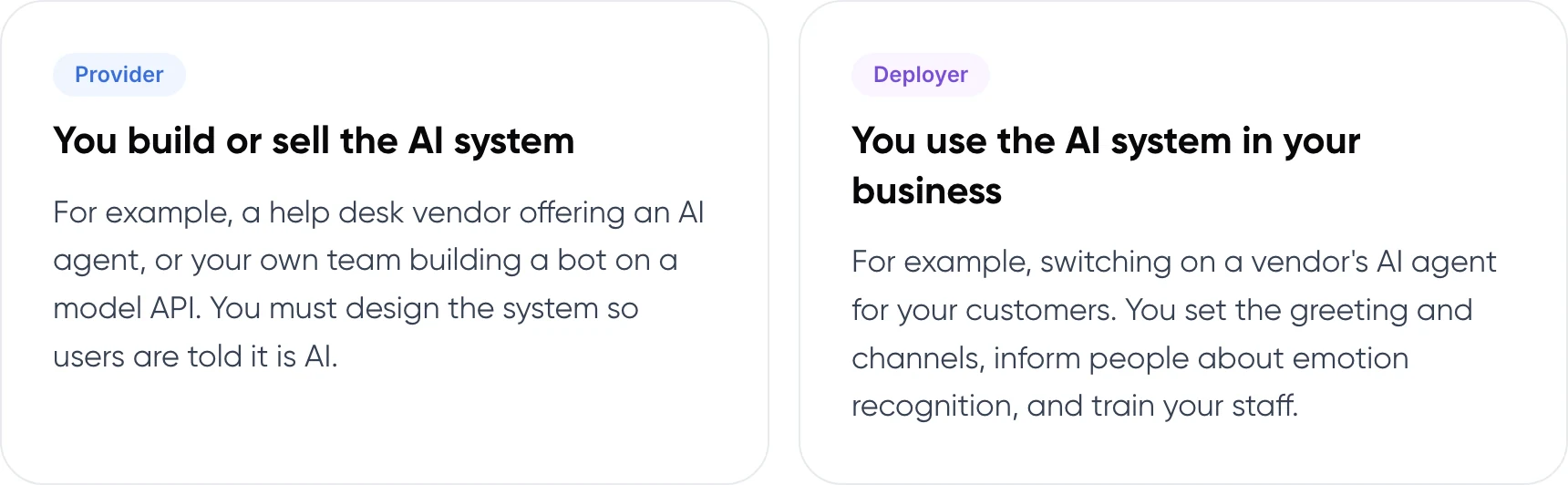
- Provider: You build or sell the AI system. For example, a help desk vendor offering an AI agent, or your own team building a bot on a model API. You must design the system so users are told it is AI.
- Deployer: You use the AI system in your business. For example, switching on a vendor’s AI agent for your customers. You set the greeting and channels, inform people about emotion recognition, and train your staff.
Article 50(1) puts the design duty on the provider: the system must be built so users are told it is AI. As a deployer, you still control the greeting, the bot’s name and the channels it runs in. So check that the notice actually appears in every flow you configure.
5. The EU AI Act Compliance Checklist for Support Teams
Run these ten checks on every chatbot, voice agent and analytics tool that touches customer conversations.
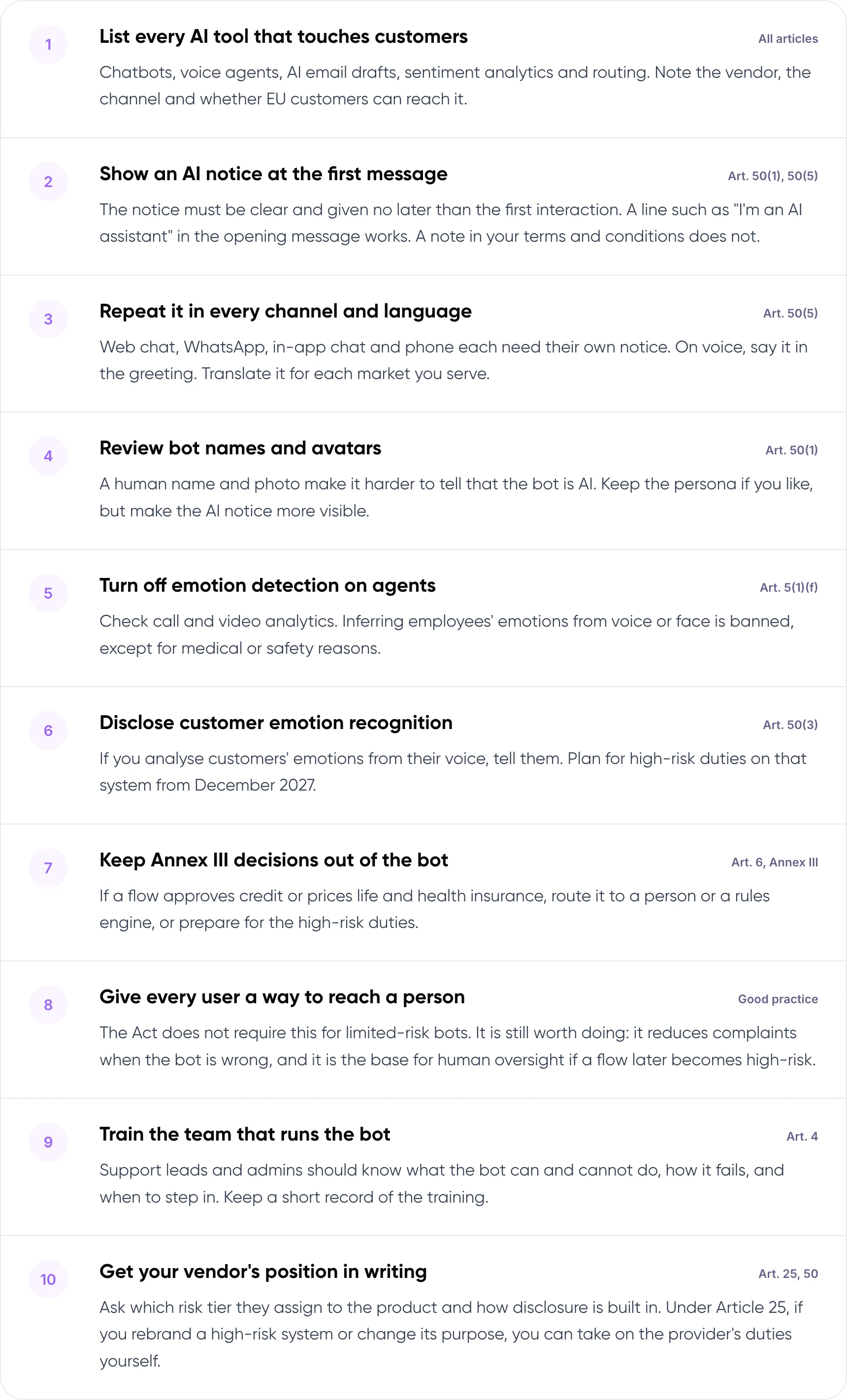
1. List every AI tool that touches customers
All articles: Chatbots, voice agents, AI email drafts, sentiment analytics and routing. Note the vendor, the channel and whether EU customers can reach it.
2. Show an AI notice at the first message
Art. 50(1), 50(5): The notice must be clear and given no later than the first interaction. A line such as “I’m an AI assistant” in the opening message works. A note in your terms and conditions does not.
3. Repeat it in every channel and language
Art. 50(5): Web chat, WhatsApp, in-app chat and phone each need their own notice. On voice, say it in the greeting. Translate it for each market you serve.
4. Review bot names and avatars
Art. 50(1): A human name and photo make it harder to tell that the bot is AI. Keep the persona if you like, but make the AI notice more visible.
5. Turn off emotion detection on agents
Art. 5(1)(f): Check call and video analytics. Inferring employees’ emotions from voice or face is banned, except for medical or safety reasons.
6. Disclose customer emotion recognition
Art. 50(3): If you analyse customers’ emotions from their voice, tell them. Plan for high-risk duties on that system from December 2027.
7. Keep Annex III decisions out of the bot
Art. 6, Annex III: If a flow approves credit or prices life and health insurance, route it to a person or a rules engine, or prepare for the high-risk duties.
8. Give every user a way to reach a person
Good practice: The Act does not require this for limited-risk bots. It is still worth doing: it reduces complaints when the bot is wrong, and it is the base for human oversight if a flow later becomes high-risk.
9. Train the team that runs the bot
Art. 4: Support leads and admins should know what the bot can and cannot do, how it fails, and when to step in. Keep a short record of the training.
10. Get your vendor’s position in writing
Art. 25, 50: Ask which risk tier they assign to the product and how disclosure is built in. Under Article 25, if you rebrand a high-risk system or change its purpose, you can take on the provider’s duties yourself.
Warning: Giving a bot a human name and photo, such as “Lisa from Support”, makes it less obvious that it is AI. Legal summaries of the Commission’s Article 50 guidelines (July 2026) say the “obvious” exception is read narrowly. If you use a persona, the AI notice matters more, not less.
Not sure which tier your support AI falls into? We can review your bots and flows with your team.
6. When Could a Support Bot Become High-Risk?
Answering questions is not on the high-risk list. Making certain decisions is. Annex III includes AI used to assess creditworthiness, to price or assess risk for life and health insurance, and emotion recognition systems.
So the line is crossed when the bot stops informing and starts deciding. A fintech support bot that explains a loan’s terms is limited risk. The same bot approving or refusing a credit limit increase is likely high-risk. A voice agent that scores customers’ emotions from their voice is an emotion recognition system.
If any of your flows look like this, the deployer duties in Article 26 will apply from 2 December 2027. These include human oversight, keeping logs and informing the people affected. In our view, the cheaper option for most teams is to keep those decisions out of the bot and hand them to a person or an existing rules engine.
7. Example: Emotion AI in the Call Centre
The European Commission used a call centre to show where the line sits on emotion recognition. Its guidelines on prohibited practices, published on 4 February 2025, give two contrasting examples.
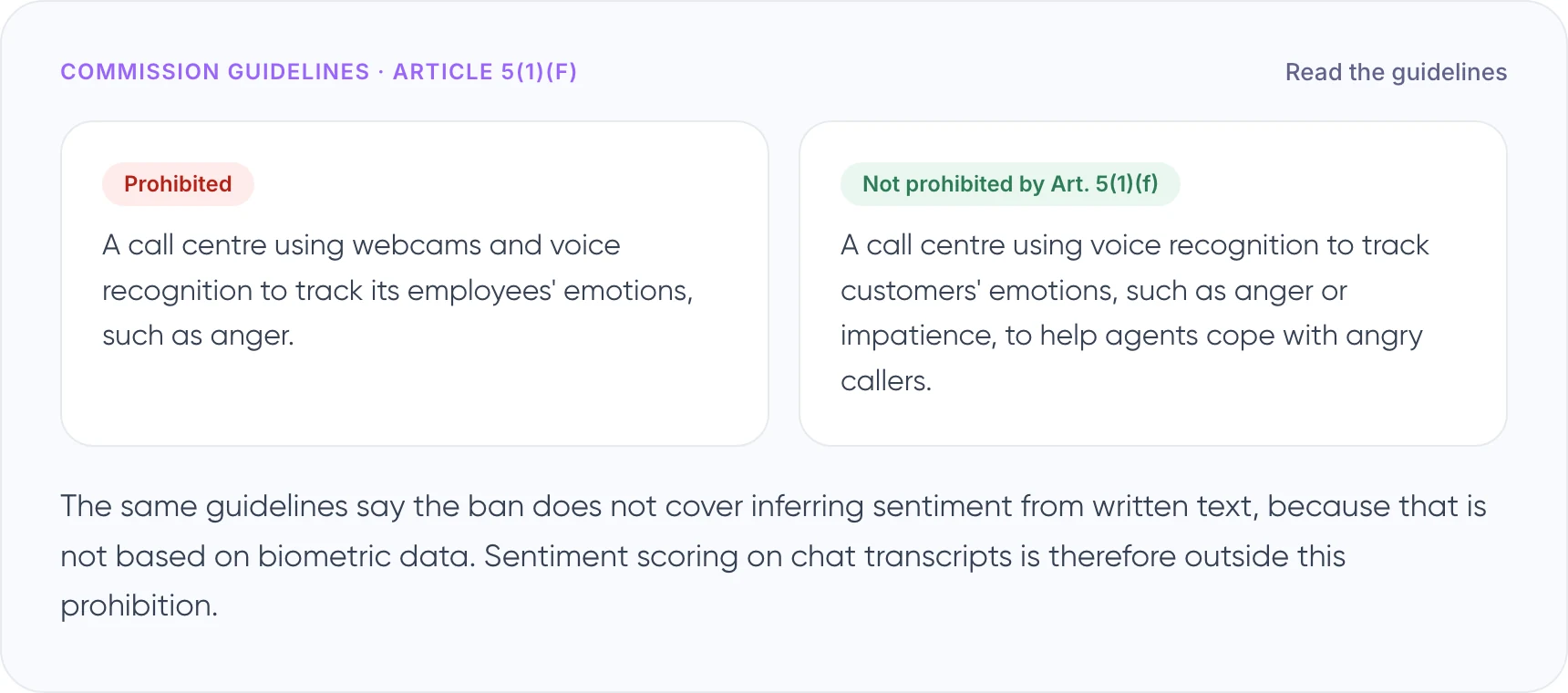
Commission guidelines · Article 5(1)(f)
- Prohibited: A call centre using webcams and voice recognition to track its employees’ emotions, such as anger.
- Not prohibited by Art. 5(1)(f): A call centre using voice recognition to track customers’ emotions, such as anger or impatience, to help agents cope with angry callers.
The same guidelines say the ban does not cover inferring sentiment from written text, because that is not based on biometric data. Sentiment scoring on chat transcripts is therefore outside this prohibition.
Many contact-centre analytics tools score both sides of a call. If yours does, ask the vendor to switch off emotion detection for the agent’s side. The ban on emotion recognition at work has applied since 2 February 2025, and it falls in the highest fine tier.
8. What Are the Fines?
Article 99 sets three ceilings. Large companies face whichever figure is higher. For SMEs and start-ups, Article 99(6) applies whichever is lower.
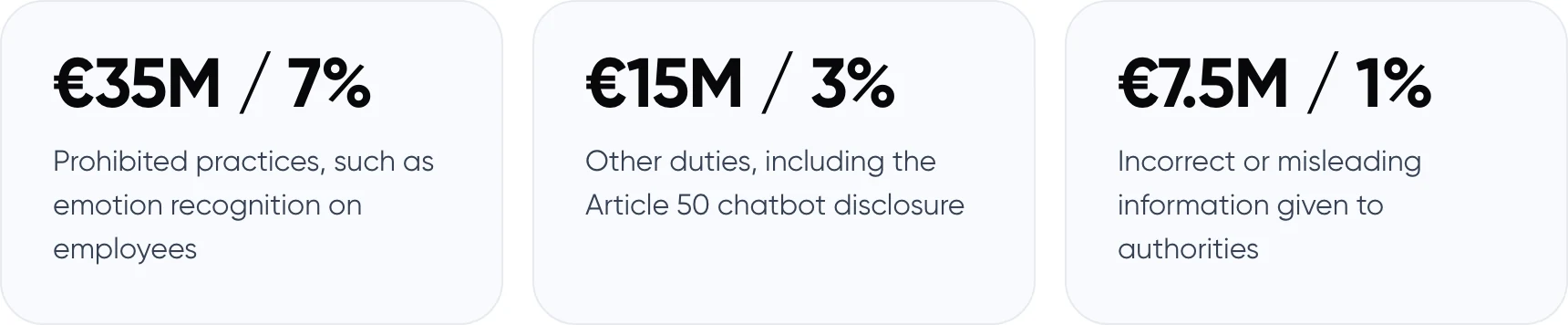
- €35M / 7%: Prohibited practices, such as emotion recognition on employees
- €15M / 3%: Other duties, including the Article 50 chatbot disclosure
- €7.5M / 1%: Incorrect or misleading information given to authorities
Source: EU AI Act, Article 99. Maximums; national authorities set the actual amount case by case.
For a support team, the realistic exposure is the middle tier, for a missing AI notice. The top tier matters if a call-analytics tool reads your agents’ emotions.
9. How to Get Your Support AI Compliant in 6 Steps
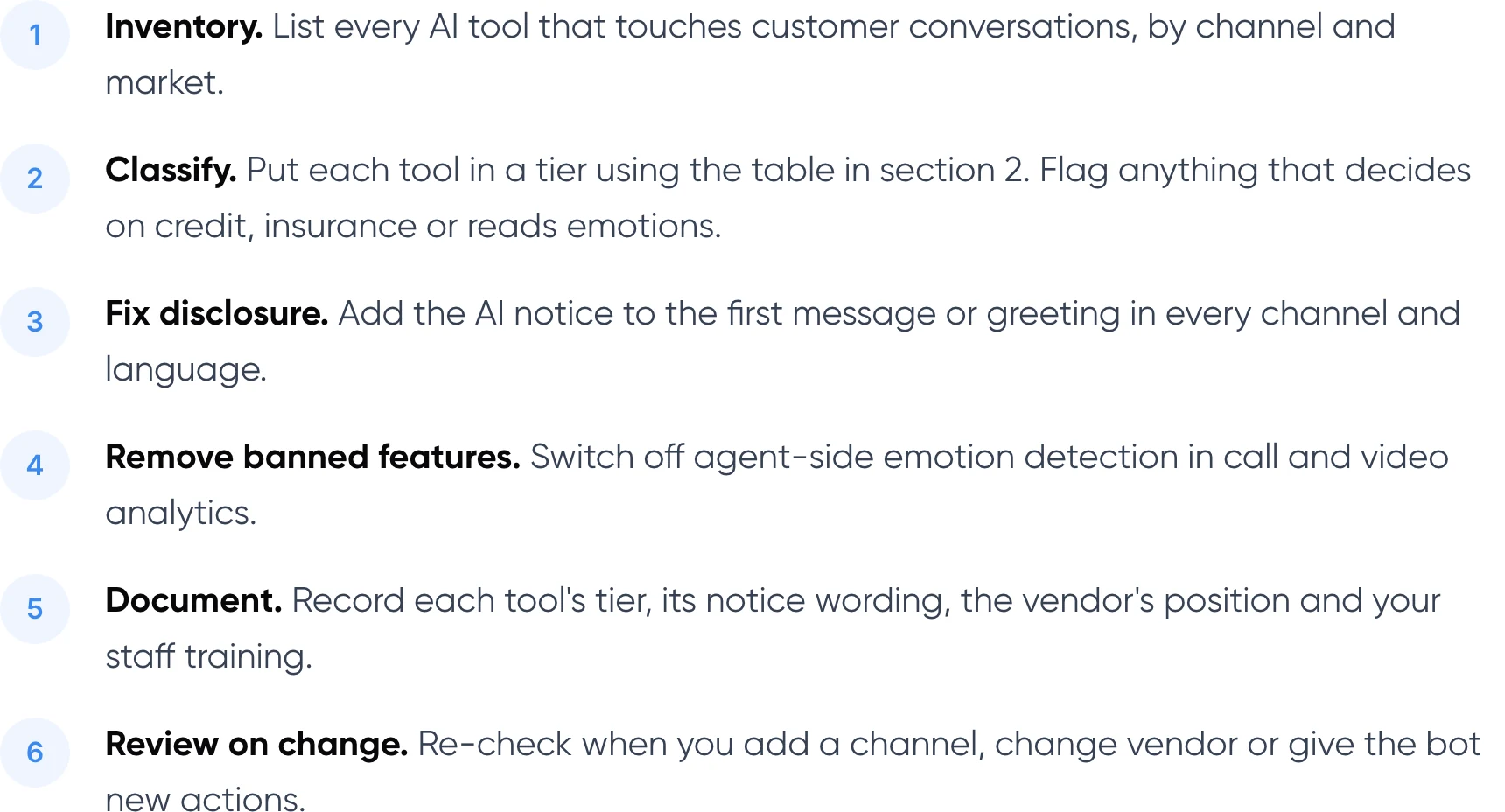
- Inventory. List every AI tool that touches customer conversations, by channel and market.
- Classify. Put each tool in a tier using the table in section 2. Flag anything that decides on credit, insurance or reads emotions.
- Fix disclosure. Add the AI notice to the first message or greeting in every channel and language.
- Remove banned features. Switch off agent-side emotion detection in call and video analytics.
- Document. Record each tool’s tier, its notice wording, the vendor’s position and your staff training.
- Review on change. Re-check when you add a channel, change vendor or give the bot new actions.
Tip: Put the AI notice inside the first bot message, not only in the widget header. Headers get cropped on mobile and are not read aloud on voice calls. On a phone line, say it in the opening greeting.
A clear route to a person also helps with the oversight duties above. See how to hand off from chatbot to human without losing context, or start with what customer support automation is and how it works.
10. Frequently Asked Questions
Does the EU AI Act apply to customer service chatbots?
Yes. Most customer service chatbots fall under Article 50, which requires telling people they are interacting with AI unless that is obvious. The duty has applied since 2 August 2026. Chatbots that only answer questions are usually not high-risk.
Was the chatbot disclosure rule delayed by the Digital Omnibus?
No. The Digital Omnibus (Regulation (EU) 2026/1744) moved the Annex III high-risk duties to 2 December 2027. The Article 50 transparency duties kept their 2 August 2026 date. Only machine-readable marking for some generative AI systems got a short transition to 2 December 2026.
Does the EU AI Act apply to companies in India, the US or the UAE?
It can. Article 2 covers providers placing AI systems on the EU market, and providers or deployers outside the EU when the system’s output is used in the EU. If EU customers use your support bot, plan to meet Article 50.
Is sentiment analysis in customer support banned?
Not for customers. The ban covers inferring employees’ emotions at work. Commission guidelines say tracking customers’ emotions in a call centre is not prohibited, but customers must be told. Text-based sentiment analysis is outside the ban because it does not use biometric data.
What is the fine for not disclosing a chatbot is AI?
Up to €15 million or 3% of worldwide annual turnover, whichever is higher, under Article 99(4). For SMEs and start-ups, the lower of the two applies. National authorities set the actual amount.
11. Conclusion
For most support teams, this EU AI Act compliance checklist comes down to three actions: show a clear AI notice in every channel, keep emotion AI away from your agents, and keep credit or insurance decisions out of the bot. Start this week by listing every AI tool that touches a customer conversation and opening each one as a new customer would. The 2 December 2027 date only matters if your bot makes the decisions listed in Annex III or you use emotion recognition on customers.
If you want a support bot that meets these rules from day one, our AI customer support automation service can build it, with the AI notice and a handoff to your team included.
Our service: AI Customer Support Automation
AI agents for your help desk, with clear AI disclosure and a clean handoff to your team.
Planning help: AI Consulting Services
An outside review of your support AI, its risk tier and your vendor setup.
See how we have built AI for clients in our AI Voice Assistant and Paymate case studies.
Author