Handoff Hell: Why Customers Repeat Themselves After the Bot Escalates, and How to Fix Context Transfer
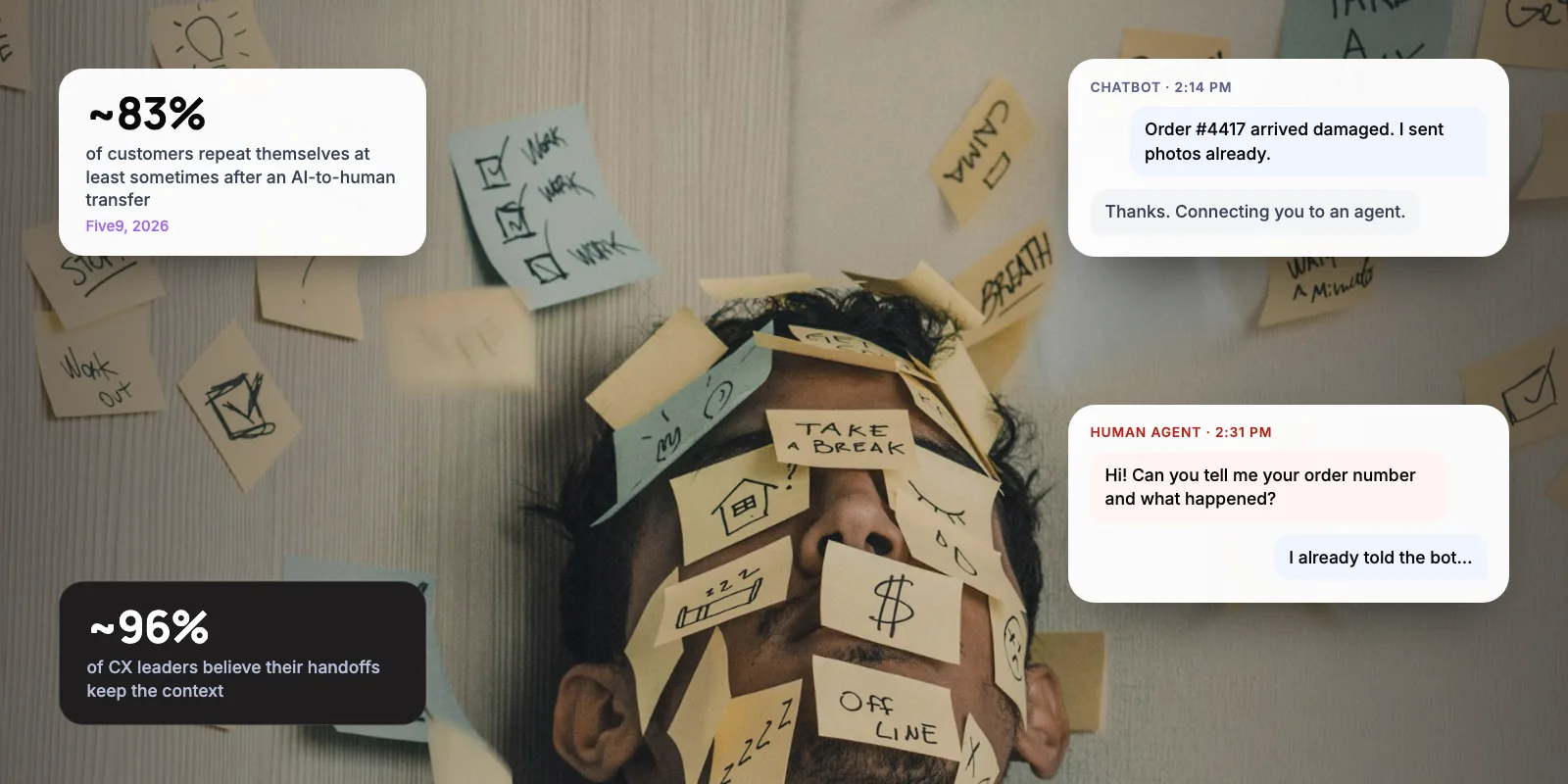
Customers repeat themselves after a bot escalates because what the bot learned often doesn’t reach the human agent. Five9’s 2026 report found ~83% of consumers have to repeat information at least sometimes after a transfer.
This guide explains what gets lost, what a good handoff should carry, and how to fix it in your customer support chatbot.
1. Why Do Customers Repeat Themselves After a Chatbot Handoff?
A handoff (or escalation) is the moment a chatbot passes a conversation to a person. The conversation may move across, but the details often don’t. The agent opens a ticket with nothing useful in it and starts from the first question.
Most teams don’t see it. Five9’s 2026 Business Leaders CX Report surveyed 3,000 consumers and 600 decision-makers. ~96% of the decision-makers said their handoffs preserve context. ~83% of consumers said they still repeat themselves, and ~35% said it happens often or always.
Customers have little patience for it. In a 2026 Parloa survey of 1,001 US consumers, ~60% said they will repeat themselves only once before abandoning an automated service. Another ~11% leave the first time.
Key takeaways
- ~83% of consumers repeat themselves at least sometimes after an AI-to-human transfer, while ~96% of CX leaders think context is preserved (Five9, 2026).
- ~60% of US consumers will repeat themselves only once before abandoning an automated service (Parloa, 2026).
- Give the agent a short structured note, not just a transcript: the issue, what the bot collected, why it escalated and the next step.
- Track the repeat-information rate on escalated tickets every week.
2. Where Does the Context Get Lost?
When asked about specific problems, the same Five9 decision-makers were less confident. ~37% admitted customers have to repeat information, ~37% said agents can’t see the earlier AI conversation, and ~35% reported technical glitches during the transfer.
- ~37% — of decision-makers admit customers repeat information (Five9, 2026)
- ~37% — say agents can’t see the earlier AI conversation (Five9, 2026)
- ~35% — report technical glitches during the transfer (Five9, 2026)
Common causes are easy to spot. The bot and the helpdesk may be separate systems with no shared record. The transcript may be attached, but nobody has time to read 40 messages while the customer waits. Or the customer moved from chat to phone, and the phone system can’t see the chat.
3. What Should a Handoff Pass to the Agent?
A full transcript is not enough on its own. The agent needs a short, structured note they can read in ten seconds. Intercom’s handoff guidance suggests the note cover what the customer asked, what the bot collected and found, why it escalated, and the recommended next step.
- Customer identity — Why the agent needs it: So the agent doesn’t ask for name, email or phone again. · Example: Priya S., verified by OTP
- Issue in one line — Why the agent needs it: The agent can start working within seconds. · Example: Order arrived damaged, wants replacement
- Key IDs — Why the agent needs it: Stops the most common repeated question. · Example: Order #4417
- What the bot checked — Why the agent needs it: Shows which lookups are already done. · Example: Delivered 6 Nov; within 30-day window
- Attachments — Why the agent needs it: The customer shouldn’t upload the same photo twice. · Example: 2 photos of the box
- Why it escalated — Why the agent needs it: Tells the agent what the bot couldn’t do. · Example: Replacement needs approval
- Suggested next step — Why the agent needs it: Cuts the agent’s thinking time. · Example: Approve replacement, send label
Tip: Tell the customer the context has been passed on. A line such as “Your conversation and photos are attached, so you won’t need to explain again” sets the expectation, and the agent has to meet it.
4. How Do Intercom and Zendesk Handle Context Transfer?
Intercom and Zendesk both pass context to agents when the bot and the agent desk are on the same platform. Gaps appear when you mix tools from different vendors.
- Intercom Fin + Intercom Helpdesk — What the agent receives: When Fin escalates, it can add an AI summary of the conversation as an internal note for the agent. · Watch out for: Through the Fin Agent API, escalation opens a new conversation, so check agents read the note first.
- Intercom Fin Voice — What the agent receives: When a call goes to an agent, the ringing screen shows an AI summary of the call. · Watch out for: Calls only humans handle don’t get this summary.
- Fin on another helpdesk (Fin for Platforms) — What the agent receives: Escalation goes to your own agent desk. · Watch out for: Intercom’s docs say the context is not surfaced. You must build the transfer yourself.
- Zendesk voice AI agents — What the agent receives: Escalated calls reach Agent Workspace with a full transcript, a short summary and the detected intent. · Watch out for: Feature was in early access when documented; confirm it’s on your plan.
Sources: Intercom Fin Agent API docs, Intercom Fin Voice docs, Zendesk voice AI agents docs (2026).
Running a bot on one platform and agents on another? We can map where your context drops.
5. How to Fix Context Transfer in 7 Steps
- Read 20 recent escalations. Note every question the agent asked that the bot had already answered.
- Define the handoff fields. Use the seven fields above, and store them as ticket fields, not free text.
- Make the bot fill them. Have it confirm IDs and details with the customer before it escalates.
- Put the summary where agents look first. Pin it at the top of the ticket or in the ringing screen for calls.
- Link channels to one customer record. Match on phone or email so a chat that turns into a call keeps its history.
- Tell the customer what was passed on. Then train agents to open with it: “I can see your order #4417 and the photos.”
- Check weekly. Sample escalated tickets and track how often a detail was asked twice.
If your bot needs to look up orders or accounts before it escalates, our guide to agentic RAG for customer service covers how to connect it to your data.
6. When Should the Bot Escalate?
Escalating late does as much damage as losing context. A customer who has looped with a bot arrives at the agent already annoyed. Gartner’s 2026 survey of 3,566 customers found only ~27% would try a chatbot again after a bad experience.
The same research found ~87% of customers say a route to a human is essential when a company uses generative AI. Intercom’s Fin hands over when it can’t resolve the question, when the customer asks for a person, or when it detects frustration. In our view, that is a sensible baseline, and a customer repeating themselves should count as frustration.
Warning: Don’t judge the bot only on containment rate (the share of chats it closes without a person). A bot that refuses to escalate scores well on containment while customers leave.
7. How Do You Measure Handoff Quality?
A transfer that connects is not the same as a handoff that works. Five9’s CTO told CRM Buyer (2026) that companies should measure handoff quality directly. We suggest starting with the repeat-information rate: the share of escalated tickets where the agent asked for something the bot already had.
You can measure it by reading a sample of escalated tickets each week. Alongside it, track three numbers: time from handoff to the agent’s first useful reply, customer effort score on escalated tickets, and repeat contacts within seven days.
To estimate what shorter escalated tickets are worth, try our free AI ROI Calculator.
8. Frequently Asked Questions
What is a chatbot to human handoff?
It is the point where a customer support chatbot passes a conversation to a human agent. A good handoff moves the conversation and the context together, so the agent knows who the customer is, what they need and what the bot already checked. A poor one makes the customer start again.
Why do agents ask customers to repeat information?
Usually because they can’t see what the bot collected, or it is buried in a long transcript. Five9’s 2026 report found ~37% of decision-makers say agents lack visibility into the earlier AI conversation. Separate bot and helpdesk systems, and switches between chat and phone, make it worse.
Is a full transcript enough?
It helps, but agents rarely read a long transcript while the customer waits. Add a short structured note with the issue, key IDs, what the bot checked, why it escalated and the next step. Intercom’s handoff guidance recommends a note like this.
How quickly should a bot escalate?
Escalate when the bot can’t resolve the issue, the customer asks for a person, or the customer seems frustrated. Intercom’s Fin uses these triggers. Parloa’s 2026 survey found ~60% of US consumers will repeat themselves only once before abandoning an automated service, so long loops cost you customers.
How do you measure handoff quality?
Check a sample of escalated tickets each week and count how often the agent asked for something the bot already had. That is your repeat-information rate. Also track time to the agent’s first useful reply, customer effort score on escalated tickets, and repeat contacts within seven days.
9. Conclusion
Customers repeat themselves because the agent starts without what the customer support chatbot already knows. The fix is a structured handoff note, one shared record across channels, and a weekly check of escalated tickets. Start by reading ten of last week’s escalations and counting how often the agent asked for something the bot already had.
To see how we kept context across channels for a payments company, read our Paymate omnichannel support case study, or explore our AI customer support automation services.
Author