Does Your AI Voice Agent Need Consent to Call Customers? TCPA and AI Calling Rules Explained
Yes. In the US, an AI voice agent that places outbound calls needs the person’s prior consent, and written consent if the call is marketing. The FCC confirmed in a February 2024 ruling that AI-generated voices count as an “artificial voice” under the Telephone Consumer Protection Act (TCPA).
An AI voice agent that only answers calls customers make to you is treated differently. This guide covers both cases, what the agent must say on each call, the new opt-out rules, and the rules in India and the UAE.
1. What Did the FCC Decide About AI Voices?
Key takeaways
- Since February 2024, the FCC treats AI-generated voices as an “artificial voice” under the TCPA.
- Outbound AI calls need prior express consent. Marketing calls need prior express written consent.
- An AI agent that only answers incoming calls is outside the TCPA’s consent rules, but recording laws still apply.
- New FCC opt-out rules take effect on 25 November 2026.
- Violations cost $500 per call, up to $1,500 if wilful, with no cap.
The TCPA, passed in 1991, limits calls that use an “artificial or prerecorded voice.” For years it was unclear whether a voice produced by AI in real time counted. The FCC settled that in its Declaratory Ruling FCC 24-17, adopted unanimously and released on 8 February 2024.
The ruling says current AI technologies that generate human voices fall under the TCPA’s artificial-voice rules. It applies whether the agent reads a fixed script or generates its replies with a language model. How natural the voice sounds makes no difference.
The ruling did not ban AI calls. It placed them in the same category as prerecorded robocalls. Those calls are legal when you have the right consent and follow the identification and opt-out rules covered below.
Note: In McLaughlin Chiropractic v. McKesson (June 2025), the US Supreme Court held that district courts are not bound by the FCC’s reading of the TCPA in private lawsuits. Courts must still give it appropriate respect. In our view, this does not make AI calls safer to place without consent: the statute itself already restricts calls using an artificial voice.
2. When Does an AI Voice Agent Need Consent?
The answer depends on two things: who starts the call, and what the call is for. The TCPA limits calls a business places. An AI phone agent that answers when a customer rings your support line is not placing a call, so TCPA consent rules do not apply to that conversation.
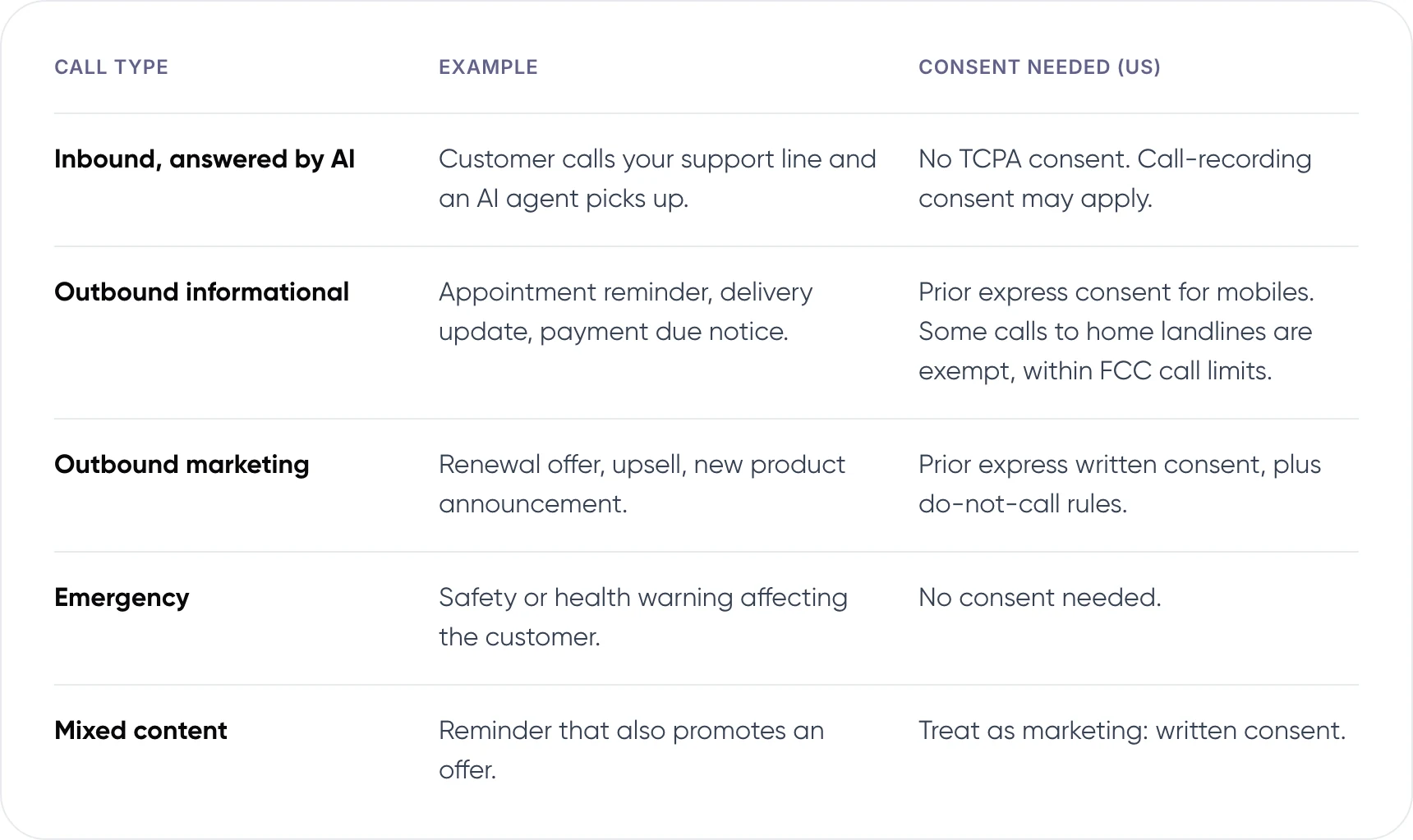
- Inbound, answered by AI — Example: Customer calls your support line and an AI agent picks up. Consent needed (US): No TCPA consent. Call-recording consent may apply.
- Outbound informational — Example: Appointment reminder, delivery update, payment due notice. Consent needed (US): Prior express consent for mobiles. Some calls to home landlines are exempt, within FCC call limits.
- Outbound marketing — Example: Renewal offer, upsell, new product announcement. Consent needed (US): Prior express written consent, plus do-not-call rules.
- Emergency — Example: Safety or health warning affecting the customer. Consent needed (US): No consent needed.
- Mixed content — Example: Reminder that also promotes an offer. Consent needed (US): Treat as marketing: written consent.
Sources: 47 U.S.C. § 227(b) and 47 CFR § 64.1200. Simplified; other exemptions exist.
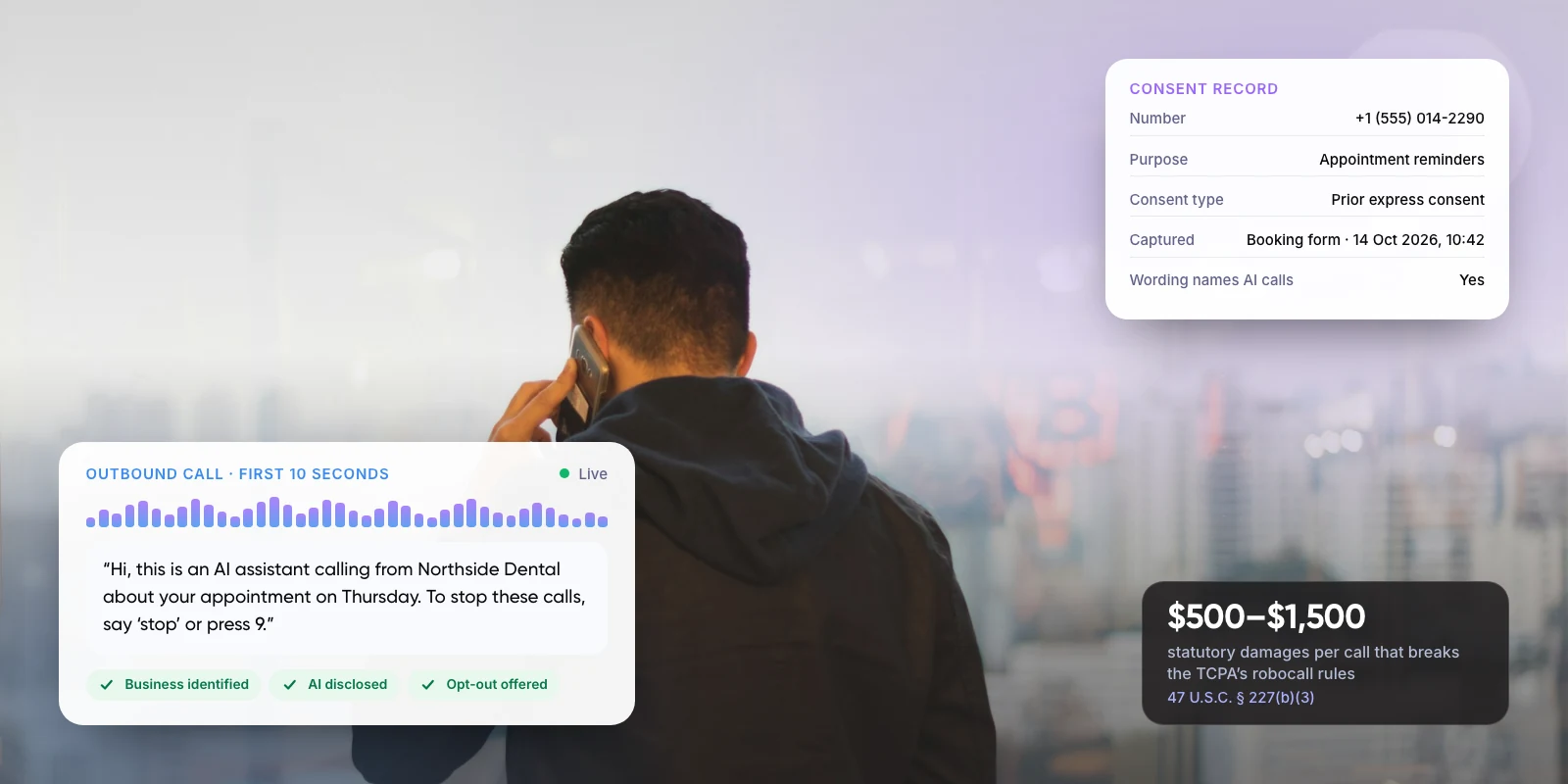
“Prior express consent” usually means the customer gave you their number for a related purpose, for example when booking an appointment. “Prior express written consent” is stricter. It needs a signed agreement, which can be electronic, that names the number and clearly authorises marketing calls using an artificial voice. The customer cannot be required to agree as a condition of buying.
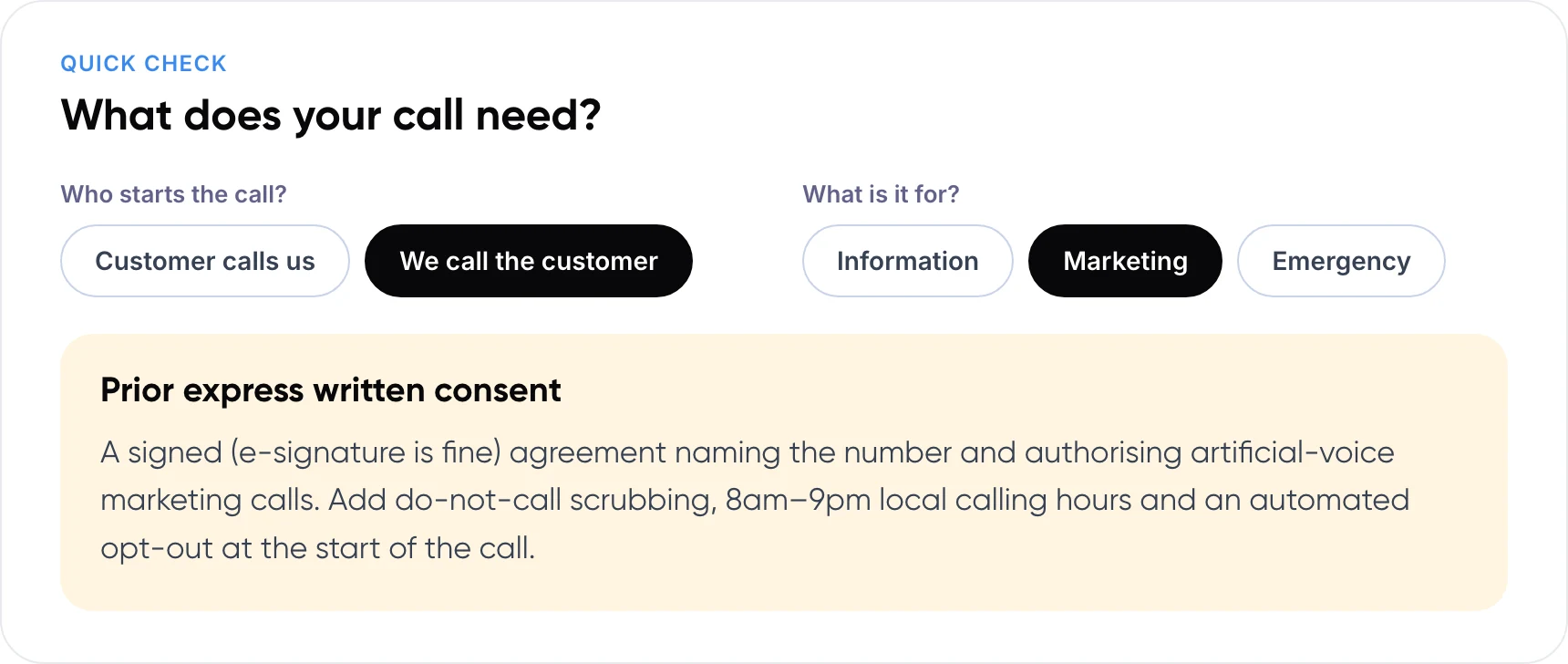
Quick check: What does your call need?
- Inbound: No TCPA consent needed to answer. The TCPA restricts calls you make, not calls you receive. You still need to follow call-recording laws: several US states, including California, require every party to agree before a call is recorded.
- Outbound, emergency: No consent needed for a genuine emergency. Calls made for an emergency purpose, such as a safety warning, are exempt. The exemption is narrow, so do not use it for routine reminders.
- Outbound, information: Prior express consent. Typically the customer gave you their number for a related purpose, such as an appointment or an order. Oral or written consent can qualify. The call must identify your business and include your phone number.
- Outbound, marketing: Prior express written consent. A signed (e-signature is fine) agreement naming the number and authorising artificial-voice marketing calls. Add do-not-call scrubbing, 8am–9pm local calling hours and an automated opt-out at the start of the call.
3. What Must the AI Voice Agent Say on the Call?
Consent is only half of compliance. The FCC’s rules for artificial-voice calls, in 47 CFR § 64.1200(b), also control what the agent says. Every outbound AI call should cover these points:
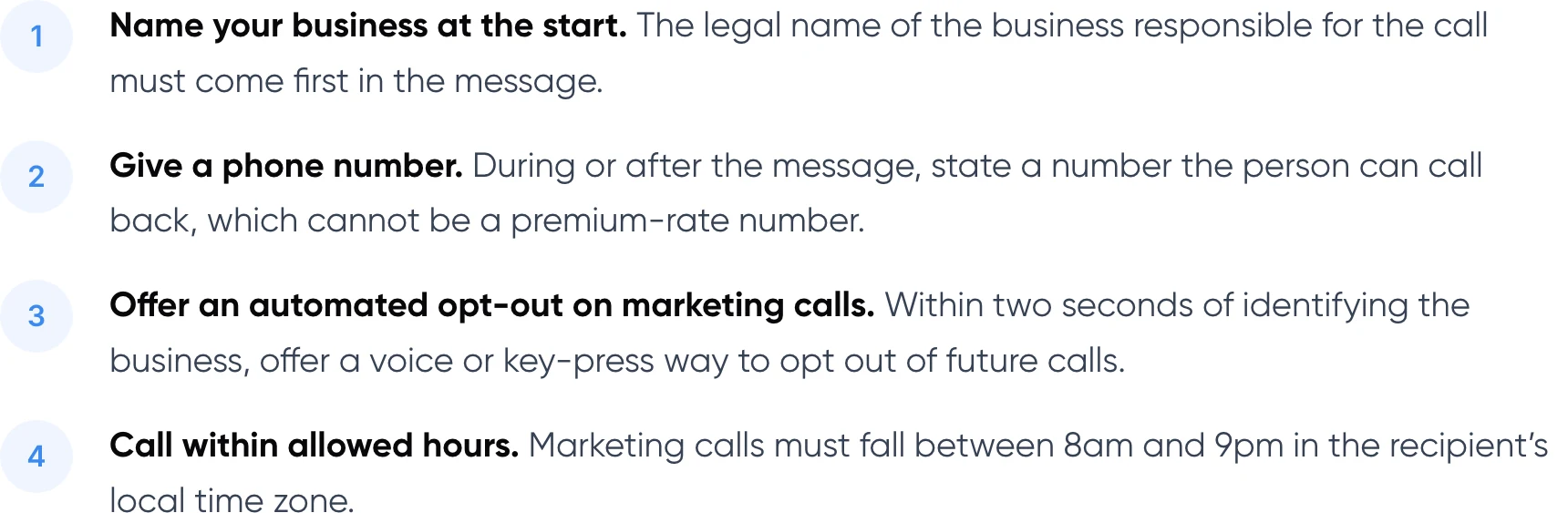
- Name your business at the start. The legal name of the business responsible for the call must come first in the message.
- Give a phone number. During or after the message, state a number the person can call back, which cannot be a premium-rate number.
- Offer an automated opt-out on marketing calls. Within two seconds of identifying the business, offer a voice or key-press way to opt out of future calls.
- Call within allowed hours. Marketing calls must fall between 8am and 9pm in the recipient’s local time zone.
There is no final federal rule yet that requires the agent to say it is an AI. The FCC proposed one in August 2024 (FCC 24-84). It would require AI-specific wording in consent forms and a disclosure at the start of each AI call. As of November 2026, the proposal has not been adopted. Some states already require AI disclosure in certain situations. Utah, for example, requires businesses to disclose AI use when a consumer asks.
Tip: Disclose the AI anyway, in the first sentence. In our view it costs a few seconds and removes the most common complaint about AI calls: feeling misled. It also means your scripts are ready if the FCC proposal becomes a rule.
4. How Do Opt-Outs Work From 25 November 2026?
Opt-out rules change this week. On 30 September 2026 the FCC adopted Report and Order FCC 26-67, which takes effect on 25 November 2026. It replaces the “revoke all” rule that had been delayed twice and was due to start in January 2027.
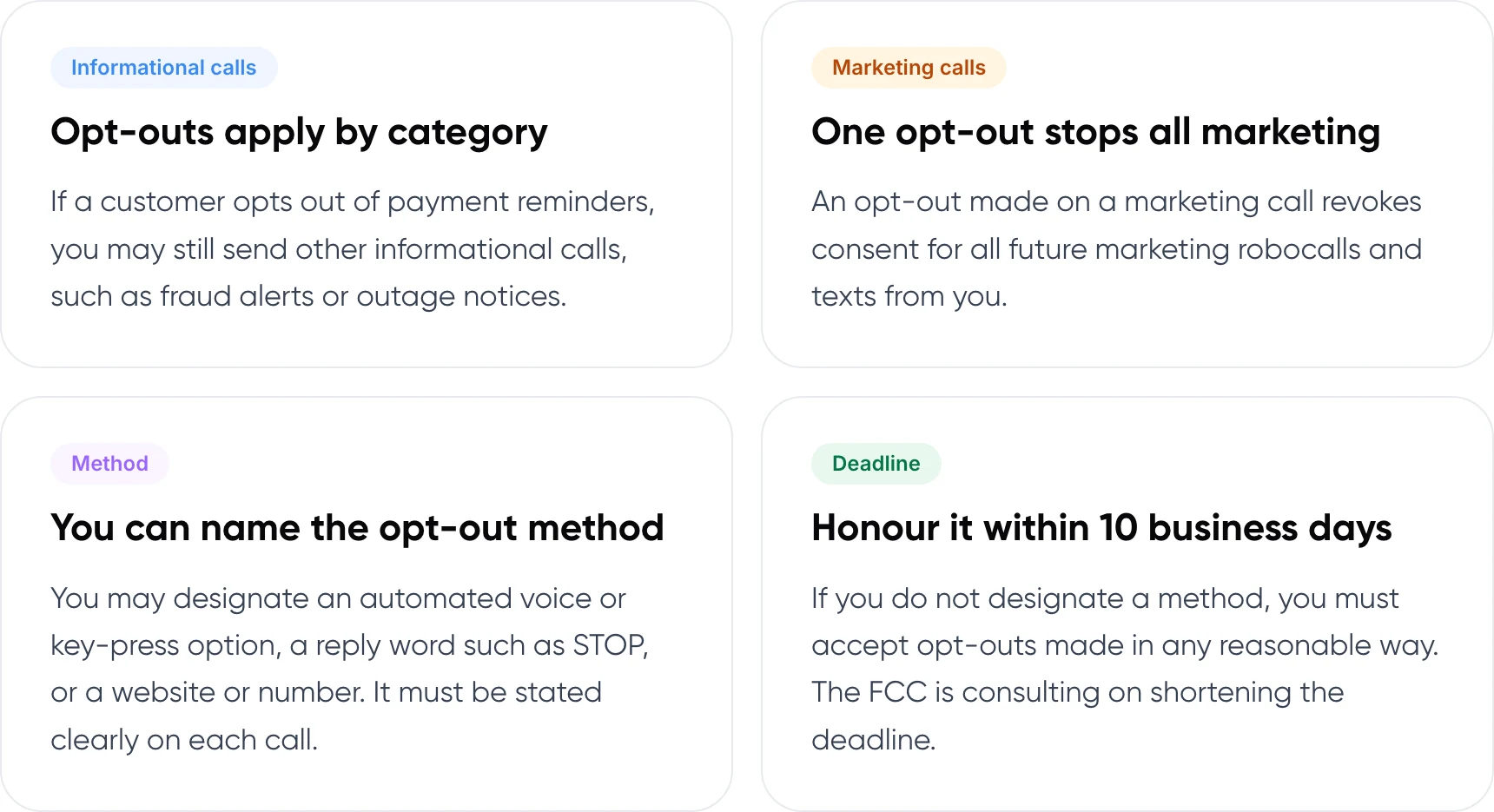
- Informational calls: Opt-outs apply by category. If a customer opts out of payment reminders, you may still send other informational calls, such as fraud alerts or outage notices.
- Marketing calls: One opt-out stops all marketing. An opt-out made on a marketing call revokes consent for all future marketing robocalls and texts from you.
- Method: You can name the opt-out method. You may designate an automated voice or key-press option, a reply word such as STOP, or a website or number. It must be stated clearly on each call.
- Deadline: Honour it within 10 business days. If you do not designate a method, you must accept opt-outs made in any reasonable way. The FCC is consulting on shortening the deadline.
For an AI voice agent, this is mostly an engineering task. The agent has to recognise a spoken “stop calling me” as reliably as a key press. It then has to write that opt-out to the right category in your systems, so no other channel calls the customer again.
Planning outbound AI calls? We can review your call flows and consent capture with you.
5. What Happens If You Get It Wrong?
The TCPA lets consumers sue directly. Under 47 U.S.C. § 227(b)(3), they can recover $500 per violating call, and a court can raise that to $1,500 if the violation was wilful or knowing. There is no cap, so a campaign of 10,000 calls without valid consent could mean up to $5 million at the base rate.

- $500 per call that breaks the TCPA robocall rules (47 U.S.C. § 227(b)(3))
- $1,500 per call if a court finds it wilful or knowing (47 U.S.C. § 227(b)(3))
- $6M FCC fine over AI-cloned Biden robocalls (FCC, September 2024)
The best-known AI calling case shows that regulators also look at the companies in the call path. In January 2024, voters in New Hampshire received robocalls with an AI-cloned voice of President Biden before the state primary. The FCC fined the consultant behind the calls $6 million in September 2024, under the Truth in Caller ID Act. Lingo Telecom, the carrier that transmitted them, agreed to pay $1 million and adopt a compliance plan.
Warning: Using a vendor’s AI calling platform does not move TCPA responsibility to the vendor. The business on whose behalf the calls are made can still be sued. Make sure your contract says who holds the consent records and who scrubs numbers against do-not-call lists.
State laws add another layer. Florida and Oklahoma, for example, have their own telemarketing statutes with private lawsuits, and some go further than the federal rules. If you call across states, check each state where your customers live.
6. What Are the AI Calling Rules in India and the UAE?
The TCPA only covers calls to US numbers. If your AI call center also reaches customers in India or the UAE, local telecom rules apply. Neither country has an AI-specific calling law yet, so an AI agent follows the same rules as any automated or marketing call.
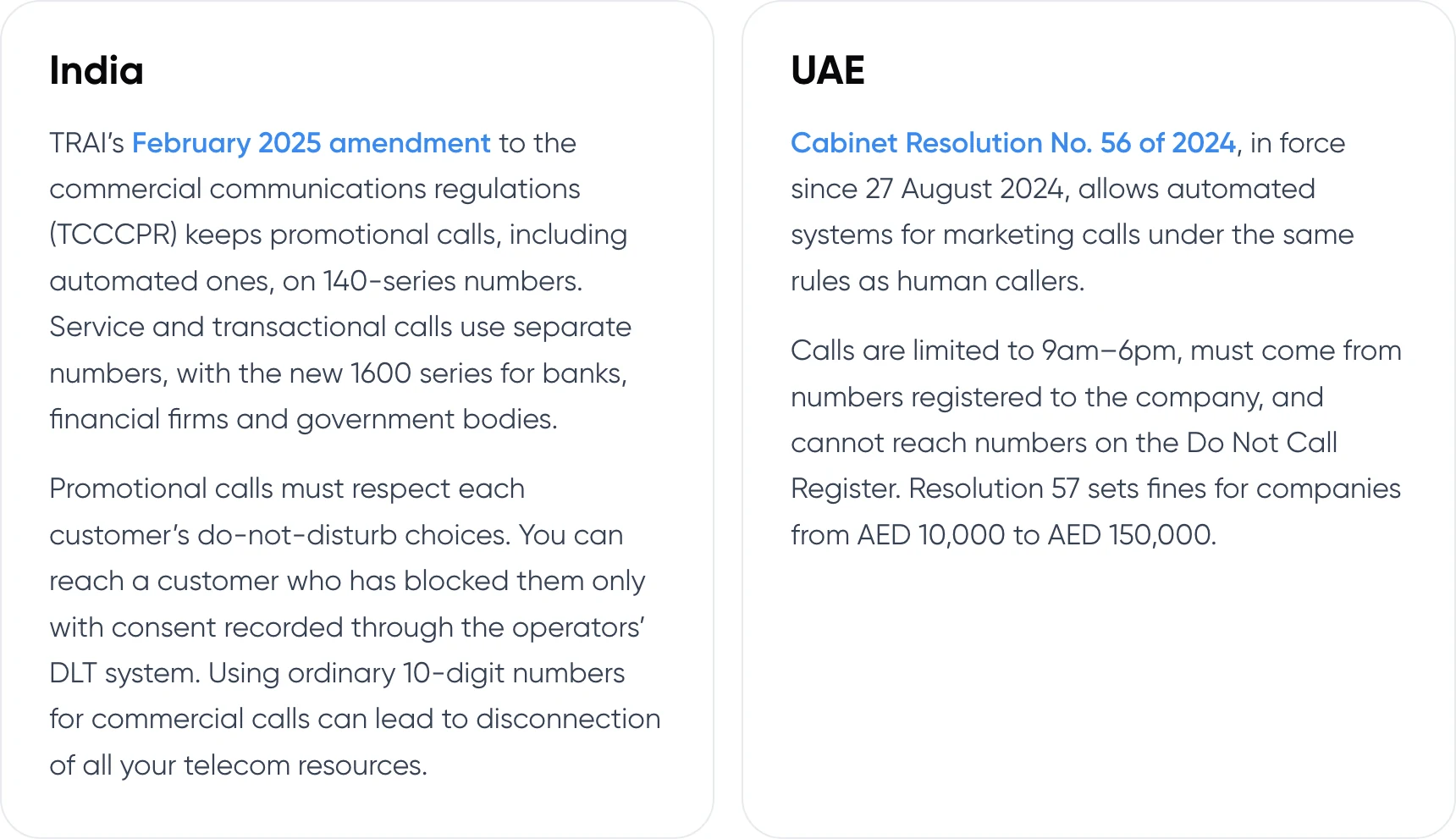
India
TRAI’s February 2025 amendment to the commercial communications regulations (TCCCPR) keeps promotional calls, including automated ones, on 140-series numbers. Service and transactional calls use separate numbers, with the new 1600 series for banks, financial firms and government bodies.
Promotional calls must respect each customer’s do-not-disturb choices. You can reach a customer who has blocked them only with consent recorded through the operators’ DLT system. Using ordinary 10-digit numbers for commercial calls can lead to disconnection of all your telecom resources.
UAE
Cabinet Resolution No. 56 of 2024, in force since 27 August 2024, allows automated systems for marketing calls under the same rules as human callers.
Calls are limited to 9am–6pm, must come from numbers registered to the company, and cannot reach numbers on the Do Not Call Register. Resolution 57 sets fines for companies from AED 10,000 to AED 150,000.
7. How Do You Make AI Voice Calls Compliant? 7 Steps
This is the order we suggest before launching any outbound AI call flow. Have your legal counsel review the result, because the details depend on your industry and where your customers are.
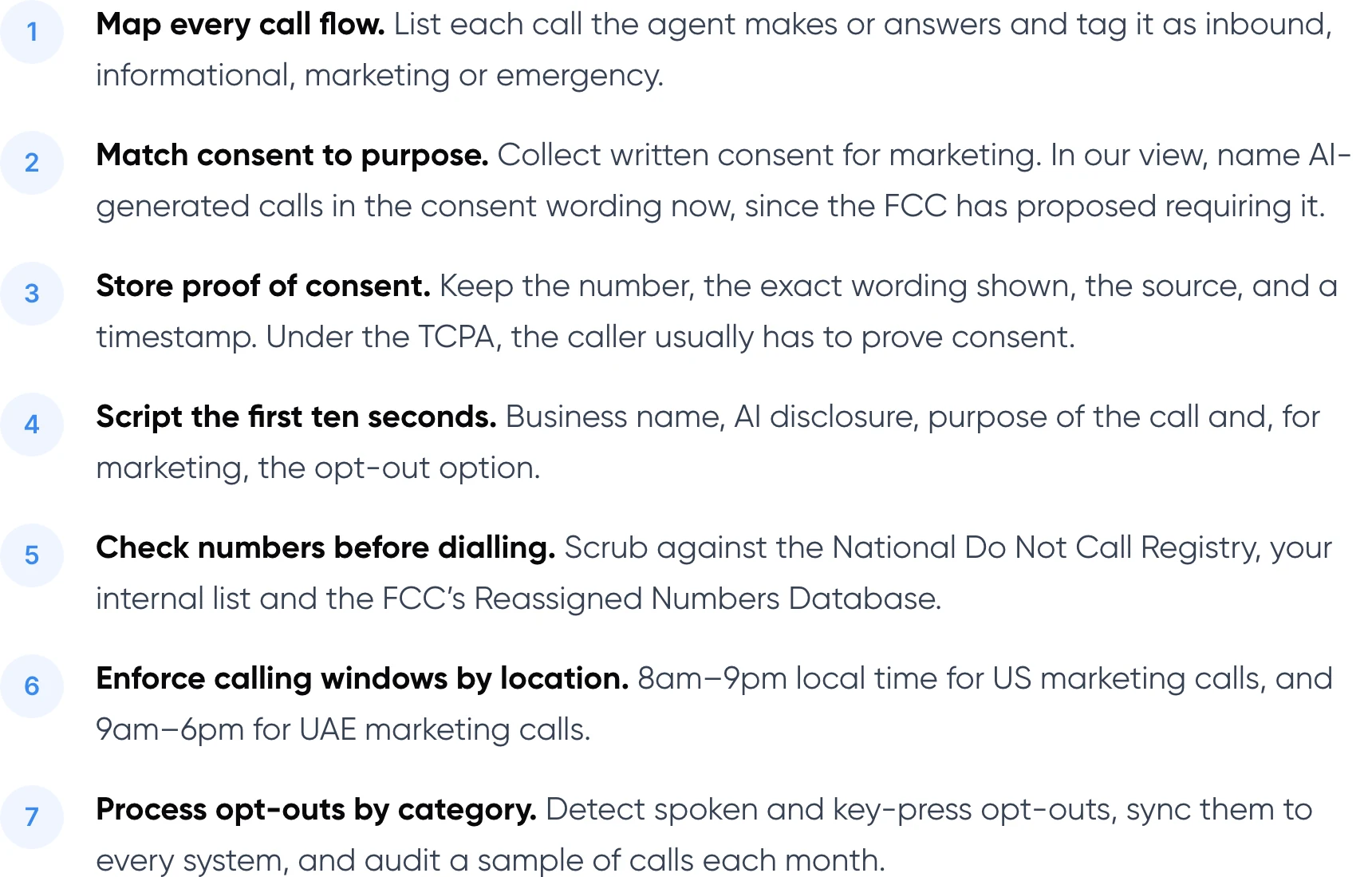
- Map every call flow. List each call the agent makes or answers and tag it as inbound, informational, marketing or emergency.
- Match consent to purpose. Collect written consent for marketing. In our view, name AI-generated calls in the consent wording now, since the FCC has proposed requiring it.
- Store proof of consent. Keep the number, the exact wording shown, the source, and a timestamp. Under the TCPA, the caller usually has to prove consent.
- Script the first ten seconds. Business name, AI disclosure, purpose of the call and, for marketing, the opt-out option.
- Check numbers before dialling. Scrub against the National Do Not Call Registry, your internal list and the FCC’s Reassigned Numbers Database.
- Enforce calling windows by location. 8am–9pm local time for US marketing calls, and 9am–6pm for UAE marketing calls.
- Process opt-outs by category. Detect spoken and key-press opt-outs, sync them to every system, and audit a sample of calls each month.
When the AI agent cannot help, the call should reach a person with the context intact. Our guide to chatbot handoff and context transfer covers how to design that step.
8. Frequently Asked Questions
Is it legal to use an AI voice agent to call customers in the US?
Yes, with the right consent. The FCC’s February 2024 ruling treats AI voices as artificial voices under the TCPA. Informational calls need prior express consent, marketing calls need prior express written consent, and every call must identify your business.
Does an AI receptionist answering inbound calls need TCPA consent?
No. The TCPA restricts calls a business makes, not calls it answers. If the AI agent records or transcribes calls, check state recording laws. Several states, including California, require every party to agree before a call is recorded.
Does an AI voice agent have to say it is an AI?
Not under current federal rules. The FCC proposed a start-of-call AI disclosure in August 2024, but it had not been adopted by November 2026. Some states have their own disclosure duties. We recommend disclosing anyway, in the first sentence of the call.
What consent do I need for AI sales calls?
Prior express written consent. That is a signed agreement, which can be electronic, naming the phone number and clearly authorising marketing calls using an artificial voice. Buying cannot depend on agreeing. You must also follow do-not-call rules and calling hours.
What are the penalties for AI calls without consent?
Consumers can sue for $500 per call, and courts can raise it to $1,500 per call for wilful or knowing violations, with no cap. The FCC and state attorneys general can also act. In 2024 the FCC fined the consultant behind AI-cloned Biden robocalls $6 million.
9. Conclusion
An AI voice agent needs consent for every outbound call in the US, and written consent for marketing. Calls customers make to you are outside the TCPA’s consent rules. Before you launch, list every call flow your agent will run, mark which consent each one needs, and check your opt-out handling against the rules that start on 25 November 2026.
Our service
Want an AI voice agent that follows these rules from day one? Our AI customer support automation service builds voice and chat support with consent checks, opt-out handling and handoff to your team.
This article is general information, not legal advice. Rules change; confirm your setup with qualified counsel.
Author