Conversational AI for Travel Companies: 10 Customer Service Use Cases (2026)
Where AI agents already answer travellers well, where they need a person behind them, and what Air India, Expedia, Trip.com and KLM have published about their results.
Company-reported results
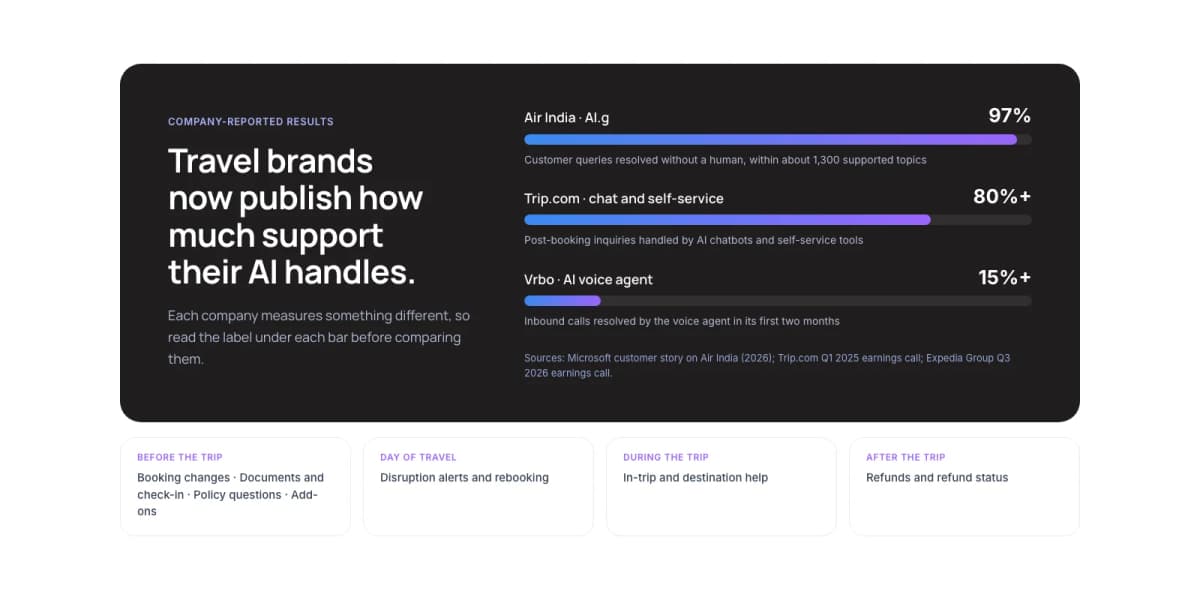
Travel brands now publish how much support their AI handles.
Each company measures something different, so read the label under each bar before comparing them.
- Air India · AI.g: 97% Customer queries resolved without a human, within about 1,300 supported topics
- Trip.com · chat and self-service: 80%+ Post-booking inquiries handled by AI chatbots and self-service tools
- Vrbo · AI voice agent: 15%+ Inbound calls resolved by the voice agent in its first two months
Sources: Microsoft customer story on Air India (2026); Trip.com Q1 2025 earnings call; Expedia Group Q3 2026 earnings call.
- Before the trip: Booking changes · Documents and check-in · Policy questions · Add-ons
- Day of travel: Disruption alerts and rebooking
- During the trip: In-trip and destination help
- After the trip: Refunds and refund status

1. The Short Answer
Conversational AI for customer service lets a travel company answer and resolve routine requests in chat, WhatsApp or by phone, without a person on every conversation. The results are real at scale. Air India says its AI agent, AI.g, handles about 40,000 queries a day and resolves 97% of them without a human, according to a 2026 Microsoft customer story.
The use cases that work best share three traits: high volume, clear rules and data the AI can look up. Booking changes, refund status, disruption alerts and policy questions fit well. Complaints, compensation disputes and emergencies still need your team.
Key takeaways
- The strongest use cases are frequent and rule-based: refund status, policy questions, documents and booking changes.
- Air India’s AI.g resolves 97% of queries within its scope, and Trip.com says AI and self-service handle over 80% of post-booking inquiries.
- An AI agent needs access to booking and payment systems. Without it, the agent can only point travellers to pages.
- Your company is responsible for what the bot says. A tribunal held Air Canada liable for its chatbot’s wrong refund advice in 2024.
- Start on one channel with two or three use cases, and keep a fast route to a person.
2. What Is Conversational AI for Customer Service?
Conversational AI is software that understands a question written or spoken in everyday language and replies the same way. Older travel chatbots followed fixed menus: press 1 for bookings, 2 for baggage. Current systems use large language models (LLMs), the same kind of model behind ChatGPT, so a traveller can type “can my dog fly with me to Delhi?” and get a relevant answer.
Two features separate a useful travel agent from a talking FAQ page. The first is retrieval-augmented generation (RAG): the AI looks up your current policy or booking data before it answers, instead of relying on what the model remembers. The second is actions: the AI can change a seat, start a refund or send a boarding pass through your booking system.

- Rule-based chatbot: Follows a fixed script. Fails when a traveller phrases a question differently. Cannot see the booking.
- AI agent: Understands free text and speech. Looks up policies and bookings. Completes tasks, then hands off to a person with the full context.
3. Why Are Travel Companies Adopting AI Customer Service Now?
Travel support has sharp peaks. One storm or system outage can cancel hundreds of flights, and every affected traveller contacts you at once. Hiring for those peaks is expensive, and AI can absorb them. The largest online travel companies now report what share of contacts their AI handles.
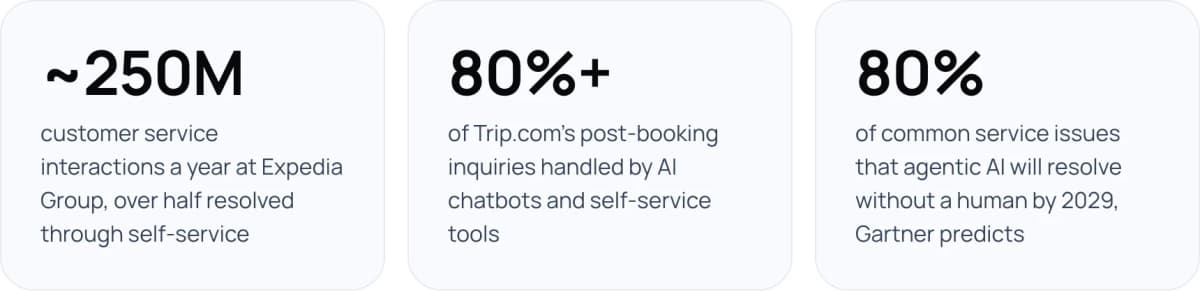
- ~250M customer service interactions a year at Expedia Group, over half resolved through self-service
- 80%+ of Trip.com’s post-booking inquiries handled by AI chatbots and self-service tools
- 80% of common service issues that agentic AI will resolve without a human by 2029, Gartner predicts
Sources: Expedia Group Q1 2026 earnings call, reported by GeekWire; Trip.com Group Q1 2025 earnings call, reported by Skift; Gartner, March 2025.
Gartner’s figure is a forecast, and it covers common issues only. In our view, that word matters more than the number. Travel has many uncommon issues, and those are the ones customers remember.

4. 10 Conversational AI Use Cases for Travel Customer Service
Each use case below explains what the AI does, gives a public example from a named travel company, and lists the cases where a person should take over.
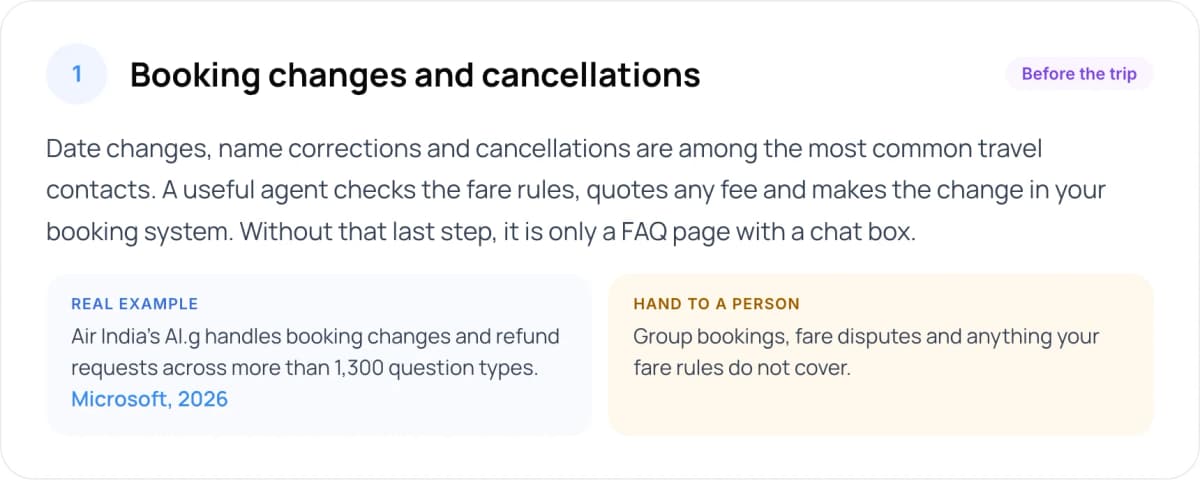
1. Booking changes and cancellations
Before the trip
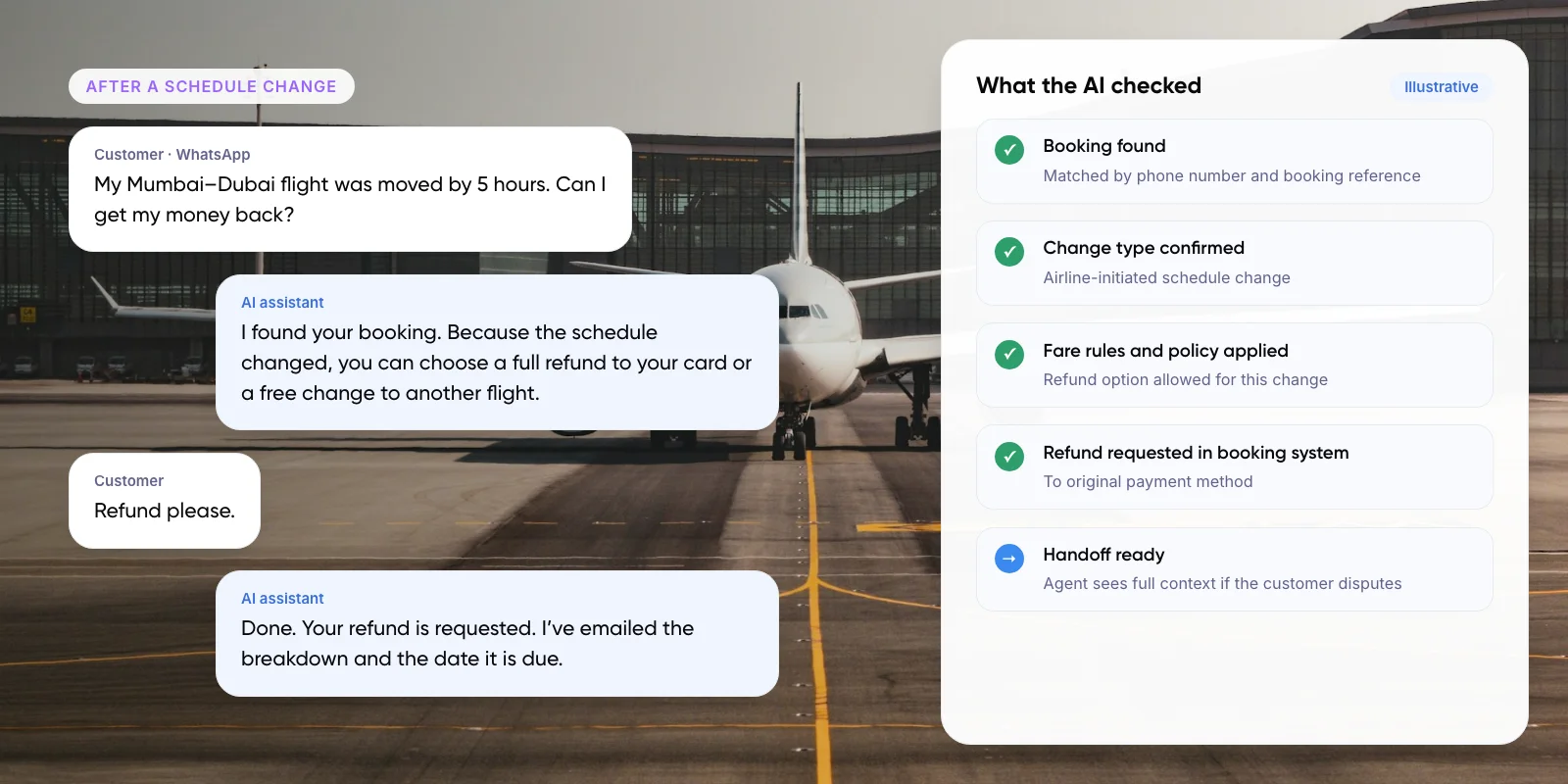
Date changes, name corrections and cancellations are among the most common travel contacts. A useful agent checks the fare rules, quotes any fee and makes the change in your booking system. Without that last step, it is only a FAQ page with a chat box.
- Real example: Air India’s AI.g handles booking changes and refund requests across more than 1,300 question types. Microsoft, 2026
- Hand to a person: Group bookings, fare disputes and anything your fare rules do not cover.
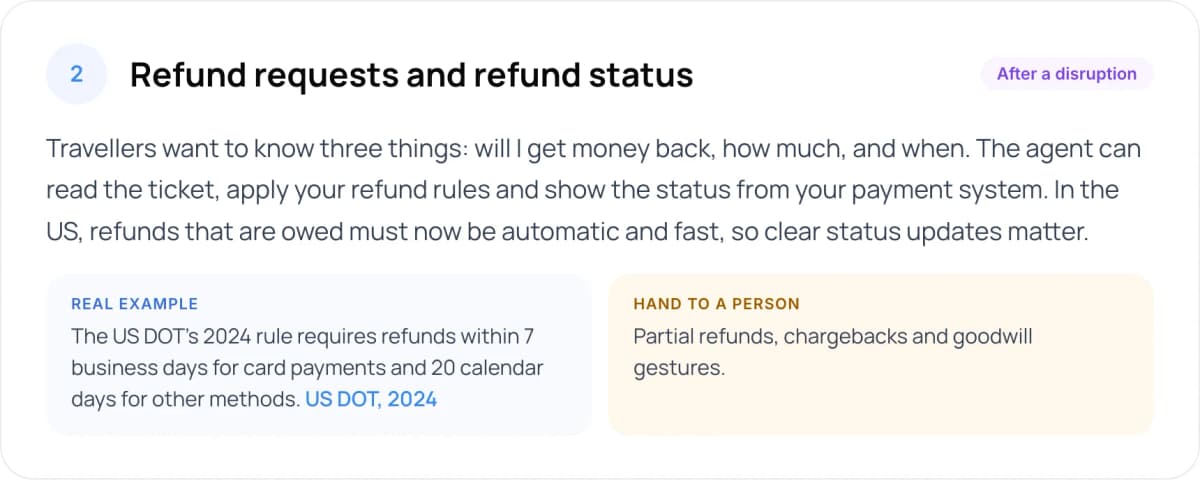
2. Refund requests and refund status
After a disruption
Travellers want to know three things: will I get money back, how much, and when. The agent can read the ticket, apply your refund rules and show the status from your payment system. In the US, refunds that are owed must now be automatic and fast, so clear status updates matter.
- Real example: The US DOT’s 2024 rule requires refunds within 7 business days for card payments and 20 calendar days for other methods. US DOT, 2024
- Hand to a person: Partial refunds, chargebacks and goodwill gestures.
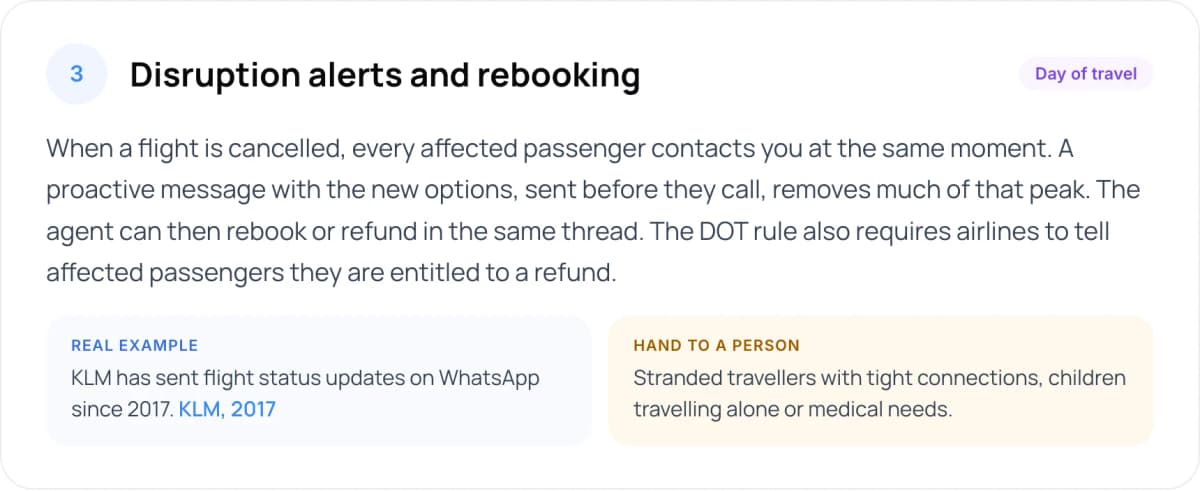
3. Disruption alerts and rebooking
Day of travel
When a flight is cancelled, every affected passenger contacts you at the same moment. A proactive message with the new options, sent before they call, removes much of that peak. The agent can then rebook or refund in the same thread. The DOT rule also requires airlines to tell affected passengers they are entitled to a refund.
- Real example: KLM has sent flight status updates on WhatsApp since 2017. KLM, 2017
- Hand to a person: Stranded travellers with tight connections, children travelling alone or medical needs.
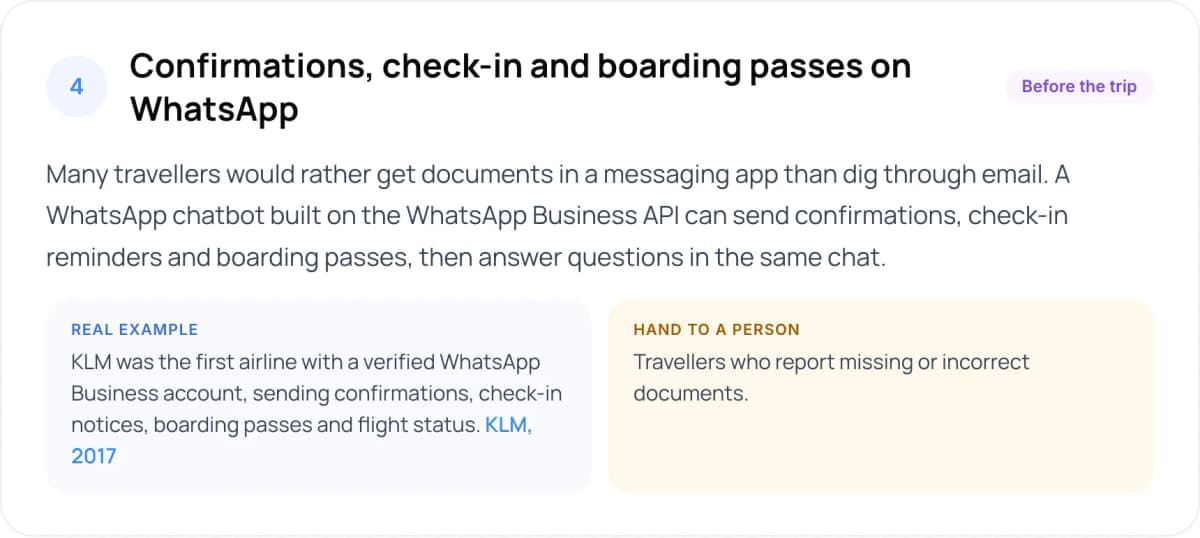
4. Confirmations, check-in and boarding passes on WhatsApp
Before the trip
Many travellers would rather get documents in a messaging app than dig through email. A WhatsApp chatbot built on the WhatsApp Business API can send confirmations, check-in reminders and boarding passes, then answer questions in the same chat.
- Real example: KLM was the first airline with a verified WhatsApp Business account, sending confirmations, check-in notices, boarding passes and flight status. KLM, 2017
- Hand to a person: Travellers who report missing or incorrect documents.
5. Baggage, pet and travel policy questions
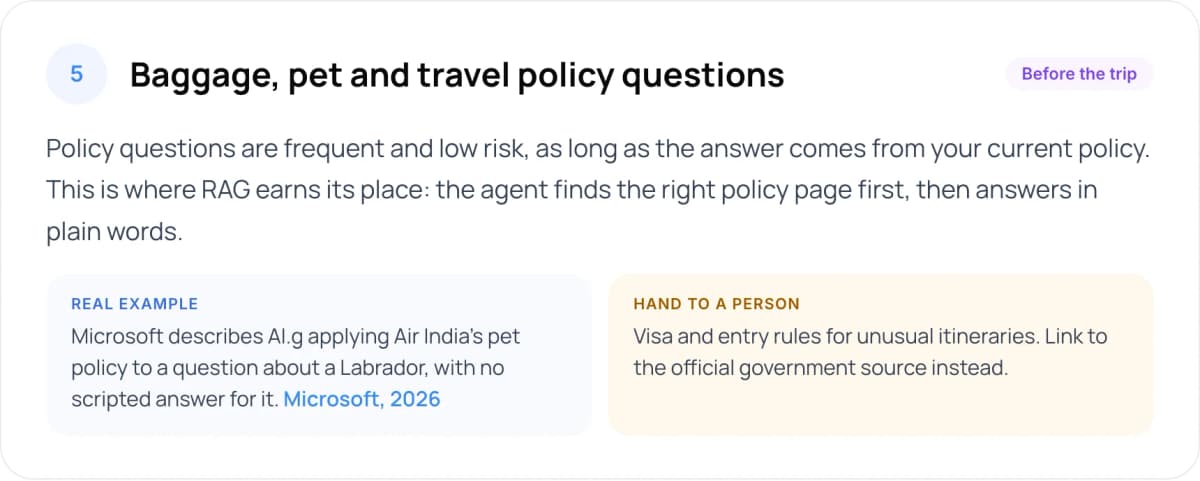
Before the trip
Policy questions are frequent and low risk, as long as the answer comes from your current policy. This is where RAG earns its place: the agent finds the right policy page first, then answers in plain words.
- Real example: Microsoft describes AI.g applying Air India’s pet policy to a question about a Labrador, with no scripted answer for it. Microsoft, 2026
- Hand to a person: Visa and entry rules for unusual itineraries. Link to the official government source instead.
6. Support in the traveller’s language
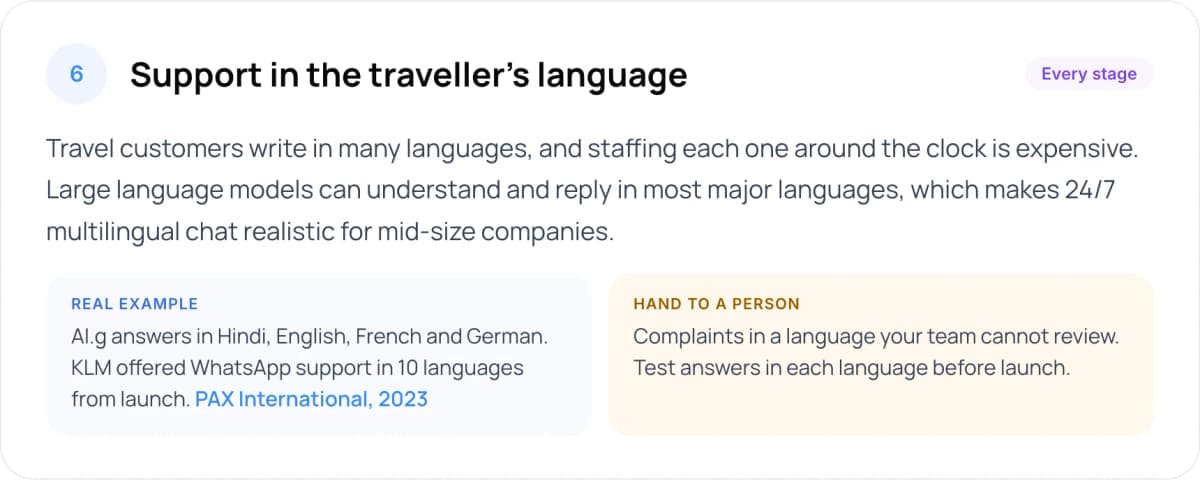
Every stage
Travel customers write in many languages, and staffing each one around the clock is expensive. Large language models can understand and reply in most major languages, which makes 24/7 multilingual chat realistic for mid-size companies.
- Real example: AI.g answers in Hindi, English, French and German. KLM offered WhatsApp support in 10 languages from launch. PAX International, 2023
- Hand to a person: Complaints in a language your team cannot review. Test answers in each language before launch.
7. AI voice agents for inbound calls
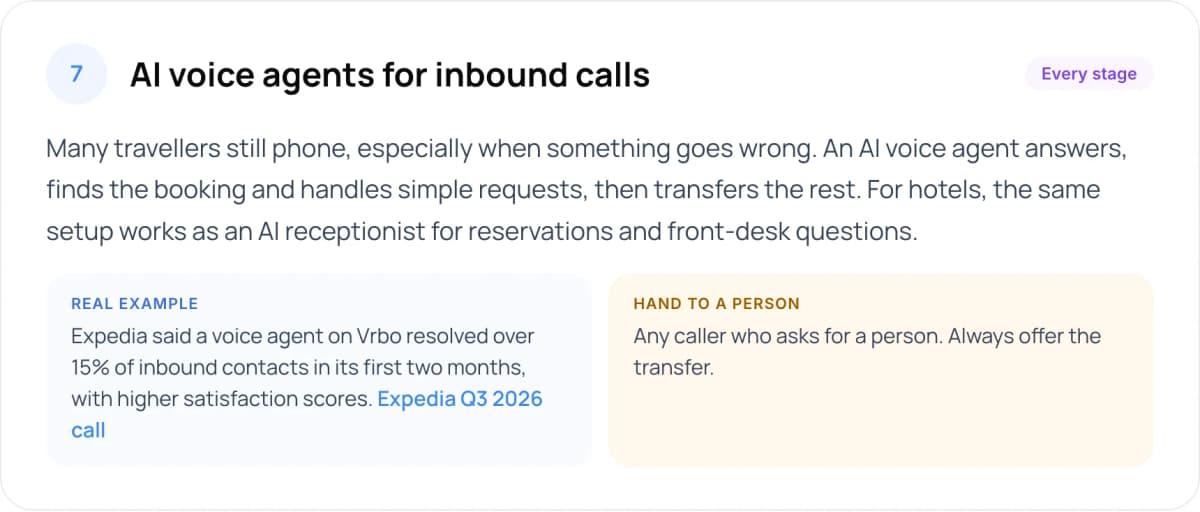
Every stage
Many travellers still phone, especially when something goes wrong. An AI voice agent answers, finds the booking and handles simple requests, then transfers the rest. For hotels, the same setup works as an AI receptionist for reservations and front-desk questions.
- Real example: Expedia said a voice agent on Vrbo resolved over 15% of inbound contacts in its first two months, with higher satisfaction scores. Expedia Q3 2026 call
- Hand to a person: Any caller who asks for a person. Always offer the transfer.
8. In-trip and destination help
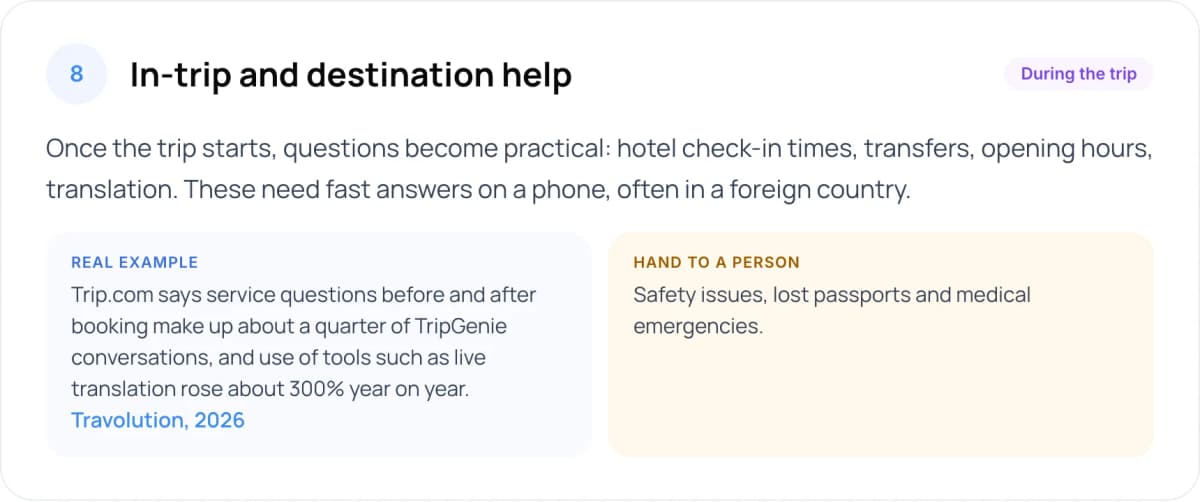
During the trip
Once the trip starts, questions become practical: hotel check-in times, transfers, opening hours, translation. These need fast answers on a phone, often in a foreign country.
- Real example: Trip.com says service questions before and after booking make up about a quarter of TripGenie conversations, and use of tools such as live translation rose about 300% year on year. Travolution, 2026
- Hand to a person: Safety issues, lost passports and medical emergencies.
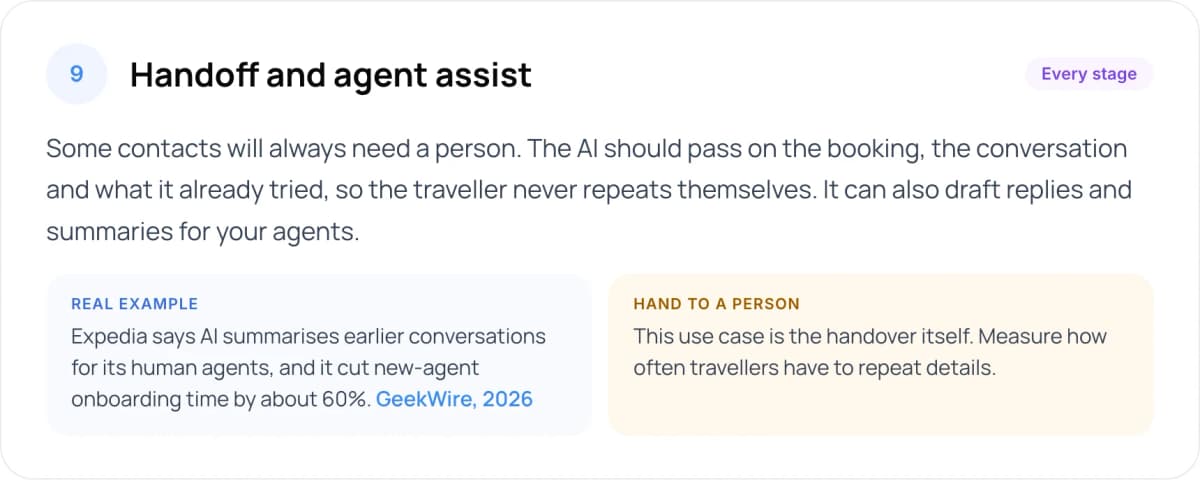
9. Handoff and agent assist
Every stage
Some contacts will always need a person. The AI should pass on the booking, the conversation and what it already tried, so the traveller never repeats themselves. It can also draft replies and summaries for your agents.
- Real example: Expedia says AI summarises earlier conversations for its human agents, and it cut new-agent onboarding time by about 60%. GeekWire, 2026
- Hand to a person: This use case is the handover itself. Measure how often travellers have to repeat details.
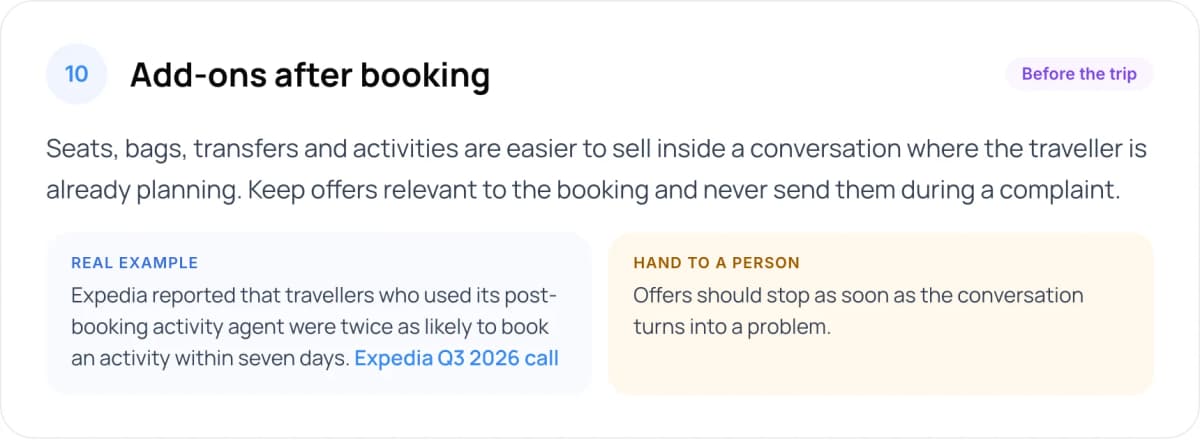
10. Add-ons after booking
Before the trip
Seats, bags, transfers and activities are easier to sell inside a conversation where the traveller is already planning. Keep offers relevant to the booking and never send them during a complaint.
- Real example: Expedia reported that travellers who used its post-booking activity agent were twice as likely to book an activity within seven days. Expedia Q3 2026 call
- Hand to a person: Offers should stop as soon as the conversation turns into a problem.
5. Which Use Cases Can You Fully Automate?
The limit is rarely the AI model. It is usually access: what systems the agent can read, and what it is allowed to change. This table shows what each use case needs and how far we would automate it today.
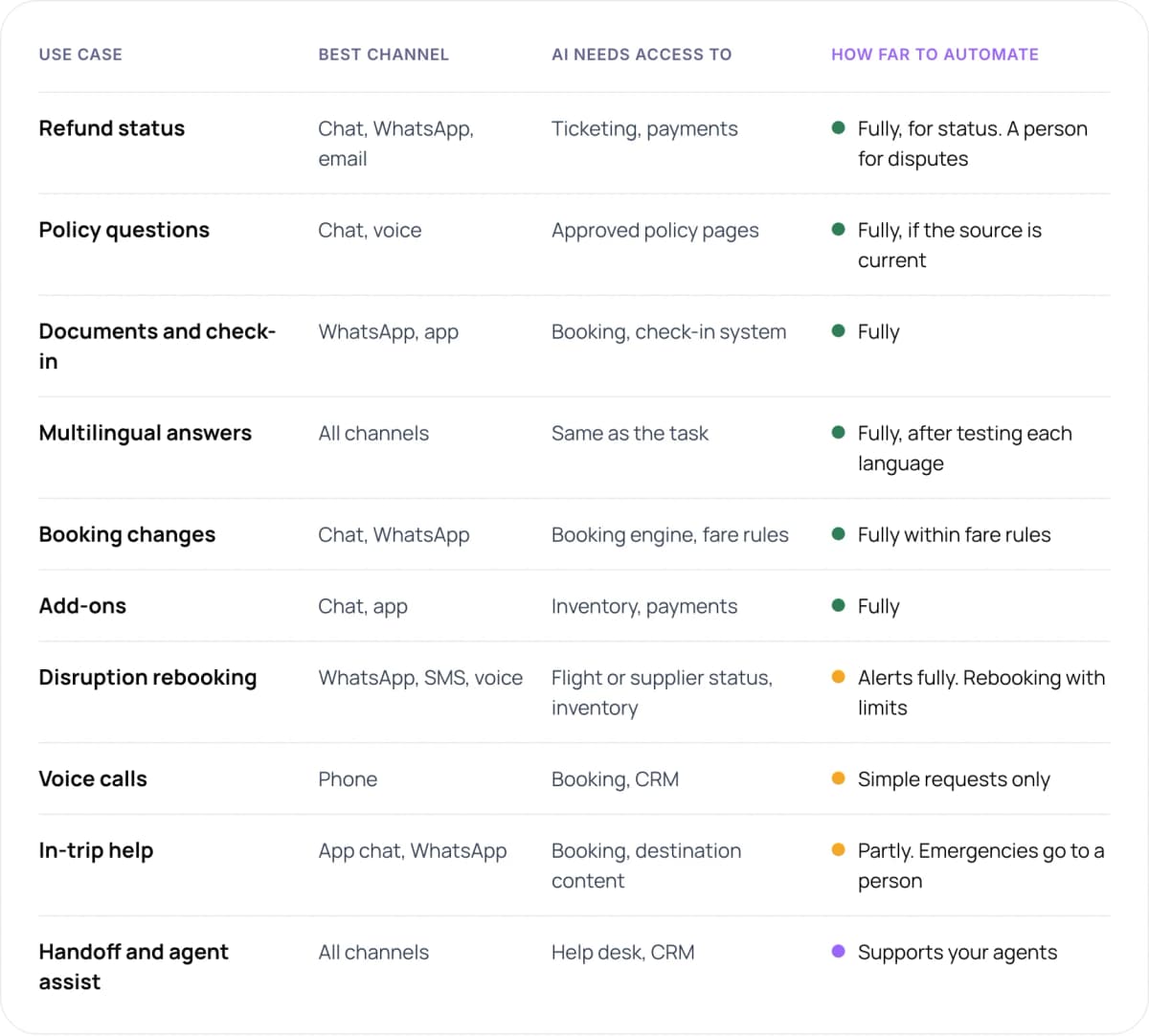
- Refund status — Best channel: Chat, WhatsApp, email. AI needs access to: Ticketing, payments. How far to automate: Fully, for status. A person for disputes.
- Policy questions — Best channel: Chat, voice. AI needs access to: Approved policy pages. How far to automate: Fully, if the source is current.
- Documents and check-in — Best channel: WhatsApp, app. AI needs access to: Booking, check-in system. How far to automate: Fully.
- Multilingual answers — Best channel: All channels. AI needs access to: Same as the task. How far to automate: Fully, after testing each language.
- Booking changes — Best channel: Chat, WhatsApp. AI needs access to: Booking engine, fare rules. How far to automate: Fully within fare rules.
- Add-ons — Best channel: Chat, app. AI needs access to: Inventory, payments. How far to automate: Fully.
- Disruption rebooking — Best channel: WhatsApp, SMS, voice. AI needs access to: Flight or supplier status, inventory. How far to automate: Alerts fully. Rebooking with limits.
- Voice calls — Best channel: Phone. AI needs access to: Booking, CRM. How far to automate: Simple requests only.
- In-trip help — Best channel: App chat, WhatsApp. AI needs access to: Booking, destination content. How far to automate: Partly. Emergencies go to a person.
- Handoff and agent assist — Best channel: All channels. AI needs access to: Help desk, CRM. How far to automate: Supports your agents.
Our assessment, based on the systems each task touches. Your fare rules and regulator may change where the line sits.
Not sure which of these fits your contact mix? We can go through a sample of your tickets with you.
6. Customer Service Chatbot Example: How Air India Runs AI.g
Air India’s AI.g is one of the best-documented generative AI deployments in travel. It started as a pilot called “Maharaja” in March 2023 and runs on Microsoft’s Azure OpenAI Service. It uses RAG over the airline’s own data, so answers come from current Air India policies rather than general web knowledge.
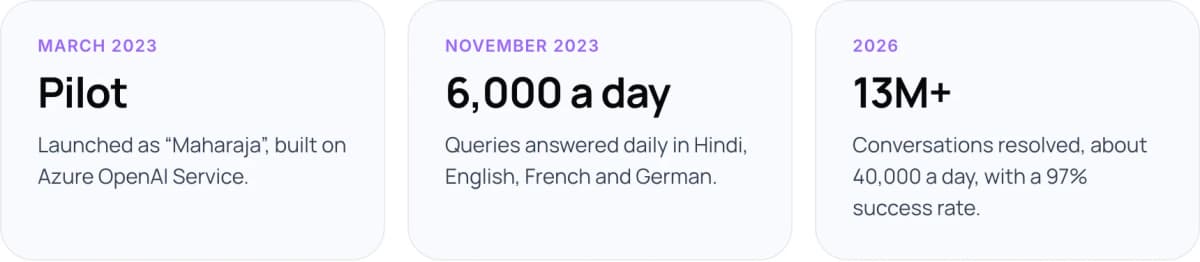
- March 2023 · Pilot: Launched as “Maharaja”, built on Azure OpenAI Service.
- November 2023 · 6,000 a day: Queries answered daily in Hindi, English, French and German.
- 2026 · 13M+: Conversations resolved, about 40,000 a day, with a 97% success rate.
Sources: Air India press release via PAX International, Nov 2023; Microsoft customer story, 2026. All figures are company-reported.
Three choices stand out. Air India defined a fixed scope of about 1,300 topics, so “97%” means 97% within that scope, not of every possible request. It brought the agent to WhatsApp, where travellers can get flight updates, boarding passes and seat selection, according to IndiaAI. And it keeps an escalation path: about 3% of queries go to a person.
7. Automated Customer Service Pros and Cons in Travel
The main benefits are 24/7 answers in many languages and a support team that can handle disruption peaks without overtime. The main risk is a confident wrong answer about money or rights. Travel has more of these risks than most industries, because fares, refunds and compensation are governed by rules and, in many markets, by law.
Warning: In February 2024, a British Columbia tribunal held Air Canada liable after its website chatbot wrongly told a passenger they could claim a bereavement fare discount after travelling. The airline argued the chatbot was responsible for its own actions. The tribunal rejected that and ordered Air Canada to pay CAD 812.02 (American Bar Association summary; Moffatt v. Air Canada, 2024 BCCRT 149).
The amount was small. The lesson is that your company owns every answer the bot gives, just as it owns every page on your website. We would not let an AI agent state refund or compensation rights unless it quotes them from a policy page your legal team has approved.
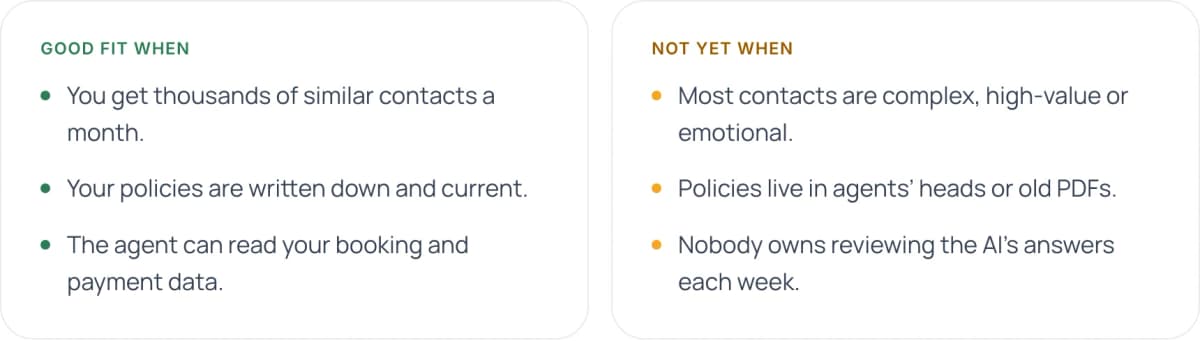
Good fit when
- You get thousands of similar contacts a month.
- Your policies are written down and current.
- The agent can read your booking and payment data.
Not yet when
- Most contacts are complex, high-value or emotional.
- Policies live in agents’ heads or old PDFs.
- Nobody owns reviewing the AI’s answers each week.
8. How to Automate Customer Service for a Travel Company in 6 Steps
- Tag three months of contacts. Group them by reason and channel. The top five reasons usually cover most of your volume.
- Pick two or three use cases. Choose ones with high volume and clear rules, such as refund status, policy questions and documents.
- Clean up your source content. Keep one approved, dated page per policy. The AI will repeat whatever these pages say.
- Connect read access first. Let the agent look up bookings before it can change them. Add actions like rebooking or refunds after testing.
- Write handoff rules and test them. Run the agent on past conversations and check every answer about money, rights or safety.
- Launch on one channel and review weekly. Track resolution rate, transfers, satisfaction and wrong answers. Fix the source content, not just the prompt.
Tip: When the AI hands a traveller to a person, pass the booking reference, the conversation and what the AI already tried. Our guide to chatbot handoff and context transfer covers how to set this up.
Note: To see how an agent can look up booking and policy data reliably, read our guide to agentic RAG for customer service.
9. Frequently Asked Questions
What is conversational AI for customer service in travel?
It is software that understands travellers’ questions in everyday language and replies in chat, WhatsApp or by voice. Modern systems use large language models and look up your policies and bookings before answering. The better ones can also complete tasks, such as changing a seat or sharing refund status.
Can AI agents handle flight cancellations and refunds?
They can send alerts, offer rebooking options and report refund status, provided they are connected to your booking and payment systems. Rules matter here. The US DOT’s 2024 rule makes refunds automatic when owed. Keep a person on disputes, partial refunds and travellers with complex needs.
Is a travel company responsible for what its chatbot says?
Yes, based on the clearest case so far. In Moffatt v. Air Canada (2024), a British Columbia tribunal held the airline liable for its chatbot’s wrong bereavement fare advice. It rejected the argument that the chatbot was a separate entity. Treat bot answers like any page on your website.
Should travel companies start with chat, WhatsApp or voice?
Start with the channel where most of your contacts already arrive. Check your own contact data rather than following trends. In our view, chat or WhatsApp is the easier first step, because answers are written down and simple to review. Voice adds speech recognition and real-time replies, so it is harder to test.
How much travel customer service can AI handle?
It depends on scope. Air India reports 97% resolution within about 1,300 supported topics. Trip.com says AI and self-service handle over 80% of post-booking inquiries. Expedia’s new Vrbo voice agent resolved over 15% of calls in two months. Expect a lower rate at launch and grow it.
10. Conclusion
Conversational AI for customer service works in travel when it is connected to real booking data, limited to clear rules and backed by people for everything else. Start with refund status, policy questions and travel documents, because they are frequent and low risk. This week, pull three months of contacts and count how many fall into those three groups. That number is your realistic first target.
From Neura Dynamics
If you want help putting this into practice, Neura Dynamics can help. Our AI customer support automation service builds AI agents for chat, WhatsApp and voice that connect to your booking and help desk systems, with handoff rules your team controls.
Author