AI Customer Service Platforms for Travel Companies: How They Handle Cancellations and Refunds
AI customer service platforms for travel companies handle cancellations by finding the booking, checking the fare rules and the law that applies, and then offering a refund, credit or rebooking. Air India runs this kind of assistant today. According to Microsoft, it handles about 40,000 customer queries a day, including refund requests.
This guide covers the refund rules your AI has to follow, which steps to automate, which to keep with your team, and how to choose a platform.

- Identify Find the booking and the traveller
- Check Fare rules, policy and law
- Act Refund, credit or rebook via API
- Escalate Exceptions go to a person
1. The Short Answer
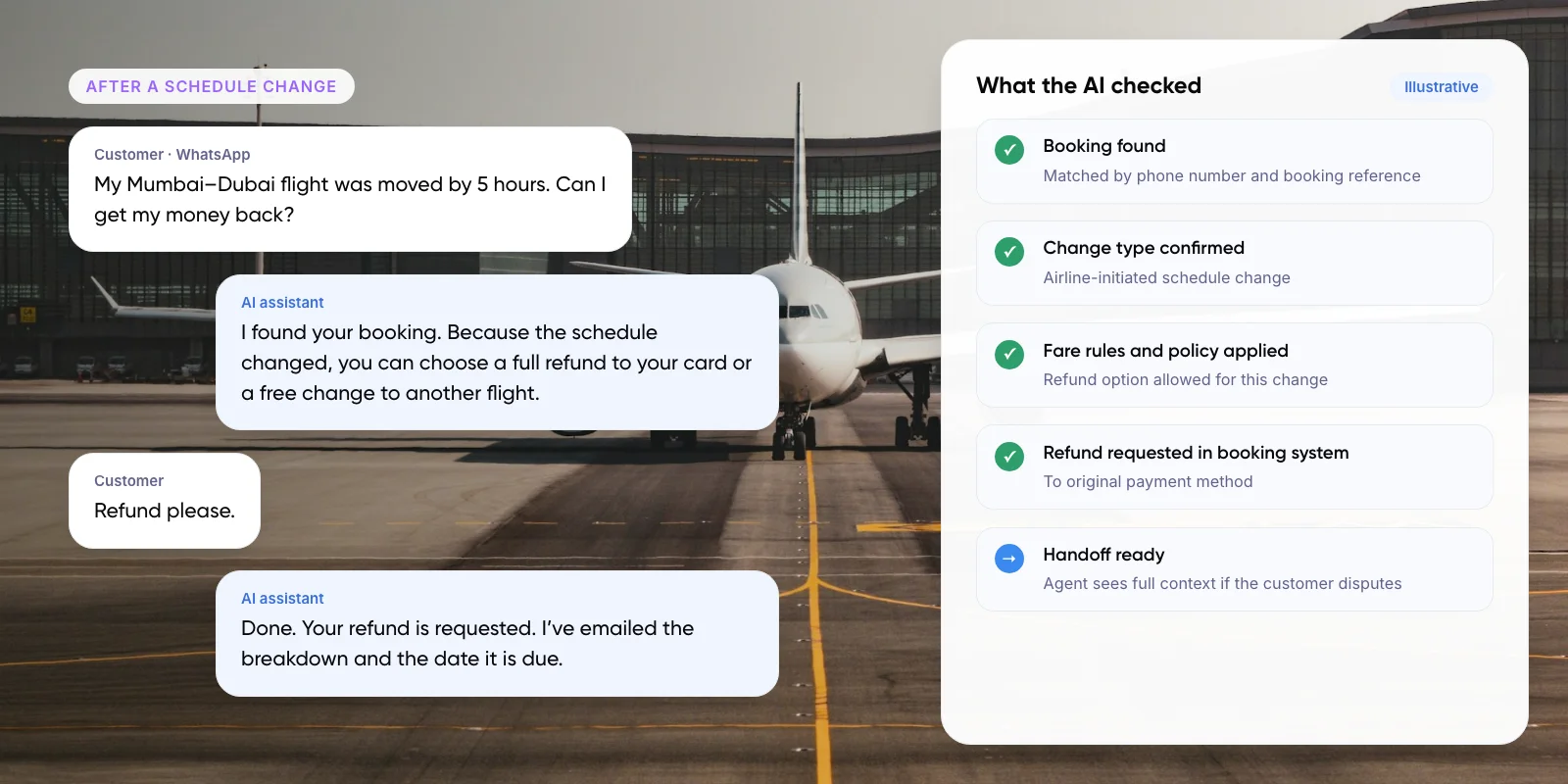
A good AI customer service platform for a travel company does more than answer questions. It reads the booking, applies the fare rules and refund rules for that trip, and completes the change in your booking system. When a case needs judgment, it hands the customer to a person.
Customers will use it if they can still reach someone. A 2026 Gartner survey of 3,566 customers found 87% consider access to a human agent essential when a company uses generative AI for service.
Key takeaways
- AI should apply your fare rules and refund policy from your own systems, not from what the model remembers.
- Refund rules differ by market: the US requires automatic refunds, EU261 adds compensation, and India’s DGCA set 7- and 14-day deadlines in 2026.
- Automate cases where the rules give a clear answer. Send exceptions, disputes and goodwill decisions to a person.
- Air India’s assistant handles about 40,000 queries a day across 1,300+ topics, according to Microsoft, with only a small share passed to people.
2. Why Are Travel Cancellations and Refunds Hard to Automate?
A refund answer depends on who cancelled, the fare type, how the ticket was paid for, where it was bought and which country’s rules apply. For example, a London to Delhi flight booked through an online travel agency can be covered by the airline’s fare rules, EU rules and India’s rules at the same time.

Regulators have also tightened refund deadlines. The table below summarises the three rule sets that travel companies selling in the US, Europe or India deal with most.
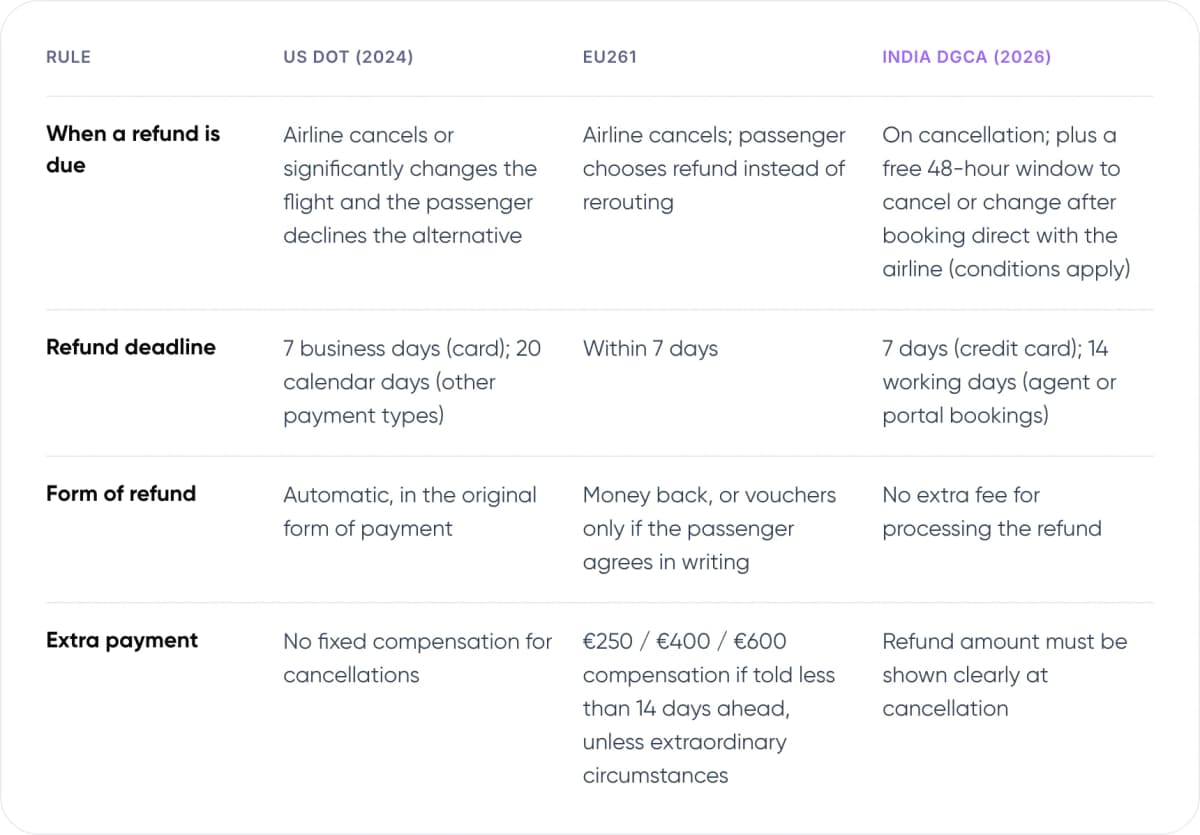
- When a refund is due — US DOT (2024): Airline cancels or significantly changes the flight and the passenger declines the alternative. EU261: Airline cancels; passenger chooses refund instead of rerouting. India DGCA (2026): On cancellation; plus a free 48-hour window to cancel or change after booking direct with the airline (conditions apply).
- Refund deadline — US DOT (2024): 7 business days (card); 20 calendar days (other payment types). EU261: Within 7 days. India DGCA (2026): 7 days (credit card); 14 working days (agent or portal bookings).
- Form of refund — US DOT (2024): Automatic, in the original form of payment. EU261: Money back, or vouchers only if the passenger agrees in writing. India DGCA (2026): No extra fee for processing the refund.
- Extra payment — US DOT (2024): No fixed compensation for cancellations. EU261: €250 / €400 / €600 compensation if told less than 14 days ahead, unless extraordinary circumstances. India DGCA (2026): Refund amount must be shown clearly at cancellation.
Sources: US DOT final rule, Federal Register 2024; Regulation (EC) 261/2004; DGCA refund CAR, reported by Business Standard, Feb 2026. Summary only, not legal advice.
Note: A refund returns what the customer paid. Compensation, such as EU261’s €250 to €600, is a separate payment for the disruption. Your AI should never tell a customer that accepting one cancels the other.
3. How Does an AI Platform Handle a Cancellation Request?
The AI model writes the replies, but the rules and the money stay in your own systems. In a well-built setup, the AI connects to your booking and payment systems through APIs (links that let one piece of software read and update another) and follows your written policy. It never works out refund amounts from memory.
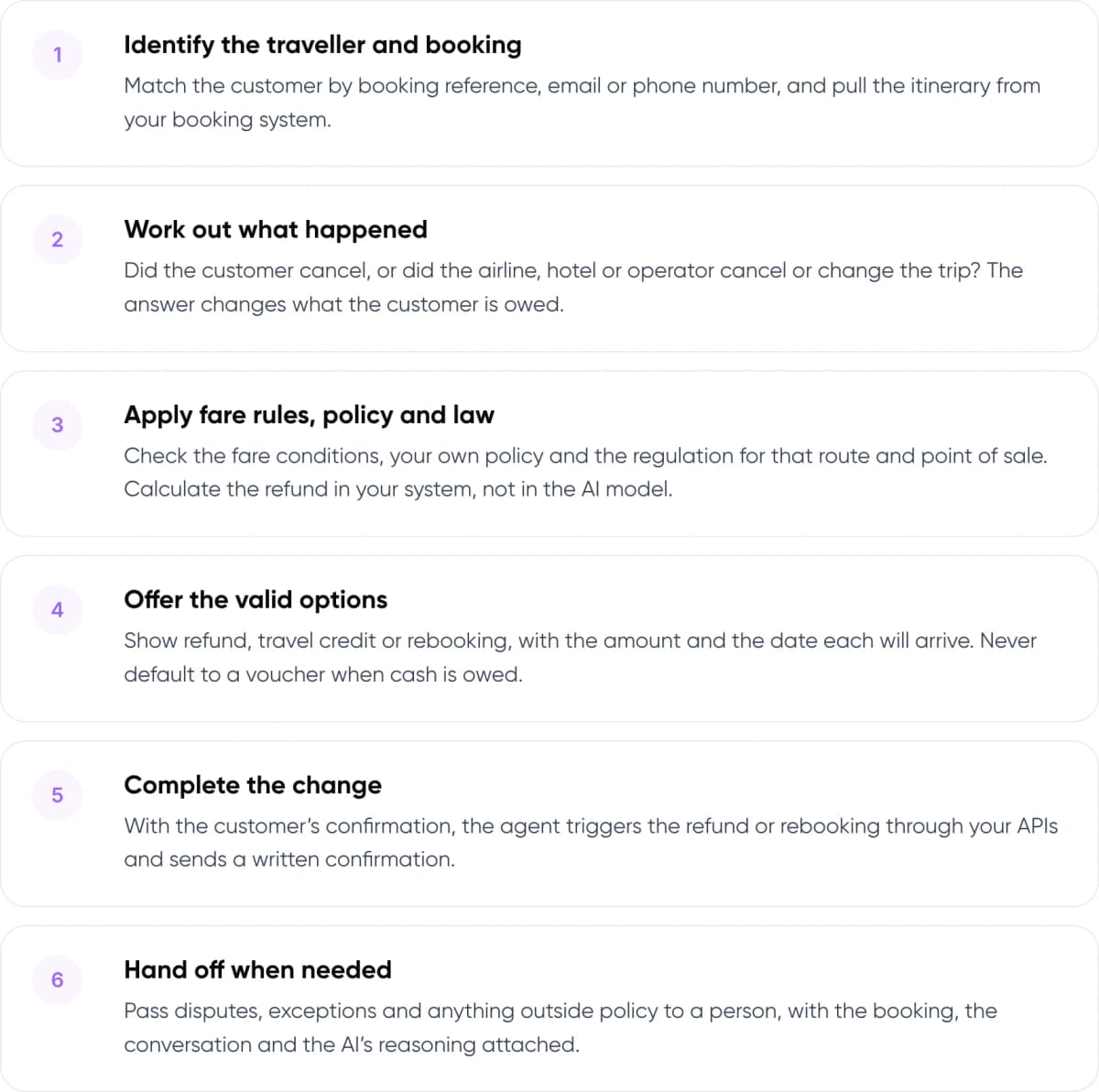
- Identify the traveller and booking Match the customer by booking reference, email or phone number, and pull the itinerary from your booking system.
- Work out what happened Did the customer cancel, or did the airline, hotel or operator cancel or change the trip? The answer changes what the customer is owed.
- Apply fare rules, policy and law Check the fare conditions, your own policy and the regulation for that route and point of sale. Calculate the refund in your system, not in the AI model.
- Offer the valid options Show refund, travel credit or rebooking, with the amount and the date each will arrive. Never default to a voucher when cash is owed.
- Complete the change With the customer’s confirmation, the agent triggers the refund or rebooking through your APIs and sends a written confirmation.
- Hand off when needed Pass disputes, exceptions and anything outside policy to a person, with the booking, the conversation and the AI’s reasoning attached.
Tip: Have the AI show the refund amount and how it was calculated before the customer confirms. India’s DGCA now requires airlines to state clearly how much will be refunded on cancellation, and a clear breakdown cuts follow-up messages anywhere.
4. What Should AI Handle, and What Should Stay With Your Team?
In our view, AI should handle any case where the rules give a single clear answer. It should hand off cases that need judgment, an exception or empathy. Gartner’s April 2026 release reported that 54% of US customers trust human agents more than AI for recommendations, against 32% who trust AI more.
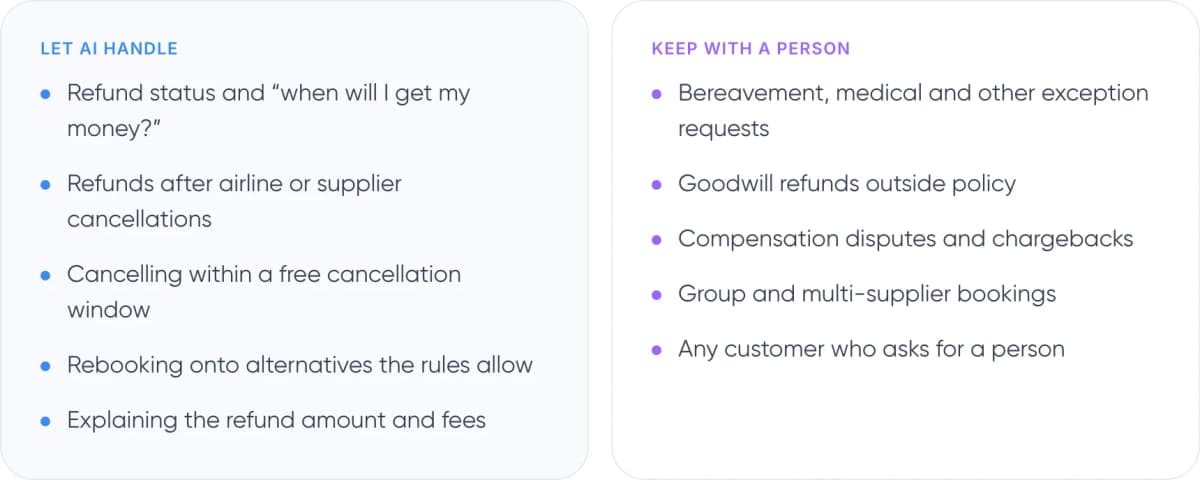
Let AI handle
- Refund status and “when will I get my money?”
- Refunds after airline or supplier cancellations
- Cancelling within a free cancellation window
- Rebooking onto alternatives the rules allow
- Explaining the refund amount and fees
Keep with a person
- Bereavement, medical and other exception requests
- Goodwill refunds outside policy
- Compensation disputes and chargebacks
- Group and multi-supplier bookings
- Any customer who asks for a person
Warning: You are responsible for what your chatbot promises. In Moffatt v. Air Canada (2024), a chatbot told a customer he could claim a bereavement fare after travel. The airline’s policy said otherwise.
British Columbia’s Civil Resolution Tribunal held Air Canada liable and ordered it to pay C$812.02. It rejected the argument that the chatbot was responsible for its own words. Ground every policy answer in your current policy documents.
Want to know which of your cancellation cases AI could resolve end to end? We can map them with you.
5. What Does This Look Like at a Real Airline?
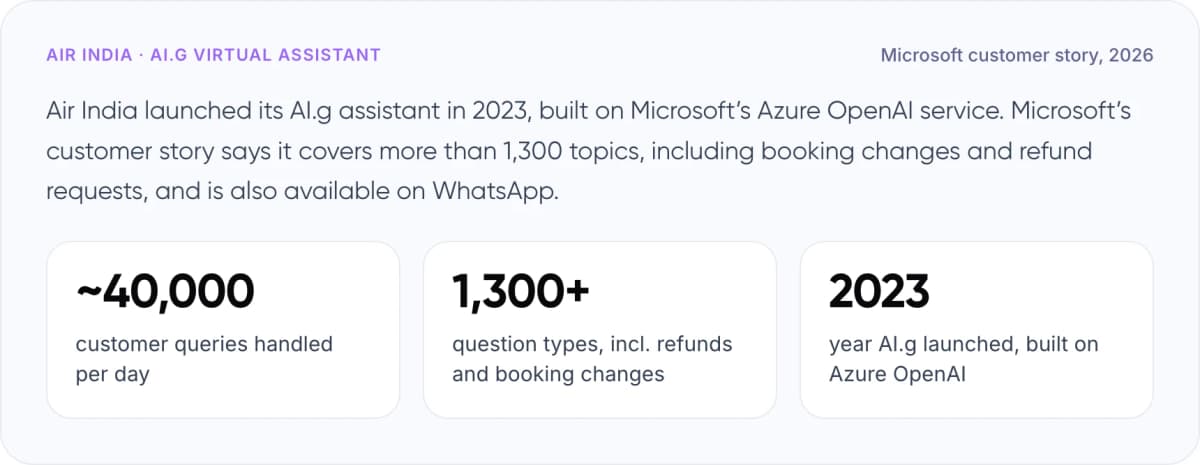
Air India · AI.g virtual assistant · Microsoft customer story, 2026
Air India launched its AI.g assistant in 2023, built on Microsoft’s Azure OpenAI service. Microsoft’s customer story says it covers more than 1,300 topics, including booking changes and refund requests, and is also available on WhatsApp.
- ~40,000 customer queries handled per day
- 1,300+ question types, incl. refunds and booking changes
- 2023 year AI.g launched, built on Azure OpenAI
The same story says Air India is testing AI agents that run the full refund process across its systems, with the aim of cutting refund times from weeks to hours. That is a goal, not a published result. The order of work is the useful part: first answer questions well, then automate actions once the answers are reliable.
6. Which Type of AI Customer Service Platform Fits a Travel Company?
Most options fall into three groups. The right choice depends less on which AI model is used and more on how well the platform connects to your booking, payment and policy systems.
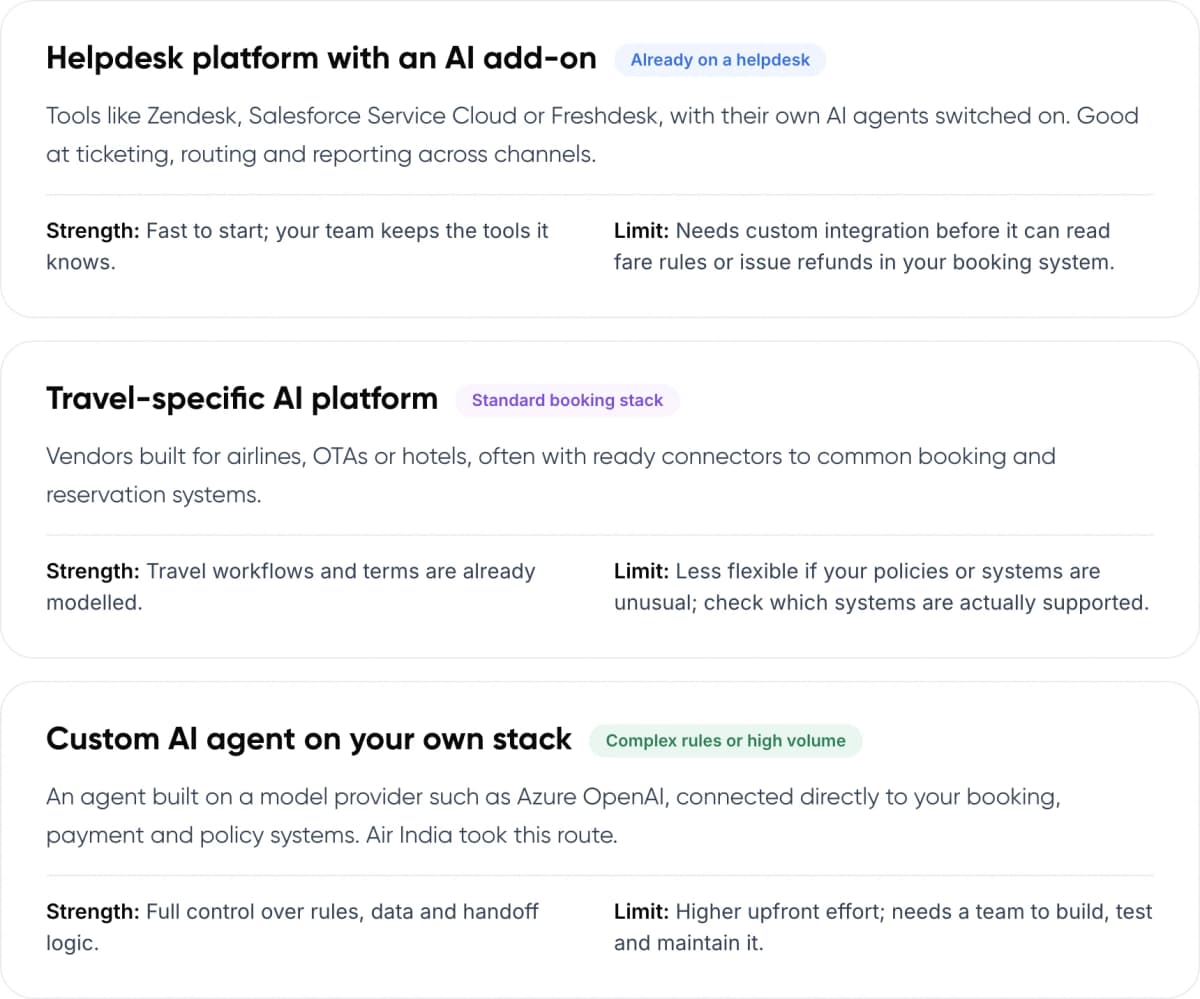
- Helpdesk platform with an AI add-on (Already on a helpdesk): Tools like Zendesk, Salesforce Service Cloud or Freshdesk, with their own AI agents switched on. Good at ticketing, routing and reporting across channels. Strength: Fast to start; your team keeps the tools it knows. Limit: Needs custom integration before it can read fare rules or issue refunds in your booking system.
- Travel-specific AI platform (Standard booking stack): Vendors built for airlines, OTAs or hotels, often with ready connectors to common booking and reservation systems. Strength: Travel workflows and terms are already modelled. Limit: Less flexible if your policies or systems are unusual; check which systems are actually supported.
- Custom AI agent on your own stack (Complex rules or high volume): An agent built on a model provider such as Azure OpenAI, connected directly to your booking, payment and policy systems. Air India took this route. Strength: Full control over rules, data and handoff logic. Limit: Higher upfront effort; needs a team to build, test and maintain it.
In our view, most mid-size travel companies get the best results from a hybrid. Keep your current helpdesk for tickets and reporting, and add an AI agent connected directly to your booking engine for cancellations and rebooking. Your team keeps a tool it already knows, and the AI can complete the cancellation instead of only answering questions about it.
7. How to Roll Out AI for Cancellations in 6 Steps
- Pull three months of cancellation contacts. Tag each by type: airline cancellation, customer cancellation, schedule change, refund status, exception.
- Write the rules down. Turn fare rules, your refund policy and the regulations for each market into a single source the AI reads from.
- Connect read access first. Let the AI look up bookings and refund status before it can change anything.
- Add actions with limits. Allow refunds and rebooking only for clear cases, with a value cap and a confirmation step.
- Design the handoff. Make “talk to a person” visible at every step, and pass the full context so the customer never repeats themselves.
- Review weekly. Check a sample of AI answers against policy, track escalations and update the rules when policies or regulations change.
For step 5, see our guide to chatbot handoff and context transfer, which covers what the agent should see when a conversation reaches them.
8. Frequently Asked Questions
Can AI process travel refunds automatically?
Yes, if it is connected to your booking and payment systems and the case fits clear rules. The AI collects details, checks eligibility and triggers the refund through an API. Keep a value limit and a confirmation step, and send exceptions such as goodwill or disputed refunds to a person.
Is a travel company liable for what its chatbot says?
It can be. In Moffatt v. Air Canada (2024), a British Columbia tribunal held the airline liable for a chatbot’s wrong answer about bereavement fares and ordered it to pay C$812.02. Ground policy answers in current documents and test them regularly.
How fast must airlines refund a cancelled flight?
It depends on the market. US DOT rules require automatic refunds within 7 business days for card payments. EU261 requires refunds within 7 days. India’s DGCA requires 7 days for credit cards and 14 working days for tickets bought through agents or portals.
Should a travel company build or buy an AI customer service platform?
Buy if you run a standard booking stack and common policies. Build, or add a custom agent to your helpdesk, if your rules are complex or your volume is high. Either way, the AI must connect to booking and payment systems to complete cancellations, not just answer questions.
Do customers accept AI for cancellations?
Many do if they can still reach a person. A 2026 Gartner survey of 3,566 customers found 87% consider human access essential when companies use generative AI for service. Make the handoff easy and pass the conversation history with it.
9. Conclusion
AI customer service platforms for travel companies work when they are connected to real booking data and written policy, and when a person is easy to reach. Start with one high-volume case, such as refunds after an airline cancellation, where the rules give a clear answer. Pull last month’s cancellation tickets this week and sort them into “rules decide” and “needs judgment”. The first group is where AI should start.
If you’d like help, our AI customer support automation service builds AI agents for chat, WhatsApp and voice that look up bookings, follow your refund policy and pass complex cases to your team with the full conversation.
- Our service: AI Customer Support Automation — AI agents that look up bookings, apply your refund rules and hand off to your team with context. See the service →
- Free savings report: AI ROI Calculator — Enter your monthly cancellation contacts and handling time to estimate what automation could save. Get your savings estimate →
See how we have built AI for clients in our AI Voice Assistant and Paymate case studies.
Author