What’s the Cheapest Way to Offer 24/7 Support for a Small Business?
For most small businesses, the cheapest way to offer 24/7 support is an AI answering service for chat and phone, with a person on call for the few cases that can’t wait. Staffing one support seat around the clock takes about 4.2 full-time hires. An AI agent charges per conversation or per minute, often under a dollar.
This guide compares the real costs of each option, works through an example, and shows what to keep human.
1. What Does 24/7 Support Cost With People Alone?
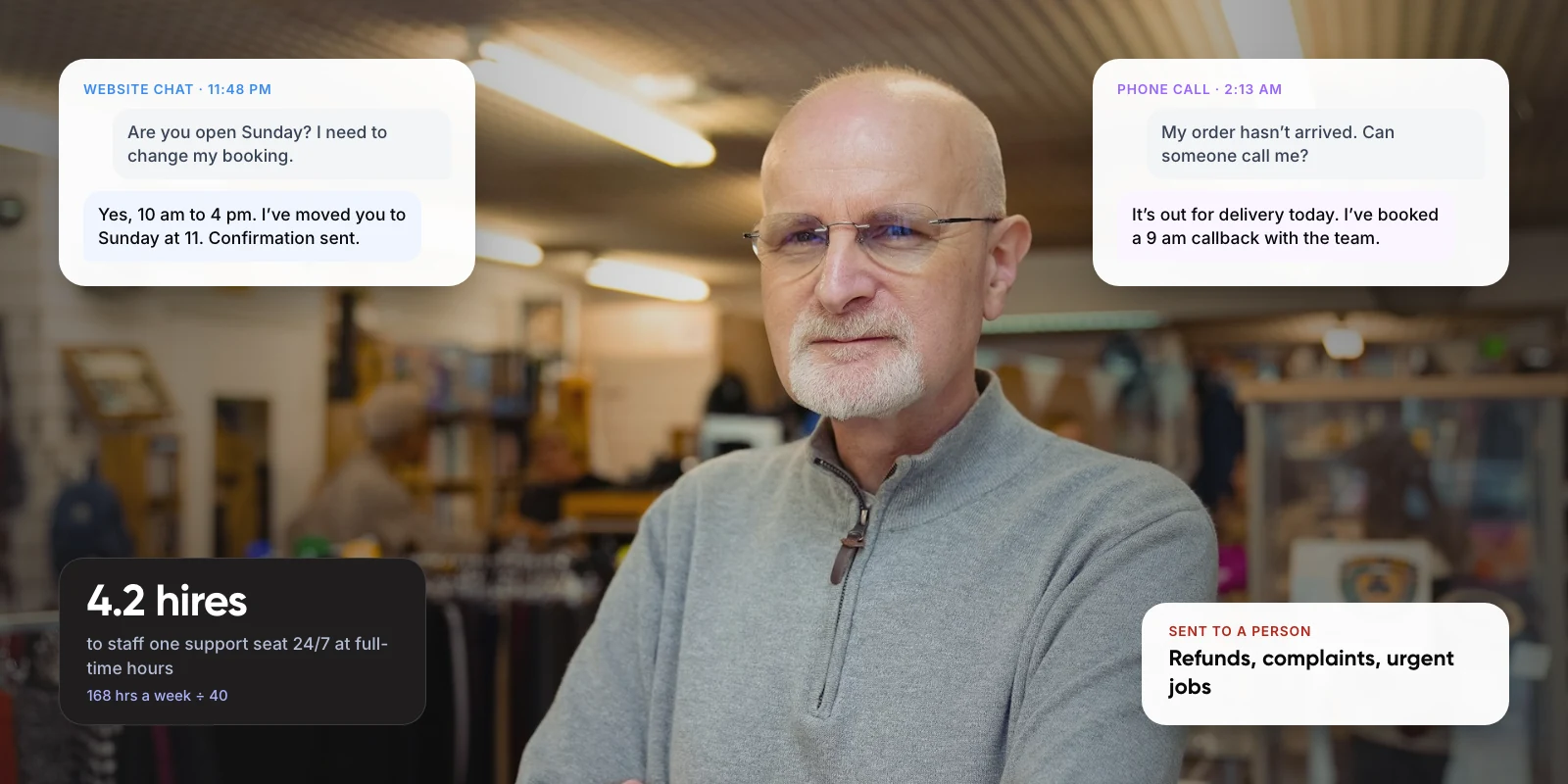
A week has 168 hours. One full-time employee covers about 40 of them, so keeping a single seat staffed day and night takes roughly 4.2 people, before holidays and sick days. That is the number most owners underestimate.
The US Bureau of Labor Statistics puts the median pay for customer service representatives at $21.53 an hour ($44,770 a year) in May 2025. At 4.2 hires, wages alone come to about $188,000 a year, or $15,700 a month. Payroll tax, benefits, software and training sit on top.
Customers still expect fast answers at night. In a 2025 InMoment survey of more than 1,200 consumers, 7 in 10 wanted a response within an hour, and about 2 in 5 within five minutes.
Key takeaways
- Staffing one support seat 24/7 takes about 4.2 full-time hires, roughly $188,000 a year in US wages alone.
- A live answering service such as Ruby starts at $250 a month for 50 minutes of receptionist time, and every call rounds up to a full minute.
- AI agents bill per outcome or per minute: Intercom’s Fin charges $0.99 per outcome, and Retell voice agents run $0.07 to $0.31 a minute.
- The cheapest setup that still works is AI first, with urgent cases sent to a person on call.
2. What Are Your Options for 24/7 Support?
There are four realistic routes. They differ less in what they promise than in how you pay: per hour, per minute, or per resolved conversation. Prices below are published list prices in the US.
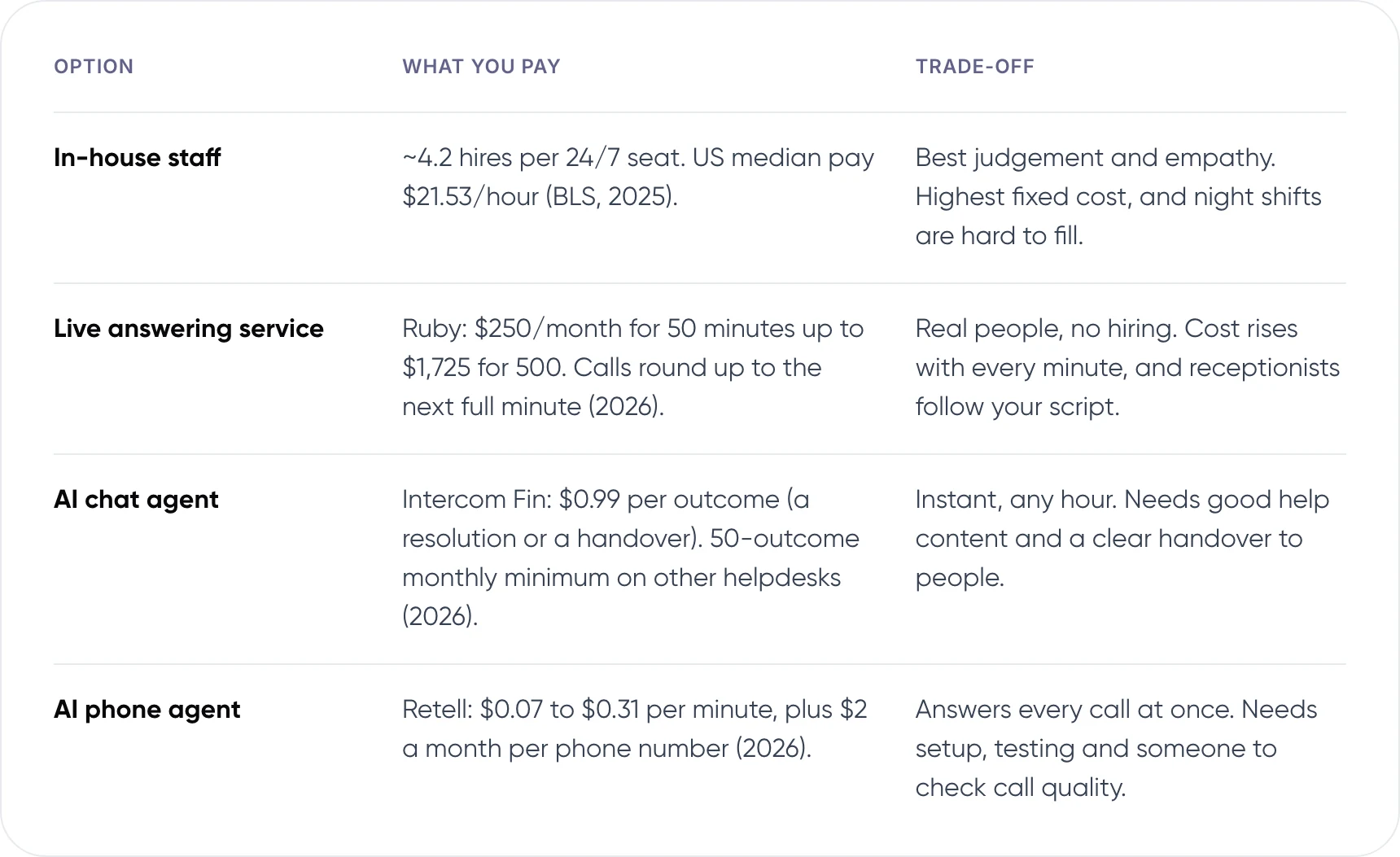
- In-house staff — What you pay: ~4.2 hires per 24/7 seat. US median pay $21.53/hour (BLS, 2025). Trade-off: Best judgement and empathy. Highest fixed cost, and night shifts are hard to fill.
- Live answering service — What you pay: Ruby: $250/month for 50 minutes up to $1,725 for 500. Calls round up to the next full minute (2026). Trade-off: Real people, no hiring. Cost rises with every minute, and receptionists follow your script.
- AI chat agent — What you pay: Intercom Fin: $0.99 per outcome (a resolution or a handover). 50-outcome monthly minimum on other helpdesks (2026). Trade-off: Instant, any hour. Needs good help content and a clear handover to people.
- AI phone agent — What you pay: Retell: $0.07 to $0.31 per minute, plus $2 a month per phone number (2026). Trade-off: Answers every call at once. Needs setup, testing and someone to check call quality.
Outsourcing to a contact centre is a fifth route. It is usually priced per agent hour, and rates vary widely by country and contract, so get two or three quotes before you compare.
3. Which Is Cheapest? A Worked Example
Take a small business that gets 300 chat conversations and 100 phone calls a month, each call about 3 minutes. That is 300 call minutes. Assume an AI agent resolves half the chats on its own, which is our working assumption, not a vendor figure.
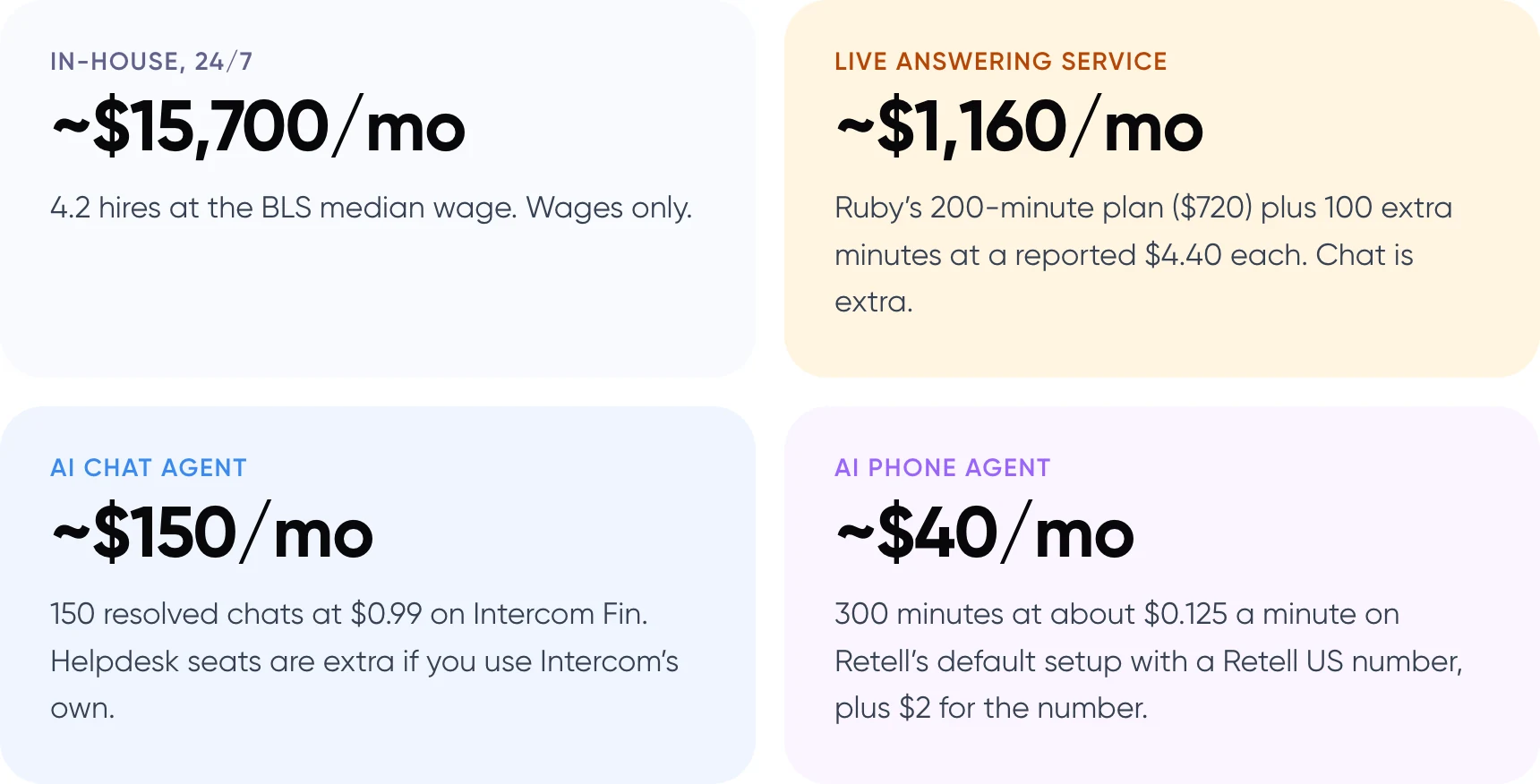
- In-house, 24/7: ~$15,700/mo — 4.2 hires at the BLS median wage. Wages only.
- Live answering service: ~$1,160/mo — Ruby’s 200-minute plan ($720) plus 100 extra minutes at a reported $4.40 each. Chat is extra.
- AI chat agent: ~$150/mo — 150 resolved chats at $0.99 on Intercom Fin. Helpdesk seats are extra if you use Intercom’s own.
- AI phone agent: ~$40/mo — 300 minutes at about $0.125 a minute on Retell’s default setup with a Retell US number, plus $2 for the number.
On monthly running costs, the AI options cost a small fraction of the other two. Those AI figures leave out setup, the time to write good answers, and the human time for the half of chats the agent can’t close. In our view, a hybrid is the right answer for most small businesses: AI takes every chat and call, and a person picks up escalations next morning or on call for emergencies.
Note: Fin bills at most once per conversation. A handover to a person is billed too, and a customer who leaves without asking for more help counts as resolved. Check each vendor’s definition of a resolution before you budget.
4. What Should an AI Answering Service Handle?
An AI answering service works best on questions with one correct answer that lives in your help content or booking system. It struggles with judgement calls and upset customers.
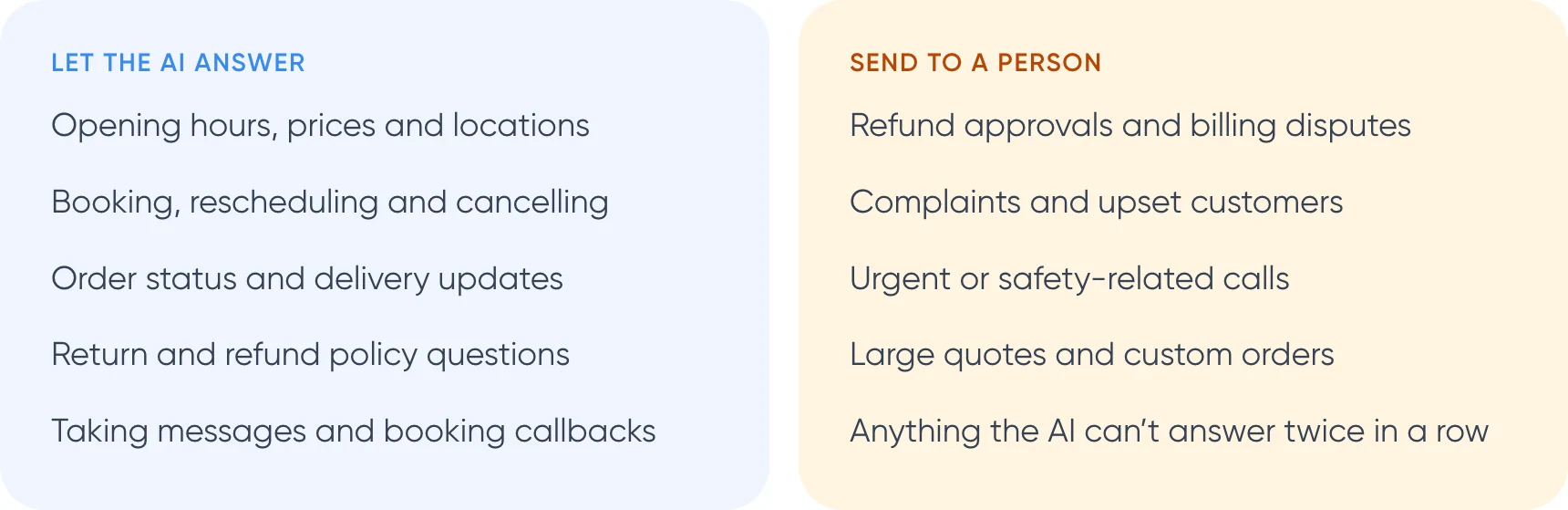
Let the AI answer
- Opening hours, prices and locations
- Booking, rescheduling and cancelling
- Order status and delivery updates
- Return and refund policy questions
- Taking messages and booking callbacks
Send to a person
- Refund approvals and billing disputes
- Complaints and upset customers
- Urgent or safety-related calls
- Large quotes and custom orders
- Anything the AI can’t answer twice in a row
Always offer a clear route to a human. Gartner’s 2026 survey found ~87% of customers say access to a human agent is essential when a company uses generative AI for service.
Warning: Decide in advance what counts as urgent at 2 am, such as a gas leak for a plumber or a failed payment run for a payroll firm. Those calls should ring a person, not wait for the morning queue.
5. What Can a Small Business Learn From Klarna?
Klarna is far from a small business, but its numbers show what automated customer support can absorb. In its February 2024 announcement, the company said its AI assistant handled 2.3 million conversations in its first month, two-thirds of all its service chats. Klarna said that was the work of 700 full-time agents. Average resolution time fell from 11 minutes to under 2, and repeat inquiries dropped by ~25%.
The follow-up matters as much. In May 2025, Klarna’s chief executive told Bloomberg that a cost-first approach had led to lower quality, and that customers should always be able to reach a human. The lesson for a small business is the same at any size: let AI handle volume, and protect the conversations where a person makes the difference.
Want to know what 24/7 AI support would cost for your volumes? We can work it out with you.
6. How Do You Set Up 24/7 Support on a Small Budget?
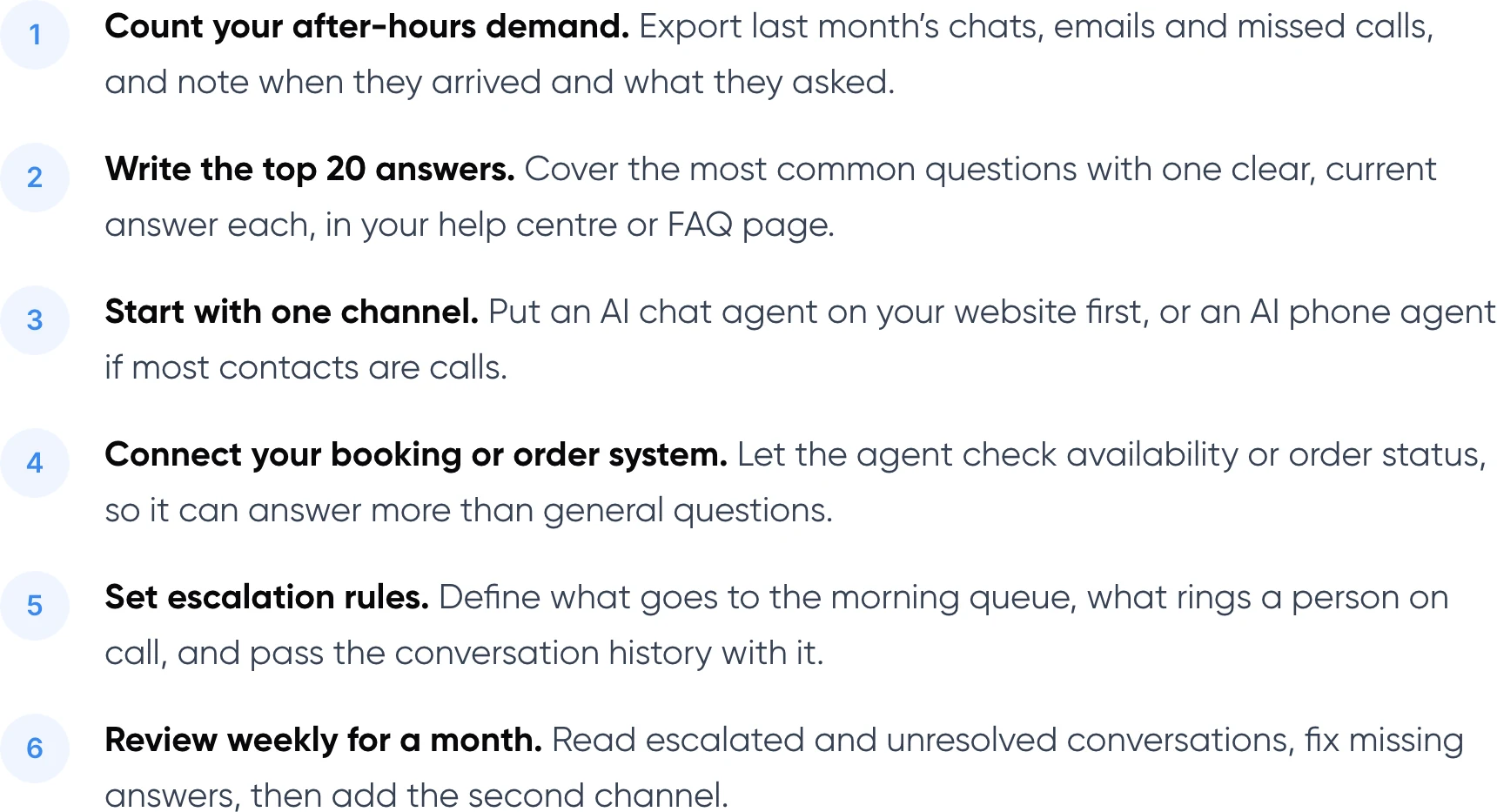
- Count your after-hours demand. Export last month’s chats, emails and missed calls, and note when they arrived and what they asked.
- Write the top 20 answers. Cover the most common questions with one clear, current answer each, in your help centre or FAQ page.
- Start with one channel. Put an AI chat agent on your website first, or an AI phone agent if most contacts are calls.
- Connect your booking or order system. Let the agent check availability or order status, so it can answer more than general questions.
- Set escalation rules. Define what goes to the morning queue, what rings a person on call, and pass the conversation history with it.
- Review weekly for a month. Read escalated and unresolved conversations, fix missing answers, then add the second channel.
For how an agent looks up order and account data reliably, see our guide to agentic RAG for customer service.
7. What Hidden Costs Should You Plan For?
Per-minute and per-resolution prices are the visible part. Voice platforms such as Retell bill the voice engine, the language model and the phone line separately, plus a monthly fee for each phone number. AI chat products often add seat fees or monthly minimums. Live answering services charge extra minutes once you pass your plan, usually at a higher rate than the included ones.
The largest cost is usually time. Someone has to write and update answers, connect the agent to bookings or orders, and read a sample of conversations each week. Budget a few hours a week for the first two months. If nobody owns that work, answer quality drifts and customers stop trusting the bot.
8. Frequently Asked Questions
What is the cheapest way to offer 24/7 customer support?
For most small businesses it is an AI agent on chat and phone, with a person on call for urgent cases. AI chat agents such as Intercom Fin charge $0.99 per resolved conversation, and AI phone agents such as Retell charge $0.07 to $0.31 a minute. Staffing 24/7 with people takes about 4.2 hires per seat.
How much does an AI answering service cost?
AI phone agents usually bill per minute. Retell lists $0.07 to $0.31 a minute in 2026, depending on the voice, language model and phone line you choose; its default setup comes to about $0.11 to $0.13 a minute. Each phone number costs $2 a month. Add setup time and the hours someone spends checking calls and updating answers.
Is a live answering service better than AI?
A live service like Ruby gives you real people, which helps for sensitive or high-value calls. It costs more per minute: $250 a month buys 50 minutes, or $5 a minute. Many small businesses use AI for routine calls and keep a human service or an on-call owner for the rest.
What are the pros and cons of automated customer support?
Automated support answers instantly at any hour and costs far less per contact. Klarna reported resolution times falling from 11 minutes to under 2. The downsides are setup effort, wrong answers if your content is out of date, and frustration if customers can’t reach a person.
Will customers accept an AI agent?
Many will, if it solves their problem quickly and offers a way to reach a human. Gartner’s 2026 survey found ~87% of customers say human access is essential when companies use generative AI for service. Make the handover easy and tell customers when a person will follow up.
9. Conclusion
Round-the-clock staff costs a small business about 4.2 hires per seat, while an AI answering service costs cents per minute or about a dollar per resolved chat. The cheapest setup that still treats customers well is AI first, with clear escalation to a person. Start by counting last month’s after-hours chats and calls, then price them against the options above.
For an example of our support work, see Paymate.
If you want help setting up round-the-clock support, our AI customer support automation service builds AI chat and phone agents that connect to your systems and hand over to your team when needed.
Author