How to Balance Automation and Live Support Staff
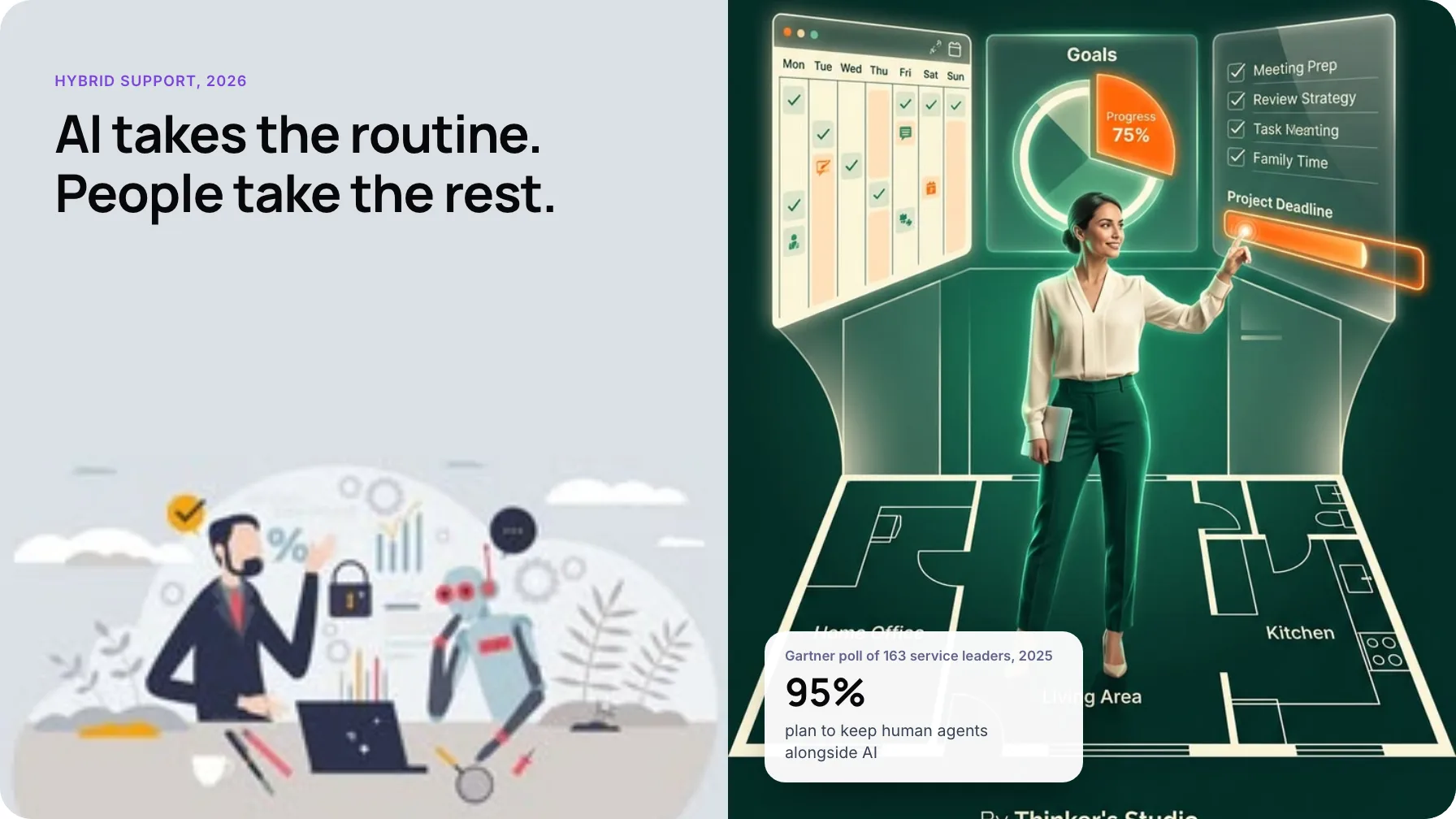
Customer service automation works best when AI resolves routine, low-risk requests and people own the complex, emotional and high-value ones. Most companies are landing there: in a 2025 Gartner poll, 95% of service leaders said they plan to keep human agents alongside AI.
This guide covers how to split the work, when a bot should hand over, how many agents you still need and what went wrong at companies that cut too far.
1. The Short Answer
To balance automation and live support staff, let AI resolve the requests that are frequent, structured and low-risk, give your agents AI help on everything else, and keep people in charge of complaints, money and judgment calls.
Analysts reached the same conclusion. In June 2025, Gartner predicted that by 2027, half of the organizations that planned to cut their service workforce because of AI will drop those plans. Its analysts called a hybrid of AI and human agents the most effective strategy.
Key takeaways
- Split work by intent. AI resolves frequent, structured, low-risk requests. People own complaints, refunds, regulated issues and high-value accounts.
- In a 2025 Gartner poll, 95% of service leaders planned to keep human agents alongside AI, and Gartner expects half of planned AI headcount cuts to be dropped by 2027.
- Agent assist is often the fastest win. One study of 5,172 agents found AI suggestions raised issues resolved per hour by 14%, and by 34% for novices.
- Write handoff rules before launch, pass full context to the agent, and keep headcount flat until the bot has handled a full busy period.
2. Why Not Automate All of Customer Service?
Because the companies that tried ran into quality problems and rising workload. A Gartner analyst told The Register in 2025 that projects expecting generative AI to answer every query were falling short on both results and unexpected costs.
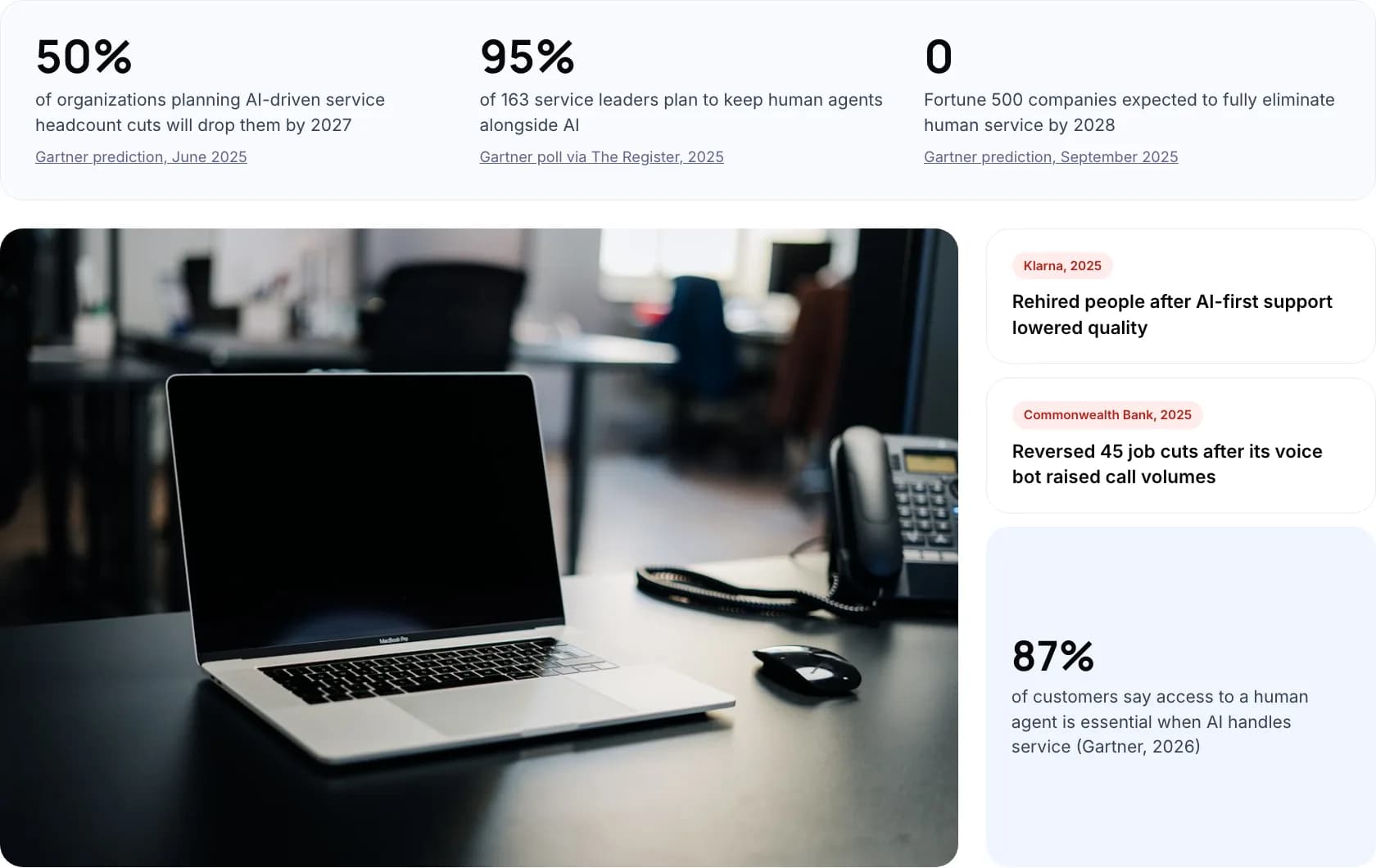
- 50%: of organizations planning AI-driven service headcount cuts will drop them by 2027 (Gartner prediction, June 2025).
- 95%: of 163 service leaders plan to keep human agents alongside AI (Gartner poll via The Register, 2025).
- 0: Fortune 500 companies expected to fully eliminate human service by 2028 (Gartner prediction, September 2025).
- Klarna, 2025: rehired people after AI-first support lowered quality.
- Commonwealth Bank, 2025: reversed 45 job cuts after its voice bot raised call volumes.
- 87%: of customers say access to a human agent is essential when AI handles service (Gartner, 2026).
Customers also want the option. In 2026, Gartner found 87% of customers say access to a human agent is essential when a company uses generative AI for service. A bot that hides the exit costs you trust even when its answers are right.
3. What Should AI Handle and What Should People Handle?
Split the work by intent, meaning the reason the customer got in touch, rather than by channel. Two questions decide each intent: is the answer the same every time, and what does a wrong answer cost?
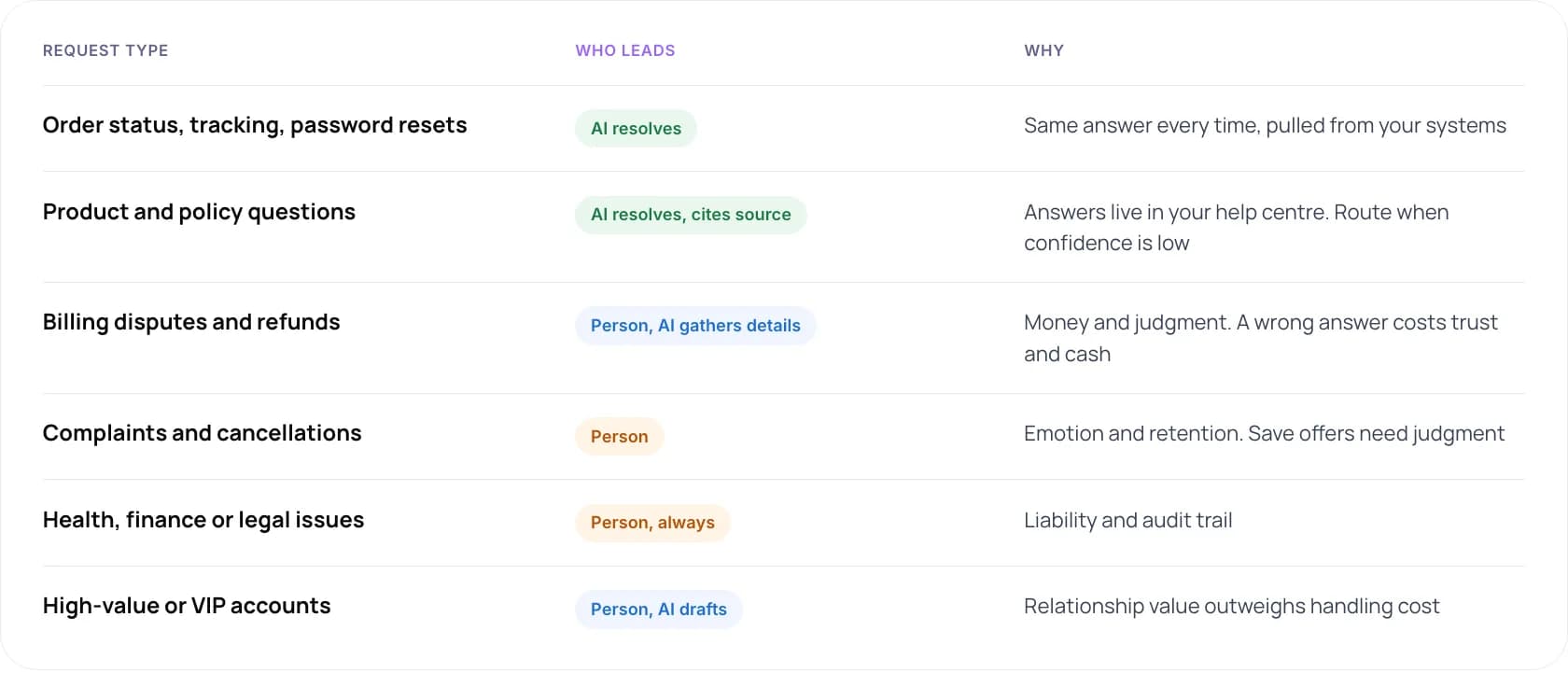
- Order status, tracking, password resets: AI resolves. Same answer every time, pulled from your systems.
- Product and policy questions: AI resolves and cites its source. Answers live in your help centre. Route when confidence is low.
- Billing disputes and refunds: a person leads and AI gathers details. Money and judgment, so a wrong answer costs trust and cash.
- Complaints and cancellations: a person. Emotion and retention, and save offers need judgment.
- Health, finance or legal issues: a person, always. Liability and audit trail.
- High-value or VIP accounts: a person leads and AI drafts. Relationship value outweighs handling cost.
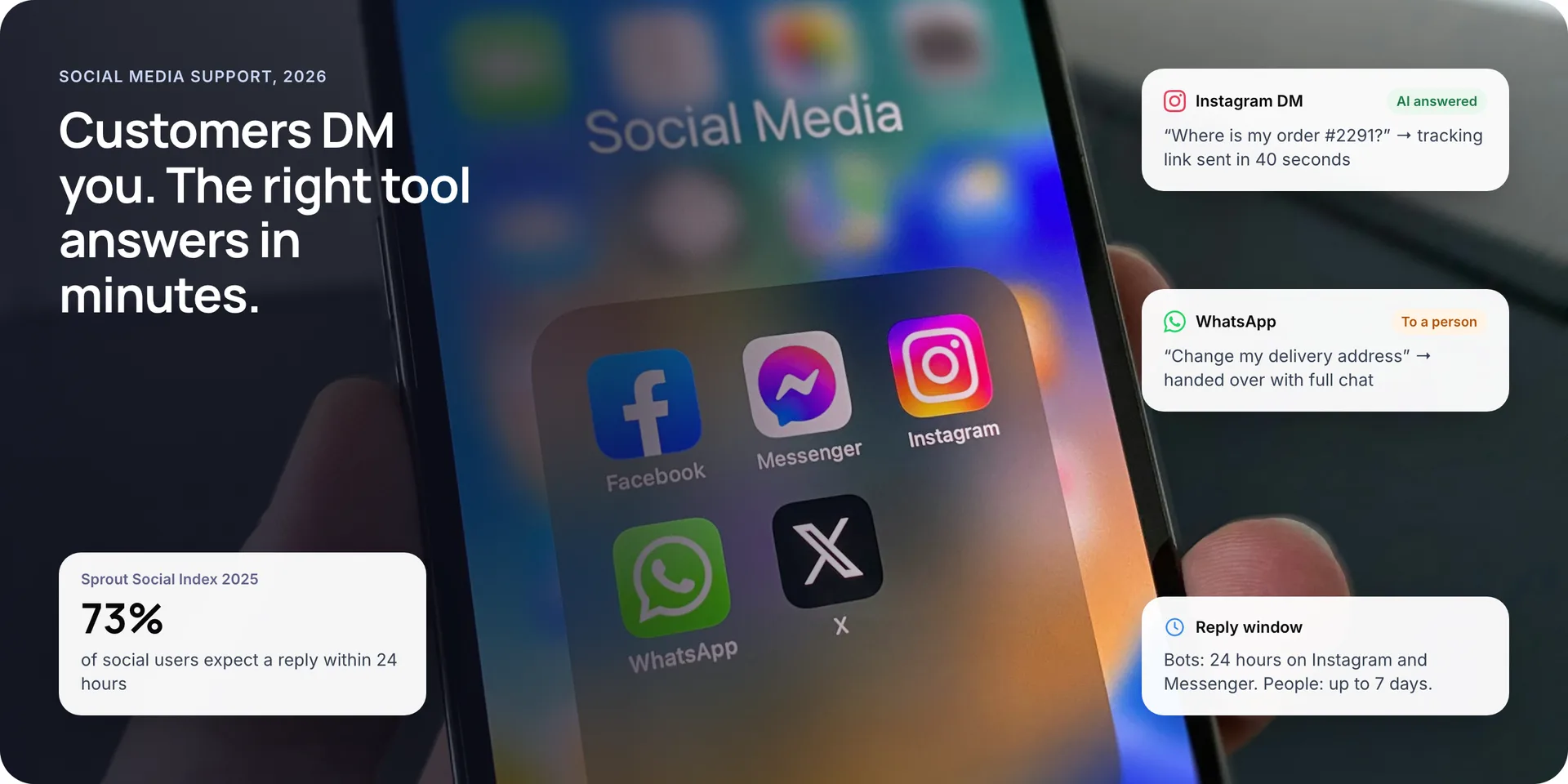
Most service teams are still early on this curve. In Salesforce’s 2025 State of Service survey of 6,500 service professionals, teams estimated AI handles 30% of cases today and expect 50% by 2027.
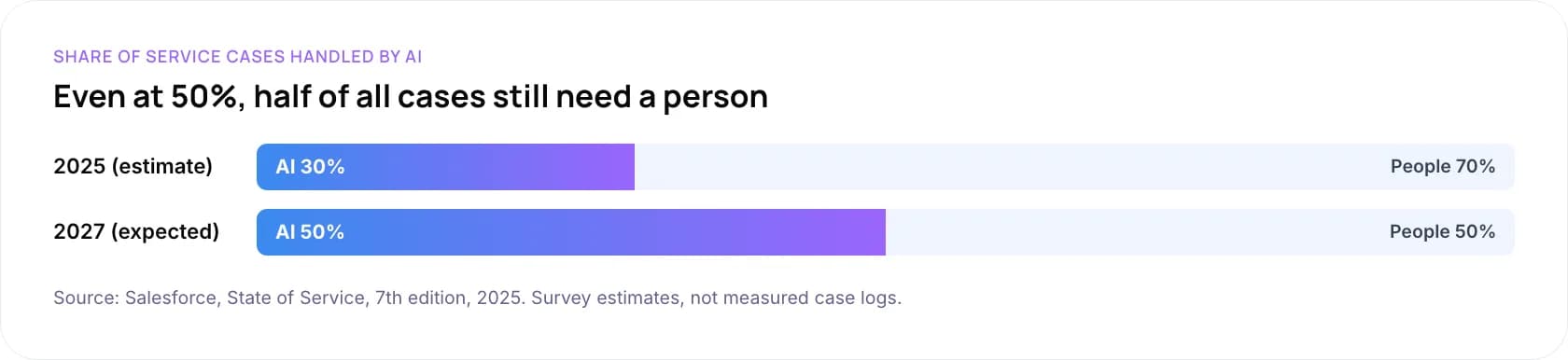
Even at 50%, half of all cases still need a person. These are survey estimates, not measured case logs (Salesforce, State of Service, 7th edition, 2025).
4. What Does a Hybrid Customer Support Model Look Like?
Think in three layers rather than bot versus human. Each conversation enters at the top and drops to the next layer when it needs more judgment.
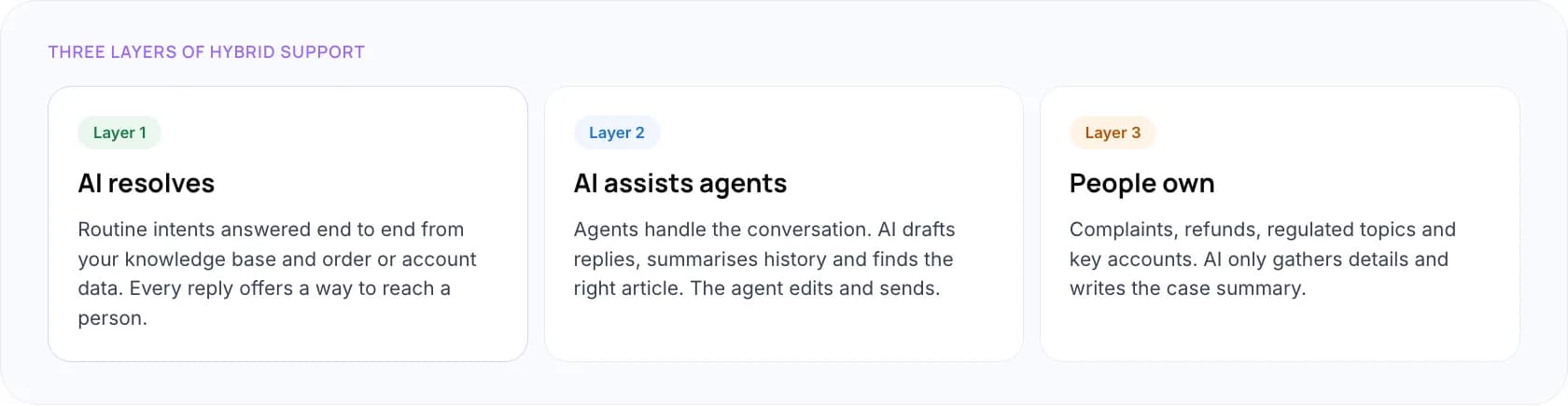
- Layer 1, AI resolves: routine intents answered end to end from your knowledge base and order or account data. Every reply offers a way to reach a person.
- Layer 2, AI assists agents: agents handle the conversation. AI drafts replies, summarises history and finds the right article. The agent edits and sends.
- Layer 3, people own: complaints, refunds, regulated topics and key accounts. AI only gathers details and writes the case summary.
The middle layer is where most of the value sits
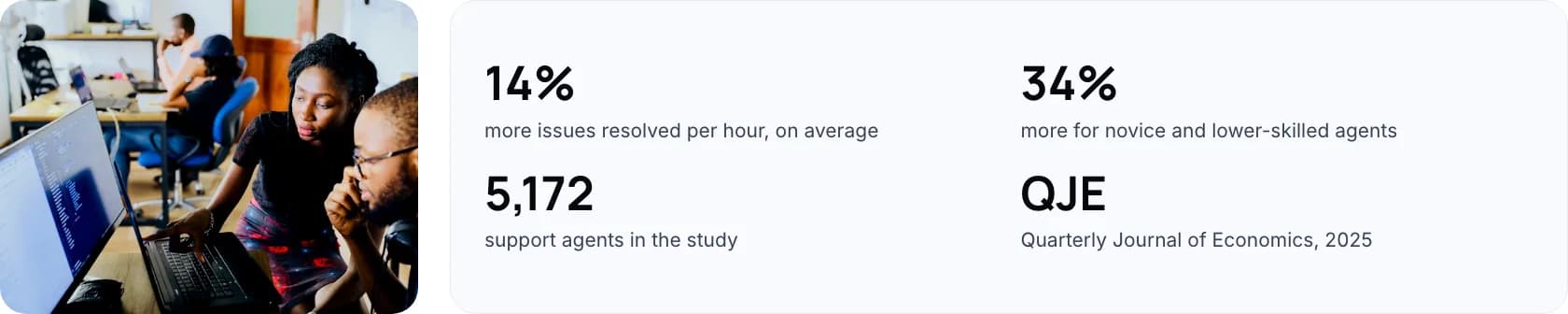
Teams often skip agent assist and go straight to a customer-facing bot. The best field evidence points the other way. In a study of 5,172 support agents published in the Quarterly Journal of Economics in 2025, an AI assistant that suggested replies raised issues resolved per hour by 14% on average and by 34% for novice agents. Agents stayed in charge of every conversation.
Note: The same study found little gain for the most experienced agents. Our view is that AI assist pays back fastest in teams with high turnover or a lot of new hires, because it spreads what your best people already know.
5. How to Set Up a Hybrid Approach in 6 Steps
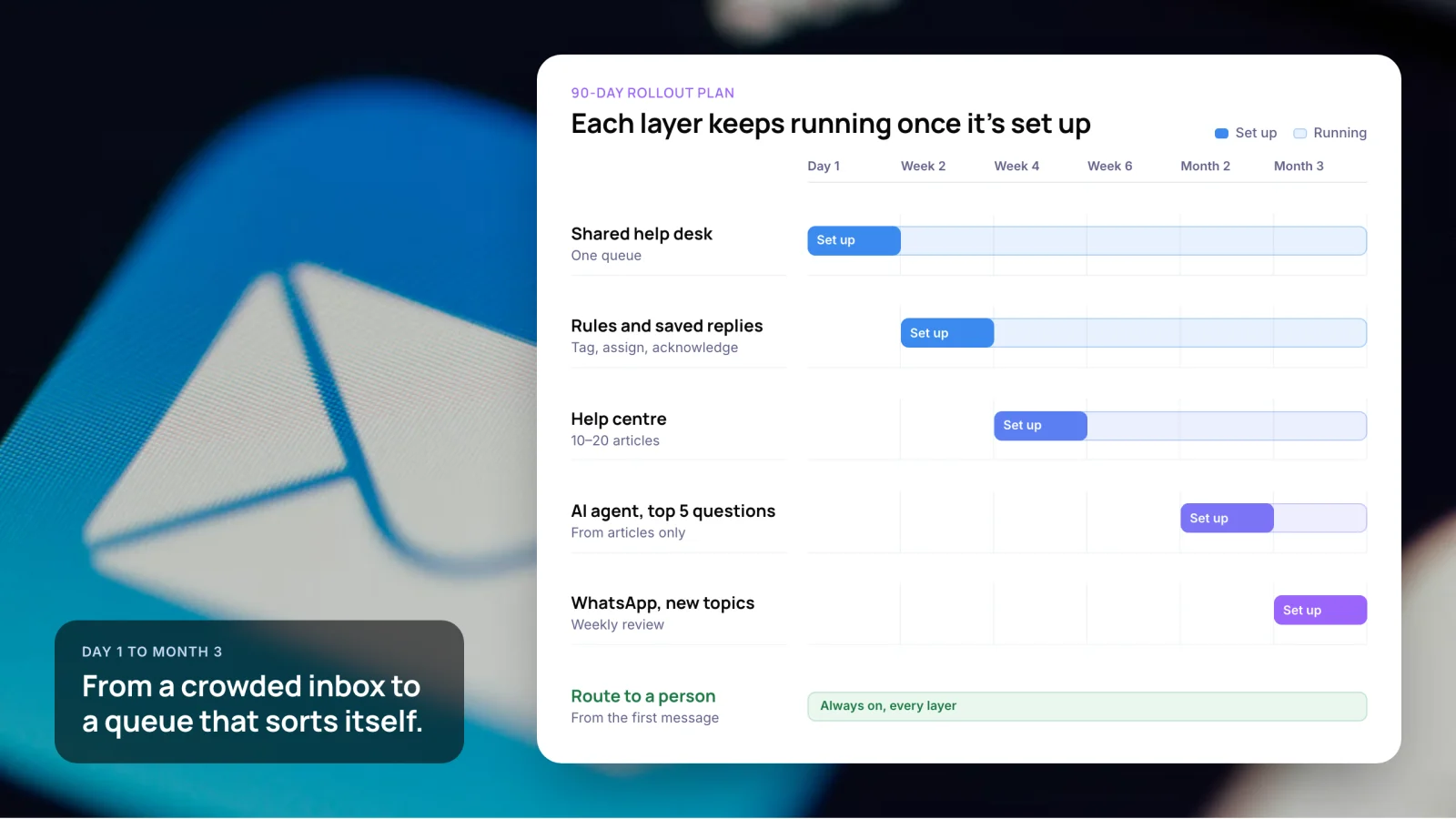
- Tag 90 days of tickets by intent. Export conversations from every channel and group them by reason for contact. A few intents usually make up most of the volume.
- Score each intent on volume, risk and data. Note how often it comes up, what a wrong answer costs and which systems the answer depends on.
- Automate two or three low-risk intents first. Pick high-volume, low-risk ones such as order status. Connect the bot to live data so it answers with facts, not guesses.
- Write handoff rules before go-live. Decide the triggers in section 6 and what the agent sees when a chat arrives.
- Give agents AI assist at the same time. Drafted replies and summaries help on the conversations the bot cannot close.
- Review weekly, then expand. Track resolution rate, reopen rate and satisfaction by intent. Add the next intent only when the current ones hold up.
Tip: Keep headcount flat until the bot has run for at least one full busy period. Peaks show where it fails, and you need people to absorb those failures.
6. When Should a Bot Hand Over to a Live Agent?
The handoff is where hybrid support usually breaks. Write the rules before launch, and make sure the agent receives the context along with the chat.
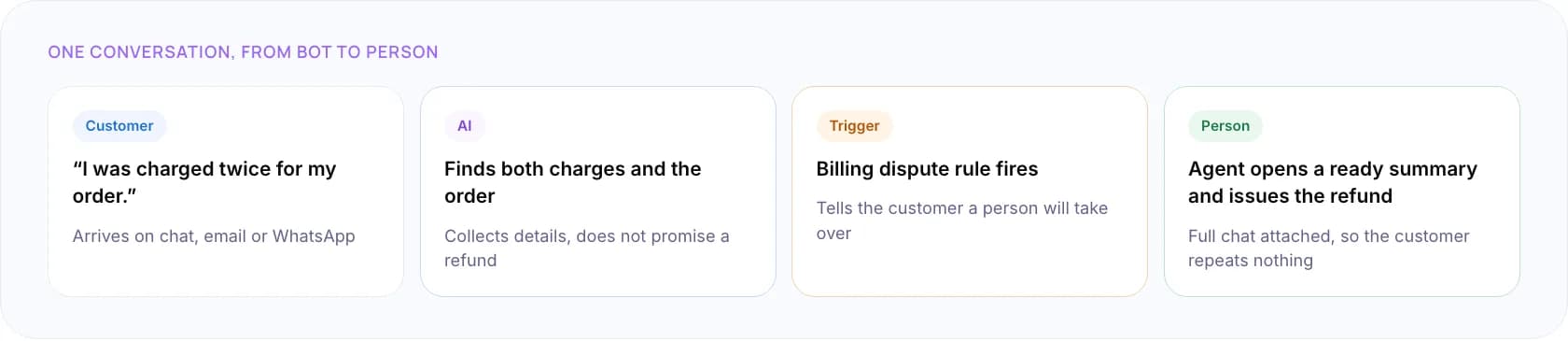
- Customer: “I was charged twice for my order.” It arrives on chat, email or WhatsApp.
- AI: finds both charges and the order. It collects details and does not promise a refund.
- Trigger: the billing dispute rule fires and the customer is told a person will take over.
- Person: the agent opens a ready summary and issues the refund. The full chat is attached, so the customer repeats nothing.
Five triggers to write down before launch:
- The customer asks for a person. Hand over on the first request. Making people ask twice is the quickest way to lose them.
- The answer is not in the knowledge base. Let the bot say it does not know and route the chat, rather than guess.
- Two failed attempts. If the customer rephrases twice or rejects two answers, stop and escalate.
- Negative sentiment or risk words. Terms such as cancel, refund, complaint, fraud or legal go straight to the human queue.
- Anything that moves money or changes an account. The bot can prepare the change. A person approves it.
Context is the part customers notice. In Zendesk’s CX Trends 2026 report, 81% of consumers said they expect agents to pick up where the conversation left off instead of making them repeat themselves.
Want help drawing the line between AI and your team? Book a free AI consultation.
7. How Many Live Support Staff Do You Still Need?
Staffing follows from two numbers: the share of conversations AI fully resolves, and how long the rest take. The estimate assumes 120 productive hours per agent each month and ignores shift cover, peaks and training time, so treat it as a floor.
The formula: conversations left for people = conversations × (1 − AI share). Agent hours = those conversations × handling time in minutes ÷ 60, divided by 1.14 if agents use AI assist. Agents needed = agent hours ÷ 120, rounded up to the nearest half agent.
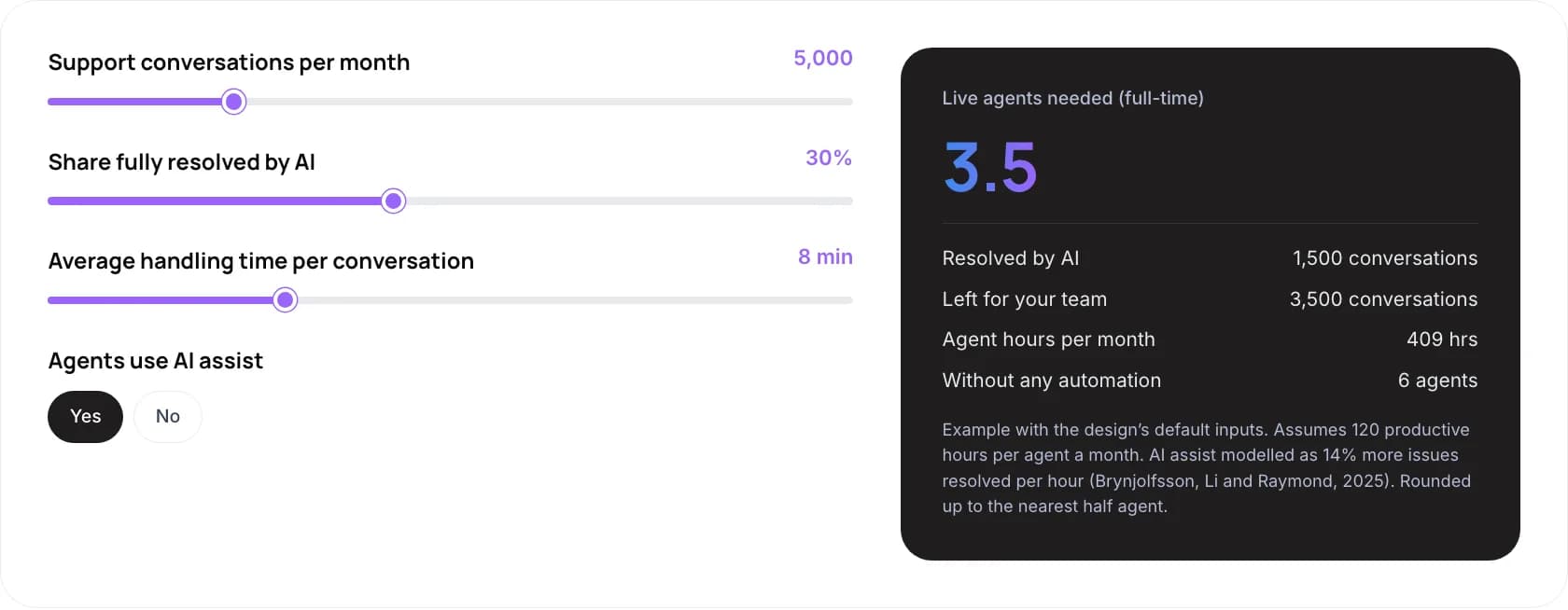
Worked example with the design’s default inputs: 5,000 conversations a month, 30% fully resolved by AI and an 8-minute average handling time, with AI assist on. AI resolves 1,500 conversations and leaves 3,500 for your team. That is about 409 agent hours a month, or 3.5 full-time agents, against 6 agents without any automation. AI assist is modelled as 14% more issues resolved per hour (Brynjolfsson, Li and Raymond, 2025).
The conversations that remain for people are harder on average, because the easy ones went to the bot. Expect handling time per human conversation to rise after launch, and plan staffing on the new figure. To weigh software cost against hours saved, try our free AI ROI Calculator.
8. Real Examples of Getting the Balance Wrong, and Right
Klarna: strong volume numbers, then a step back
In February 2024, Klarna said its AI assistant handled 2.3 million conversations in its first month, two-thirds of its service chats, and did the work of 700 full-time agents. In May 2025, its CEO told Bloomberg that the AI-first approach had produced lower-quality service, and that Klarna was hiring people again so customers could always reach a human.
Commonwealth Bank: cuts made before the bot proved itself
In July 2025, Commonwealth Bank of Australia cut 45 call-centre roles after launching an AI voice bot. A month later it reversed the decision and called it an error. The Finance Sector Union said call volumes had risen, with team leaders moved onto the phones to cope.
How we approach it
We design the handoff first and the bot second. For a payments company, we built an omnichannel customer support system that answers high-confidence email queries in under a minute and hands the rest to human support with context. For ecommerce merchants, we built an AI assistant that drafts replies from live order data, with an agent approving each one.

9. Common Mistakes
- Cutting staff before measuring the bot. Commonwealth Bank reversed 45 redundancies in 2025 after call volumes rose.
- Tracking deflection only. A closed chat is not a solved problem. Track reopen rate and repeat contacts too.
- Hiding the human option. 87% of customers in Gartner’s 2026 survey call human access essential.
- Handing over without context. If the agent starts from zero, the customer repeats everything and the bot added a step.
- Automating complaints first. Start with the predictable intents. Complaints are where a wrong answer costs most.
10. Frequently Asked Questions
What is a hybrid approach to customer service automation?
It is a support model where AI fully resolves routine requests, AI tools help agents on the rest, and people own complex, emotional or high-risk cases. Work is split by the customer’s intent. Clear handoff rules move conversations from the bot to a person with full context.
What percentage of customer service can be automated?
It depends on your mix of requests. In Salesforce’s 2025 State of Service survey, service teams estimated AI handles 30% of cases today and expected 50% by 2027. Teams with many order-status and account questions can automate more. Teams dealing mostly with complex B2B issues will automate less.
What are the pros and cons of automated customer service?
The pros are round-the-clock answers, instant replies to routine questions and lower cost per conversation. The cons are wrong answers on unusual cases, frustration when customers cannot reach a person, and setup and upkeep costs. A hybrid model keeps the speed and limits the risks by routing hard cases to people.
Will AI replace customer service agents?
Not fully. Gartner predicts that no Fortune 500 company will have fully eliminated human customer service by 2028. It also expects half of the organizations planning AI-driven service headcount cuts to drop those plans by 2027. The work changes: agents handle fewer routine requests and more complex ones.
When should a chatbot hand over to a human agent?
Hand over when the customer asks for a person, when the answer is not in the knowledge base, or after two failed attempts. Do the same when the message shows anger or mentions refunds, cancellations, fraud or legal issues, and for any action that moves money. Pass the full chat and a summary to the agent.
How do you know the balance is right?
Track results by intent, not just in total. For automated intents, watch resolution rate, reopen rate and satisfaction scores. For human queues, watch wait time and handling time. If reopens rise on an automated intent, move it back toward people until the bot’s answers improve.
11. Conclusion
Good customer service automation decides, intent by intent, what AI resolves, what it helps with and what stays with people. Start by tagging last quarter’s tickets and picking two low-risk intents to automate. Give your agents AI assist at the same time, and set a review date before you change headcount.
See our AI customer support automation services or custom AI agent development, or read how customer support automation works.
Author