How to Automate Inbound Phone Support with AI Voice Agents
An AI voice agent answers inbound calls, resolves routine requests by connecting to your systems, and transfers the rest to a person with full context.
This guide covers which calls to automate first, how the technology works, what published deployments reported, a seven-step rollout plan and the rules to follow.
1. The Short Answer
To automate inbound phone support, put an AI voice agent in front of your queue, connect it to the systems that hold the answers, and set clear rules for when it transfers to a person. Start with two or three frequent call types, not the whole phone line.
The direction is clear. In March 2025, Gartner predicted that agentic AI will autonomously resolve 80% of common customer service issues without human intervention by 2029, leading to a 30% reduction in operational costs. It is a prediction, not a result, and it covers common issues, not every call.
Key takeaways
- Start with two or three frequent, predictable call types, such as payments or order status.
- An AI voice agent completes tasks through your systems; an IVR only routes calls.
- PG&E’s agent went from a 3.5% containment target to 67%, according to its vendor, PolyAI.
- 64% of customers said they would prefer companies didn’t use AI for service (Gartner, 2024), so keep a clear route to a person.
- In the EU, Article 50 of the AI Act has required providers to design AI systems that talk to people so users are told it is AI, unless that is obvious, since August 2, 2026.
2. What Is an AI Voice Agent?
An AI voice agent (also called an AI phone agent) is software that holds a spoken conversation with a caller. It understands free speech, looks up or changes data in your systems, and replies in a natural voice.
That makes it different from an IVR (interactive voice response), the “press 1 for billing” menu. An IVR routes calls. A voice agent can finish the job, such as taking a payment or rescheduling an appointment, while the caller speaks in their own words.
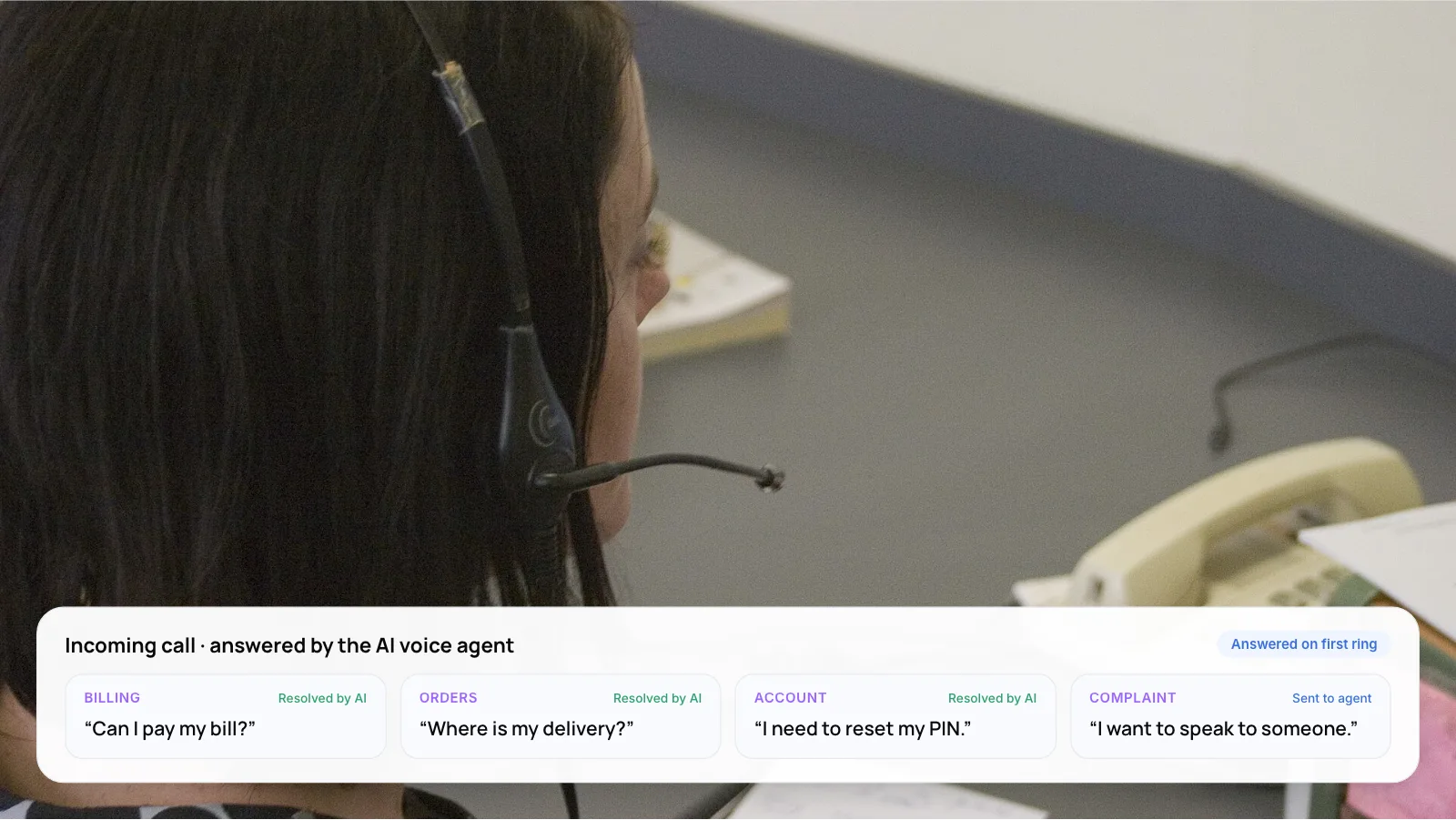
On a support line, a call goes through four steps:
- Answer. Pick up every call right away.
- Understand. Work out the request from natural speech.
- Resolve. Complete the task in your systems.
- Transfer. Pass complex calls to a person with context.
Note: “AI receptionist” and “AI answering service” can describe simpler products that take messages or book into a calendar. For a support line, look for an agent that can act inside your CRM, billing or order system.
3. Which Inbound Calls Should You Automate First?
Pick calls that are frequent, follow a predictable pattern and can be completed through a system you already have. Leave emotional or high-risk calls with people.
- Automate first: payments and balances. Take a payment, read a balance or set up a plan. According to PolyAI’s guide, PG&E’s voice agent cut payment transactions from roughly seven minutes to 3.5. Needs: a billing API and caller verification.
- Automate first: order and appointment status. Where is my order, change my slot, cancel my booking. Needs: access to your order or scheduling system.
- Automate next: account changes and FAQs. Update an address, reset a PIN, explain a policy, report an outage. Needs: CRM access and an approved knowledge base.
- Keep with people: complaints and sensitive calls. Disputes, cancellations with retention offers, bereavement and vulnerable callers. The AI’s role here is to identify the reason, summarize it and transfer.
Our view: begin where the integration already exists. A retail bank working with PolyAI resolved 30% of calls with no API integrations, partly by sending callers an SMS link to the right online page. That is a sensible first phase for teams without clean APIs.
4. How Does an AI Voice Agent Handle a Call?
Every turn of the conversation runs through the same five stages. Delays matter at each one, because a long pause makes a call feel broken.
- Speech to text. The caller’s audio is transcribed as they speak, including accents and background noise.
- Understand the request. A language model works out what the caller wants and which details are still missing, such as an account number.
- Verify the caller. For account actions, the agent checks identity, for example with a PIN or a one-time code sent by SMS.
- Act in your systems. It calls your CRM, billing or order API to look up or change data, then confirms the result.
- Reply or transfer. The answer is spoken back in a natural voice. If the agent is unsure, or the caller asks for a person, it transfers the call with a summary.
Tip: make the handoff carry context. Online travel agency Hopper’s voice assistant hands calls to a travel agent with the relevant context through Amazon Connect, so customers don’t need to repeat information.
5. AI Voice Agent vs IVR vs Human Agents
Most contact centers end up running all three. The question is which one answers first.
- How callers speak. IVR: keypad or set phrases. AI voice agent: their own words. Human agents: their own words.
- Completes tasks. IVR: rarely, mostly routes. AI voice agent: yes, through your APIs. Human agents: yes.
- Wait time. IVR: none, then a queue. AI voice agent: none. Human agents: depends on staffing.
- Best for. IVR: simple routing. AI voice agent: frequent, predictable requests. Human agents: complaints, complex or sensitive cases.
- Main risk. IVR: callers press 0 to escape. AI voice agent: wrong answers if data or rules are thin. Human agents: long queues at peak times.
Our assessment of typical setups, not a survey.
Customers need convincing. In a Gartner survey of 5,728 customers (fieldwork in December 2023, released in July 2024), 64% said they would prefer companies didn’t use AI for customer service. Their top concern was that it would get harder to reach a person. A visible way to ask for an agent at any time speaks to that concern.
6. What Results Have Companies Reported?
The clearest public example is Pacific Gas and Electric (PG&E), a US utility. According to PolyAI’s case study, unpredictable weather created call peaks, callers could wait over an hour to speak to someone, and the legacy IVR was outdated.
The agent first worked alongside the existing IVR and started without API integrations. A target of 3.5% call containment was set as the level for positive ROI. The case study says the agent contained 15% of calls on the first day and that overall containment has reached 67%. Containment means the share of calls finished without a person.
- 67% containment, which PolyAI says is 6% higher than the legacy IVR.
- 35,000 labor hours saved.
- +22% CSAT on outage calls.
- About 16 million calls a year.
All PG&E figures are published by PolyAI, not independently audited. Results vary by call mix. Hopper, the online travel agency above, reports that its agent fully resolves 15% of its call volume and transfers the rest to travel agents. Treat both as examples of what happened, not as averages.
From our own work: the AI Voice Assistant is a voice AI platform for inbound and outbound calls, with a knowledge base and calendar and CRM actions. Our role was to stabilize and enhance the existing platform, so we don’t publish call-volume or containment results for it. For handoff design, see Paymate: its support system covers voice, email and web chat, checks its confidence, retries up to three times, then hands the case to human support with context.
Want to know which of your call types an AI voice agent could handle? If you are weighing this for your team, book a 30-minute call and we will walk through it.
7. How to Roll Out an AI Voice Agent in 7 Steps
- Rank your call reasons. Use a recent month of IVR logs or call recordings. Find the reasons with the highest volume and the most predictable flow.
- Set a modest containment target. PG&E started at 3.5%. A low first target lets you prove value before you widen scope.
- Connect the systems that finish the job. Billing, CRM, orders or scheduling. Without them, the agent can only give information.
- Write the transfer rules. List what always goes to a person, how callers ask for one, and what summary the agent passes on.
- Script the greeting and disclosure. Say it is an AI assistant, mention recording, and tell callers they can ask for an agent at any time.
- Test with real recordings. Replay a batch of past calls with different accents and noise levels. Fix misunderstandings before launch.
- Launch on part of the traffic. Route a share of calls to the agent, compare containment, CSAT and transfers with the old line, then scale.
Plan internal time as well as vendor time. A Forrester study cited in PolyAI’s guide modeled about 200 internal labor hours for implementation. It is a modeled figure for one composite organization, so use it as a planning prompt, not a forecast.
8. What Rules Apply to AI Phone Agents?
If any of your callers are in the EU, Article 50 of the EU AI Act has applied since August 2, 2026. Under Article 50(1), providers must make sure AI systems that interact directly with people are designed so those people are told they are dealing with AI, unless that is obvious from the context. Cooley’s summary names voice assistants among the covered systems. Fines for breaking these transparency obligations can reach €15 million or 3% of worldwide annual turnover, whichever is higher (see Article 99).
In the US, the FCC ruled in February 2024 (Declaratory Ruling FCC 24-17) that calls made with AI-generated voices fall under the Telephone Consumer Protection Act’s rules for artificial or prerecorded voices. As Wiley’s alert explains the ruling concerns outbound calls, so it matters if your agent places callbacks or reminders.
Warning: this is general information, not legal advice. As a practical default, say in the greeting that the caller is speaking with an AI assistant and that the call may be recorded, then check recording-consent rules in each state or country you serve. Ask your vendor and your legal advisor how disclosure applies to your setup.
New to the wider topic? Read what customer support automation is and how it works.
9. Frequently Asked Questions
Can an AI voice agent replace human phone agents?
Not fully. It handles frequent, predictable calls well, but complaints, sensitive topics and unusual cases still need people. Gartner predicted in 2025 that agentic AI will resolve 80% of common issues by 2029, which still leaves complex calls for human teams.
What is a good containment rate for an AI phone agent?
It depends on your call mix. Published examples from PolyAI range from 15% of inbound calls fully resolved at Hopper to 67% containment at PG&E. Set a modest first target based on your top call types, then raise it as you add integrations and use cases.
How is an AI voice agent different from an IVR?
An IVR asks callers to press keys or say set phrases, then routes the call. An AI voice agent understands natural speech and can complete tasks in your systems, such as taking a payment or changing an appointment, before transferring anything it cannot handle.
Do customers accept AI on support calls?
Many are wary. Gartner’s survey of 5,728 customers, run in December 2023 and released in 2024, found 64% would prefer companies didn’t use AI for service, and the top concern was that it would get harder to reach a person. A fast answer and a clear option to reach an agent speak to both concerns.
Does an AI voice agent need to say it is AI?
In the EU, Article 50 of the AI Act has required providers to design AI systems that talk to people so that users are told they are dealing with AI, unless it is obvious, since August 2, 2026. Elsewhere, disclosure is good practice. Check local call-recording consent rules too.
10. Conclusion
An AI voice agent works best on inbound phone support when it starts with a few predictable call types, connects to real systems and hands off cleanly. This week, pull a recent month of call recordings or IVR logs and rank your top ten call reasons by volume. The top two are a good place to pilot.
Tip: our free AI ROI Calculator turns team size, time spent on a task and cost per hour into a rough estimate. Try it on your phone team before you set a containment target.
To build it with us, see our AI customer support automation services. Or book a free AI consultation.
Author