Who Is Liable When Your AI Support Agent Gets It Wrong? What Businesses Need to Know
In most cases, your business is. When an AI support agent gives a customer wrong information, courts and regulators treat it as your company speaking. In Moffatt v. Air Canada (2024), a Canadian tribunal rejected the airline’s argument that its chatbot was responsible for its own answers.
This guide covers the cases and rules that matter in Canada, the US, the EU and India, what your AI vendor does and does not cover, and seven steps that lower your risk.
1. Who Is Responsible for What an AI Support Agent Says?
The company that puts the agent in front of customers. Customers do not have a contract with your AI vendor or the model provider. They have one with you, and they read the bot’s answers as your answers.
Regulators take the same line. When it announced its Operation AI Comply sweep in September 2024, the US Federal Trade Commission’s then-chair, Lina Khan, said there is “no AI exemption from the laws on the books”. Existing rules on misrepresentation, consumer protection and data privacy apply to AI answers as they do to human ones.
Your vendor still matters. What it owes you depends on your contract, which section 5 covers.
Note: This article is general information, not legal advice. Rules differ by country and change often. Check your own setup with a lawyer in each market you serve.
Key takeaways
- The business that deploys an AI support agent is usually liable for what it tells customers. Air Canada lost when it argued otherwise in 2024.
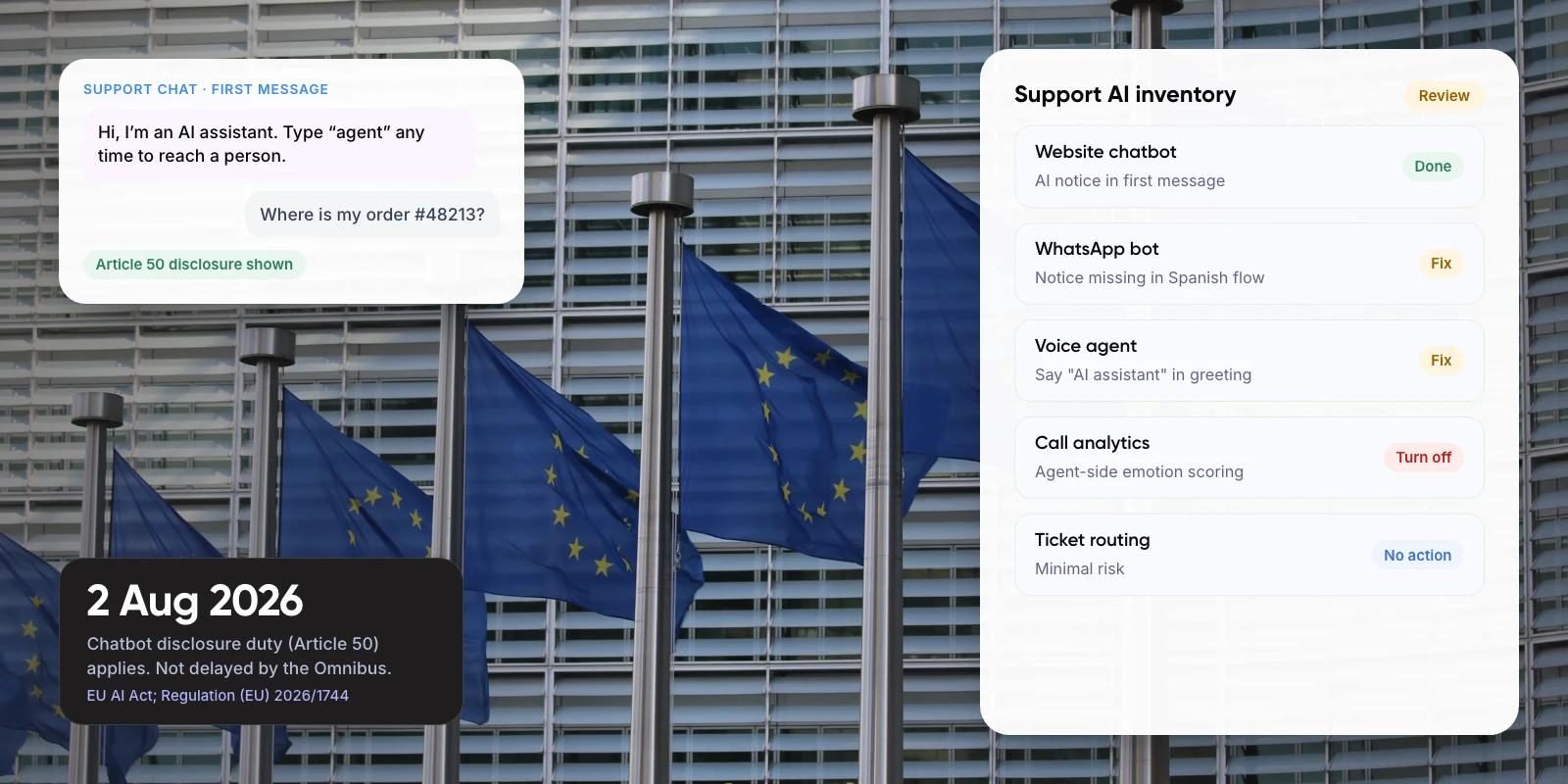
- The EU now requires chatbots to tell people they are AI (from 2 August 2026) and treats software as a product for liability from 9 December 2026.
- Vendor contracts can share costs between you and the vendor, but customers and regulators will come to you first.
- The main defences are practical: answer only from approved sources, label the agent as AI, hand off promises and keep logs.
2. What Happened in the Air Canada Chatbot Case?
In November 2022, Jake Moffatt asked Air Canada’s website chatbot about bereavement fares after his grandmother died. The chatbot said he could book at full price and apply for the reduced fare within 90 days. Air Canada’s own bereavement page said the discount could not be claimed after travel, and the airline refused his request.
Air Canada argued that the chatbot was responsible for its own actions. British Columbia’s Civil Resolution Tribunal disagreed in February 2024. It found the chatbot was simply part of the airline’s website, and that Air Canada “did not take reasonable care to ensure its chatbot was accurate.”
The tribunal also dismissed the point that the correct policy was on another page. It said Air Canada had not explained why customers should double-check one part of its website against another. Moffatt was awarded C$650.88 in damages, plus interest and fees, for negligent misrepresentation: a careless, inaccurate statement that someone reasonably relied on and lost money because of.
The sum was small and the decision came from a small-claims tribunal, so it does not bind other courts. In our view it still matters, because it rejects the defence most companies would reach for first: that the bot, not the business, made the mistake.
3. Which Laws Apply to AI Customer Service?
No single “chatbot law” covers this. Liability comes from a mix of old rules and new AI-specific ones. These are the ones most relevant to a support agent.
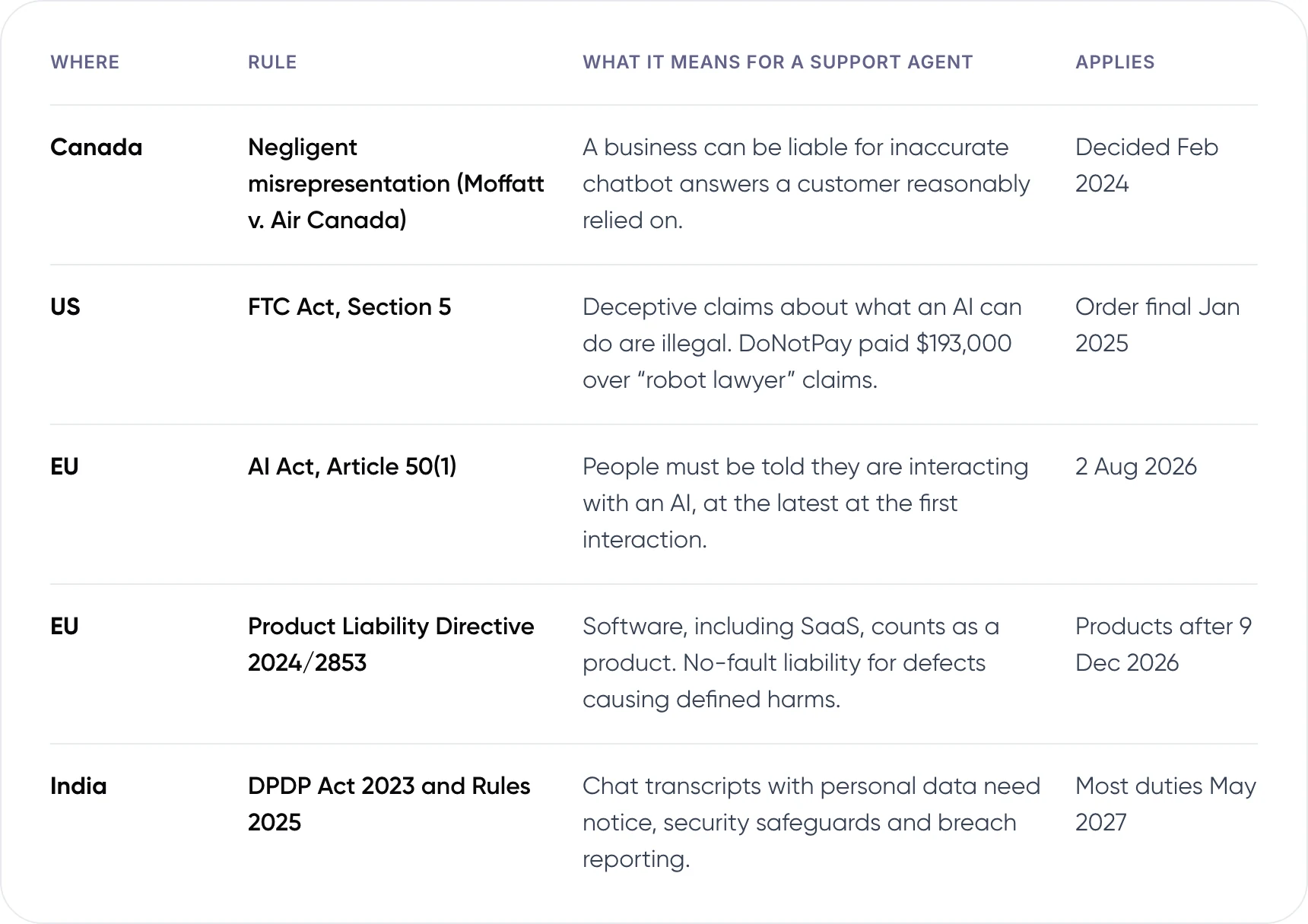
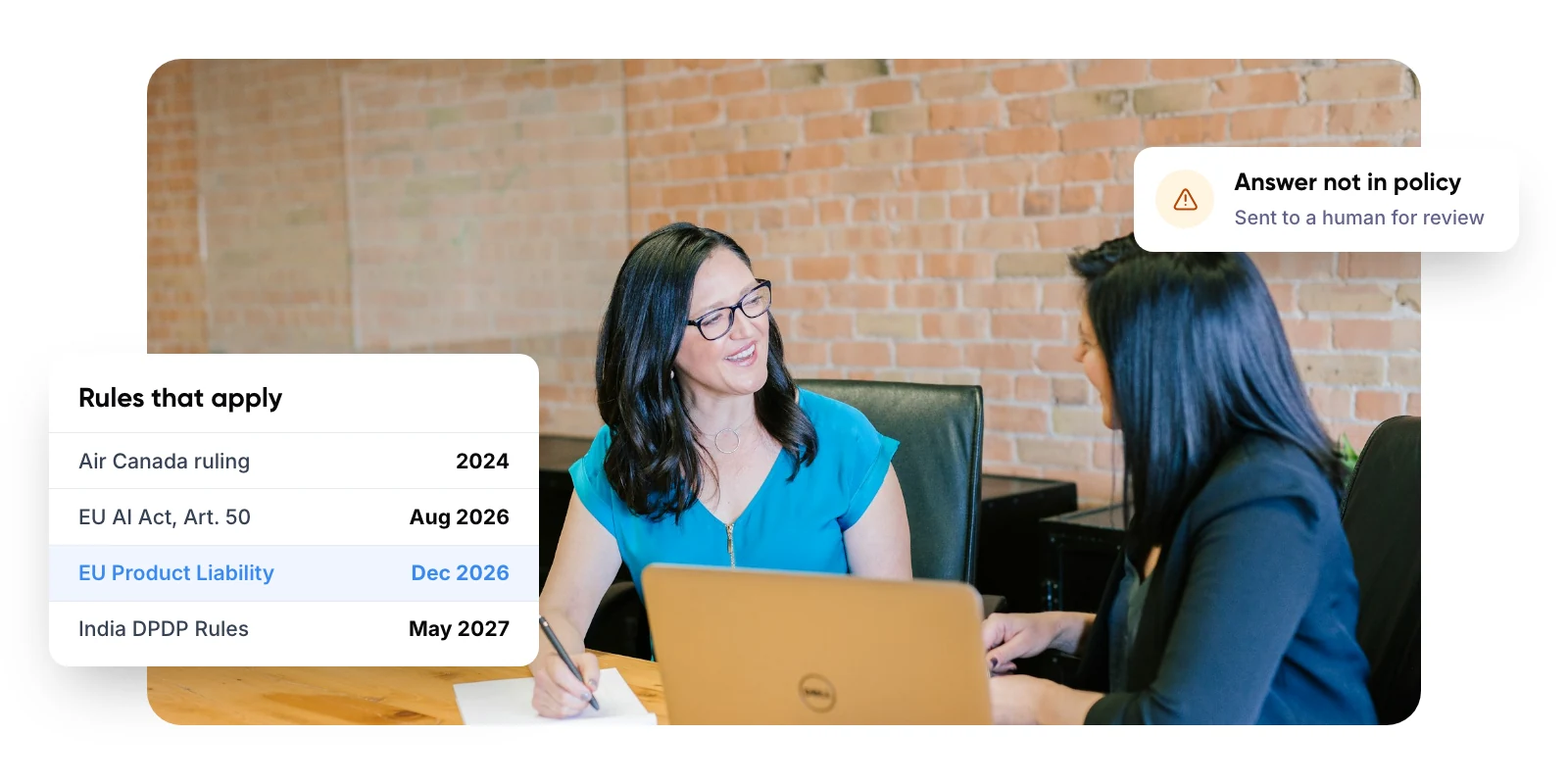
- Canada — Rule: Negligent misrepresentation (Moffatt v. Air Canada). What it means for a support agent: A business can be liable for inaccurate chatbot answers a customer reasonably relied on. Applies: Decided Feb 2024.
- US — Rule: FTC Act, Section 5. What it means for a support agent: Deceptive claims about what an AI can do are illegal. DoNotPay paid $193,000 over “robot lawyer” claims. Applies: Order final Jan 2025.
- EU — Rule: AI Act, Article 50(1). What it means for a support agent: People must be told they are interacting with an AI, at the latest at the first interaction. Applies: 2 Aug 2026.
- EU — Rule: Product Liability Directive 2024/2853. What it means for a support agent: Software, including SaaS, counts as a product. No-fault liability for defects causing defined harms. Applies: Products after 9 Dec 2026.
- India — Rule: DPDP Act 2023 and Rules 2025. What it means for a support agent: Chat transcripts with personal data need notice, security safeguards and breach reporting. Applies: Most duties May 2027.
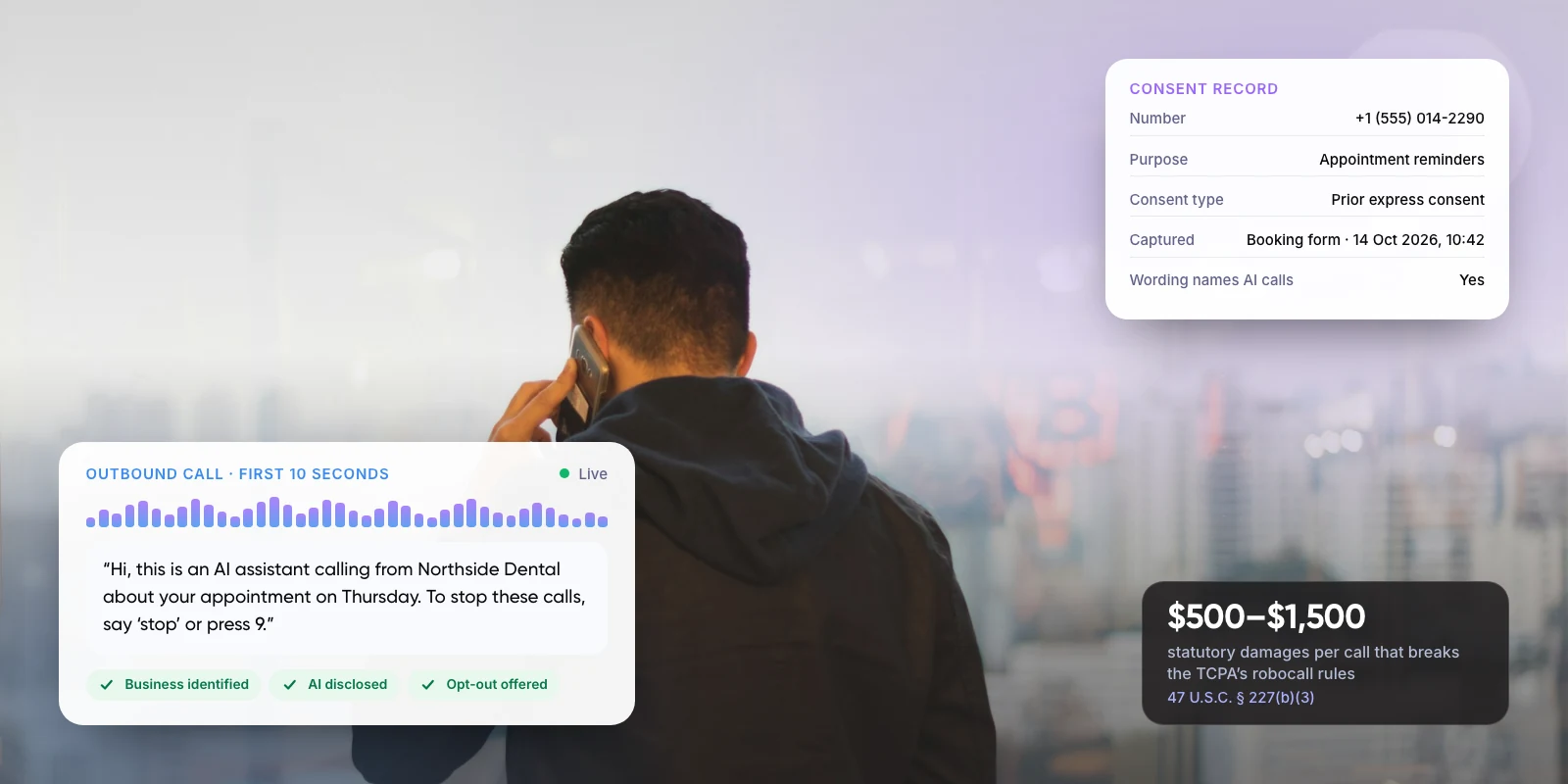
The EU AI Act requires that people be told they are talking to an AI unless it is obvious from context. Breaking Article 50 can lead to fines of up to €15 million or ~3% of worldwide annual turnover, whichever is higher. The new Product Liability Directive names software as a product, including software supplied as a service. It covers defined harms: personal injury, damage to private property, and destruction or corruption of data not used for professional purposes. A purely financial loss from a wrong answer will usually fall under contract or consumer law instead.
In India, support chats almost always contain personal data. Under the DPDP Act, 2023 and the DPDP Rules, 2025, most business obligations take effect in May 2027, 18 months after the Rules were notified. Failing to take reasonable security safeguards can draw a penalty of up to ₹250 crore.
4. What Does a Wrong Answer Cost Beyond Court?
Most AI support mistakes never reach a tribunal. They cost you in refunds, cancellations and trust. In April 2025, Cursor’s AI support agent, which signed its emails as “Sam”, told users who were being logged out that the product only allowed one device per subscription. No such policy existed.
The reply spread on Reddit and Hacker News, and some users cancelled. Co-founder Michael Truell posted that the company had no such policy and that the logouts were a bug. The affected user was refunded, and Cursor said AI-generated support replies would be labelled from then on.
Two things made it worse: the agent invented a policy, and customers did not know they were talking to an AI. Customers also expect a way out. In a 2026 Gartner survey, ~87% of customers said companies using generative AI for service must give access to a human agent. Our guide to chatbot handoff and context transfer covers how to build that route.
5. Can You Pass the Risk to Your AI Support Agent’s Vendor?
Partly, and only between you and the vendor. A contract can decide who pays whom after a claim. It cannot stop a customer or regulator from coming to you first.
Read four clauses closely before you sign. The liability cap sets the most the vendor will ever pay you; check whether it is tied to the fees you pay. The indemnity says which claims the vendor will defend; check whether wrong answers are included or only claims such as copyright. Data processing terms decide where chat transcripts are stored and whether they train the vendor’s models. Audit and logging rights decide whether you can prove what the bot said.
In our view, you should not expect a vendor to guarantee that AI answers are accurate, because model output varies from one request to the next. Plan on carrying that risk yourself and controlling it through how you set the agent up.
Want a second look at your AI agent’s guardrails and handoff rules?
6. How Do You Reduce Your Risk? 7 Steps
Each step below maps to a failure in the cases above. None of them needs new technology; they need decisions about what the agent may say.
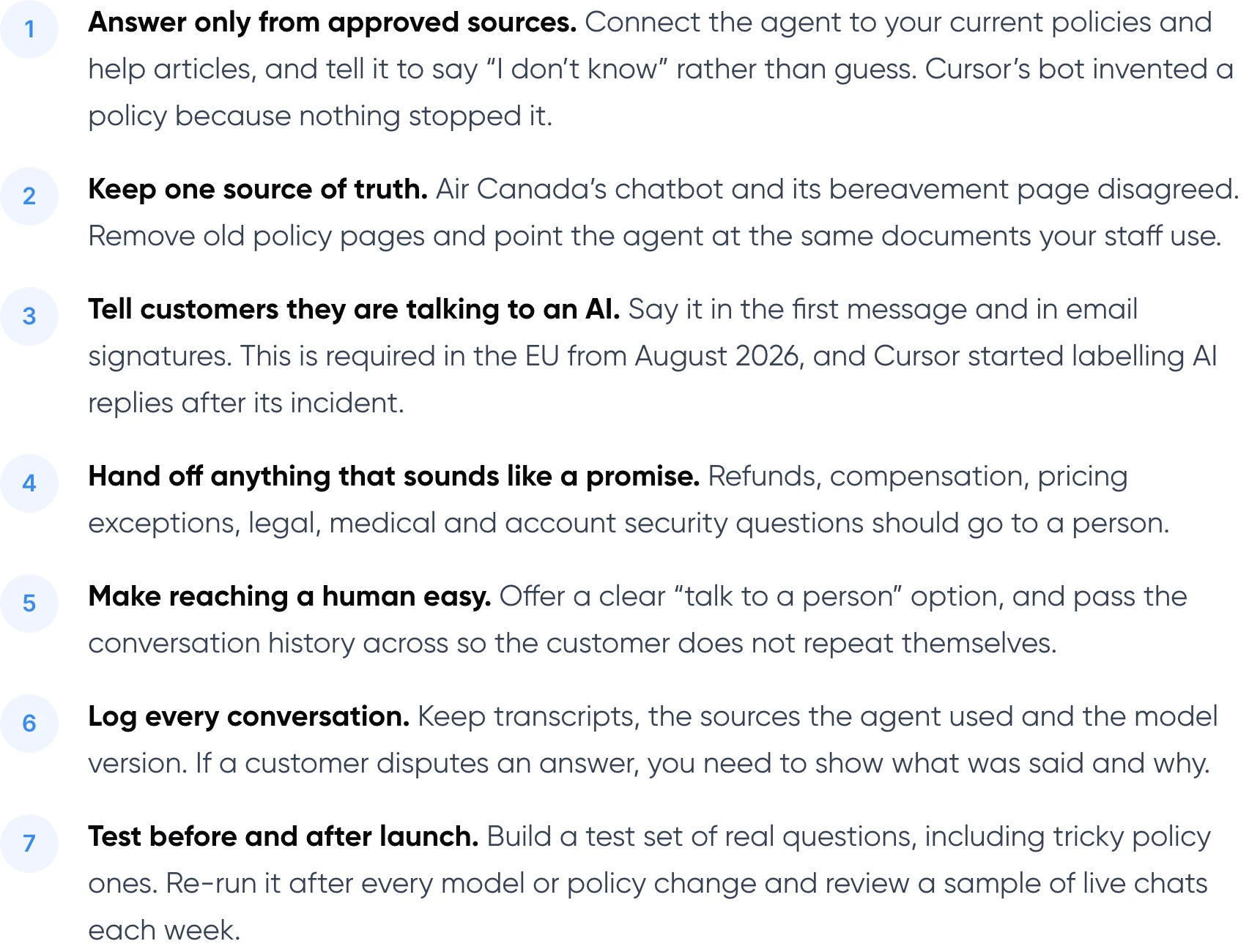
- Answer only from approved sources. Connect the agent to your current policies and help articles, and tell it to say “I don’t know” rather than guess. Cursor’s bot invented a policy because nothing stopped it.
- Keep one source of truth. Air Canada’s chatbot and its bereavement page disagreed. Remove old policy pages and point the agent at the same documents your staff use.
- Tell customers they are talking to an AI. Say it in the first message and in email signatures. This is required in the EU from August 2026, and Cursor started labelling AI replies after its incident.
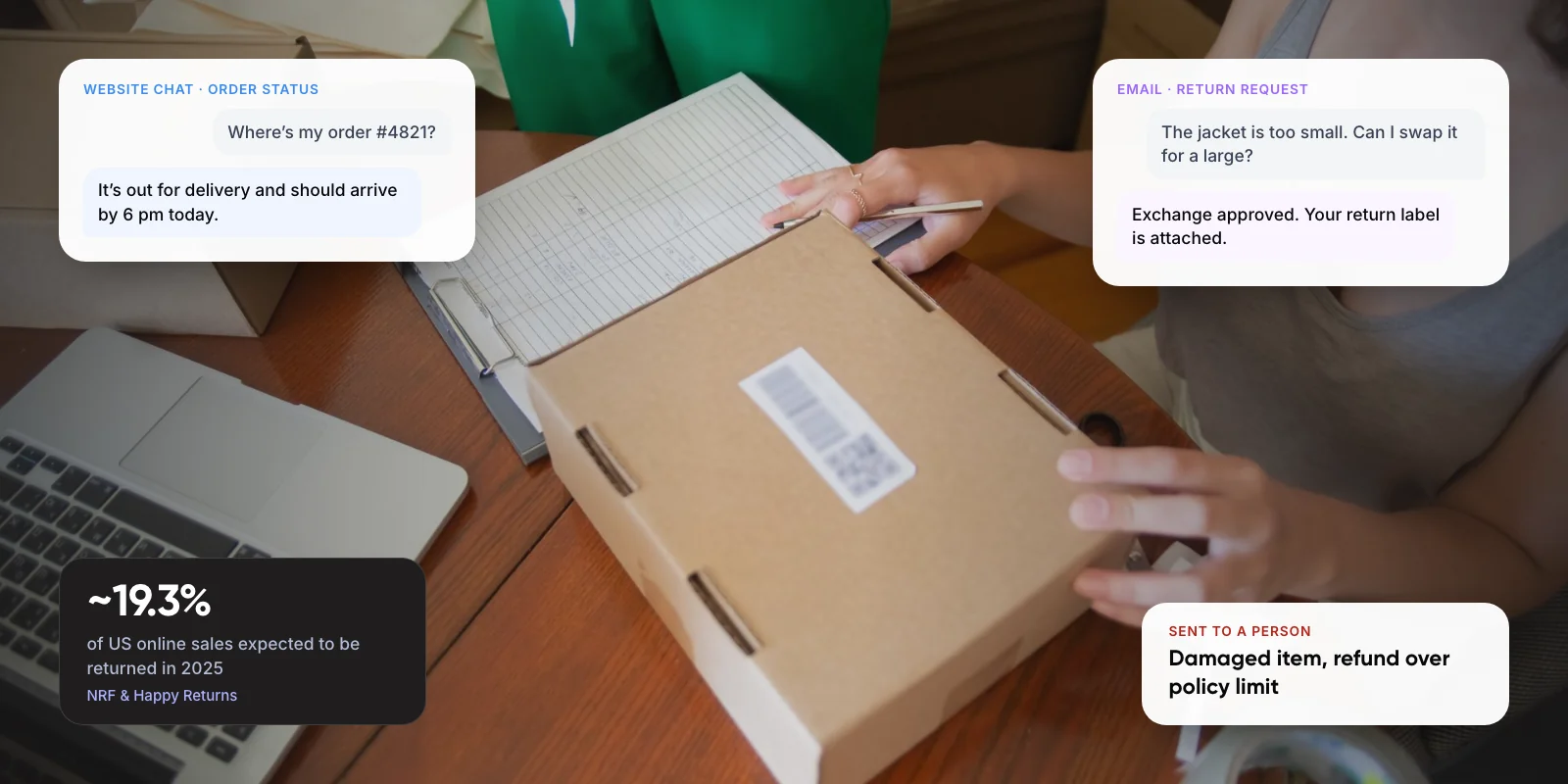
- Hand off anything that sounds like a promise. Refunds, compensation, pricing exceptions, legal, medical and account security questions should go to a person.
- Make reaching a human easy. Offer a clear “talk to a person” option, and pass the conversation history across so the customer does not repeat themselves.
- Log every conversation. Keep transcripts, the sources the agent used and the model version. If a customer disputes an answer, you need to show what was said and why.
- Test before and after launch. Build a test set of real questions, including tricky policy ones. Re-run it after every model or policy change and review a sample of live chats each week.
7. Which Questions Should AI Answer, and Which Should It Hand Off?
A simple way to set scope is to sort questions by what a wrong answer would cost. This is our recommended starting point; adjust it to your industry.
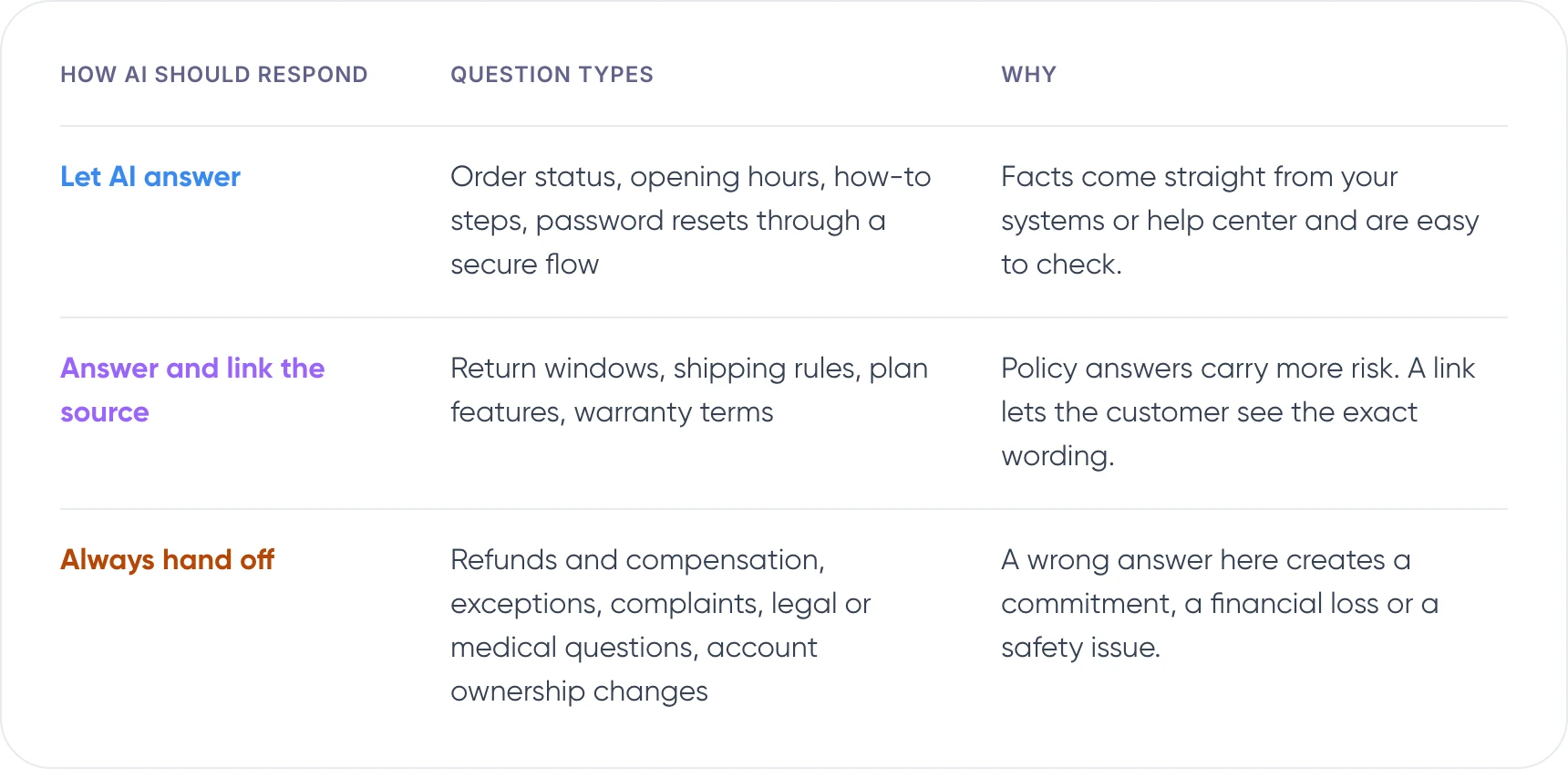
- Let AI answer — Question types: Order status, opening hours, how-to steps, password resets through a secure flow. Why: Facts come straight from your systems or help center and are easy to check.
- Answer and link the source — Question types: Return windows, shipping rules, plan features, warranty terms. Why: Policy answers carry more risk. A link lets the customer see the exact wording.
- Always hand off — Question types: Refunds and compensation, exceptions, complaints, legal or medical questions, account ownership changes. Why: A wrong answer here creates a commitment, a financial loss or a safety issue.
Warning: Watch for answers that sound like promises, such as “you will get a refund” or “this is covered”. In the Air Canada case, a statement like that was enough to create liability.
8. Frequently Asked Questions
Can a company be held liable for its chatbot’s answers?
Yes. In Moffatt v. Air Canada (2024), a British Columbia tribunal held the airline liable for its chatbot’s wrong advice on bereavement fares. It rejected the argument that the chatbot was a separate entity and awarded C$650.88 in damages plus interest and fees.
Do I have to tell customers they are talking to an AI?
In the EU, yes. Article 50 of the AI Act has required this since 2 August 2026, unless it is obvious from context. Some US states have their own disclosure rules. Elsewhere it is good practice: Cursor began labelling AI support replies in 2025 after customers mistook its bot for staff.
Is my AI vendor liable if its model gives a wrong answer?
Not to your customer, in most cases. The customer deals with you. Your contract may let you recover some costs from the vendor, but liability caps and narrow indemnities often limit this. Read those clauses before you sign.
Does the EU Product Liability Directive cover AI chatbots?
It covers software, including software supplied as a service, placed on the EU market after 9 December 2026. It applies to defined harms: personal injury, damage to private property and destruction or corruption of non-professional data. Most purely financial losses from wrong advice fall under contract or consumer law instead.
How can I reduce the risk of my AI support agent giving wrong answers?
Limit it to approved sources, keep one current version of each policy, label it as AI, and route refunds, exceptions and legal questions to people. Log every conversation and re-test the agent after each model or policy change.
9. Conclusion
When an AI support agent gets it wrong, the business that deployed it answers for it, and new EU rules add disclosure and product liability duties from 2026. The practical defence is scope: answer only from approved sources, label the agent as AI, hand off anything that sounds like a promise, and keep the logs. This week, pull 50 recent bot conversations and check every answer about refunds, prices or policy against your current terms.
For an example of our multichannel support work, see Paymate.
If you would like these controls built in from day one, our customer support automation service sets up AI agents that answer from your approved content, hand off to your team and log every conversation.
Author