Is Per-Resolution Pricing for AI Support Agents Worth It Compared to a Custom Build?
Per-resolution AI customer support software is usually cheaper below a few thousand resolutions a month. Above that, a custom build can cost less to run. We price both with 2026 list prices so you can find your own break-even point.

- Count Your monthly AI resolutions
- Price Vendor fee at that volume
- Model Custom running cost plus build
- Decide Buy, build, or buy then build
1. The Short Answer
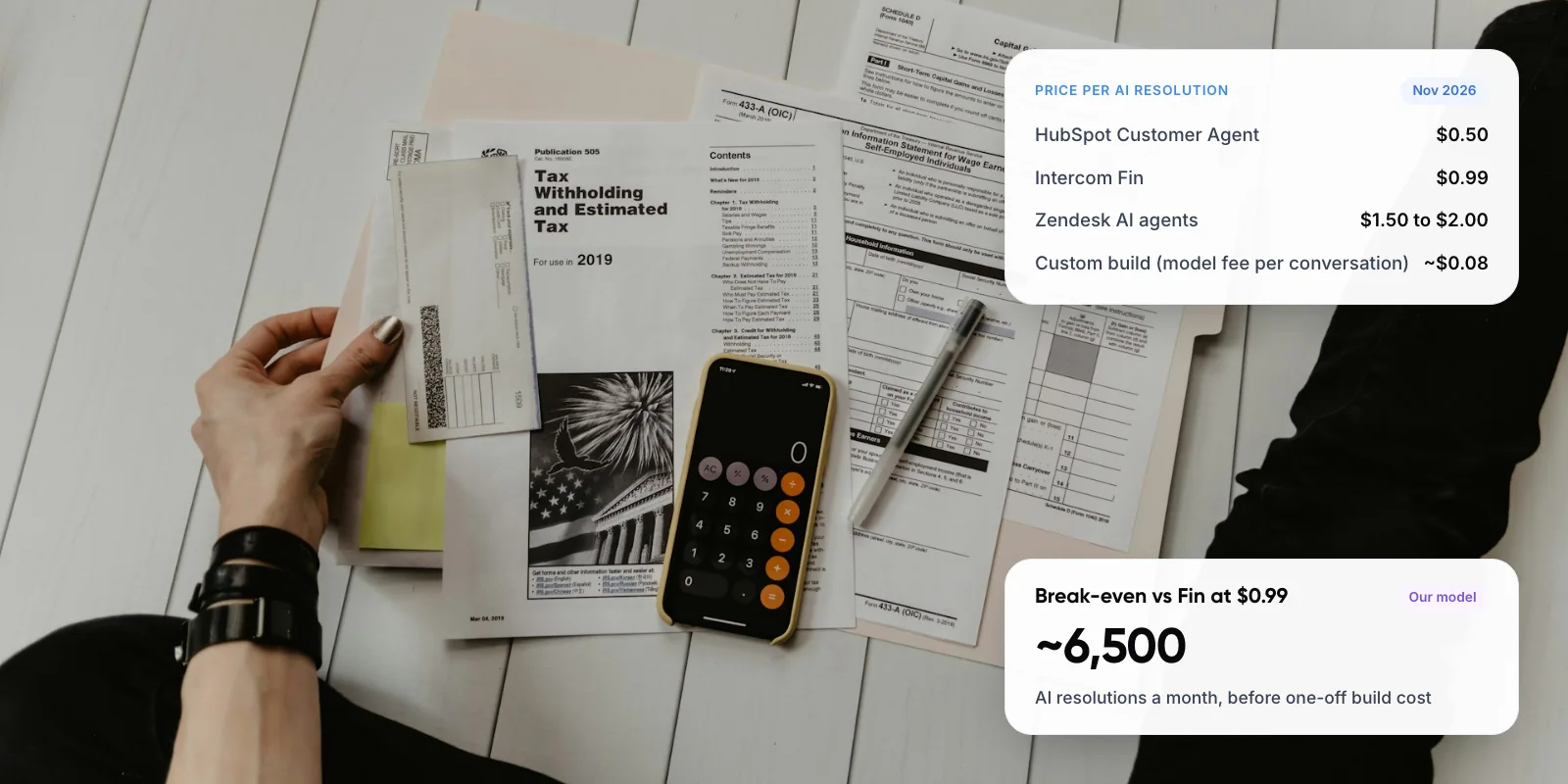
For most teams starting out, yes. There is nothing to build, you can often launch within a few weeks, and you only pay when the AI resolves a conversation. Intercom’s Fin charges $0.99 per outcome, and HubSpot’s Customer Agent charges $0.50 per resolved conversation.
The catch is that the fee grows with every resolution, while most of a custom build’s running cost stays the same each month. In our cost model, a custom AI agent becomes cheaper to run than Fin at around 6,500 AI resolutions a month. That figure leaves out the one-off cost of building it, so in practice the switch point comes later.
Key takeaways
- Per-resolution fees in November 2026 range from $0.50 (HubSpot) to $2.00 (Zendesk pay-as-you-go), on top of helpdesk seats.
- A custom agent’s model fee is about $0.08 per conversation in our example. Engineering time is the main cost.
- In our model, custom running costs match Fin at about 6,500 AI resolutions a month, before the one-off build.
- In our view, most mid-size teams should start on per-resolution software and build only once volume or integration needs justify it.
2. How Does Per-Resolution Pricing Work?
With per-resolution pricing, the vendor charges a fee each time its AI agent handles a customer issue without a person stepping in. You usually pay for helpdesk seats on top. The rate matters, but so does each vendor’s definition of “resolved”.
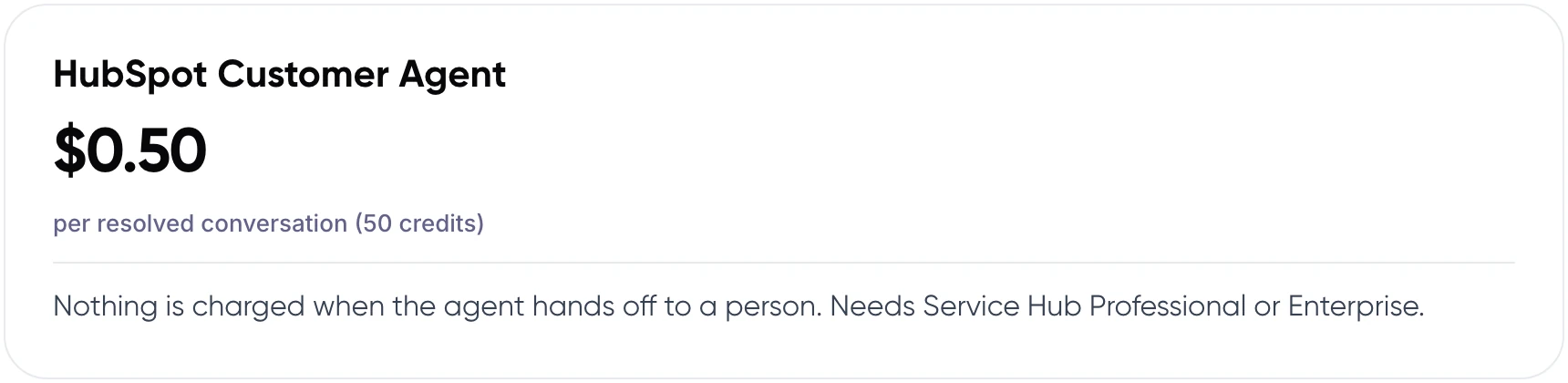
$0.50 per resolved conversation (50 credits)
Nothing is charged when the agent hands off to a person. Needs Service Hub Professional or Enterprise.
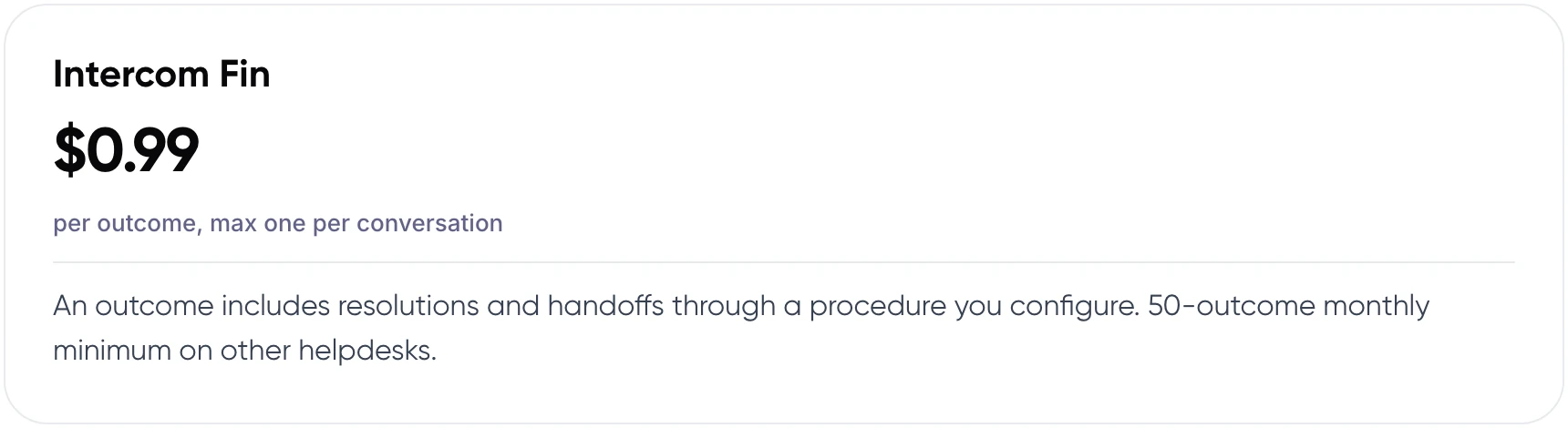
$0.99 per outcome, max one per conversation
An outcome includes resolutions and handoffs through a procedure you configure. 50-outcome monthly minimum on other helpdesks.
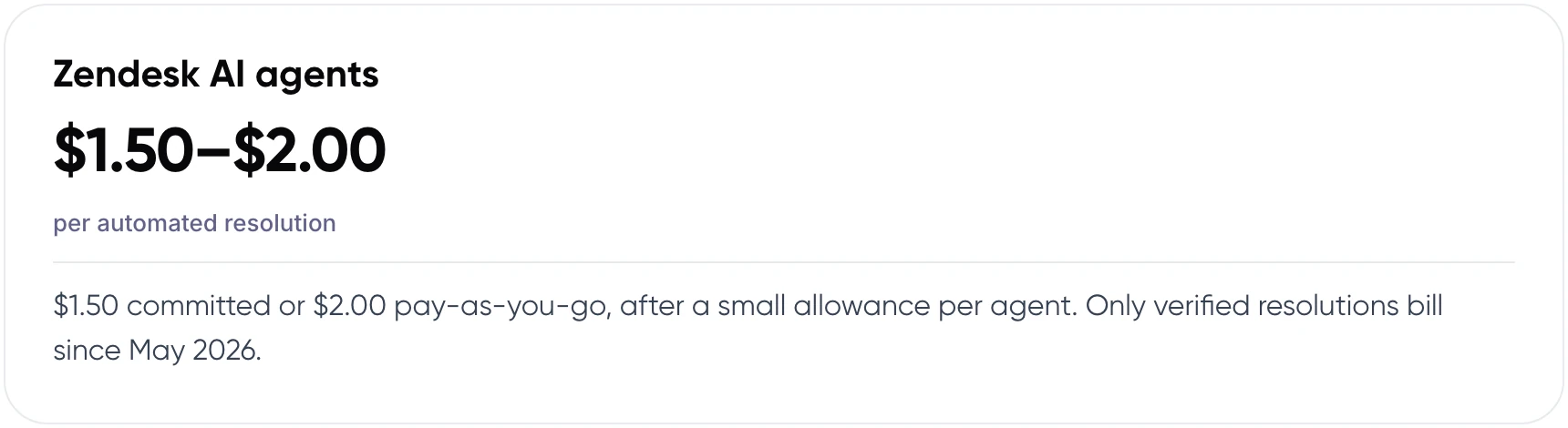
$1.50–$2.00 per automated resolution
$1.50 committed or $2.00 pay-as-you-go, after a small allowance per agent. Only verified resolutions bill since May 2026.
Sources: Fin, Zendesk and HubSpot pricing pages (linked on each card), US list prices as of November 2026.
Note: These are AI fees only. Fin inside Intercom also needs Intercom seats, listed from $29 a month. Zendesk Suite seats start at $55 per agent a month, and HubSpot’s agent needs Service Hub Professional or Enterprise.
3. What Does a Custom AI Support Agent Cost to Run?
A custom agent is software your team or a partner builds on a large language model (LLM) such as OpenAI’s GPT models. It reads your help content, connects to your systems and replies to customers. Instead of a vendor fee, you pay for three things.
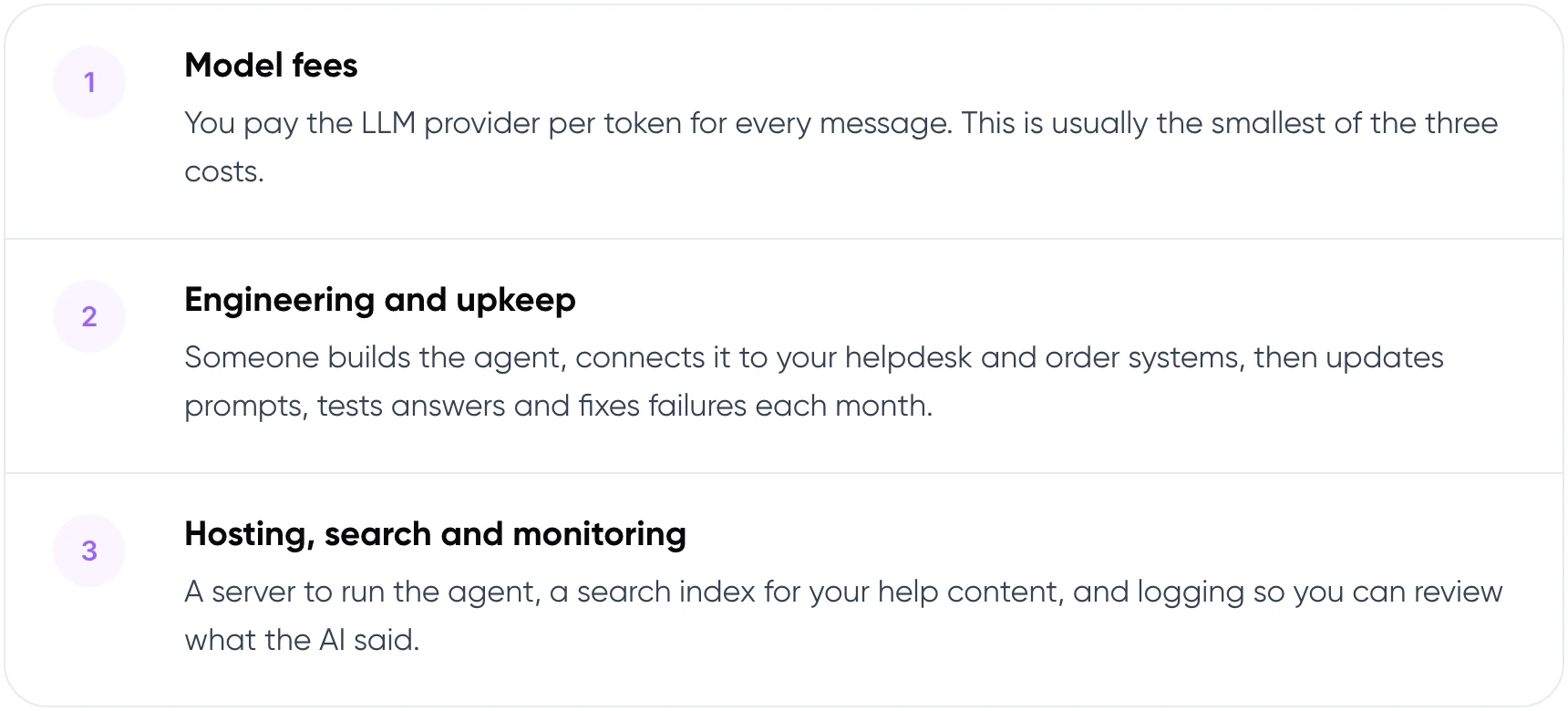
- Model fees — You pay the LLM provider per token for every message. This is usually the smallest of the three costs.
- Engineering and upkeep — Someone builds the agent, connects it to your helpdesk and order systems, then updates prompts, tests answers and fixes failures each month.
- Hosting, search and monitoring — A server to run the agent, a search index for your help content, and logging so you can review what the AI said.
How much does the AI model cost per conversation?
LLM providers charge per token. A token is a small piece of text, roughly three-quarters of a word. OpenAI’s November 2026 price list puts its mid-tier GPT-6.1 Sol model at $2 per million input tokens and $10 per million output tokens.
Here is a worked example. Say the AI sends eight replies in a conversation. For each reply it reads about 4,000 tokens (your help articles plus the chat so far) and writes about 200. That adds up to 32,000 tokens read and 1,600 written, or about $0.08 per conversation. Shorter chats cost less, and longer ones cost more.
Tip: Model fees are rarely what makes a custom build expensive. The people who maintain it are. Price the engineering time first.
4. Per-Resolution AI Customer Support Software vs Custom Build: The Numbers
We priced the yearly AI cost at three volumes. The custom column assumes half an engineer for upkeep, at the US Bureau of Labor Statistics median wage for software developers of $133,080 (May 2024). It adds $0.08 of model cost per conversation, with ~60% of conversations resolved.
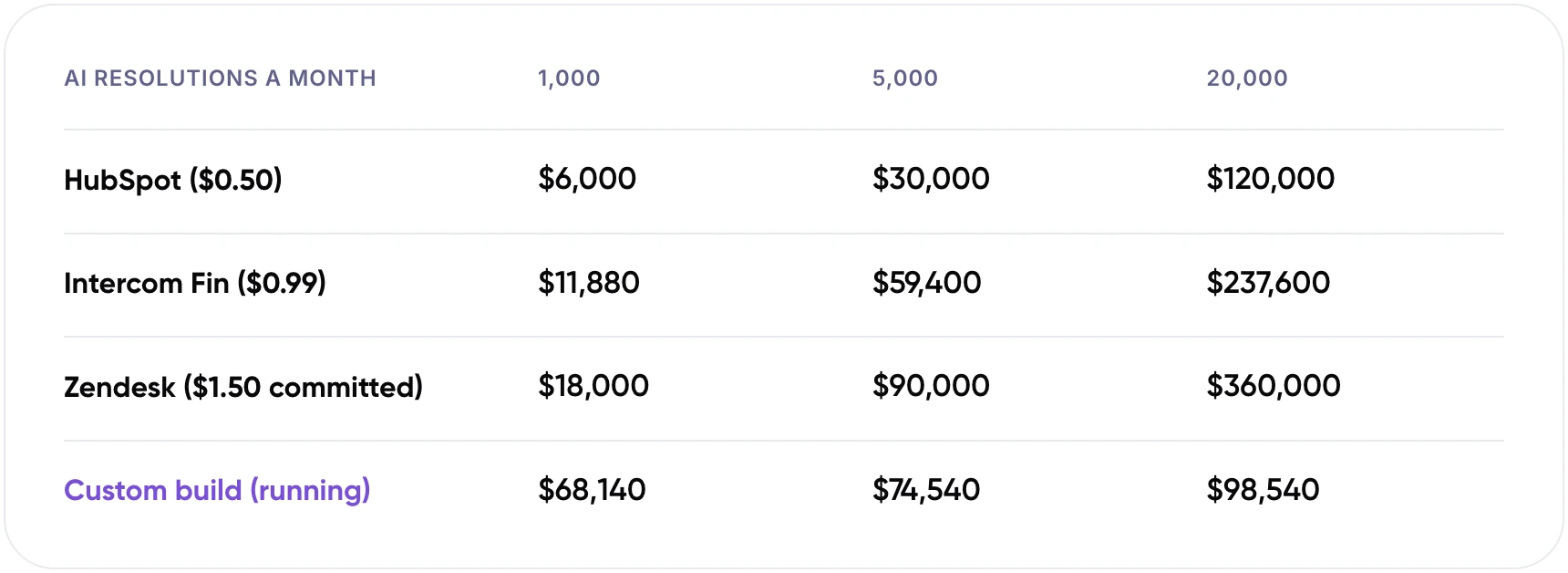
- HubSpot ($0.50) — 1,000 AI resolutions a month: $6,000. 5,000: $30,000. 20,000: $120,000.
- Intercom Fin ($0.99) — 1,000 AI resolutions a month: $11,880. 5,000: $59,400. 20,000: $237,600.
- Zendesk ($1.50 committed) — 1,000 AI resolutions a month: $18,000. 5,000: $90,000. 20,000: $360,000.
- Custom build (running) — 1,000 AI resolutions a month: $68,140. 5,000: $74,540. 20,000: $98,540.
Yearly AI cost. Our calculation from vendor list prices (Nov 2026), OpenAI API pricing (Nov 2026) and BLS (May 2024). Excludes helpdesk seats, included allowances, hosting and the one-off build.
Where is the break-even point?
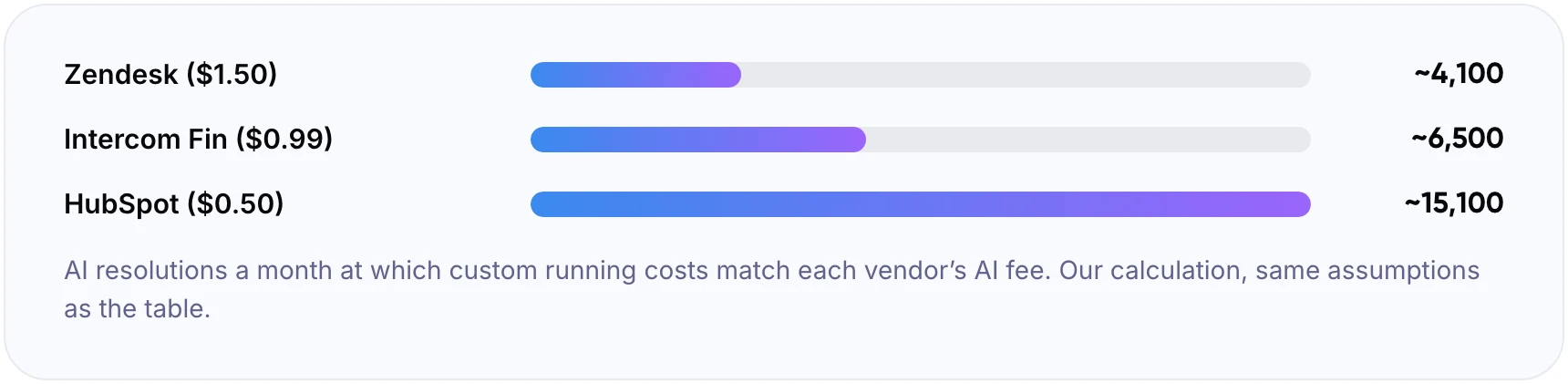
- Zendesk ($1.50) — ~4,100
- Intercom Fin ($0.99) — ~6,500
- HubSpot ($0.50) — ~15,100
AI resolutions a month at which custom running costs match each vendor’s AI fee. Our calculation, same assumptions as the table.
The one-off build moves these points higher. For example, a $60,000 build paid back over two years adds $2,500 a month, which pushes the Fin break-even from about 6,500 to about 9,400 resolutions. Your build cost depends on integrations, channels and languages, so treat these as starting points for your own figures.
Want this model run on your own ticket volume and stack? We can work through it with you.
5. What Changes Besides the Price?
Cost is only one part of the decision. How fast you can launch, how much control you need and who fixes problems often matter just as much.
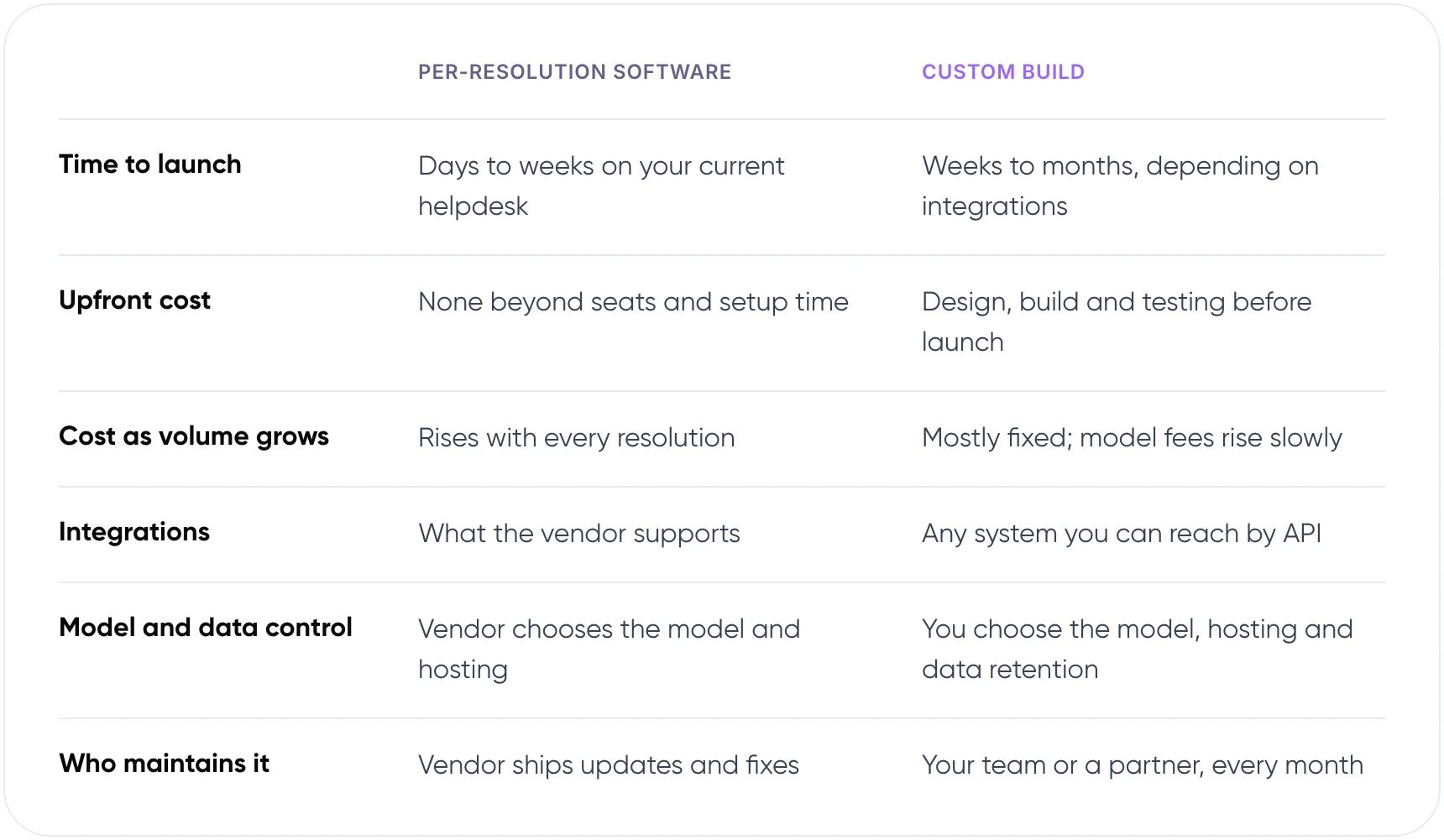
- Time to launch — Per-resolution software: Days to weeks on your current helpdesk. Custom build: Weeks to months, depending on integrations.
- Upfront cost — Per-resolution software: None beyond seats and setup time. Custom build: Design, build and testing before launch.
- Cost as volume grows — Per-resolution software: Rises with every resolution. Custom build: Mostly fixed; model fees rise slowly.
- Integrations — Per-resolution software: What the vendor supports. Custom build: Any system you can reach by API.
- Model and data control — Per-resolution software: Vendor chooses the model and hosting. Custom build: You choose the model, hosting and data retention.
- Who maintains it — Per-resolution software: Vendor ships updates and fixes. Custom build: Your team or a partner, every month.
Our assessment of typical setups.
There is a middle path. Some teams launch on a per-resolution tool, learn which questions the AI handles well, then build custom only for the flows the vendor can’t reach. In our view this is the lowest-risk route for most mid-size companies, because the first months of data tell you whether a build is worth it.
6. What Does a Custom Build Look Like in Practice?
Example · Klarna
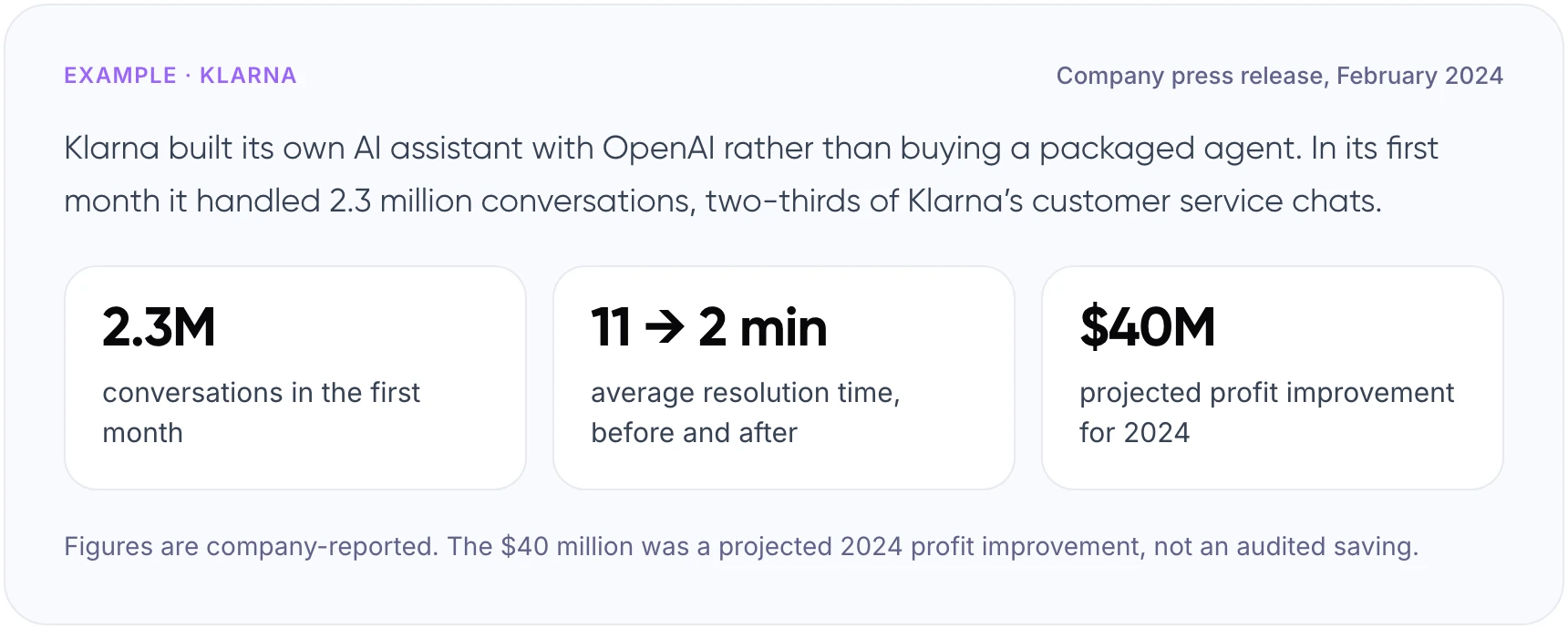
Company press release, February 2024
Klarna built its own AI assistant with OpenAI rather than buying a packaged agent. In its first month it handled 2.3 million conversations, two-thirds of Klarna’s customer service chats.
- 2.3M — conversations in the first month
- 11 → 2 min — average resolution time, before and after
- $40M — projected profit improvement for 2024
Figures are company-reported. The $40 million was a projected 2024 profit improvement, not an audited saving.
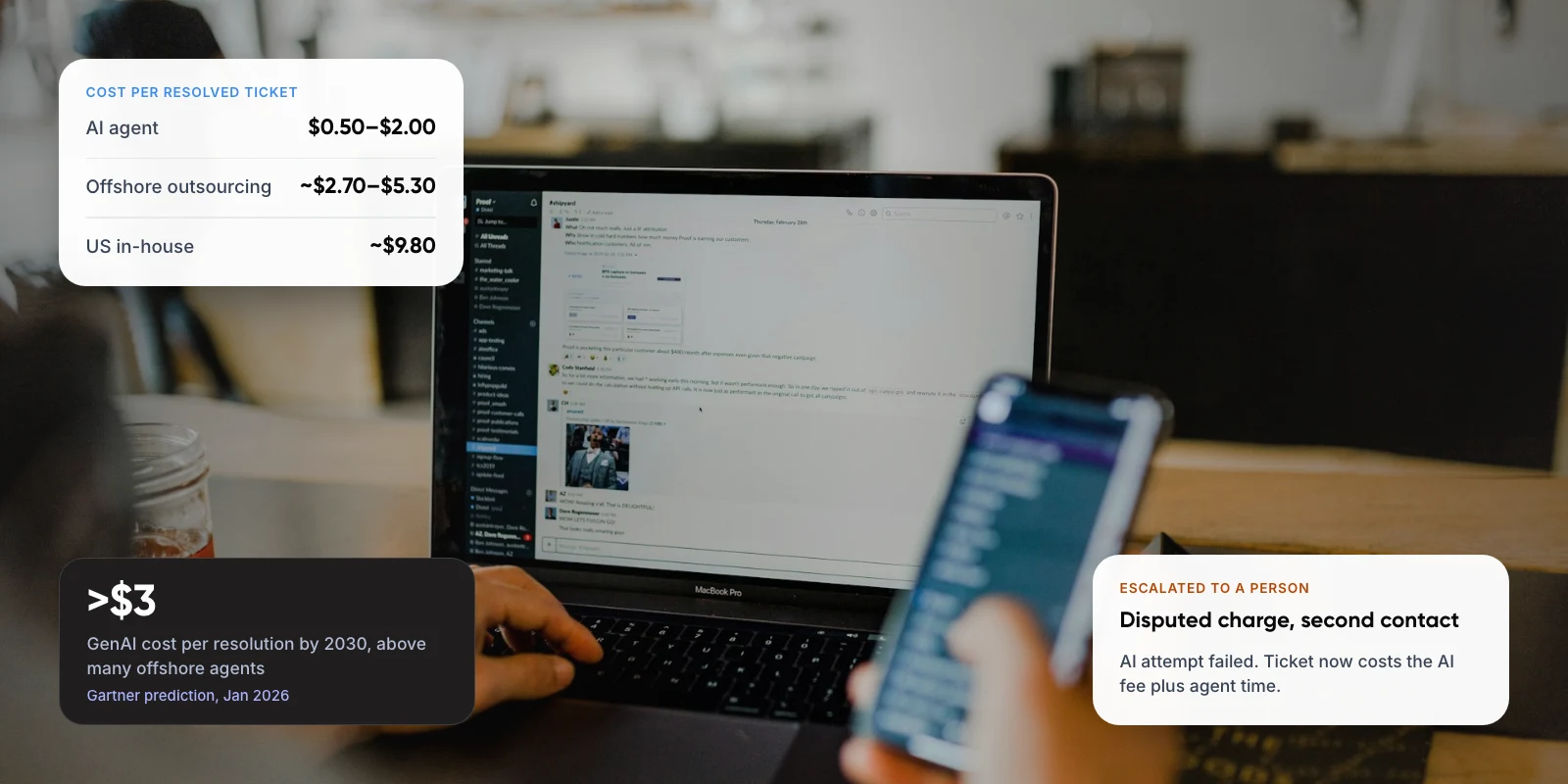
In our view, volume is the reason a build made sense here: at millions of conversations a month, even a $0.50 fee per resolution would add up to millions of dollars a year. The case also shows the limits. In May 2025 the CEO told Bloomberg that a focus on cost had lowered quality, and Klarna put more weight back on human support.
Warning: With a custom build, every answer is your responsibility. In Moffatt v. Air Canada (2024), a British Columbia tribunal held the airline liable after its website chatbot gave a customer wrong information about bereavement fares. Budget for testing and for a clear route to a person.
7. How to Decide in 6 Steps
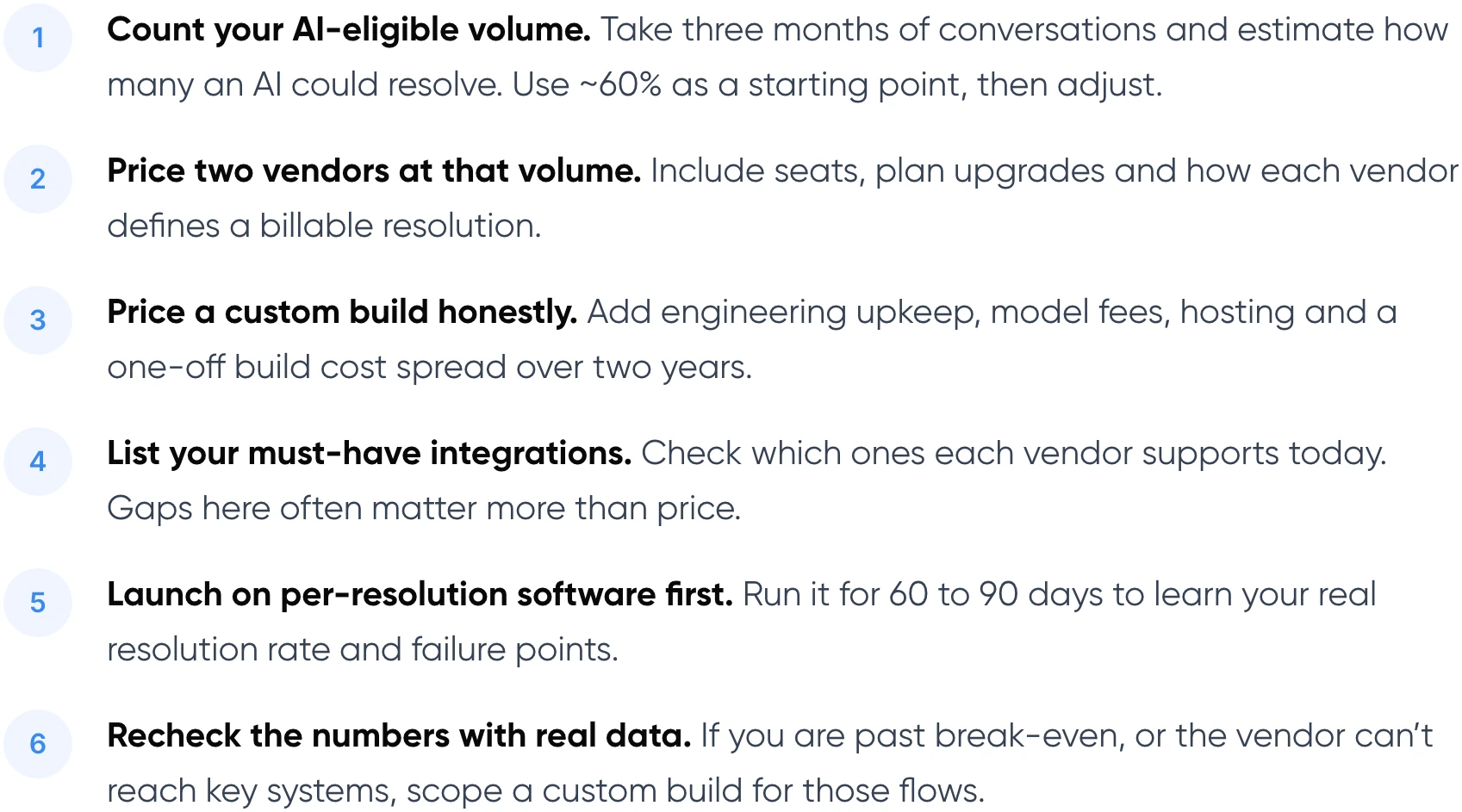
- Count your AI-eligible volume. Take three months of conversations and estimate how many an AI could resolve. Use ~60% as a starting point, then adjust.
- Price two vendors at that volume. Include seats, plan upgrades and how each vendor defines a billable resolution.
- Price a custom build honestly. Add engineering upkeep, model fees, hosting and a one-off build cost spread over two years.
- List your must-have integrations. Check which ones each vendor supports today. Gaps here often matter more than price.
- Launch on per-resolution software first. Run it for 60 to 90 days to learn your real resolution rate and failure points.
- Recheck the numbers with real data. If you are past break-even, or the vendor can’t reach key systems, scope a custom build for those flows.
New to the topic? Start with what customer support automation is and how it works. For the handoff itself, see our guide to chatbot handoff and context transfer.
8. Frequently Asked Questions
What is per-resolution pricing for AI support agents?
It means you pay the vendor each time its AI agent resolves a customer conversation without a person stepping in. In November 2026, HubSpot charges $0.50, Intercom Fin $0.99 per outcome and Zendesk $1.50 to $2.00. Helpdesk seats are usually billed separately.
How much does it cost to build a custom AI support agent?
Running costs are mostly engineering time plus model fees. In our model, half an engineer at the US median developer wage ($133,080, BLS 2024) plus $0.08 of model cost per conversation comes to about $68,000 a year at 1,000 resolutions a month, before the one-off build.
When is a custom build cheaper than per-resolution AI customer support software?
In our model, custom running costs fall below Zendesk at about 4,100 AI resolutions a month, Fin at about 6,500 and HubSpot at about 15,100. A one-off build cost pushes each point higher, so recheck with your own figures.
Is per-resolution pricing worth it for small teams?
Usually, yes. There is no build cost, you can launch within weeks, and a quiet month costs little. Check the vendor’s definition of a resolution and any monthly minimum, such as Fin’s 50 outcomes on other helpdesks.
What are the risks of building your own AI support agent?
You own every answer and every failure. A British Columbia tribunal held Air Canada liable in 2024 for wrong information from its website chatbot. You also need people to test, monitor and update the agent, and a clear route to a person.
9. Conclusion
Per-resolution AI customer support software is the sensible start for most teams, because it costs nothing to build and bills only for results. A custom build starts to pay off at high, steady volume, or when you need integrations the vendors don’t offer. Take last month’s conversation count, apply a 60% resolution rate and compare it with the break-even points above.
- Our service: AI Customer Support Automation. Custom AI support agents connected to your helpdesk, systems and channels, with handoff to your team built in. See the service →
- Free savings report: AI ROI Calculator. Enter your monthly ticket volume and cost per ticket to estimate what an AI agent could save. Get your savings estimate →
Need help with the build? Our AI customer support automation service builds custom AI support agents that connect to your helpdesk and systems. For an example of our work, see the Paymate case study.
Author