Security and Compliance Checklist for AI Support Tools (SOC 2, GDPR, HIPAA)
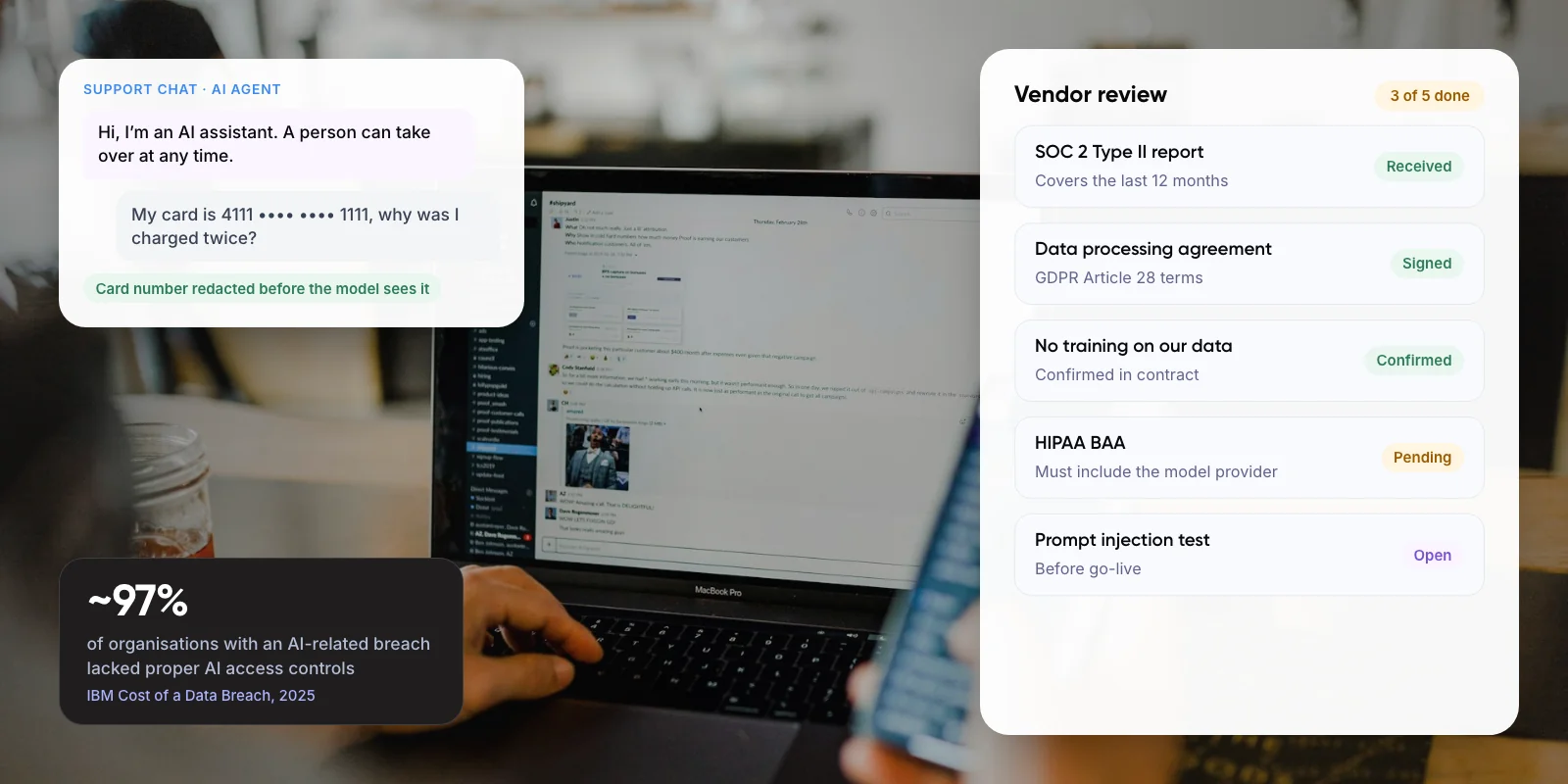
AI customer support security compliance comes down to three questions. Where does customer data go? Who can reach it? And can you prove both to an auditor? IBM’s 2025 breach study found that 97% of organisations with an AI-related breach lacked proper AI access controls.
This checklist covers what SOC 2, GDPR, HIPAA, the EU AI Act and India’s DPDP Rules each require from an AI support tool, and what to ask a vendor before you sign.
1. The Short Answer
An AI support tool reads the same messages your agents read: names, order numbers, addresses and sometimes payment or health details. So it needs the same controls as any system that holds customer data, plus a few that are specific to AI. The extra ones are where data is sent for the model to process, whether it is kept or used for training, and what the bot is allowed to say.
SOC 2 shows a vendor’s controls were tested by an auditor. GDPR and India’s DPDP Act decide how personal data may be used. HIPAA applies if the bot handles US patient data. Since 2 August 2026, the EU AI Act also requires you to tell people when they are talking to AI.
Key takeaways
- Treat an AI support tool like any system that stores customer data, then add checks for the model: where data goes, retention and training.
- SOC 2 is an audit report, not a law. Ask for Type II. GDPR, HIPAA and India's DPDP Act apply based on whose data you handle.
- Under HIPAA, you need a signed BAA with the AI vendor, and the vendor needs one with its model provider.
- The EU AI Act has required chatbots to disclose they are AI since 2 August 2026.
- You are liable for what your bot says. Air Canada lost a 2024 tribunal case over a chatbot's wrong refund advice.
2. Why Do AI Support Tools Need Their Own Security Review?
A help desk stores tickets. An AI support tool also sends parts of each conversation to a language model, often run by another company, and can take actions such as issuing refunds. That adds new places where data can leak and new ways for the bot to be misled.
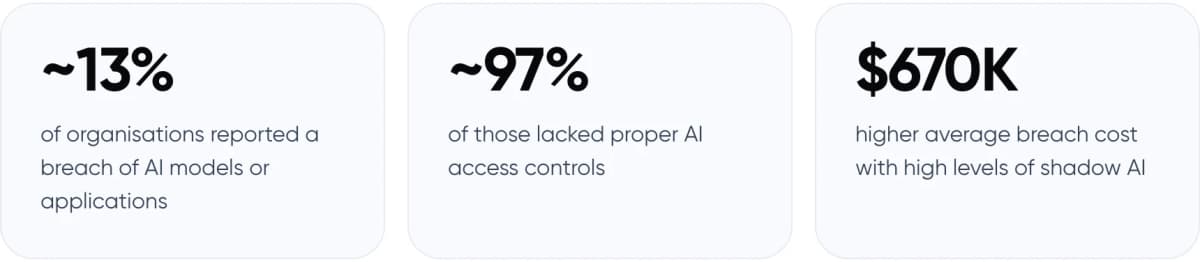
- ~13% of organisations reported a breach of AI models or applications
- ~97% of those lacked proper AI access controls
- $670K higher average breach cost with high levels of shadow AI
Source: IBM Cost of a Data Breach Report 2025, conducted by the Ponemon Institute.
The OWASP Top 10 for LLM Applications (2025) lists prompt injection first and sensitive information disclosure second. In support, prompt injection means a customer typing instructions that trick the bot into ignoring its rules. Sensitive information disclosure means the bot revealing data it should not, such as another customer’s order.
3. SOC 2, GDPR, HIPAA: Which Applies to You?
These are different kinds of rules. SOC 2 is an audit report, not a law. GDPR, HIPAA and DPDP are laws that apply based on whose data you handle. The EU AI Act adds AI-specific duties on top.
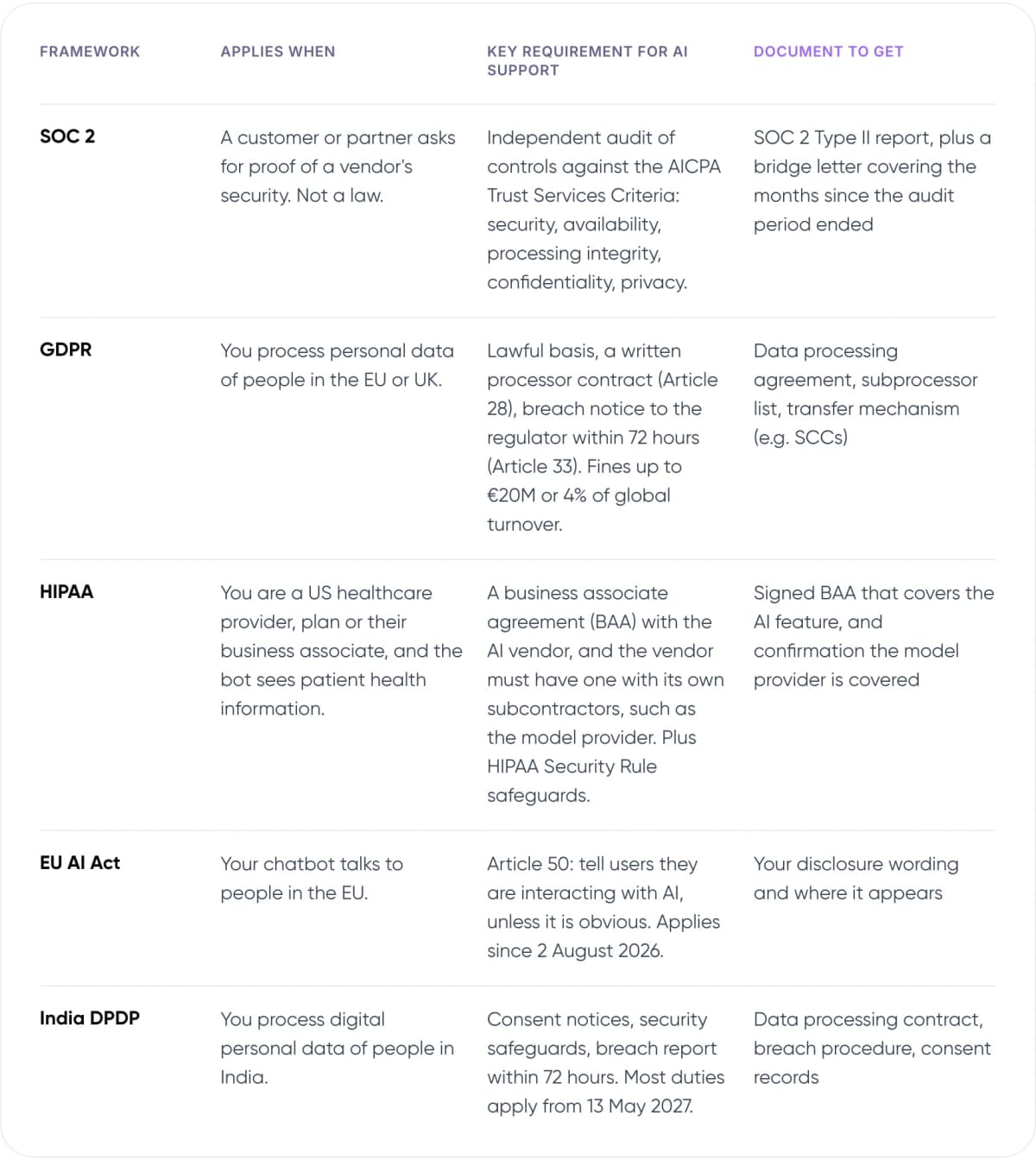
- SOC 2 — Applies when: A customer or partner asks for proof of a vendor's security. Not a law. Key requirement for AI support: Independent audit of controls against the AICPA Trust Services Criteria: security, availability, processing integrity, confidentiality, privacy. Document to get: SOC 2 Type II report, plus a bridge letter covering the months since the audit period ended.
- GDPR — Applies when: You process personal data of people in the EU or UK. Key requirement for AI support: Lawful basis, a written processor contract (Article 28), breach notice to the regulator within 72 hours (Article 33). Fines up to €20M or 4% of global turnover. Document to get: Data processing agreement, subprocessor list, transfer mechanism (e.g. SCCs).
- HIPAA — Applies when: You are a US healthcare provider, plan or their business associate, and the bot sees patient health information. Key requirement for AI support: A business associate agreement (BAA) with the AI vendor, and the vendor must have one with its own subcontractors, such as the model provider. Plus HIPAA Security Rule safeguards. Document to get: Signed BAA that covers the AI feature, and confirmation the model provider is covered.
- EU AI Act — Applies when: Your chatbot talks to people in the EU. Key requirement for AI support: Article 50: tell users they are interacting with AI, unless it is obvious. Applies since 2 August 2026. Document to get: Your disclosure wording and where it appears.
- India DPDP — Applies when: You process digital personal data of people in India. Key requirement for AI support: Consent notices, security safeguards, breach report within 72 hours. Most duties apply from 13 May 2027. Document to get: Data processing contract, breach procedure, consent records.
Sources: AICPA SOC 2; GDPR (Regulation 2016/679), Articles 28, 33 and 83; HHS business associate guidance; EU AI Act, Article 50; PIB, DPDP Rules 2025.
Note: A SOC 2 Type I report checks that controls are designed properly on one date. A Type II report checks that they actually worked over a period, often 6 to 12 months. For a tool that will read customer conversations, ask for Type II.
4. The AI Customer Support Security Compliance Checklist
Use these eight checks for any AI support tool, bought or built. Each one maps to at least one of the frameworks above.

- Map where conversation data goes (GDPR · DPDP · SOC 2) — Draw the path of one chat: widget, help desk, AI vendor, model provider, logs, analytics. Each stop is a place data is stored or processed, and each third party must be in your contracts. Ask the vendor: Which subprocessors receive conversation data, and in which countries?
- Confirm data is not used for training (GDPR · HIPAA) — Some AI services use inputs to improve their models unless you opt out. For support data, the default you want is no training on your content, in writing. Ask the vendor: Is our data used to train or fine-tune any model, yours or a third party's?
- Set retention and deletion (GDPR · DPDP · HIPAA) — Decide how long transcripts, prompts and model logs are kept, and check the vendor can delete them on request. Model providers often keep logs separately for abuse monitoring. Ask the vendor: How long are prompts and outputs retained, by you and by the model provider?
- Redact sensitive data before the model (HIPAA · GDPR) — Mask card numbers, government IDs and health details before text reaches the model, unless the task truly needs them. What is never sent cannot leak. Ask the vendor: Can we redact or block specific data types before they reach the model?
- Limit what the AI can access and do (SOC 2 · OWASP) — Give the bot read-only access by default and the smallest set of actions it needs. A refund tool should check limits on the server, not rely on the prompt. Ask the vendor: What permissions does the AI agent have, and how are actions authorised?
- Defend against prompt injection (OWASP LLM01) — Assume customers will try to make the bot ignore its rules. Keep system instructions and customer data separate, filter outputs, and never let the model alone decide on money or account changes. Ask the vendor: How do you test for prompt injection, and how often?
- Ground answers and keep a human path (EU AI Act · liability) — Limit the bot to approved help content, tell users it is AI, and make it easy to reach a person. Route policy questions such as refunds and eligibility to fixed answers or an agent. Ask the vendor: Can we restrict answers to our content and set topics that always go to a person?
- Keep audit logs and an incident plan (SOC 2 · GDPR · DPDP) — Log who changed the bot's prompts, content and permissions, and what it said. GDPR and DPDP both set a 72-hour clock for reporting a breach to the regulator, so your vendor must alert you well before that. Ask the vendor: How quickly will you notify us of a breach, and what logs can we export?
Warning: A vendor’s SOC 2 report covers the vendor’s own systems. It does not cover the model provider they send data to, or how you configure the bot. Check that the model provider is listed as a subprocessor and has its own report.
Reviewing an AI support vendor, or planning your own? We can walk through this checklist with your team.
5. What Does the EU AI Act Add for Support Chatbots?
Article 50 of the EU AI Act requires that people are told they are interacting with an AI system, unless it is obvious from the context. These duties have applied since 2 August 2026. The Digital Omnibus package, in force since 27 July 2026, delayed the high-risk rules to December 2027 but did not move this date.
It also applies to companies outside the EU that run a chatbot for EU customers. In practice, a short line at the start of the chat, such as “I’m an AI assistant,” meets the disclosure duty for most support bots. Customer support is not one of the high-risk uses listed in Annex III of the Act, so the heavier high-risk rules usually don’t apply to a support bot.
Sources: EU AI Act, Article 50; Digital Omnibus on AI, Regulation (EU) 2026/1744.
6. What Happens When a Support Bot Gets It Wrong?
Compliance is also about what the bot says. The best-known case is from Canada.
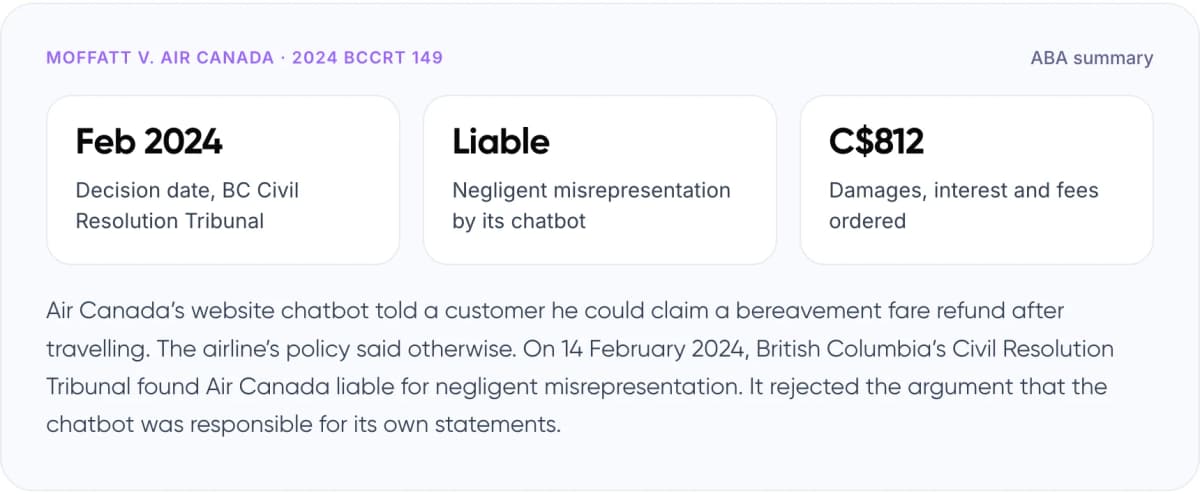
Moffatt v. Air Canada · 2024 BCCRT 149 — ABA summary
- Feb 2024 Decision date, BC Civil Resolution Tribunal
- Liable Negligent misrepresentation by its chatbot
- C$812 Damages, interest and fees ordered
Air Canada’s website chatbot told a customer he could claim a bereavement fare refund after travelling. The airline’s policy said otherwise. On 14 February 2024, British Columbia’s Civil Resolution Tribunal found Air Canada liable for negligent misrepresentation. It rejected the argument that the chatbot was responsible for its own statements.
The amount was small, but the principle is clear: you are responsible for what your support bot tells customers. In our view, this is why checks 6 and 7 in the list above matter as much as encryption. Limit the bot to approved help content, and send policy questions such as refunds to a person or a fixed answer.
7. How to Run a Vendor Security Review in 6 Steps
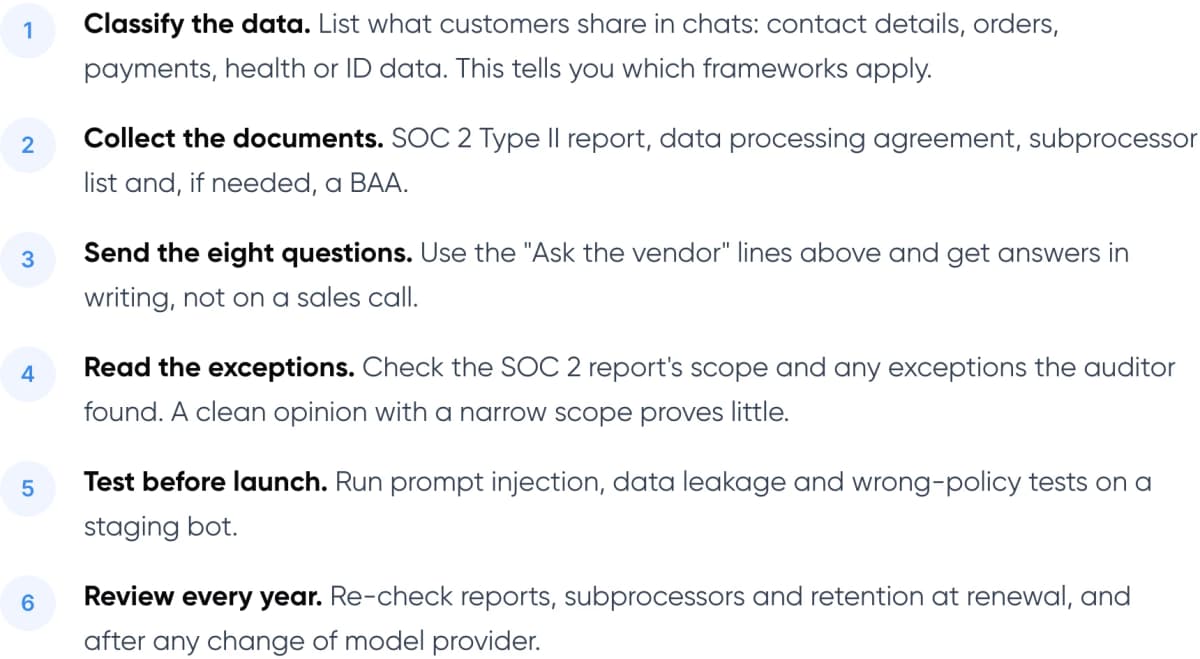
- Classify the data. List what customers share in chats: contact details, orders, payments, health or ID data. This tells you which frameworks apply.
- Collect the documents. SOC 2 Type II report, data processing agreement, subprocessor list and, if needed, a BAA.
- Send the eight questions. Use the "Ask the vendor" lines above and get answers in writing, not on a sales call.
- Read the exceptions. Check the SOC 2 report's scope and any exceptions the auditor found. A clean opinion with a narrow scope proves little.
- Test before launch. Run prompt injection, data leakage and wrong-policy tests on a staging bot.
- Review every year. Re-check reports, subprocessors and retention at renewal, and after any change of model provider.
Tip: Before go-live, try to break the bot yourself. Ask it to ignore its instructions, reveal another order, or promise a refund. Fix what gets through, then repeat after every major prompt or content change.
For how data should move when a bot hands a chat to a person, see how to hand off without losing context. For the basics, read what customer support automation is and how it works.
8. What About Teams in India?
India’s Digital Personal Data Protection Rules were notified in November 2025. Most obligations under the DPDP Act and Rules take effect 18 months later, on 13 May 2027. That includes clear consent notices, security safeguards and breach reporting: notice to the Data Protection Board and affected people without delay, and a detailed report within 72 hours.
If you serve customers in India, the EU and the US, you will often need GDPR, DPDP and SOC 2 at the same time. In our view, the controls overlap heavily, because all three ask for the same basics: know your data, limit access, keep records and report breaches quickly. One set of data maps, retention rules and breach procedures can serve all three if you design it that way from the start.
9. Frequently Asked Questions
Is an AI chatbot GDPR compliant by default?
No. Compliance depends on how you use it. You need a lawful basis, a data processing agreement with the vendor, a list of subprocessors and a way to delete data on request. If data leaves the EU, you also need a valid transfer mechanism such as standard contractual clauses.
Does SOC 2 cover AI risks?
Partly. SOC 2 tests a vendor's controls for security, availability, processing integrity, confidentiality and privacy. It does not test for AI-specific issues such as prompt injection or wrong answers unless the auditor includes them. Ask for the report scope and your own test results.
Can I use an AI support bot with patient data under HIPAA?
Only with a signed business associate agreement (BAA) with the AI vendor that covers the AI feature. The vendor in turn needs a BAA with any subcontractor that handles the data, such as its model provider. Without that chain in place, keep patient health information out of the bot.
Do I need to tell customers they are chatting with AI?
In the EU, yes. Article 50 of the EU AI Act has required this since 2 August 2026, unless it is obvious from context. Elsewhere it is good practice, and it helps set expectations about when a person will step in.
Who is liable if the AI support bot gives wrong information?
Usually the business that runs it. In Moffatt v. Air Canada (2024), a Canadian tribunal held the airline liable for its chatbot's wrong refund advice and rejected the idea that the bot was responsible for itself.
10. Conclusion
AI customer support security compliance is mostly the discipline you already apply to customer data, plus clear answers on where the model runs, what it keeps and what it may say. Start this week by drawing the data flow for your support bot. Then send your vendor the eight checks above and ask for the documents in the framework table.
If you are planning an AI support agent and want these controls in place from day one, our AI customer support automation service can help. We build AI agents for your help desk with PII redaction, access limits, audit logs and a handoff to your team.
Our service · AI Customer Support Automation: AI agents for your help desk, built with data controls and a clean handoff to your team. See the service →
Planning help · AI Consulting Services: Get an outside review of your AI support architecture, data flows and vendor choices. Talk to a consultant →
See how we have built AI for regulated clients in our DocPharma and Paymate case studies.
Author