Customer Support Automation Pricing: What Small Businesses Should Expect to Pay
Customer support automation for a small business usually costs between $40 and $1,100 a month on popular tools, based on our worked example of up to 1,000 conversations a month. You pay for two things: seats for your human agents, and a usage fee each time the AI handles or resolves a conversation.
This guide explains the pricing models, what Intercom, Zendesk, Freshdesk and Tidio charge in November 2026, the costs that don’t show on pricing pages, and how to set a budget.
1. How Much Does Customer Support Automation Cost?
Three numbers decide your bill: how many conversations you get, how many the AI resolves on its own, and how many human agents you keep. Each tool charges for these in a different way. That is why the same month of support can cost twice as much on one tool as on another.

- $0.99 per outcome on Intercom Fin
- $1.50–$2.00 per automated resolution on Zendesk
- $0.49 per AI Agent session on Freshdesk
Sources: Fin, Zendesk and Freshdesk pricing pages, as published in October–November 2026. Prices in USD, before tax.
Key takeaways
- AI support is priced per seat, per resolution, per session or as a monthly bundle. What counts as a billable unit matters more than the headline price.
- For 1,000 conversations a month, the AI fee on popular tools runs about $490 to $980 in our worked example (November 2026 prices).
- Watch for one-time free allowances, monthly minimums and WhatsApp message fees, which changed on 1 October 2026.
- Gartner predicts generative AI cost per resolution will exceed $3 by 2030, so track the cost of each resolved conversation.
2. How Are AI Customer Support Tools Priced?
Most tools charge a seat fee for your team, plus one of three AI usage models. Check what the vendor counts as a billable unit before you look at the price.
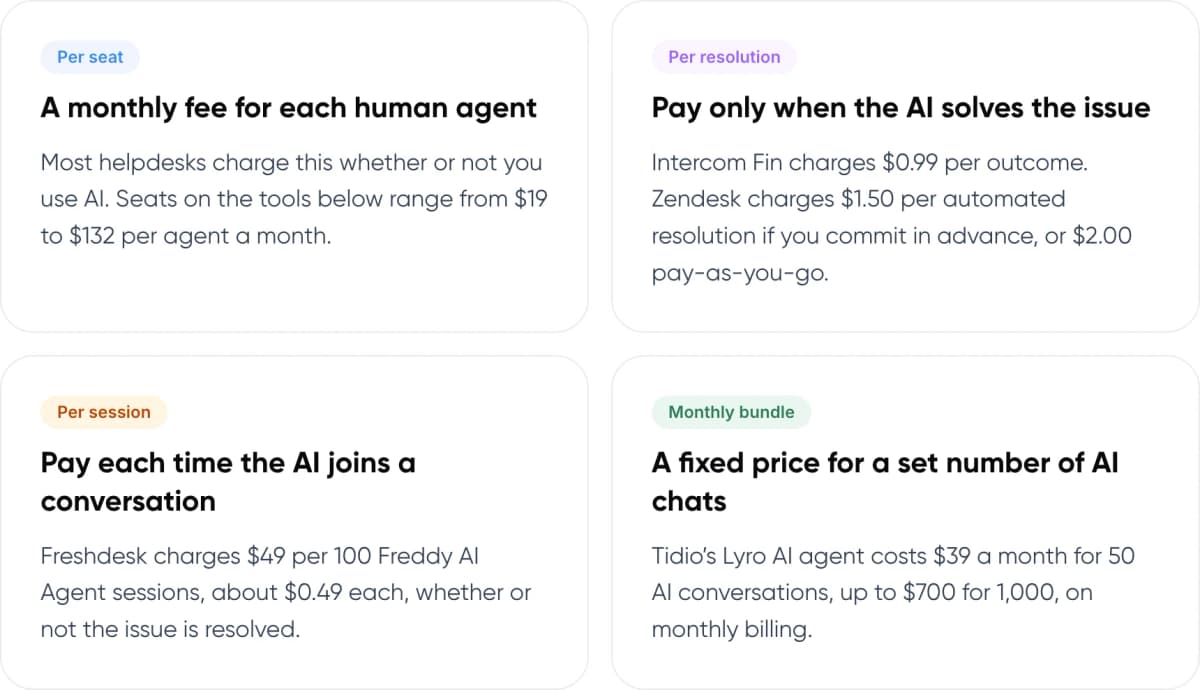
- Per seat: A monthly fee for each human agent. Most helpdesks charge this whether or not you use AI. Seats on the tools below range from $19 to $132 per agent a month.
- Per resolution: Pay only when the AI solves the issue. Intercom Fin charges $0.99 per outcome. Zendesk charges $1.50 per automated resolution if you commit in advance, or $2.00 pay-as-you-go.
- Per session: Pay each time the AI joins a conversation. Freshdesk charges $49 per 100 Freddy AI Agent sessions, about $0.49 each, whether or not the issue is resolved.
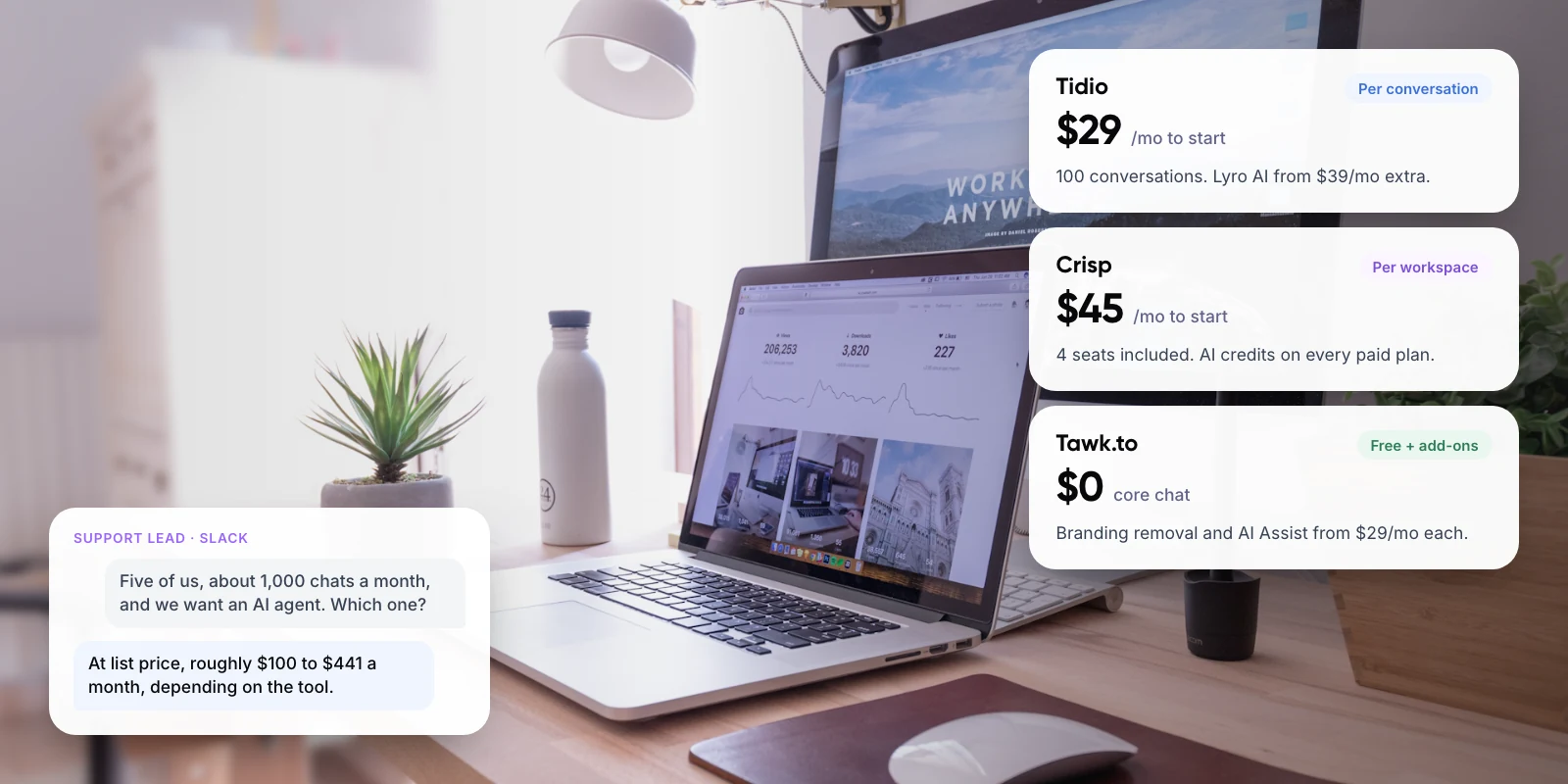
- Monthly bundle: A fixed price for a set number of AI chats. Tidio’s Lyro AI agent costs $39 a month for 50 AI conversations, up to $700 for 1,000, on monthly billing.
In our view, per-resolution pricing is the safest place to start, because you don’t pay when the AI fails. Per-session pricing can work out cheaper once the AI resolves most conversations reliably.
Note: Vendors define a “resolution” differently. Fin counts one when the customer asks for no further help after its last answer. Zendesk has billed only verified resolutions since 18 May 2026. Compare the definitions before you compare prices.
3. What Do Popular AI Customer Support Tools Charge in 2026?
These four tools publish their prices, so they make a useful benchmark. Many enterprise vendors share prices only on request.
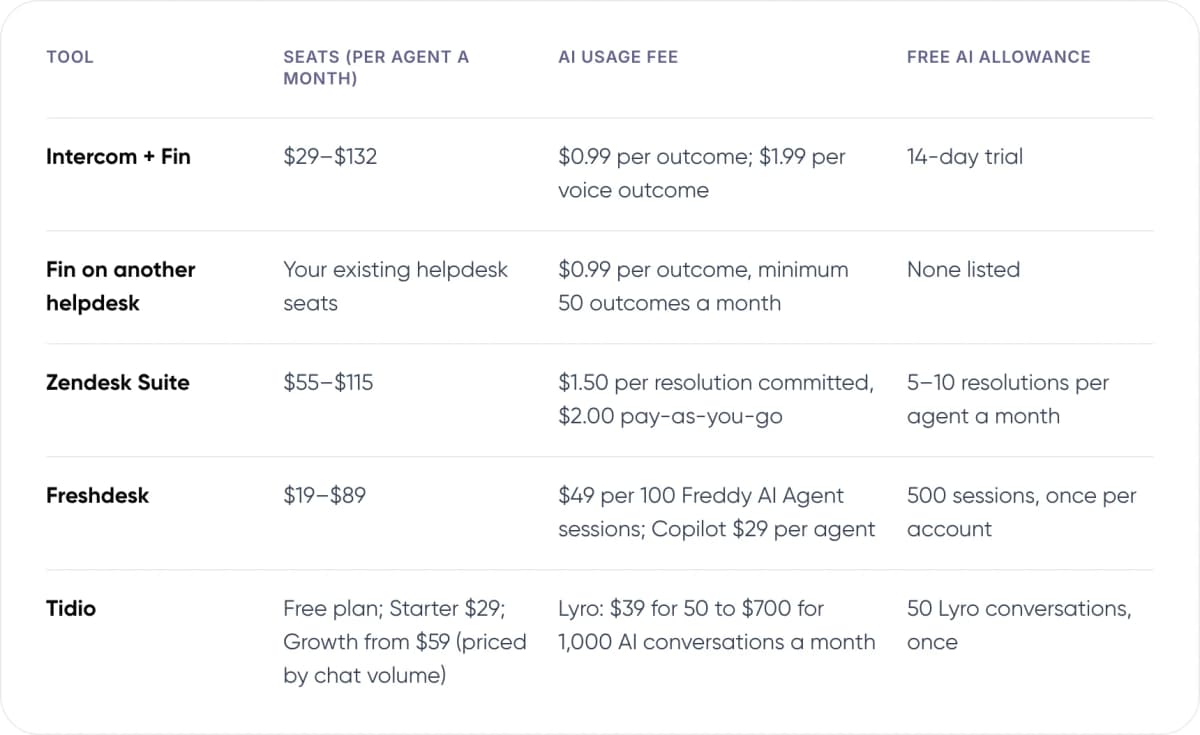
- Intercom + Fin — Seats (per agent a month): $29–$132. AI usage fee: $0.99 per outcome; $1.99 per voice outcome. Free AI allowance: 14-day trial.
- Fin on another helpdesk — Seats (per agent a month): Your existing helpdesk seats. AI usage fee: $0.99 per outcome, minimum 50 outcomes a month. Free AI allowance: None listed.
- Zendesk Suite — Seats (per agent a month): $55–$115. AI usage fee: $1.50 per resolution committed, $2.00 pay-as-you-go. Free AI allowance: 5–10 resolutions per agent a month.
- Freshdesk — Seats (per agent a month): $19–$89. AI usage fee: $49 per 100 Freddy AI Agent sessions; Copilot $29 per agent. Free AI allowance: 500 sessions, once per account.
- Tidio — Seats (per agent a month): Free plan; Starter $29; Growth from $59 (priced by chat volume). AI usage fee: Lyro: $39 for 50 to $700 for 1,000 AI conversations a month. Free AI allowance: 50 Lyro conversations, once.
Sources: fin.ai/pricing, zendesk.com/pricing, Freshdesk pricing, tidio.com/pricing, as published October–November 2026. Seat prices are billed annually. Prices change often, so check before you buy.
4. What Will a Small Business Actually Pay?
Take a business with two support agents and 1,000 chat conversations a month. Assume the AI resolves half of them. That is our cautious starting assumption, not a vendor figure. Here is the monthly AI fee on each tool at November 2026 prices.
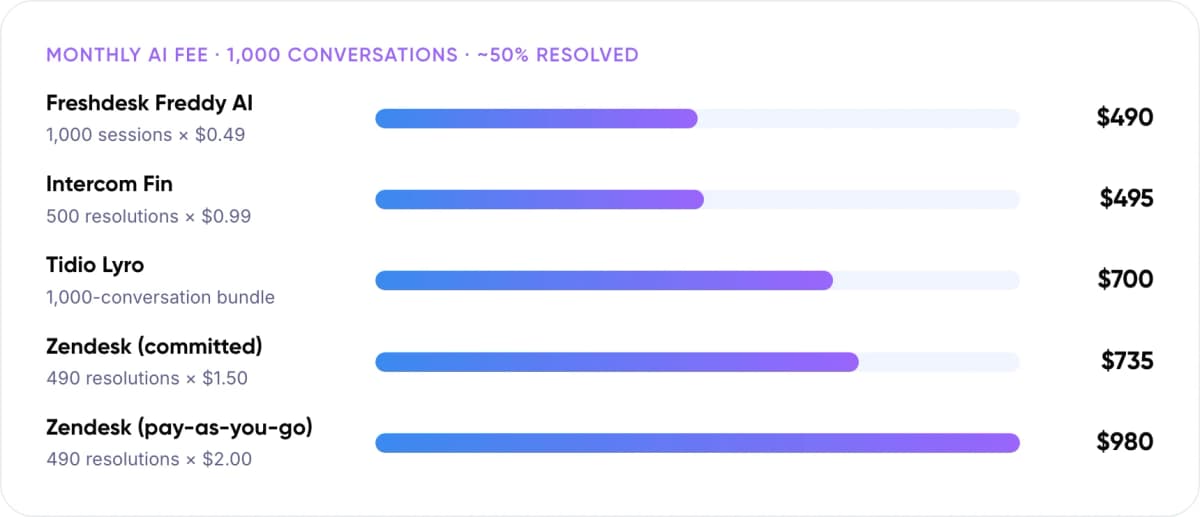
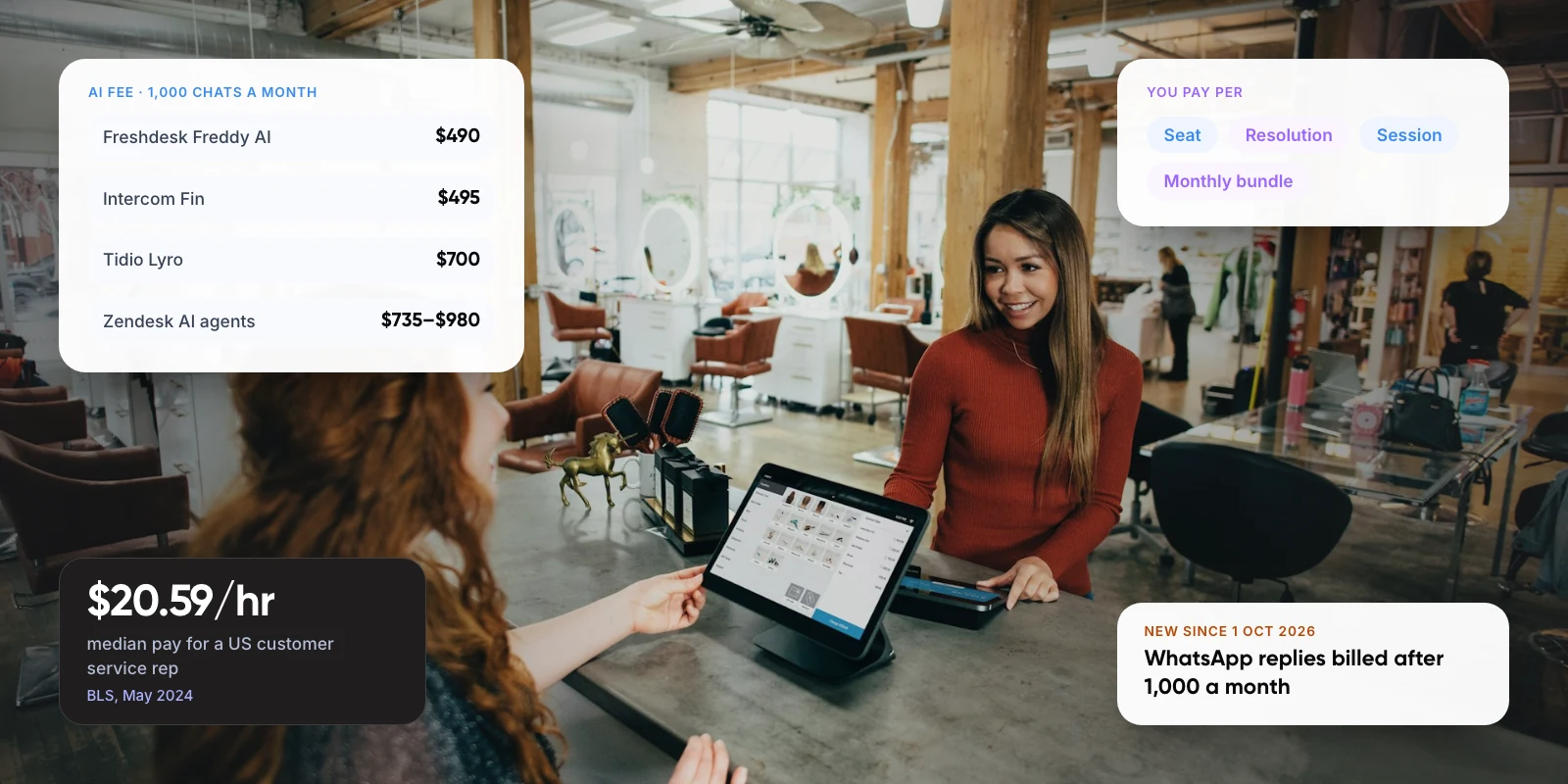
Monthly AI fee · 1,000 conversations · ~50% resolved
- Freshdesk Freddy AI (1,000 sessions × $0.49): $490
- Intercom Fin (500 resolutions × $0.99): $495
- Tidio Lyro (1,000-conversation bundle): $700
- Zendesk (committed) (490 resolutions × $1.50): $735
- Zendesk (pay-as-you-go) (490 resolutions × $2.00): $980
Seats come on top. Two Intercom Essential seats cost $58 a month. Two Zendesk Suite Team or Freshdesk Pro seats cost $110. Tidio prices human chats by volume instead of by seat. In total, this business would pay roughly $550 to $1,100 a month.
For comparison, the US Bureau of Labor Statistics put median pay for customer service representatives at $20.59 an hour in May 2024, or $42,830 a year. That is about $3,570 a month for one person, before benefits. The AI fee is much lower, but people still need to handle the other half of conversations.
Tip: Per-session pricing gets cheaper per resolution as the AI improves. At ~50% resolved, Freshdesk’s $0.49 session works out to $0.98 per resolution. At ~80% resolved, it falls to about $0.61.
5. Which Costs Don’t Appear on the Pricing Page?
The per-unit price is only part of the bill. In our experience, these are the costs small businesses most often leave out of their budget.
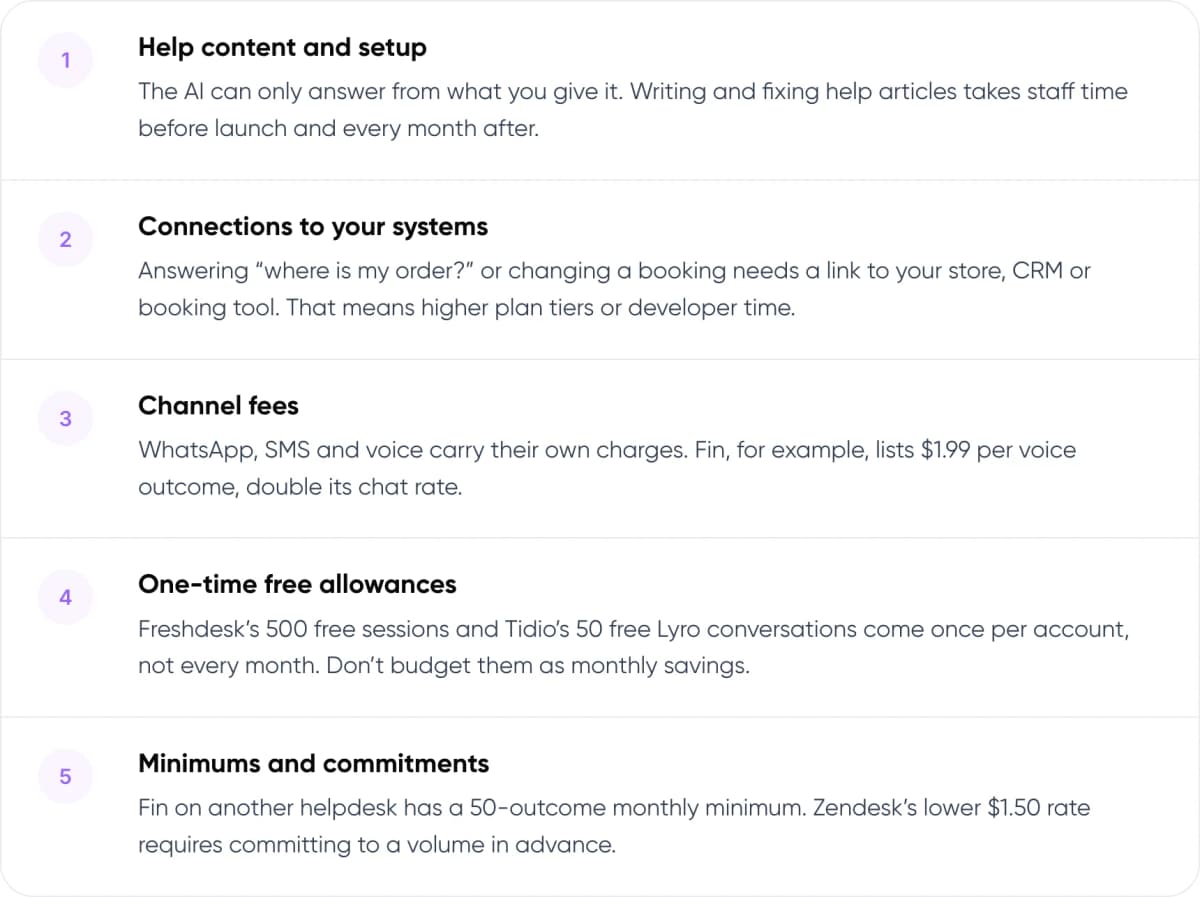
- Help content and setup: The AI can only answer from what you give it. Writing and fixing help articles takes staff time before launch and every month after.
- Connections to your systems: Answering “where is my order?” or changing a booking needs a link to your store, CRM or booking tool. That means higher plan tiers or developer time.
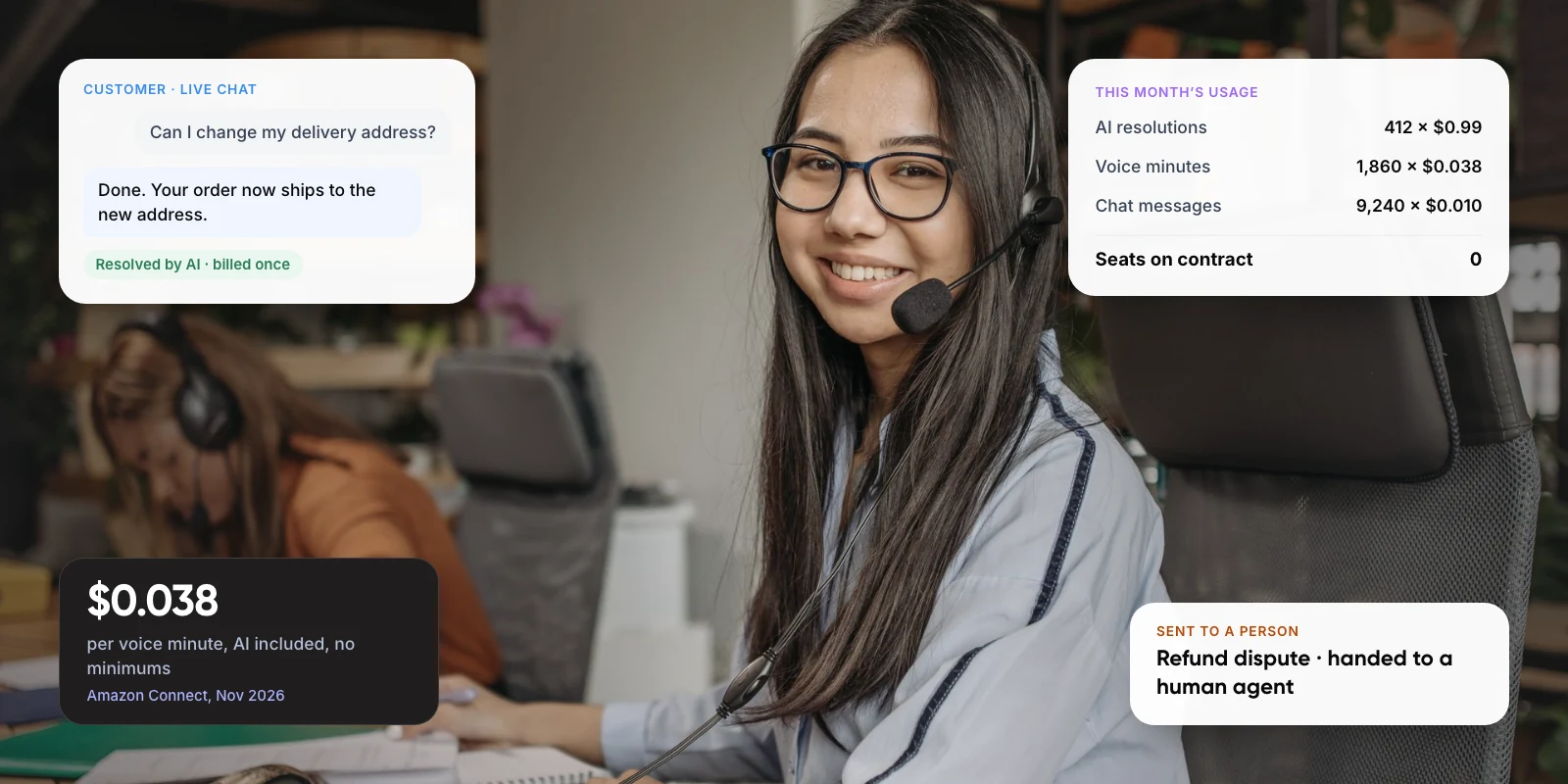
- Channel fees: WhatsApp, SMS and voice carry their own charges. Fin, for example, lists $1.99 per voice outcome, double its chat rate.
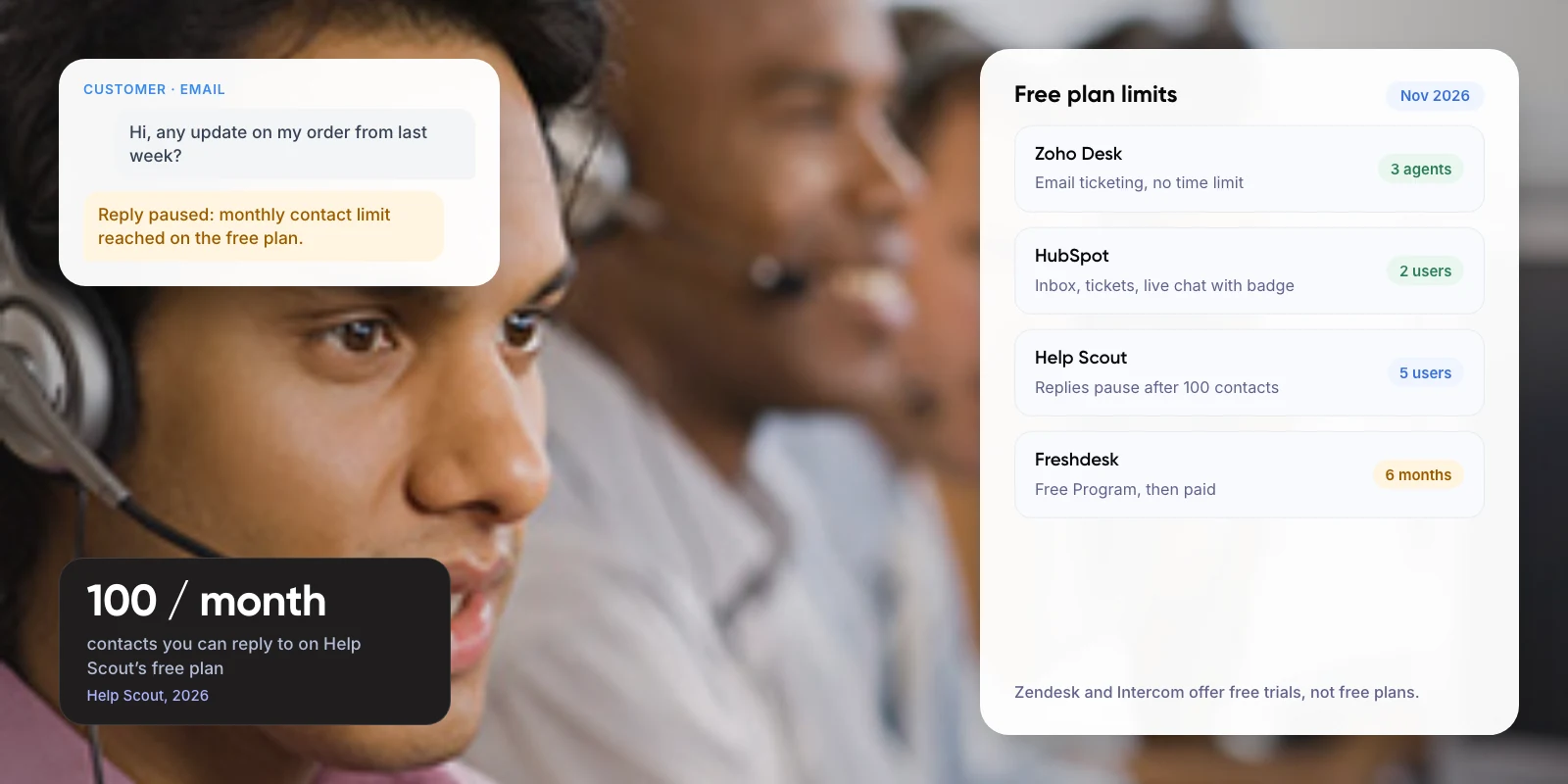
- One-time free allowances: Freshdesk’s 500 free sessions and Tidio’s 50 free Lyro conversations come once per account, not every month. Don’t budget them as monthly savings.
- Minimums and commitments: Fin on another helpdesk has a 50-outcome monthly minimum. Zendesk’s lower $1.50 rate requires committing to a volume in advance.
WhatsApp needs a closer look if your customers use it. Meta has charged per message since July 2025. Since 1 October 2026, replies inside the 24-hour customer service window are also charged after the first 1,000 per business number each month. The rate is $0.0034 per message to US numbers and ₹0.115 in India, plus any fee your WhatsApp provider adds.
Warning: Freshdesk charges for each Freddy AI Agent session, whether or not the issue gets resolved. If your help articles are thin, you will pay for many conversations that end with a handoff to a person.
6. Should You Buy a Tool or Build a Custom AI Agent?
If you use one helpdesk and get fewer than a few thousand conversations a month, we would start with an off-the-shelf tool. A custom build makes sense when the AI has to take actions across several systems, not just answer questions.
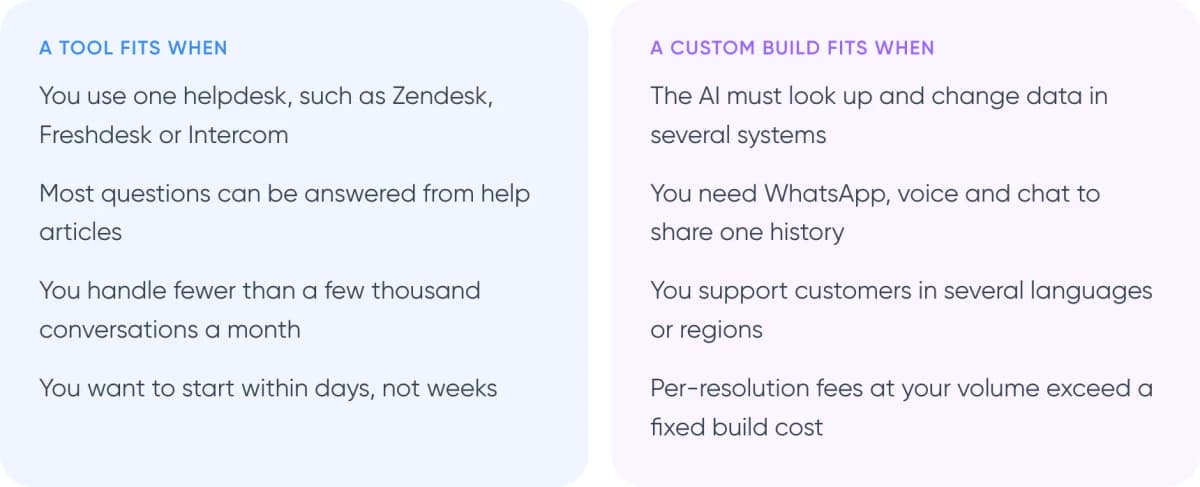
A tool fits when
- You use one helpdesk, such as Zendesk, Freshdesk or Intercom
- Most questions can be answered from help articles
- You handle fewer than a few thousand conversations a month
- You want to start within days, not weeks
A custom build fits when
- The AI must look up and change data in several systems
- You need WhatsApp, voice and chat to share one history
- You support customers in several languages or regions
- Per-resolution fees at your volume exceed a fixed build cost
Our AI agent development is a custom build. At small volumes that is more than a tool subscription, so it only pays off when the agent takes over manual work that a tool can’t reach.
Not sure which pricing model fits your volume? We can work it out with you.
7. Does Automated Customer Support Actually Save Money?
It can, at scale. In February 2024, Klarna reported that its AI assistant handled 2.3 million conversations in its first month. That was two-thirds of its customer service chats. Klarna said this equalled the work of 700 full-time agents and estimated a $40 million profit improvement for 2024.

- 2.3M conversations handled in the first month
- <2 min average time to resolve, down from 11 minutes
- ~25% fewer repeat inquiries
Source: Klarna press release, February 2024. Figures reported by Klarna.
Klarna is a large company, and a small business won’t save on that scale. AI costs may also rise. In January 2026, Gartner predicted that generative AI cost per resolution will exceed $3 by 2030, more than many offshore human agents. Its reasons: rising data centre costs, AI vendors moving from subsidised growth to profit, and more complex uses that need more computing.
Our view: budget on the cost of each resolved conversation, not the cost of each message. Ask for a 12-month price lock, and plan for per-unit prices to rise at renewal.
8. How Do You Budget for Customer Support Automation? 6 Steps
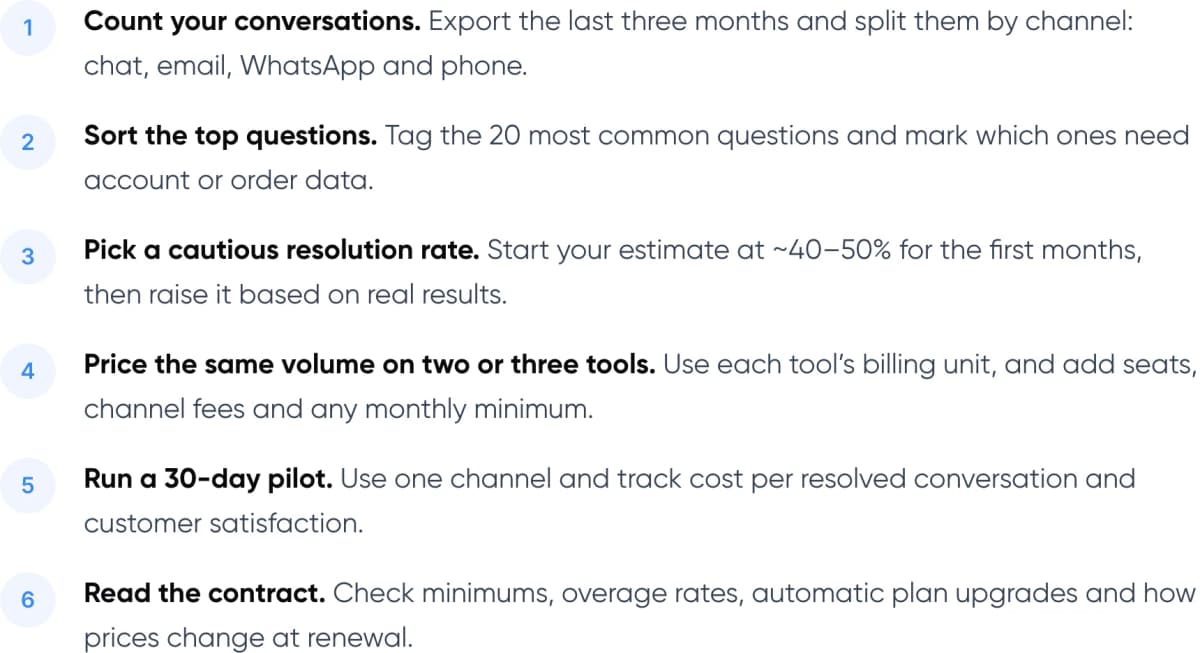
- Count your conversations. Export the last three months and split them by channel: chat, email, WhatsApp and phone.
- Sort the top questions. Tag the 20 most common questions and mark which ones need account or order data.
- Pick a cautious resolution rate. Start your estimate at ~40–50% for the first months, then raise it based on real results.
- Price the same volume on two or three tools. Use each tool’s billing unit, and add seats, channel fees and any monthly minimum.
- Run a 30-day pilot. Use one channel and track cost per resolved conversation and customer satisfaction.
- Read the contract. Check minimums, overage rates, automatic plan upgrades and how prices change at renewal.
The resolution rate has the biggest effect on cost, and it depends on accurate answers and clean handoffs. Our guides to agentic RAG for customer service and chatbot handoff with context transfer cover both.
9. Frequently Asked Questions
How much does customer support automation cost for a small business?
On popular tools, expect roughly $40 to $1,100 a month for up to 1,000 conversations, based on November 2026 prices. The total depends on your volume, how many conversations the AI resolves, and how many agent seats you need. AI usage fees range from about $0.49 a session to $2.00 a resolution.
Is per-resolution pricing better than per-session pricing?
Per-resolution pricing is safer while you are starting out, because you pay only when the AI solves the issue. Per-session pricing charges for every conversation the AI joins, resolved or not. It can be cheaper per resolution once the AI reliably resolves most conversations.
Are there free AI customer support tools?
Some tools include small free allowances. Tidio’s free plan includes 50 Lyro AI conversations once per account, and Freshdesk includes 500 Freddy AI Agent sessions once per account. These are one-time allowances, so they suit testing rather than ongoing support.
Do I pay extra to use AI support on WhatsApp?
Usually, yes. Meta charges per message on the WhatsApp Business Platform. Since 1 October 2026, replies inside the 24-hour window are charged after the first 1,000 per business number each month: $0.0034 per message to US numbers and ₹0.115 in India. Providers may add their own fee.
Is AI customer support cheaper than hiring an agent?
For routine questions, usually yes. US customer service representatives earned a median $20.59 an hour in May 2024, according to the BLS. But you still need people for complex issues, and Gartner predicts AI cost per resolution will exceed $3 by 2030. Compare cost per resolved conversation, not just the monthly fee.
10. Conclusion
Customer support automation pricing for a small business usually lands between a few dozen and about a thousand dollars a month. The billing unit decides where you fall in that range. Before you sign, export three months of conversations, price that exact volume on two or three tools, and run a 30-day pilot that tracks cost per resolved conversation.
For an example of our multichannel support work, see Paymate.
- AI Customer Support Automation (Our service): We plan, build and run AI support across chat, email, WhatsApp and voice, connected to your helpdesk and business systems. Explore the service →
Author