AI Support Automation vs. BPO Outsourcing: Cost, Speed & Quality Comparison
AI is cheaper and faster for simple, repeatable questions. Customer service outsourcing to a BPO (business process outsourcing) firm is still better value for complex, emotional or phone-heavy work.
This guide compares the two on 2026 prices, speed and quality, and shows when a hybrid of both costs least.
1. The Short Answer
AI support automation costs less than customer service outsourcing for high-volume, simple questions, but a BPO team still wins on complex, sensitive and voice-heavy work. Most mid-size companies get the lowest total cost by combining them.
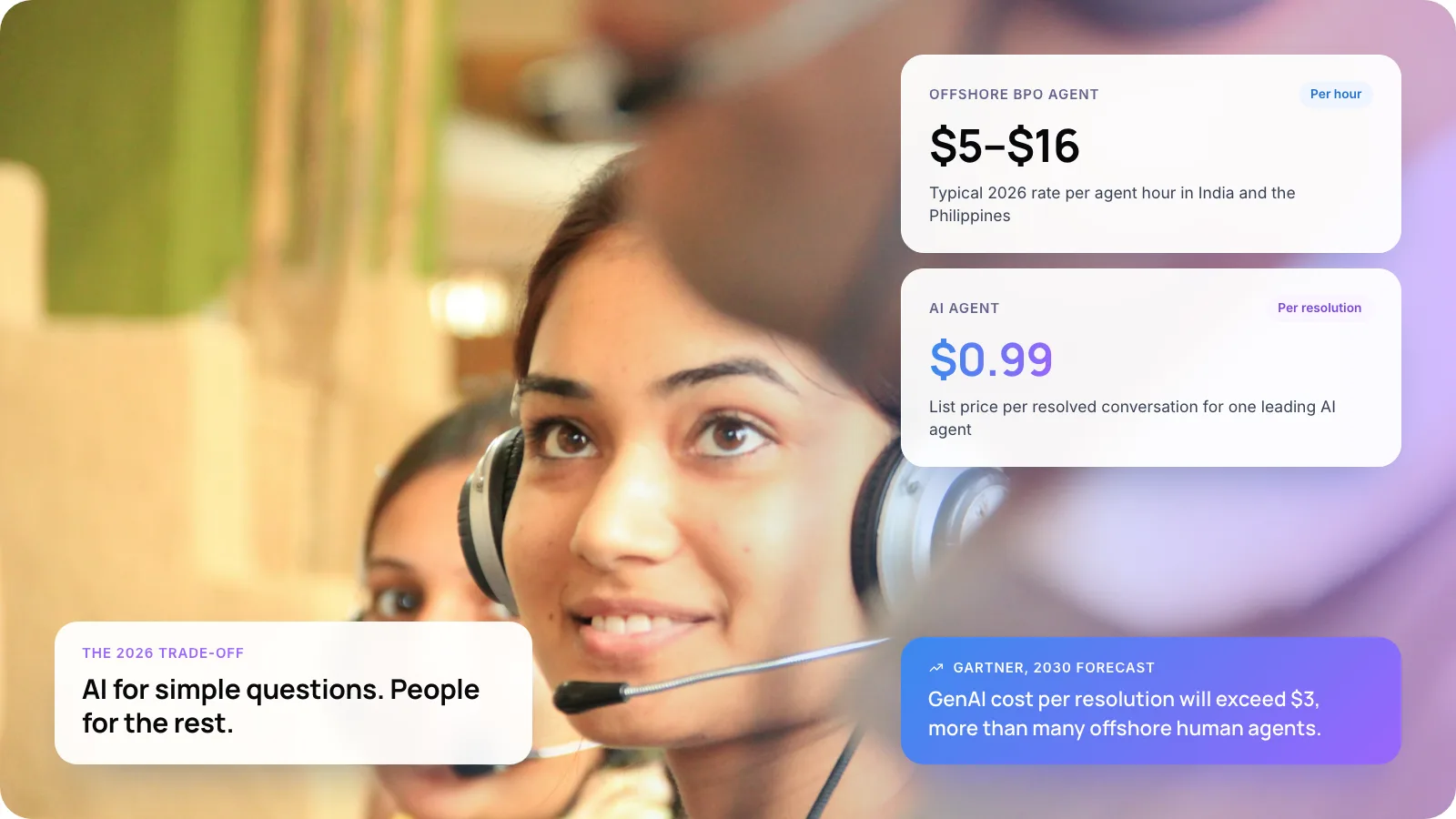
Human contacts keep getting more expensive. Deloitte Digital’s 2026 Global Contact Center Survey puts the average cost of an assisted contact at $7.80, up from $6.70 in 2024. AI is not a free alternative either. Gartner expects generative AI to cost more than $3 per resolution by 2030, above many offshore human agents.
Key takeaways
- Offshore BPO support typically costs $5 to $16 per agent hour in India and the Philippines in 2026, before setup, tools and management.
- AI agents are often priced per resolution. Intercom lists Fin at $0.99 per outcome, and unresolved conversations still need a person.
- Gartner forecasts generative AI will cost more than $3 per resolution by 2030, so do not assume AI prices only fall.
- AI wins on speed and 24/7 coverage. People win on complaints, judgement and trust.
- For most mid-size teams, a hybrid of AI for simple questions and a smaller BPO team costs least.
2. What Does Customer Service Outsourcing Cost in 2026?
Most BPO contracts charge per agent hour or per dedicated agent per month. Location sets most of the price. Published 2026 rate cards from outsourcing providers cluster in these ranges for customer support:
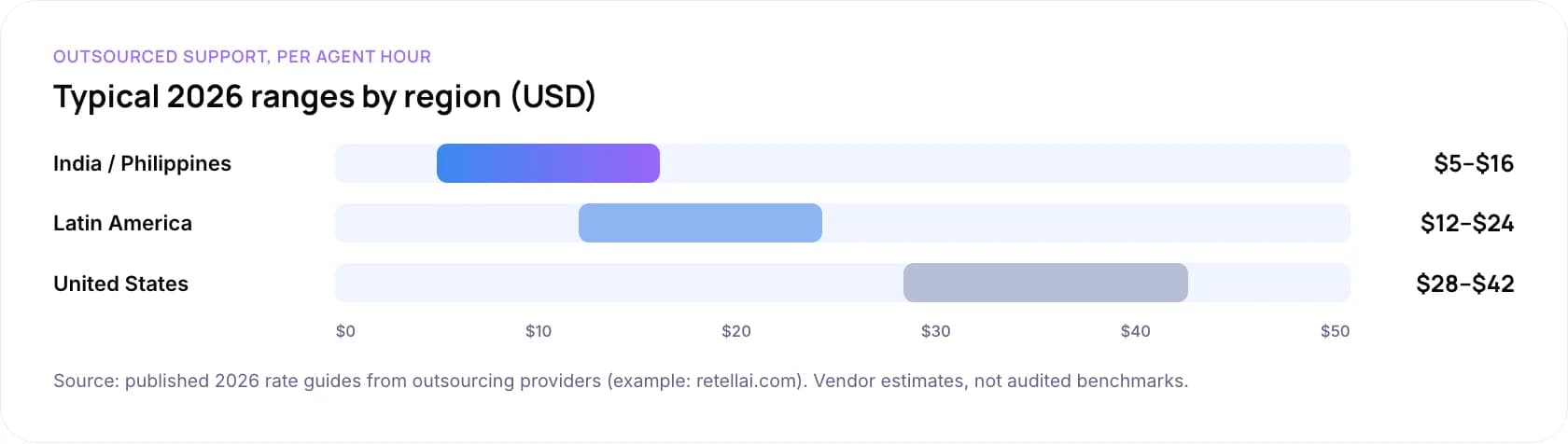
- India and the Philippines: $5 to $16 per agent hour.
- Latin America: $12 to $24 per agent hour.
- United States: $28 to $42 per agent hour.
Source: published 2026 rate guides from outsourcing providers (example). These are vendor estimates, not audited benchmarks.
The hourly rate is only part of the bill. You also pay for setup and training, quality checks, the help desk and phone tools, and your own team managing the vendor. BPOs bill for idle time too, so an agent waiting for the next ticket costs the same as one solving it.
Note: Agent turnover is a hidden cost. Contact center attrition is high, and each new agent needs training before reaching full speed, so you keep paying for ramp-up.
3. What Does AI Customer Service Cost?
AI customer service is usually priced per resolution or per conversation. Intercom lists its Fin AI agent at $0.99 per outcome. Other vendors charge per conversation, per seat or a flat platform fee. Custom builds swap the usage fee for build and running costs.
The fee per resolution is not the full cost. You also pay for:
- Setup and integration with your systems.
- Writing and maintaining the knowledge base the AI answers from.
- Monitoring answer quality.
- The humans who take over when the AI cannot help.
Gartner’s January 2026 forecast is a useful warning. It cites rising data center costs, vendors moving from subsidised growth to profit, and more complex use cases. Our view: model AI cost per resolution as flat or rising over a three-year contract, not falling.
4. AI vs. BPO: Cost, Speed and Quality Compared
The table compares an AI agent with an offshore BPO team on the points that usually decide the contract.
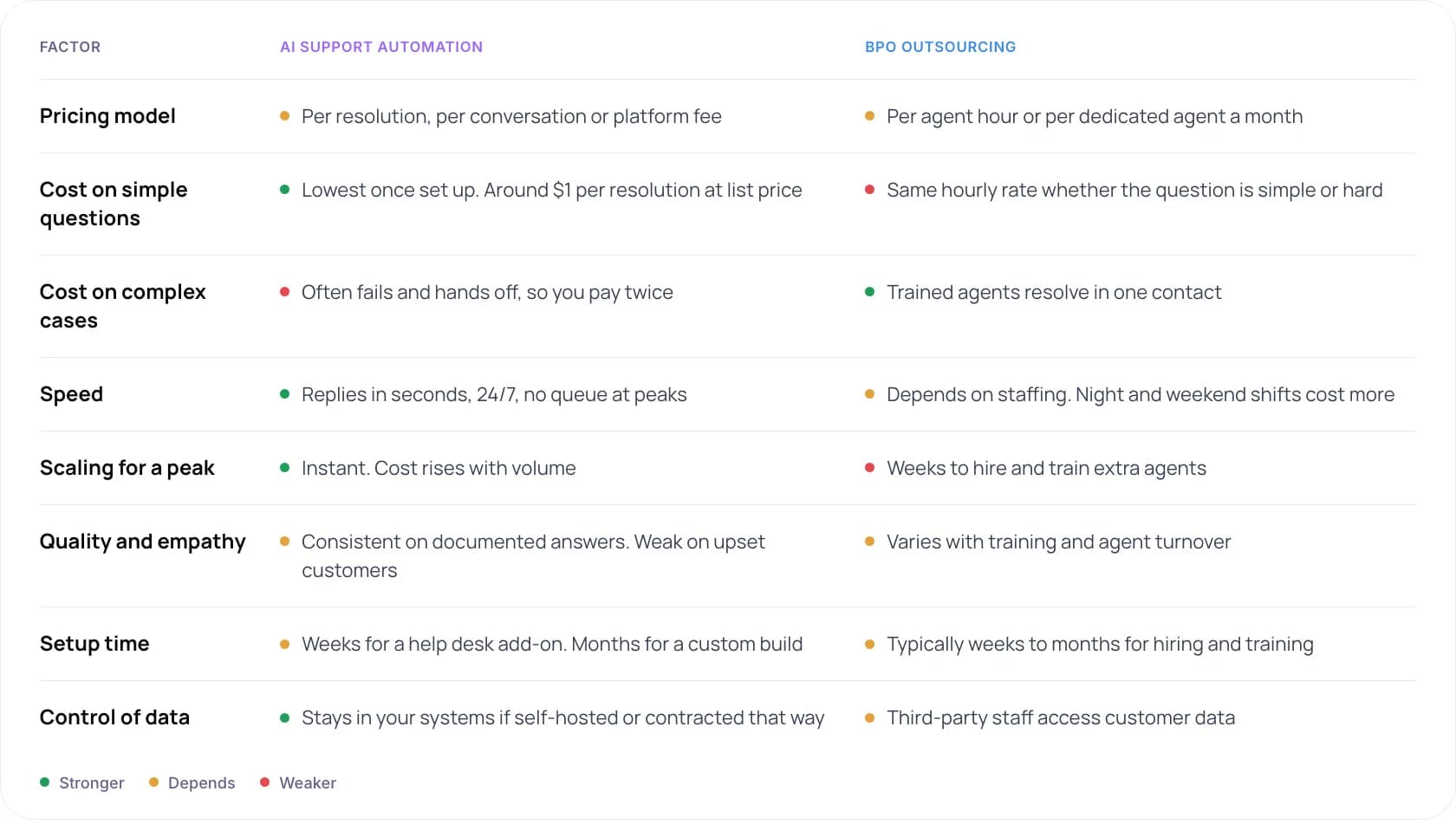
- Pricing model: AI is billed per resolution, per conversation or as a platform fee. A BPO bills per agent hour or per dedicated agent a month.
- Cost on simple questions: AI is lowest once set up, around $1 per resolution at list price. A BPO charges the same hourly rate whether the question is simple or hard.
- Cost on complex cases: AI often fails and hands off, so you pay twice. Trained BPO agents resolve in one contact.
- Speed: AI replies in seconds, 24/7, with no queue at peaks. A BPO depends on staffing, and night and weekend shifts cost more.
- Scaling for a peak: AI is instant, and cost rises with volume. A BPO needs weeks to hire and train extra agents.
- Quality and empathy: AI is consistent on documented answers and weak on upset customers. BPO quality varies with training and agent turnover.
- Setup time: AI takes weeks for a help desk add-on and months for a custom build. A BPO typically takes weeks to months for hiring and training.
- Control of data: AI data stays in your systems if self-hosted or contracted that way. With a BPO, third-party staff access customer data.
Speed is where AI clearly leads. It answers in seconds at any hour, and volume spikes do not create a queue. A BPO needs weeks to hire and train for a new peak, and night shifts cost more.
5. AI vs. BPO Cost Calculator
Enter your volume and rates to compare three setups: BPO only, AI only for what it can resolve, and a hybrid where AI takes the simple share and the BPO handles the rest.
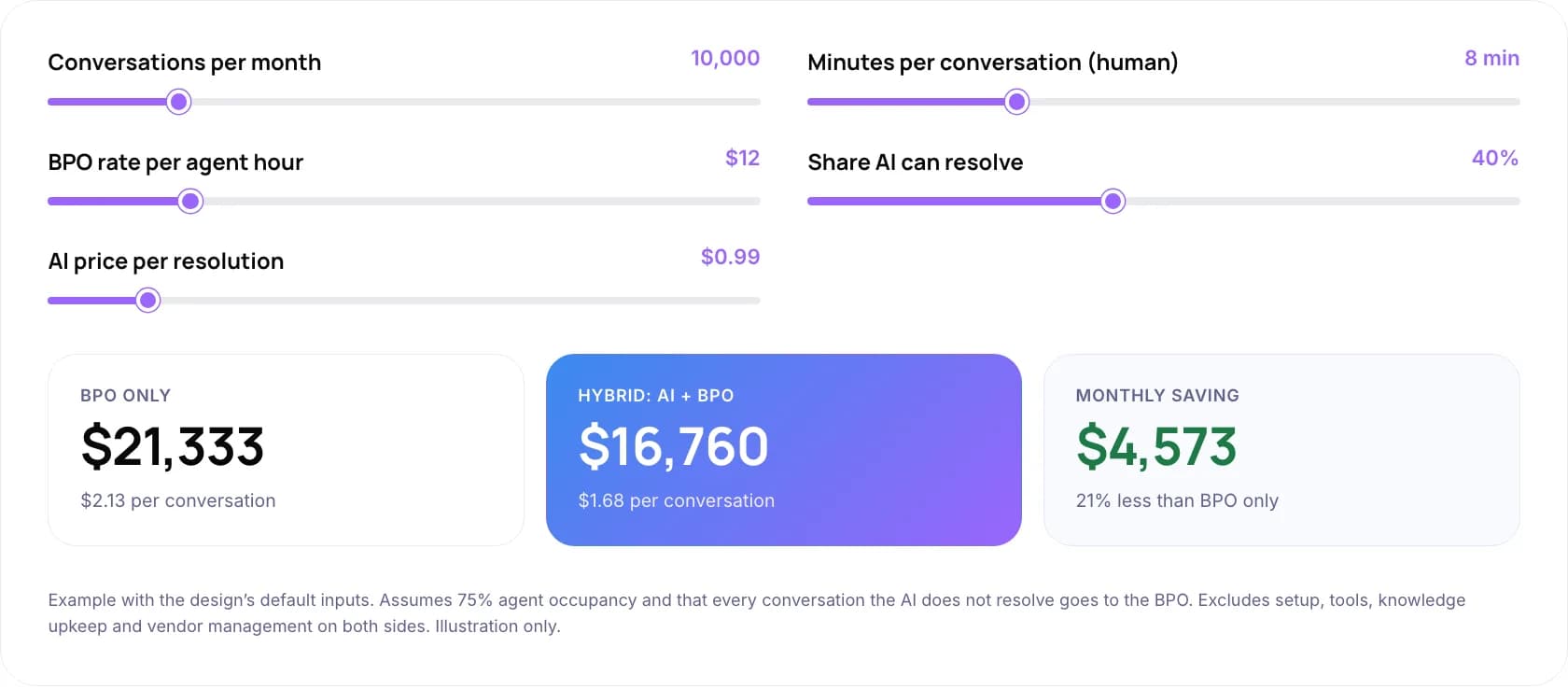
Worked example with the design’s default inputs: 10,000 conversations a month, 8 minutes per conversation for a human agent, a BPO rate of $12 an hour, 40% of conversations resolved by AI and $0.99 per AI resolution. BPO only costs about $21,333 a month, or $2.13 per conversation. A hybrid costs about $16,760, or $1.68 per conversation, because AI resolves 4,000 conversations and the BPO handles the other 6,000. That is a saving of about $4,573 a month, 21% less than BPO only.
The calculator assumes 75% agent occupancy and that every conversation the AI does not resolve goes to the BPO. It excludes setup, tools, knowledge upkeep and vendor management on both sides, so treat it as an illustration. To weigh software cost against hours saved, try our free AI ROI Calculator.
Tip: Run the numbers with your real resolution rate from a pilot, not a vendor’s headline figure. Each conversation the AI fails to resolve still costs you a human contact.
6. Which Gives Better Quality, AI or Human Agents?
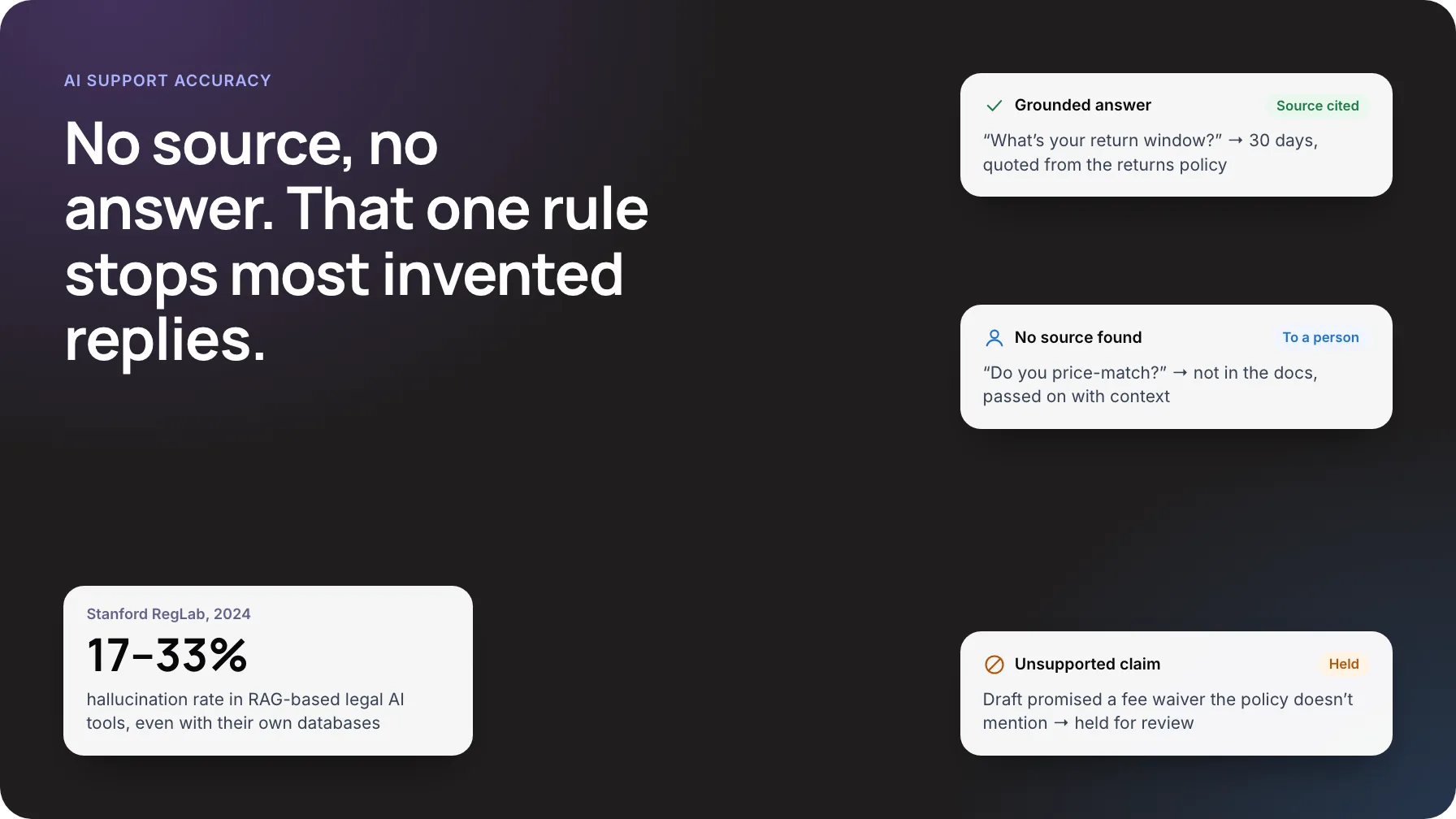
It depends on the question. AI is consistent on factual answers it has a source for, such as order status, policies and how-to steps. People do better when the customer is upset, the case needs judgement, or the answer is not written down anywhere.
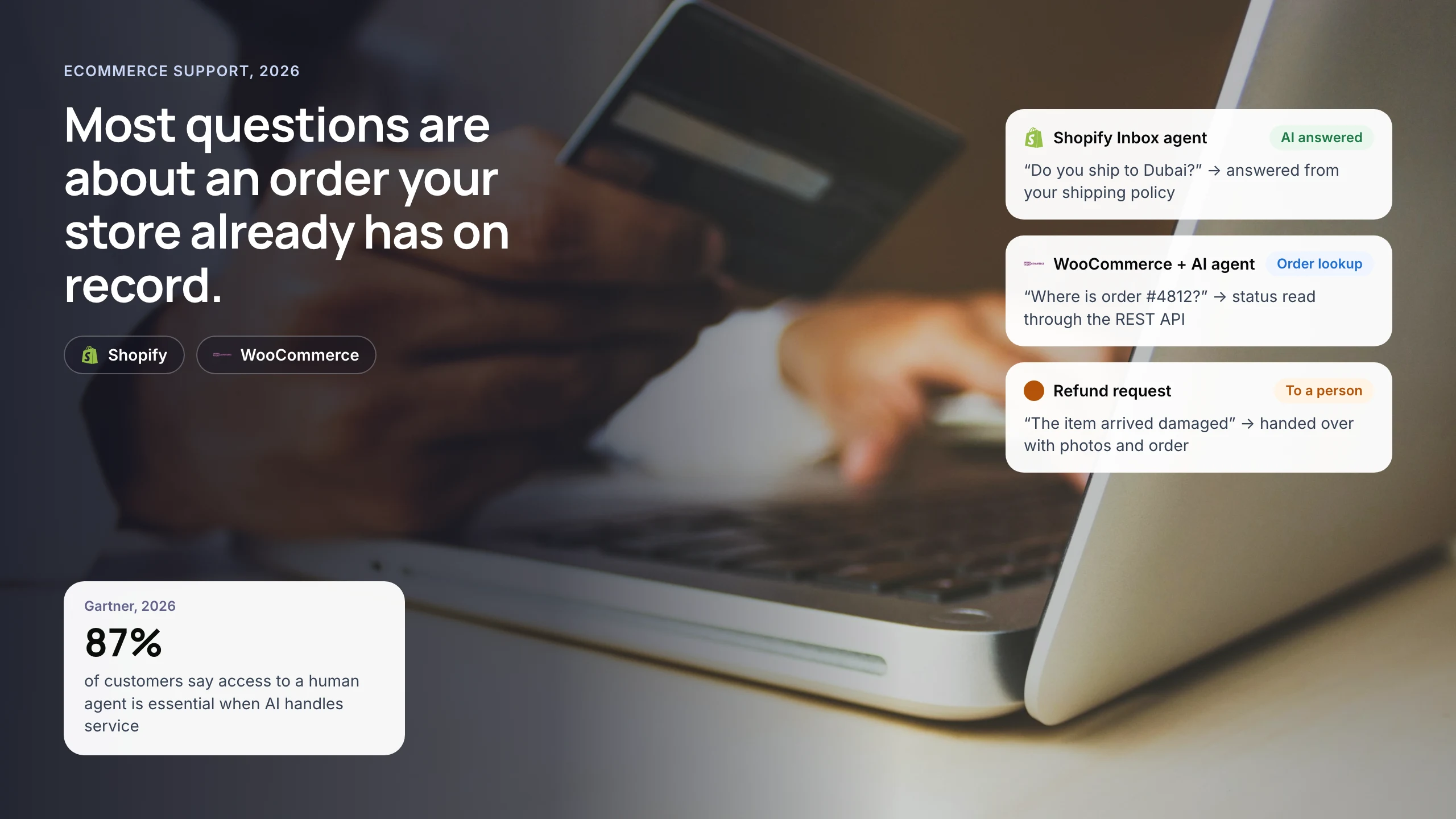
Customers say the same. In a Gartner survey of 5,801 US customers, 54% trusted human agents more than AI for product or service recommendations, against 32% who trusted AI more. A separate 2026 Gartner survey found 87% of customers say access to a human agent is essential when companies use generative AI.

- AI alone (simple and documented): order status and tracking, password and login help, policy and how-to questions.
- AI drafts, person approves (needs a check): refunds and credits, plan and billing changes, warranty claims.
- People, in-house or BPO (judgement and trust): complaints and escalations, cancellations and retention, complex technical cases.
Want to know how much of your volume AI could take? Book a free AI consultation.
7. How to Move From BPO to a Hybrid Model in 5 Steps
Most companies we speak to do not replace their BPO outright. They shift the simple share of volume to AI and renegotiate the contract around what is left.
- Tag a month of tickets by intent. Mark which ones a written answer could resolve. This share sets your AI ceiling.
- Price both sides. Use the calculator above with your real BPO rate and handle time.
- Pilot AI on the top intents. Run it on one channel for four to six weeks and measure true resolution, not just deflection.
- Renegotiate the BPO contract. Shift from fixed seats to the reduced, more complex volume. Ask for pricing per resolved case where possible.
- Review monthly. Track cost per resolution, customer satisfaction and handoff rate for AI and BPO side by side.
Gartner’s research suggests this is the common path. In its survey of 321 service leaders, 85% were expanding human agent responsibilities as AI took on simple work.
8. Real Examples
Klarna: AI first, then people again
In February 2024, Klarna reported that its AI assistant handled 2.3 million conversations in its first month, two-thirds of its service chats, and cut resolution time from 11 minutes to under 2. It said the assistant did the work of 700 full-time agents.
In May 2025, its CEO told Bloomberg the company was hiring human agents again so customers could always reach a person. The AI stayed on routine questions. The lesson for anyone replacing a BPO: cut the simple volume, not the human option.
Two of our builds
For a payments company, we built an omnichannel customer support system that answers high-confidence email queries in under a minute and hands complex cases to human support with context. For ecommerce merchants, we built an AI assistant that drafts replies from live order data, with an agent approving each one.

9. Common Mistakes
- Comparing an AI list price with a fully loaded BPO cost. Add setup, knowledge upkeep and human fallback to the AI side too.
- Counting deflection as resolution. A customer who leaves the chat and calls later is not resolved.
- Cancelling the BPO before the AI is proven. Run both through a full peak season first.
- Hiding the route to a person. Gartner expects regulation on access to humans to raise assisted volume 30% by 2028.
- Signing long AI contracts on today’s prices. Gartner forecasts AI cost per resolution to rise, so cap price increases in the contract.
10. Frequently Asked Questions
Is AI customer service cheaper than outsourcing?
For simple, documented questions, usually yes. AI agents list at around $1 per resolution, while an offshore BPO agent costs $5 to $16 an hour. For complex cases AI often hands off, so you pay for both. Gartner also forecasts AI cost per resolution will exceed $3 by 2030.
How much does customer service outsourcing cost?
Published 2026 rate guides put customer support outsourcing at about $5 to $16 per agent hour in India and the Philippines, $12 to $24 in Latin America and $28 to $42 in the US. Setup, training, tools and vendor management are extra. Rates vary with language, channel and contract length.
Can AI replace a BPO call center?
Rarely in full. AI handles high-volume, simple questions well, but customers still want people for complaints and complex cases. Klarna moved much of its chat volume to AI in 2024, then began hiring human agents again in 2025. Most companies shrink the BPO contract instead of ending it.
What is the difference between BPO and AI support automation?
BPO outsourcing means paying another company’s staff to handle your customer conversations, usually per hour or per agent. AI support automation uses software to answer customers directly, usually priced per resolution or conversation. A hybrid model uses AI for simple questions and people for the rest.
Which is faster, AI or a BPO team?
AI. It replies in seconds at any hour and does not queue during spikes. A BPO team’s speed depends on how many agents are scheduled, and adding capacity for a peak takes weeks of hiring and training. For phone support, a well-staffed BPO can still answer quickly.
How do I calculate AI vs BPO cost?
Multiply monthly conversations by handle time in hours, divide by agent occupancy and multiply by the BPO hourly rate. For AI, multiply resolved conversations by the price per resolution, then add the human cost of the rest. Compare total cost per conversation, not list prices.
11. Conclusion
Choosing between AI support automation and customer service outsourcing comes down to what your customers ask. Pull last quarter’s tickets, mark which ones follow a written answer, and price that share at an AI rate and the rest at your BPO rate. If the simple share is large, a hybrid will almost always beat either option alone.
See our AI customer support automation services, try the free AI ROI Calculator, or read how customer support automation works.
Author