Best AI Voice Agent Platforms Compared: Vapi, Retell, Bland AI and Custom Builds
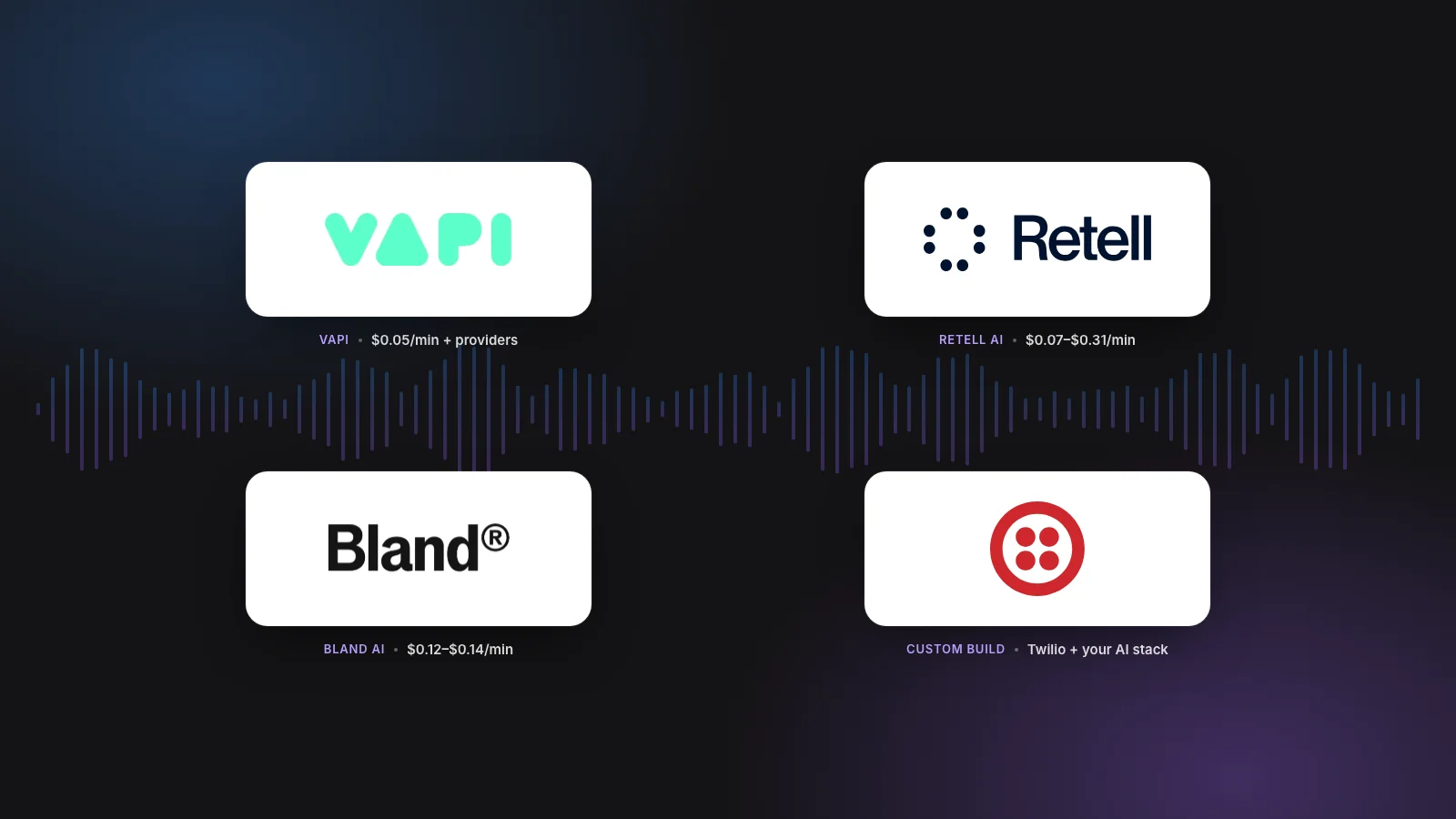
For most teams, Retell AI is the fastest route to a production AI voice agent, Vapi gives developers the most control over each component, and Bland AI suits high-volume calling at one bundled rate. A custom build on Twilio makes sense when volume, data rules or deep integration outweigh the engineering cost. As of November 2026, published rates start at $0.05 a minute on Vapi (platform fee only), $0.07 on Retell and $0.14 on Bland’s free Start plan.
Those numbers can’t be compared directly, because each vendor bundles a different part of the call into its rate. The sections below break the rates down, show a worked monthly bill, and map each option to the call types it handles best. Neura Dynamics partners with Vapi, so read our picks with that in mind.
Key takeaways
- Vapi’s $0.05 a minute covers orchestration only. With its default providers, a minute costs about $0.08 to $0.13 before telephony.
- Retell’s $0.07 to $0.31 range depends on the LLM and voice you pick. Bland bundles model, voice and transcription into $0.12 to $0.14 on its self-serve plans, with a $299 monthly fee on Build. Telephony is billed separately.
- A custom build swaps platform fees for engineering time and on-call ownership. In our view it pays off only at high, steady volume or under strict data rules.
- In the US, AI voices count as “artificial” under the TCPA, so most outbound AI calls need prior express consent.
1. What Does an AI Voice Agent Platform Actually Do?
An AI voice agent answers or places phone calls and holds a spoken conversation. Each turn of that conversation passes through four layers: telephony carries the audio, speech-to-text (STT) transcribes the caller, a large language model (LLM) decides what to say or which tool to call, and text-to-speech (TTS) speaks the reply.

- Telephony connects. Twilio, Telnyx or a SIP trunk carries the audio.
- Speech-to-text. A model such as Deepgram transcribes the caller.
- Language model decides. The LLM picks a reply or calls your CRM or calendar.
- Text-to-speech replies. A voice model speaks the answer back.
Vapi, Retell and Bland orchestrate those layers for you. They detect when the caller has finished speaking, handle interruptions, call your CRM or calendar mid-conversation, transfer to a human and log every call. That orchestration is the hard part, and latency is why. A 2009 PNAS study of ten languages found the typical gap between speakers is around 200 milliseconds. Every layer adds delay, so the platform’s job is to keep the total short enough that callers don’t talk over the agent.
Note: Speech-to-speech models hear audio and reply in audio, skipping separate STT and TTS steps. Retell’s pricing page lists them as an option. They change both the cost and the latency math, so price them separately.
2. How Do Vapi, Retell AI and Bland AI Compare?
The three platforms differ most in what their per-minute rate includes. Vapi charges for orchestration and passes every other provider through at cost. Retell prices each component on one bill. Bland sells one bundled AI rate per plan. The table uses each vendor’s published pricing as of November 2026.
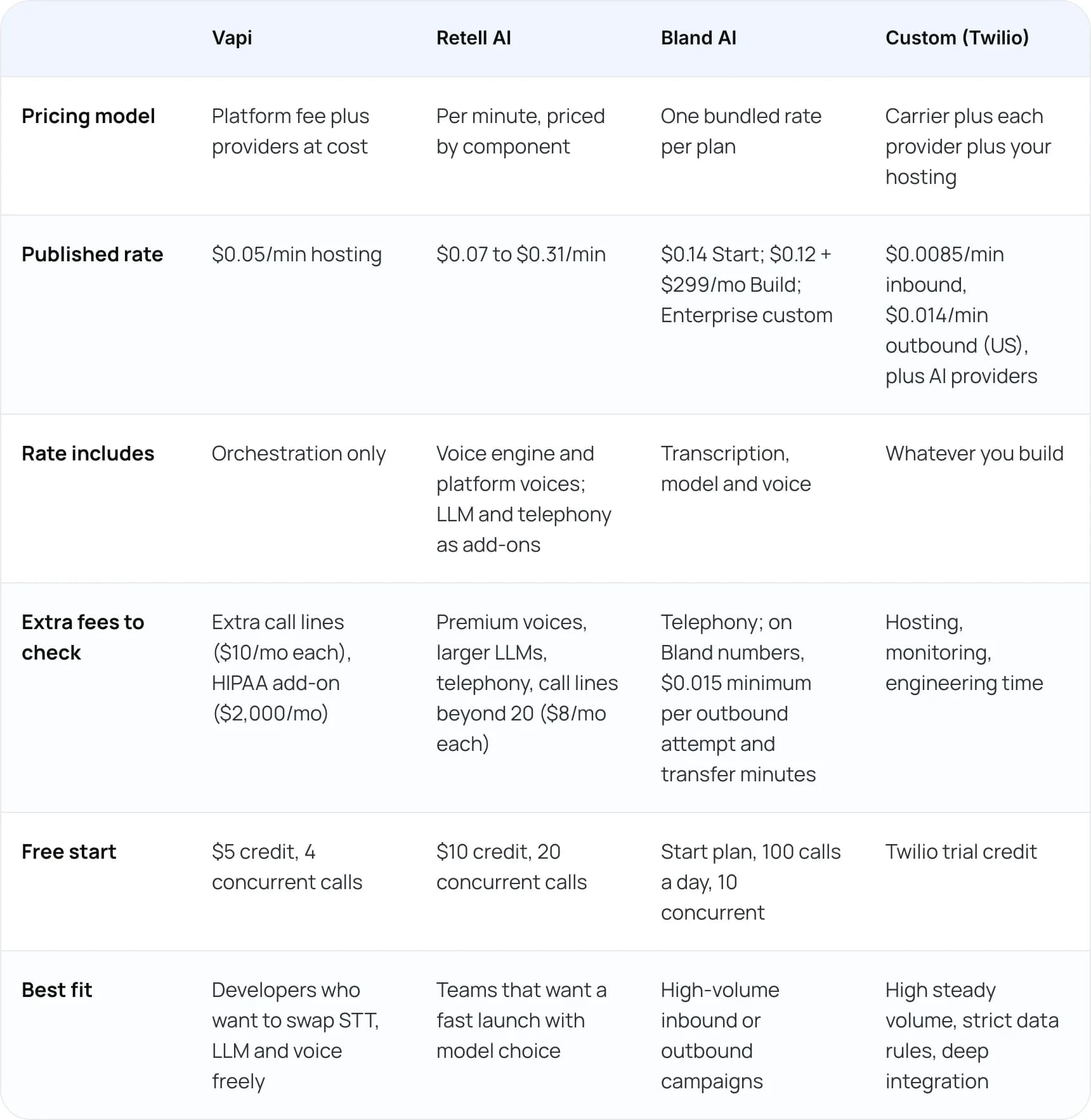
Vapi
- Pricing model: platform fee plus providers at cost.
- Published rate: $0.05 a minute hosting.
- Rate includes: orchestration only.
- Extra fees to check: extra call lines ($10 a month each) and the HIPAA add-on ($2,000 a month).
- Free start: $5 credit and 4 concurrent calls.
- Best fit: developers who want to swap STT, LLM and voice freely.
Retell AI
- Pricing model: per minute, priced by component.
- Published rate: $0.07 to $0.31 a minute.
- Rate includes: the voice engine and platform voices; the LLM and telephony are add-ons.
- Extra fees to check: premium voices, larger LLMs, telephony, and call lines beyond 20 ($8 a month each).
- Free start: $10 credit and 20 concurrent calls.
- Best fit: teams that want a fast launch with model choice.
Bland AI
- Pricing model: one bundled AI rate per plan.
- Published rate: $0.14 a minute on Start; $0.12 a minute plus $299 a month on Build; custom pricing on Enterprise.
- Rate includes: transcription, model and voice.
- Extra fees to check: telephony; on Bland’s own numbers, a $0.015 minimum per outbound attempt and transfer minutes.
- Free start: the Start plan, with 100 calls a day and 10 concurrent calls.
- Best fit: high-volume inbound or outbound campaigns.
Custom build on Twilio
- Pricing model: the carrier, plus each AI provider, plus your hosting.
- Published rate: $0.0085 a minute inbound and $0.014 a minute outbound (US), plus AI providers.
- Rate includes: whatever you build.
- Extra fees to check: hosting, monitoring and engineering time.
- Free start: Twilio trial credit.
- Best fit: high, steady volume, strict data rules or deep integration.
Tip: Run one test call at your real average call length on each platform, then ask for the itemized cost. Bland, for example, charges a $0.015 minimum for every outbound attempt on its own telephony, answered or not, and bills transfer minutes on its numbers on top of the connected rate.
3. What Does an AI Voice Agent Cost per Minute in Practice?
Labor is the cost these tools go after. Gartner’s 2022 forecast put labor at up to 95% of contact center costs and expected conversational AI to cut agent labor costs by $80 billion in 2026, with about one in ten interactions automated. The question for your budget is what each minute of AI call center automation costs.
Take a support line with 10,000 inbound minutes a month, roughly 3,300 three-minute calls. Here is what that volume costs on each option, using published rates and your own Twilio number.
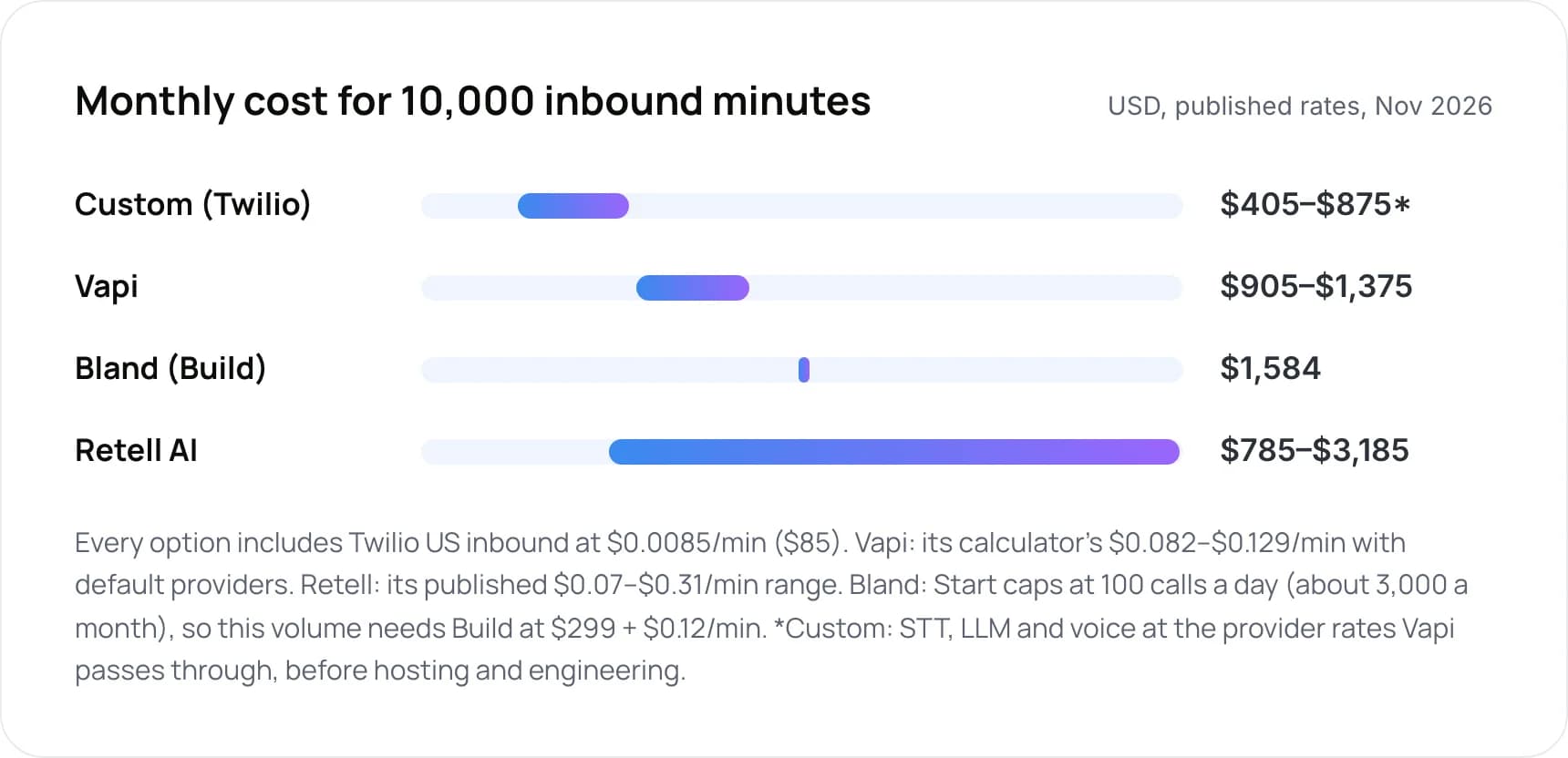
- Custom (Twilio): $405 to $875 a month, before hosting and engineering.
- Vapi: $905 to $1,375 a month.
- Bland (Build): $1,584 a month.
- Retell AI: $785 to $3,185 a month.
Every option includes Twilio US inbound at $0.0085 a minute ($85). Vapi uses its calculator’s $0.082 to $0.129 a minute with default providers. Retell uses its published $0.07 to $0.31 range. Bland’s Start plan caps at 100 calls a day (about 3,000 a month), so this volume needs Build at $299 plus $0.12 a minute. The custom figure prices STT, LLM and voice at the provider rates Vapi passes through.
Retell’s spread is the widest because the LLM dominates the bill. On its pricing page, model choice alone moves the cost from under a cent to more than $0.30 a minute. Vapi has the same effect, just billed by the provider instead. Pick the smallest model that passes your test calls, then move up only where it fails.
Warning: None of these figures include the people who build, test and maintain the agent. Long system prompts and knowledge-base lookups also raise LLM cost per minute as the agent grows.
4. When Is a Custom Build Better Than a Platform?
A platform gets you to a working call in days because turn-taking, interruptions and transfers are already solved. A custom build on Twilio Programmable Voice means your team owns those problems. In our view, that trade only makes sense in four situations.
- High, steady volume. At 100,000 minutes a month, Vapi’s hosting fee alone is $5,000. That budget can fund engineers who tune your own stack.
- Data that must stay in your cloud or region. Healthcare, lending and public-sector clients often require it.
- Workflows across several internal systems. Multi-step lookups and writes are easier to test and audit in your own code.
- Languages or voices the platforms handle poorly. You choose STT and TTS providers per language and test them on real call audio.
Several of our published projects use Vapi for voice. Paymate’s support system uses it for its voice channel, and on the AI Voice Assistant platform we stabilized and extended an existing platform built on Vapi and Twilio.
There is also a middle path. Vapi can use your own Twilio account as transport, so your phone numbers stay with you. Start on the platform, learn which call types work, and move the high-volume ones to a custom stack later without changing numbers.
Not sure which path fits your call volume? We’ll review your call types and estimate cost on each option. Book a free consultation.
5. Which AI Voice Agent Platform Fits Which Use Case?
These picks are our view, based on each platform’s pricing model and published features. Treat them as a shortlist to test, not a verdict.
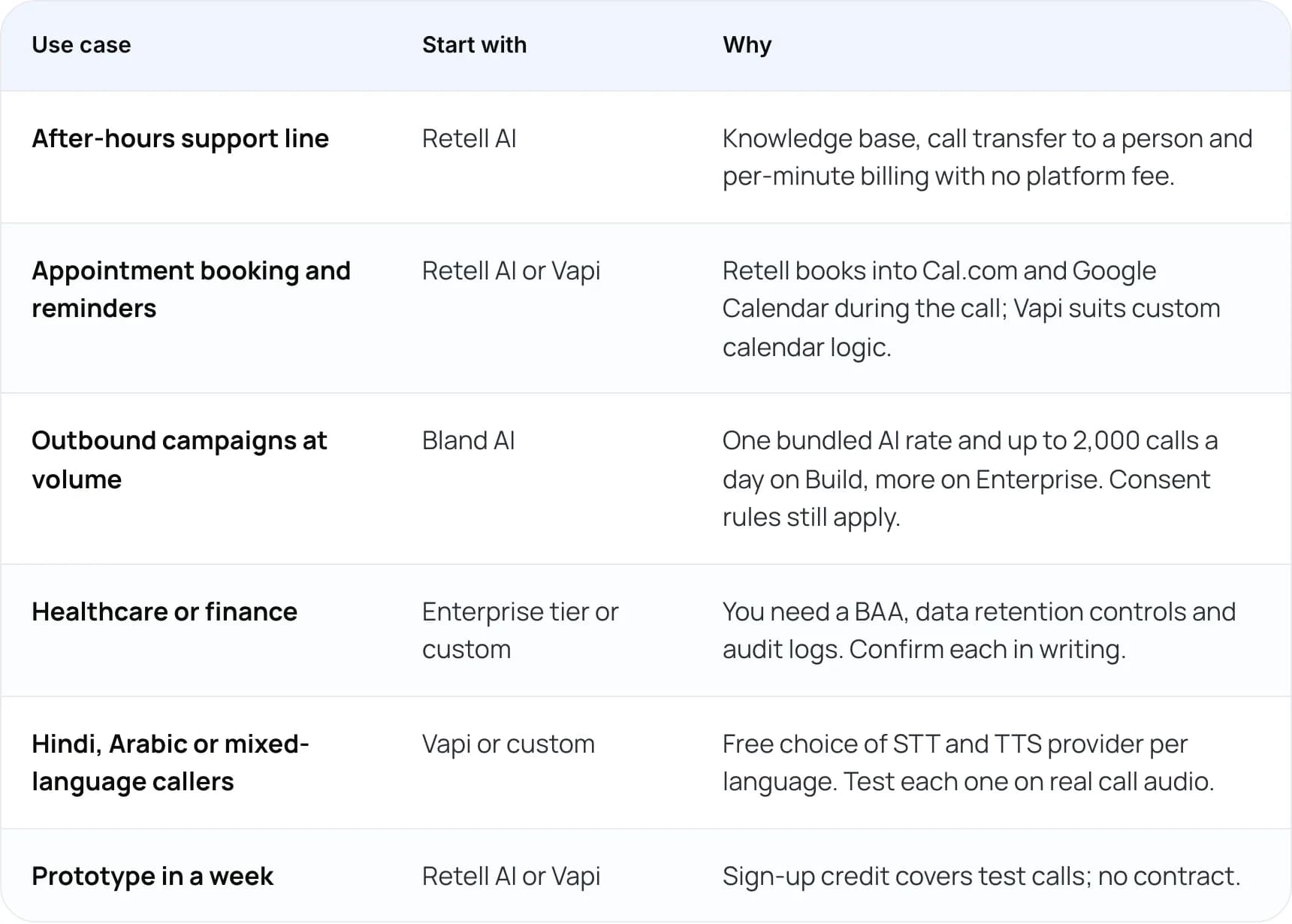
- After-hours support line (an AI receptionist or answering service): start with Retell AI. It has a knowledge base, call transfer to a person and per-minute billing with no platform fee.
- Appointment booking and reminders: Retell AI or Vapi. Retell books into Cal.com and Google Calendar during the call; Vapi suits custom calendar logic.
- Outbound campaigns at volume: Bland AI. It has one bundled AI rate and up to 2,000 calls a day on Build, more on Enterprise. Consent rules still apply.
- Healthcare or finance: an enterprise tier or a custom build. You need a BAA, data retention controls and audit logs. Confirm each in writing.
- Hindi, Arabic or mixed-language callers: Vapi or a custom build, for a free choice of STT and TTS provider per language. Test each one on real call audio.
- Prototype in a week: Retell AI or Vapi. Sign-up credit covers test calls, with no contract.
6. How Do You Choose an AI Voice Agent Platform?
A one-week bake-off between two platforms tells you more than any feature list. This is the sequence we suggest.
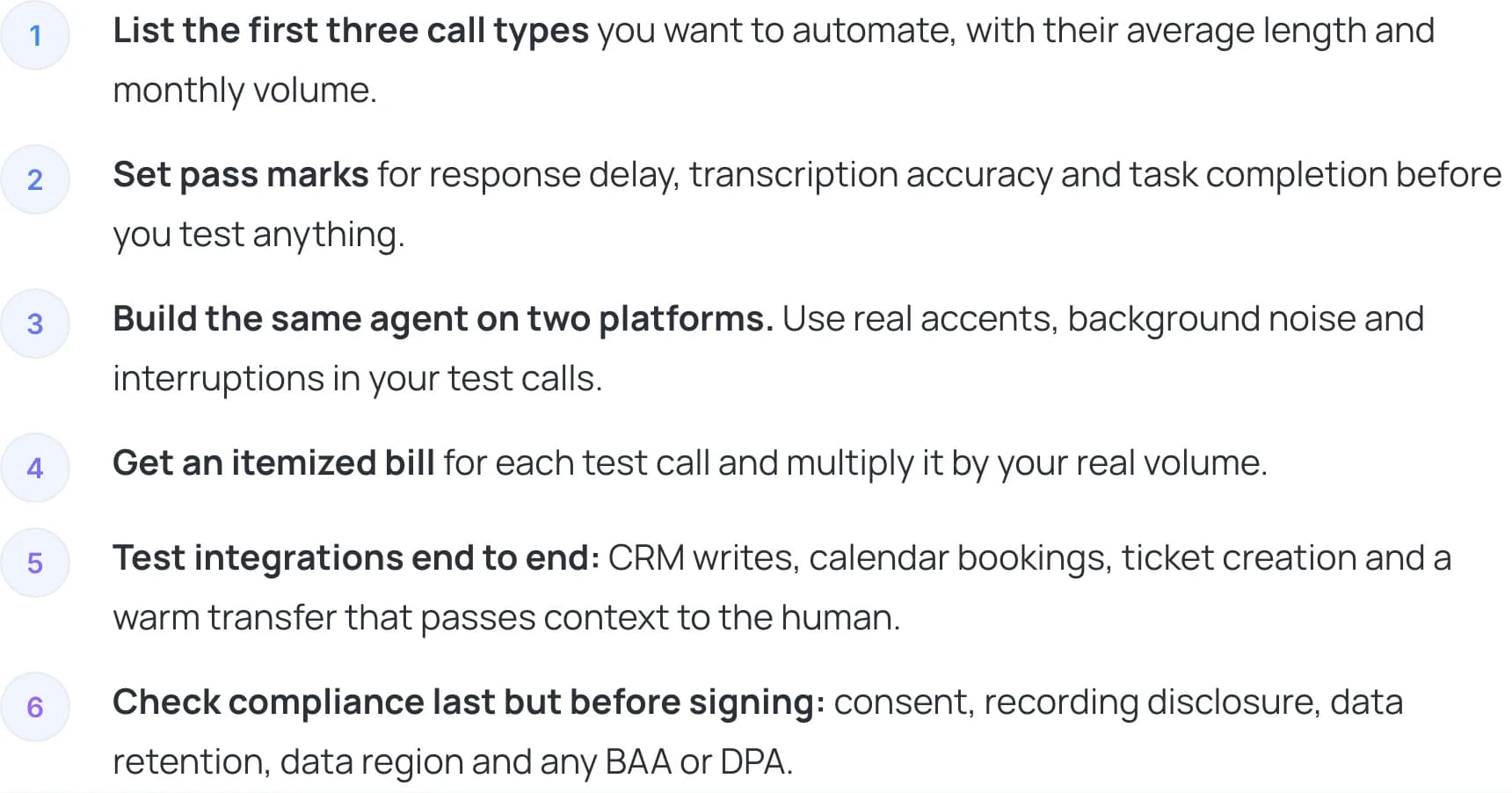
- List the first three call types you want to automate, with their average length and monthly volume.
- Set pass marks for response delay, transcription accuracy and task completion before you test anything.
- Build the same agent on two platforms. Use real accents, background noise and interruptions in your test calls.
- Get an itemized bill for each test call and multiply it by your real volume.
- Test integrations end to end: CRM writes, calendar bookings, ticket creation and a warm transfer that passes context to the human.
- Check compliance last but before signing: consent, recording disclosure, data retention, data region and any BAA or DPA.
Tip: Keep your phone numbers on your own Twilio account from day one. Both Vapi and Retell accept your own Twilio numbers, so switching platforms later doesn’t mean changing the number customers call.
7. What Do Compliance Rules Mean for AI Calling?
In the US, the FCC’s February 2024 Declaratory Ruling confirmed that AI-generated voices are “artificial or prerecorded” voices under the Telephone Consumer Protection Act (TCPA). AI calls are not banned. They follow the same rules as other prerecorded calls, which means prior express consent for most outbound calls, plus identification and opt-out requirements.
The exposure is real: the TCPA lets consumers sue for $500 per unwanted call, and up to $1,500 if the violation was willful or knowing. If you serve India or the UAE, check local telemarketing and consent rules as well.
Warning: Inbound support calls carry less consent risk than outbound campaigns. If your first project is outbound, involve legal before you choose a platform, not after.
8. What Results Have Companies Published?
Two Retell customers have shared numbers. Both are vendor-published case studies, so read them as results from deployments that went well.
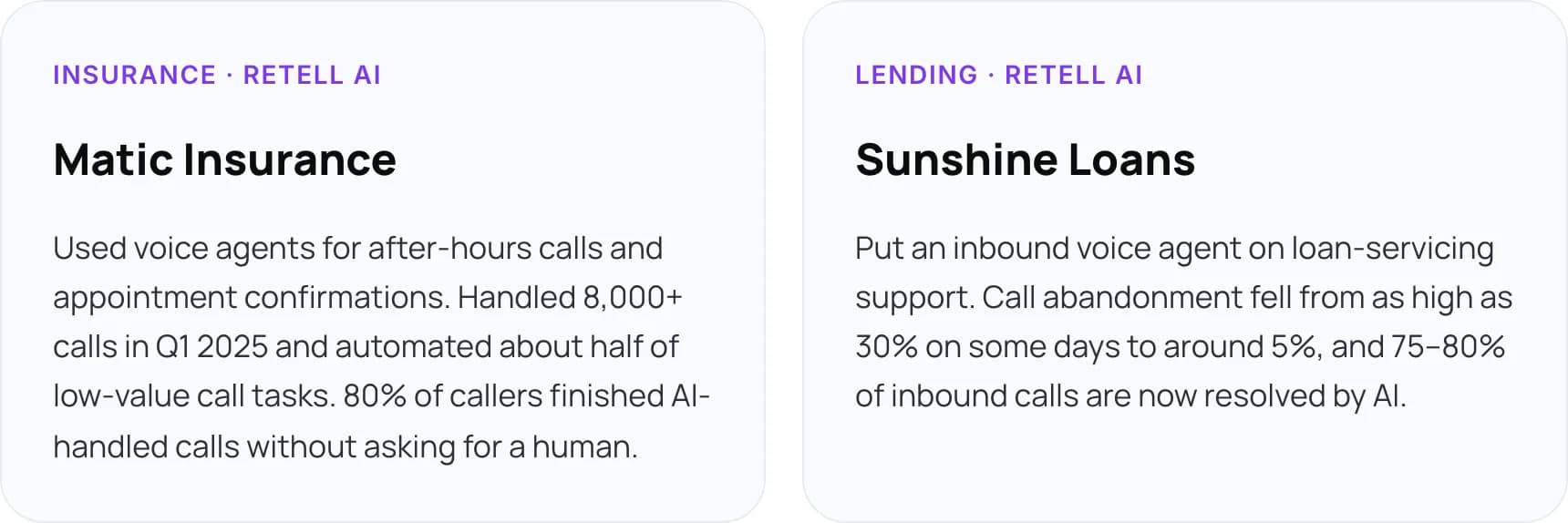
Matic Insurance (insurance, Retell AI)
Used voice agents for after-hours calls and appointment confirmations. Handled 8,000+ calls in Q1 2025 and automated about half of low-value call tasks. 80% of callers finished AI-handled calls without asking for a human (Retell case study).
Sunshine Loans (lending, Retell AI)
Put an inbound voice agent on loan-servicing support. Call abandonment fell from as high as 30% on some days to around 5%, and 75–80% of inbound calls are now resolved by AI (Retell case study).
The common thread is scope. Both started with narrow, repetitive call types and kept a human transfer for the rest. For a smaller example, see how an AI voice agent handles restaurant calls.
9. Frequently Asked Questions
What is the best AI voice agent platform?
There is no single best option. Retell AI suits teams that want a fast launch with model choice. Vapi suits developers who want to pick every provider. Bland AI suits high-volume campaigns at one bundled rate. A custom Twilio build fits high, steady volume or strict data rules.
How much does an AI voice agent cost per minute?
Published rates in November 2026 were $0.05 a minute for Vapi hosting (about $0.08 to $0.13 with its default providers), $0.07 to $0.31 on Retell, and $0.12 to $0.14 on Bland’s self-serve plans. Telephony, transfers and premium voices can add to these figures.
Is Vapi better than Retell AI?
They suit different teams. Vapi charges a $0.05 platform fee and passes speech, model and voice providers through at cost, which gives developers fine control. Retell prices components on one bill and includes more out of the box. Build the same agent on both and compare cost and call quality.
Can I use my own Twilio number with Vapi or Retell?
Yes. Vapi supports Twilio as a transport option, and Retell lets you bring your own telephony with no Retell telephony charge, so Twilio bills you directly. Keeping numbers on your own Twilio account makes it easier to switch platforms or move to a custom build later.
Are AI phone calls legal in the US?
Yes, with conditions. In February 2024 the FCC confirmed that AI-generated voices count as artificial voices under the TCPA. Most outbound AI calls therefore need prior express consent, plus identification and opt-out handling. Inbound calls that customers place to you carry less consent risk.
10. Conclusion
The right AI voice agent platform depends on how much of the stack you want to own. Start with Retell or Vapi for a fast, low-commitment pilot, look at Bland when outbound volume is the main job, and plan a custom Twilio build once volume or data rules justify it. Pick one call type, run a one-week test on two platforms, and price it at your real volume before you commit.
To scope a voice agent, see our AI customer support automation and AI agent development services. Or book a free AI consultation.
Author