The Angry Customer Playbook: Sentiment Detection, De-escalation Scripts, and the Exact Moment to Hand Off
How to spot rising frustration in a chat, what your AI agent should say, and the signals that mean a person should take over.
- Detect Spot negative sentiment and repeat contacts
- Acknowledge Name the problem in plain words
- Resolve Fix what the bot can actually fix
- Hand off Pass the chat and context to a person

1. The Short Answer
AI customer service should treat an angry customer differently from the first sign of frustration. Detect it, acknowledge it in plain words, fix what can be fixed quickly, and hand off to a person when clear triggers appear.
The hand-off matters most. In Gartner’s 2024 survey of 5,728 customers, 64% said they would prefer companies didn’t use AI for service. Their top worry was that AI would make it harder to reach a person.
Key takeaways
- Sentiment scores are one signal. Combine them with clear rules such as repeat questions and direct requests for a person.
- De-escalation scripts should acknowledge, act and give a time. Generic empathy with no action makes things worse.
- Hand off on the first request for a human. Gartner found 64% of customers would prefer companies didn’t use AI for service.
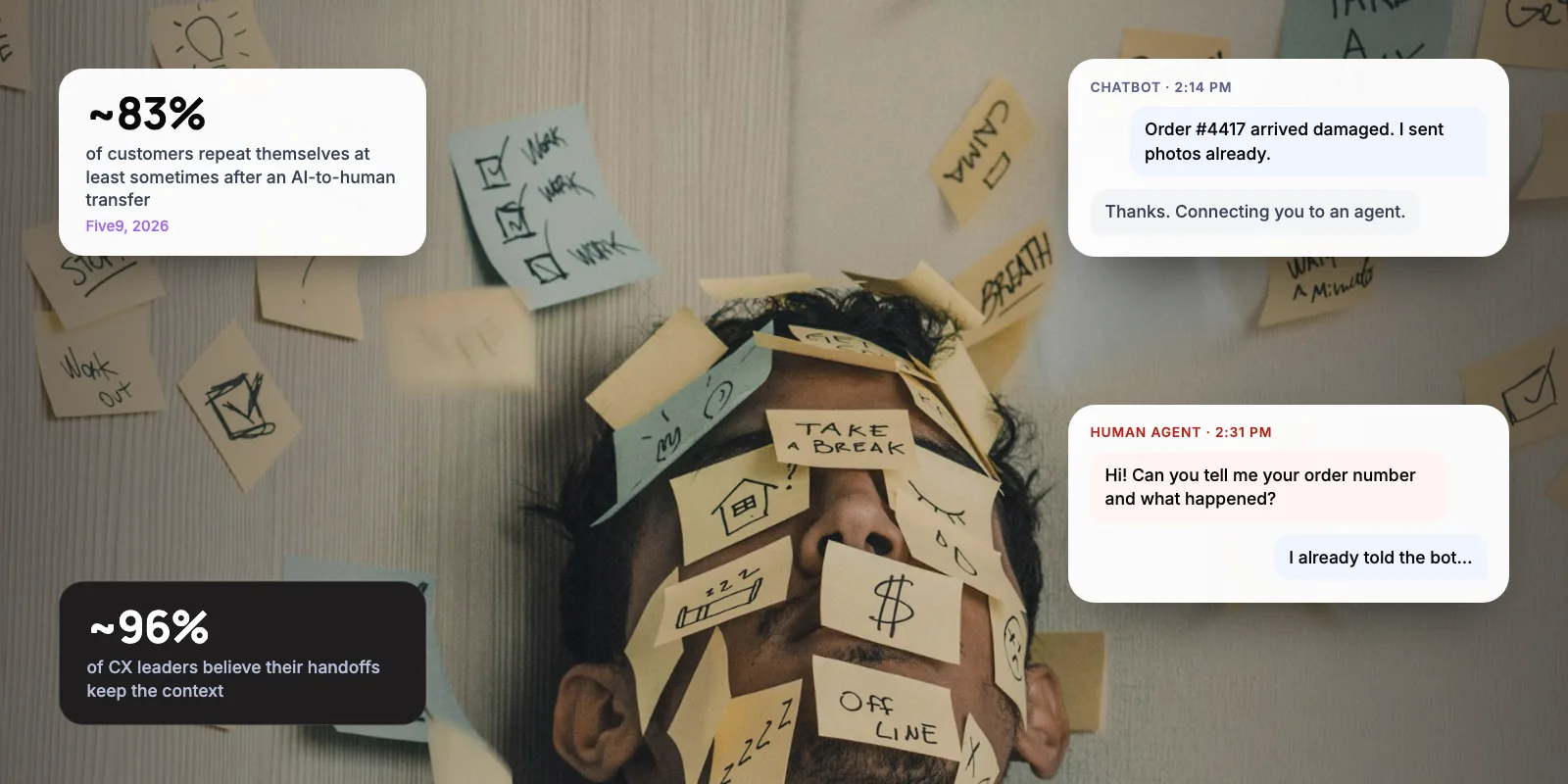
- Every hand-off should carry a summary, so the customer never has to repeat themselves.
2. What Does Sentiment Detection Look For?
Sentiment detection labels how a customer sounds, from very negative to very positive. Zendesk’s intelligent triage does this for new tickets, but mostly reads only the first message. In a live chat, you need your AI agent to score every message. One angry word means little. A pattern across several messages matters.
- Negative words and tone. Insults, swearing and words like “useless” or “ridiculous”. — “This is ridiculous.”
- Repeat contact. The same issue raised again, in this chat or in earlier tickets. — “Third time I’m asking.”
- Shouting and punctuation. All caps, repeated exclamation or question marks. — “WHERE IS MY ORDER??”
- Exit and threat language. Mentions of cancelling, reviews, social media or legal action. — “I’m cancelling today.”
Note: Sentiment models misread sarcasm, slang and mixed languages such as Hinglish. Use the score as one signal next to the rules below, not as the only switch.
3. Why Do Angry Customers Need a Different Path?
An upset customer stuck with a bot gets angrier. The US Consumer Financial Protection Bureau’s 2023 report on bank chatbots called this a “doom loop”: the same unhelpful replies, with no way out to a person. It said these loops often start when a problem is outside what the bot can handle.
- 64% of customers would prefer companies didn’t use AI for customer service
- 60% worry AI will make it harder to reach a person
- 53% would consider switching to a competitor if a company used AI for service
Source: Gartner survey of 5,728 customers, run December 2023, published July 2024.
4. De-escalation Scripts Your AI Agent Can Use
Good scripts follow the order a trained agent uses: acknowledge the problem, take the next step, and give a time. Keep replies short. Long apologies read as stalling. The examples below are illustrative; adapt them to your policies.
- “This is the third time I’m asking.” — AI agent says: “Sorry you’ve had to ask three times. I can see your earlier messages. Let me check the order now.” · Avoid: “I understand your frustration.” with no action
- “Your product is useless.” — AI agent says: “That’s not the experience we want. Tell me what went wrong and I’ll fix it or get a person to.” · Avoid: Defending the product or quoting features
- “Where is my refund?!” — AI agent says: “Your refund of ₹2,400 was sent on 3 Nov. Banks take 5–7 working days. Want me to send the reference?” · Avoid: “Refunds usually take some time.”
- “I want to talk to a human.” — AI agent says: “Sure. I’m connecting you now and passing on what we’ve discussed, so you won’t need to repeat it.” · Avoid: Asking “Can I try to help first?” again
- “I’ll cancel and post about this.” — AI agent says: “I don’t want you to leave over this. I’m bringing in a team member who can review your account.” · Avoid: Offering a discount the bot can’t approve
Tip: Never let the bot promise a refund, credit or policy exception it can’t actually trigger. Limit promises to actions the system can complete, and route everything else to a person.
5. When Should AI Hand Off to a Human?
In our view, hand off as soon as any one of these triggers fires. Clear rules work better than waiting for a sentiment score to cross one threshold, because rules are easier to test and explain.
- The customer asks for a person. Any wording, any channel. Connect on the first request. This is the trigger customers notice most when it’s missing.
- Sentiment stays negative for two or three turns. One sharp message can be venting. Several in a row means the bot is not helping.
- The same question comes back. If the customer repeats or rephrases the same request, the bot’s answer didn’t land.
- Churn, legal or social threats. Words like “cancel”, “lawyer”, “complaint” or “posting this” go straight to a senior agent.
- Money, safety or vulnerable customers. Disputed charges, fraud, health or safety issues, and signs of distress need a person.
- The bot is unsure. If retrieval confidence is low or no policy covers the case, hand off instead of guessing.
Warning: A hand-off that makes the customer repeat everything undoes the work. Pass the summary, order details and what the bot already tried, so the agent’s first line can be “I can see what happened.”
6. What Happens When AI Customer Service Gets It Wrong?
DPD · January 2024
A chatbot that swore at a customer
A customer who couldn’t get DPD’s chatbot to find his parcel prompted it to swear and write a poem criticising the company. His posts were viewed over a million times. DPD said an error followed a system update and disabled the AI element.
Lesson: test how the bot responds to provocation before launch.
Air Canada · February 2024
Liable for what the chatbot promised
Air Canada’s chatbot told a grieving customer he could claim a bereavement discount after travel. The airline’s policy said otherwise. A British Columbia tribunal held Air Canada responsible and ordered it to pay C$812.02, covering the fare difference, interest and fees.
Lesson: on refunds and policy, the bot must quote real rules or hand off.
Want hand-off rules tested on your own chat logs? We can review them with you.
7. How to Set Up the Playbook in 6 Steps
- Review chats that went badly. Pull 50 recent chats with low ratings or complaints. Mark where a person should have joined.
- Write your hand-off triggers. Start with the six in section 5, then add any patterns from your own chats.
- Turn on sentiment scoring. Use your help desk’s feature for new tickets. For live chats, have your AI model score each message and log it.
- Write the scripts. Draft replies for your five most common angry messages. Have your best agents review them.
- Build the hand-off package. Send a short summary, the customer’s details and what the bot tried, straight into the agent’s view.
- Test, then track. Replay past chats, including provocation attempts. After launch, watch satisfaction on escalated chats each week.
New to the topic? Read what customer support automation is and how it works.
8. Frequently Asked Questions
What is sentiment detection in customer service?
Sentiment detection uses AI to label how a customer sounds, from very negative to very positive. Help desks such as Zendesk use it to prioritise new tickets. It can misread sarcasm, short messages or mixed languages, so pair it with simple rules such as repeat questions.
How should a chatbot respond to an angry customer?
Acknowledge the problem in plain words, take a real action, and give a time. Keep the reply short. Avoid generic empathy lines with no action, and never promise refunds or exceptions the bot cannot actually make. If anger continues, hand off.
When should a chatbot transfer to a live agent?
Transfer when the customer asks for a person, when negative sentiment lasts two or three turns, when a question repeats, or when money, safety, legal or churn risk appears. Also transfer when the bot has low confidence in its answer.
Do customers prefer AI or human agents?
Many want a clear route to a person. In Gartner’s survey of 5,728 customers, published in 2024, 64% said they would prefer companies didn’t use AI for service. The top concern, at 60%, was that it would be harder to reach a human. An easy hand-off addresses that.
What should be passed to the agent during a hand-off?
A short summary of the issue, the customer’s account or order details, what the bot already tried, and the sentiment history. The agent should be able to start with a solution instead of asking the customer to explain again.
9. Conclusion
AI customer service handles angry customers well only when it knows when to step aside. Pull 50 recent chats that ended badly and mark where a person should have joined. Turn those moments into your hand-off triggers, then test them before going live.
Tip: Use our free AI ROI Calculator to check the savings with a realistic share of chats going to people.
To build it with us, see our AI customer support automation services.
Author