What Actually Changes From Simple RAG to Agentic RAG
This post explains how traditional single-pass RAG works and where it falls short on complex questions. It then breaks down what agentic RAG actually changes i.e planning, iterative retrieval, tool use, and self-correction and helps you decide when the added cost and latency are justified versus when a simpler approach is still better.
Introduction
Retrieval-Augmented Generation has become one of the most useful techniques in applied AI. If you have ever asked a chatbot a question about your company’s internal documents and received a grounded answer instead of a generic reply, you have probably seen RAG at work. The core idea is to give the language model fresh, relevant information before it answers so it does not have to rely only on what it memorized during training.
For a long time the standard way to do this was a single, linear process. Take the user’s question, retrieve a few relevant document chunks, put them in the prompt, and generate. That approach is still widely used and works well for many tasks. Yet as questions grow more complex, the limits of that one-shot method become clear. Teams are now moving toward something more flexible and autonomous called agentic RAG.
This post explains what actually changes when you go from simple, single-pass RAG to agentic RAG. We will look at planning, multi-step retrieval, tool use, and self-correction. We will also discuss the real costs in latency and money, and help you decide when the extra complexity is worth it. The goal is practical understanding so you can make better choices about the systems you build or buy.
What Is Retrieval-Augmented Generation?
Before comparing the two styles, it helps to be clear on the basics. A large language model is trained on a huge amount of public text. That training ends at a certain date, and the model has no automatic access to your private files, recent reports, or proprietary knowledge. RAG solves this by adding a retrieval step.
When a user asks a question, the system first searches a knowledge base - usually a collection of documents that have been split into chunks and turned into vectors. It pulls back the chunks that seem most relevant and includes them in the prompt the model sees. The model then generates an answer that is supposed to stay faithful to those retrieved pieces.
This combination of retrieval plus generation is what people mean by RAG. It reduces hallucinations on private data, keeps answers up to date, and lets companies use their own knowledge without fine-tuning the entire model. The difference between simple RAG and agentic RAG lies in how that retrieval process is organized and controlled.
How Simple RAG Works
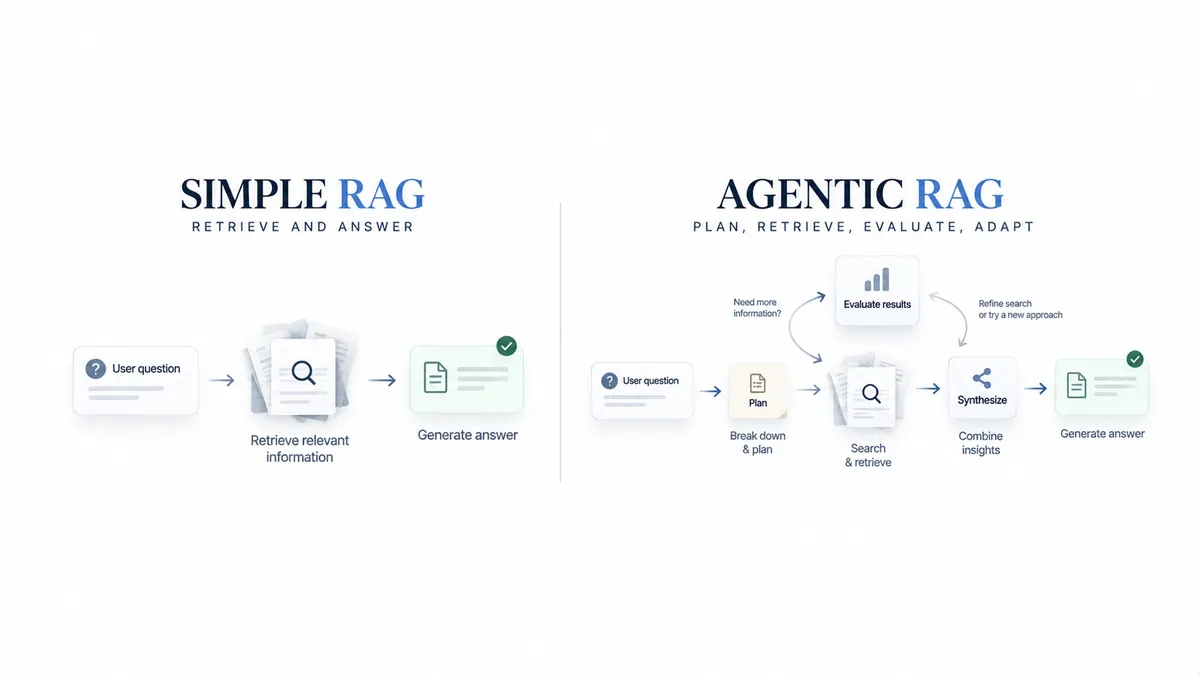
Simple RAG, sometimes called traditional or single-pass RAG, follows a fixed pipeline.
1. The user submits a question.
2. The system converts that question into a search query, often by creating an embedding vector.
3. It searches the vector database (and sometimes a keyword index) and returns the top matching chunks.
4. Those chunks are inserted into a prompt along with the original question and any system instructions.
5. The language model generates a final answer in one go.
There is no looping. Retrieval happens once. Generation happens once. The system does not look at the retrieved text and decide to search again. It does not break the question into parts. It does not call external tools beyond the initial search.
This design has real advantages. It is relatively easy to implement and debug. Latency is predictable: one retrieval call plus one generation call. Token costs stay under control because you decide in advance how many chunks to fetch. Monitoring is straightforward - you can log the query, the retrieved documents, and the final answer.
Simple RAG is good when the answer lives in a small number of clearly relevant documents. Customer support bots that answer from a product manual, internal wikis that answer “what is our expense policy,” and documentation assistants that pull from API references often work well with this pattern. If the information is easy to locate and the question does not require heavy synthesis, the single-pass approach is efficient and reliable.
Where Simple RAG Starts to Struggle
The same simplicity becomes a limitation when questions grow more demanding. Consider a request such as: “Compare our actual Q3 revenue in Europe against the forecast we set at the start of the year, and summarize the main reasons for any difference.”
A single retrieval might surface a revenue report or a forecast slide. It is unlikely to pull every needed number, the accompanying commentary, currency notes, and related deal information in one clean set of chunks. The model then has to work with incomplete context. It may produce a plausible-sounding answer that is missing key details or contains subtle inaccuracies.
Other common failure modes include -
- Vocabulary mismatch. The user says “customer churn,” but the documents talk about “attrition rate” or “logo retention.” A single query may miss the best material.
- Scattered information. The facts needed to answer sit in several different documents written by different teams at different times.
- Need for calculation or verification. The model is asked to compute a percentage change or cross-check a number against another source, but it has only the text in front of it.
- Ambiguous or multi-part questions. The system has no chance to clarify intermediate steps or gather supporting evidence step by step.
In all these cases the single-pass nature of simple RAG means early mistakes or gaps flow straight into the final answer. There is no built-in mechanism for the system to notice what is missing and go look for it.
What Agentic RAG Actually Changes
Agentic RAG treats the language model less like a pure text generator and more like an agent that can decide what to do next. Instead of a fixed pipeline, the system operates in a loop: plan, act, observe, and decide whether to continue or stop.
Several concrete capabilities appear -
Planning
The agent often begins by breaking the user question into smaller sub-questions or outlining the information it will need. For the revenue example it might decide: first locate the original forecast numbers for Europe, then find the actual Q3 results, then look for management commentary or variance analysis, and finally check for external factors such as currency movements. Planning can be written out explicitly in the model’s reasoning or remain implicit in the sequence of actions it chooses. Either way, the system now has a map instead of jumping straight into a single search.
Multi-step retrieval
Because the agent can act more than once, retrieval becomes iterative. It can pull an initial set of documents, read them, notice gaps, and issue a more precise follow-up query. Each new search can be narrower or broader depending on what the previous results revealed. This is especially useful when documents use different terminology or when the needed evidence is distributed across many files. The agent can also choose different indexes or filters at different steps—financial reports first, then meeting notes, then a structured database of deals.
Tool use
Agentic systems usually give the model access to tools beyond pure text retrieval. Common examples include calculators, SQL or API calls to structured data sources, code interpreters, and (when appropriate) external web search. If a document contains a table of numbers, the agent can extract the relevant cells and hand them to a calculation tool rather than trusting the language model’s arithmetic. If a product code or customer ID appears, it can look it up in a system of record. Tool use turns the agent from a passive reader into something closer to an analyst who can both find information and operate on it.
Self-correction and reflection
After each retrieval or tool call, the agent evaluates what it has learned. Does this new information answer the current sub-question? Does it contradict earlier findings? Are there still obvious gaps? Some implementations include an explicit critique step in which the model scores its intermediate answer or checks statements against the retrieved evidence. If something looks wrong or incomplete, the agent can discard weak material, rephrase a query, or dig deeper. This ability to notice and recover from mistakes is one of the largest practical differences from single-pass RAG.
Together these capabilities create a more autonomous retrieval process. The system is no longer limited to one search and one generation. It can conduct a small investigation on the user’s behalf.
A Walk-Through
Imagine the same revenue question arriving at an agentic system.
The agent first plans: “I need the original forecast, the actuals, variance commentary, and any noted drivers.” It retrieves from the financial reporting index and finds the forecast deck and the Q3 results presentation. After reading them it notices that the variance explanation is thin. It issues a second query focused on “Europe Q3 revenue drivers” or “regional performance commentary.” It may also call a structured finance API to pull the exact currency-adjusted numbers. Once it has the pieces, it checks whether the numbers are consistent and whether the commentary actually supports the observed difference. Only then does it write a final answer that combines the figures and the explanations.
A simple RAG system would have stopped after the first retrieval and generated from whatever happened to come back. The agentic version kept going until the evidence felt sufficient.
Cost, Latency, and the Real Trade-Offs
Agentic RAG is more expensive and slower. Each extra retrieval, tool call, or intermediate reasoning step adds latency and token cost. A question that once took one embedding lookup and one generation may now require several rounds of model calls and multiple searches. In high-volume applications or products that must respond in under a second, this overhead can be unacceptable.
There are also new failure modes. The agent can loop too long, follow an unproductive plan, or over-retrieve and fill its context with noise. Good systems therefore add guardrails: maximum step limits, cost budgets, and fallbacks that drop back to a simpler path when progress stalls.
The extra cost is justified when the value of a higher-quality answer is high and the questions are complex enough that single-pass retrieval regularly falls short. Analytical work, multi-document synthesis, compliance or financial questions, and technical troubleshooting often fall into this category. When users expect the system to “figure it out” rather than simply return the nearest matching passages, agentic behavior becomes attractive.
When Simple RAG Is Still the Better Choice
Simple RAG remains the smarter default in several common situations:
- Most questions are straightforward factual lookups.
- Response time must stay very low.
- Query volume is high and per-query cost matters.
- The knowledge base is clean, well-organized, and uses consistent terminology.
- The team is still learning retrieval fundamentals and wants something easy to monitor and improve.
Many mature systems therefore run a hybrid. They try a fast single-pass path first. If the retrieved context looks thin or the question matches a complexity pattern, they escalate to an agentic path. This keeps average latency and cost reasonable while still offering stronger handling for hard questions.
Current Shift Toward Autonomous Retrieval
Moving from simple RAG to agentic RAG is part of a larger change in how people build language-model applications. Early systems treated the model mainly as a clever generator that needed carefully prepared context. Newer systems treat it as a decision-making component that can orchestrate tools, memory, and retrieval over multiple steps.
This changes what teams optimize. Chunking strategies, embedding quality, and re-ranking still matter, but they are no longer the whole story. Attention shifts toward agent loops, planning prompts, tool interfaces, state management, and trajectory-level evaluation. Observability becomes more important because you need to see not only the final answer but the path the agent took to reach it.
At the same time, the fundamentals do not disappear. An agent is only as good as the indexes and tools it can call. High-quality retrieval remains the foundation; agentic techniques simply give the system more ways to use that foundation when the first attempt is not enough.
Conclusion
In a nutshell, if you are deciding between the two approaches, start by looking at the questions your users actually ask. Measure where simple RAG already succeeds and where it consistently falls short. Introduce agentic capabilities selectively rather than by default. Keep the simple path available as a fast baseline and as a fallback. Invest in clear evaluation that looks at both final answer quality and the reasonableness of intermediate steps.
Agentic RAG is not magic and it is not always necessary. It is a more flexible way of organizing retrieval when the information needed to answer well is hard to gather in one shot. Understanding of planning, multi-step retrieval, tool use, and self-correction helps you judge when that flexibility is worth the added cost and complexity.
The systems that use these ideas thoughtfully will turn retrieval from a static lookup into something closer to a capable research assistant. The rest will continue to serve the large number of questions that simple, well-tuned RAG already handles cleanly.
Author

Himanshu is the Founder of Neuradynamics and a seasoned Full Stack Developer with 15+ years of experience in application development, cloud infrastructure, automation, and scalable digital solutions. With expertise across Python, Django, AWS, Azure, and AI-powered systems, he shares practical insights on modern technology, software architecture, and digital transformation.