MVP Development: A Step-by-Step Guide to Building, Testing, and Scaling Products
Every Big Product Starts Small
Every successful product you see today once started as a simple idea. Not a fully built platform. Not a feature-heavy application. Just a basic version designed to test one core concept.
Imagine launching a product after months of development - only to realize users don’t need half of what you built. That’s where mvp development services change the game.
Instead of building everything at once, businesses now focus on creating a Minimum Viable Product (MVP), a simplified version that helps validate ideas, reduce risks, and accelerate growth.

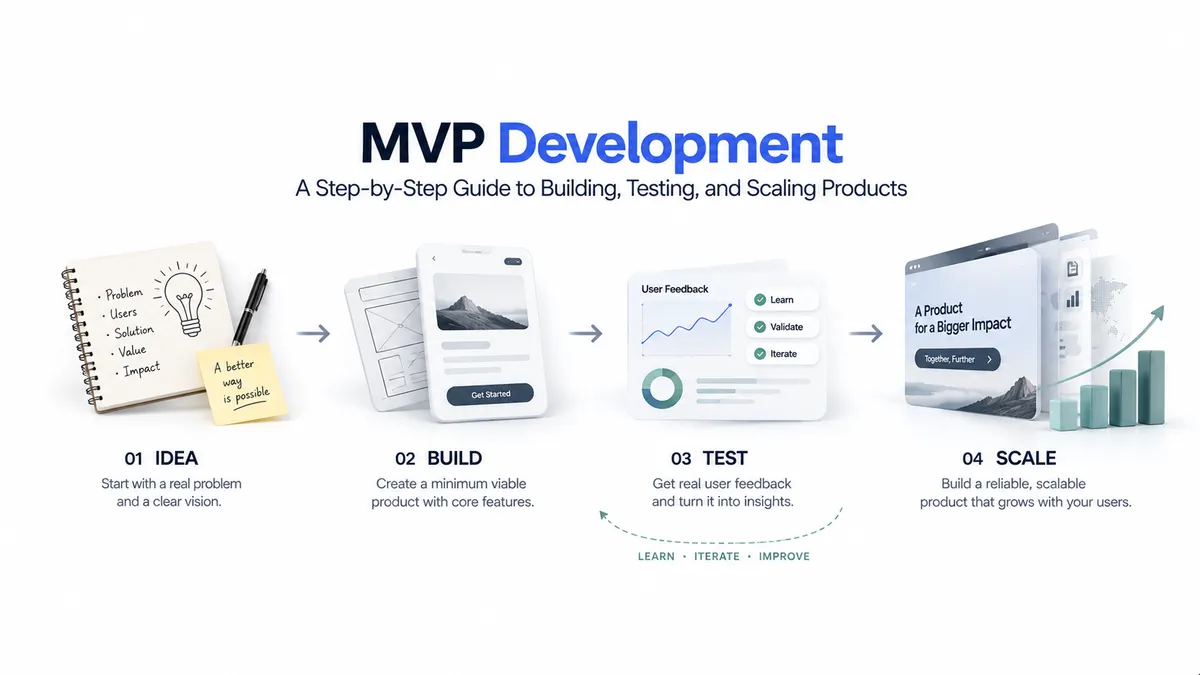
Step 1: Defining the Core Problem
Every great product solves a clear problem. But many startups fail because they try to solve too many things at once.
The first step in MVP development services is clarity.
Ask yourself:
- What is the one problem you want to solve?
- Who are you solving it for?
- Why does it matter?
When the problem is well-defined, everything else becomes easier.

Step 2: Prioritizing Features That Matter
This is where most ideas get complicated. It’s tempting to add multiple features, thinking they will improve the product.
But MVP thinking is different. It focuses on essentials only.
A structured approach includes:
- Listing all possible features
- Identifying must-have vs. nice-to-have
- Focusing only on the core functionality
A good MVP development services provider ensures that your first version stays lean and purposeful.
Step 3: Designing a Simple, User-Centric Experience
Even a minimal product should feel intuitive.
Design is not about adding complexity; it’s about removing it. A clean and simple interface ensures users can quickly understand and use your product.
Key focus areas include:
- Clear navigation
- Minimal steps to complete actions
- Consistent design patterns
With the right MVP development services, design becomes a tool for clarity, not decoration.

Step 4: Building the MVP Quickly
Speed is one of the biggest advantages of MVP development.
The goal is to launch fast without compromising on quality. This often involves:
- Using agile development methods
- Choosing scalable technologies
- Focusing only on core features
A strong MVP development services approach ensures that development is efficient, flexible, and aligned with business goals.
Step 5: Testing with Real Users
An MVP is not the final product; it’s the beginning of learning.
Once launched, the focus shifts to user feedback. Real users provide insights that no internal team can fully predict.
Important aspects of testing include:
- Observing user behavior
- Collecting feedback through surveys or interviews
- Identifying pain points
This stage helps validate whether your idea truly works in the real world.
Step 7: Scaling the Product Strategically
Once your MVP proves successful, it’s time to scale. But scaling should be thoughtful, not rushed.
This involves:
- Expanding features based on user demand
- Strengthening infrastructure
- Enhancing performance and security
The foundation built during the MVP stage plays a crucial role here. A well-developed MVP makes scaling smoother and more sustainable.
Final Thoughts: Choosing the Right Partner
Building a successful product isn’t about getting everything right the first time; it’s about learning quickly and adapting.
That’s why choosing the right partner for MVP development services is critical. A company like Neura Dynamics understands that every idea has potential, but success lies in how it’s executed.
By combining strategic thinking, user-focused design, and agile development, Neura Dynamics helps businesses turn ideas into real, testable products—faster and smarter.
Because in today’s fast-moving digital world, it’s not the biggest ideas that win. It’s the ones that are built, tested, and improved at the right time.
Author

Himanshu is the Founder of Neuradynamics and a seasoned Full Stack Developer with 15+ years of experience in application development, cloud infrastructure, automation, and scalable digital solutions. With expertise across Python, Django, AWS, Azure, and AI-powered systems, he shares practical insights on modern technology, software architecture, and digital transformation.