Difference between AI Agents vs Agentic AI
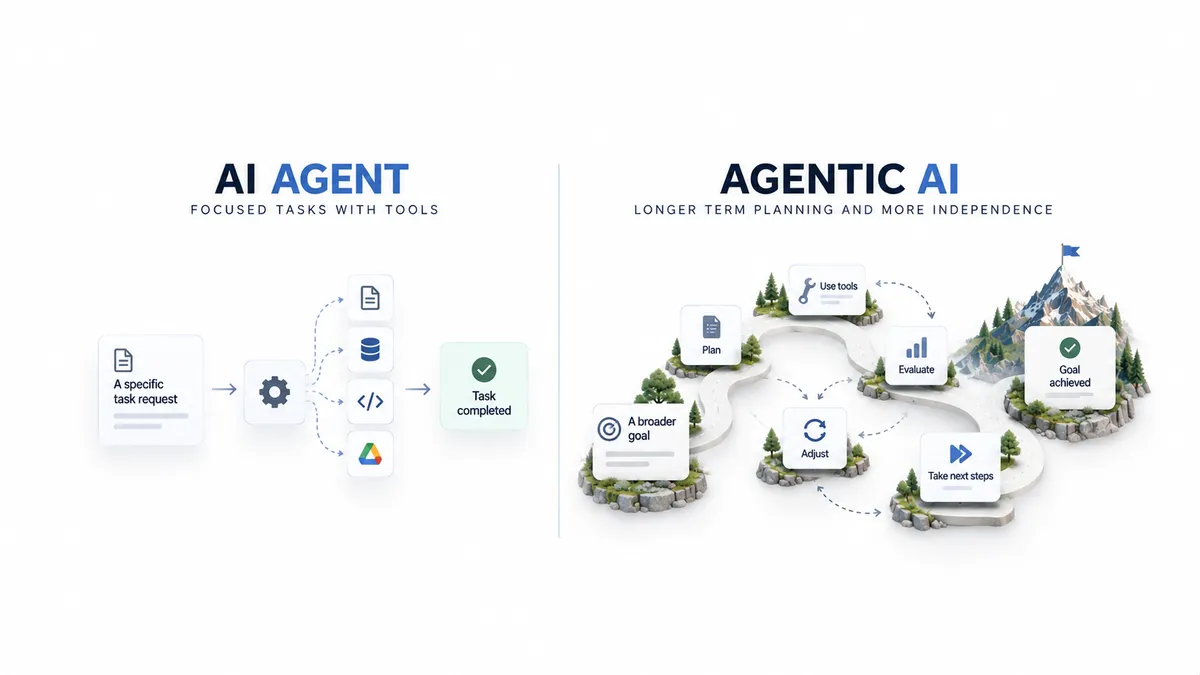
AI agents and agentic AI are often mixed up. One handles focused tasks with tools. The other aims for longer term planning and more independence. Here’s a clear explanation of both and how to decide which one you need.
Introduction
Many people use the terms AI agent and agentic AI as if they mean exactly the same thing. In conversations about new tools and systems the two phrases often appear side by side and the distinction gets lost. Yet the difference matters when you are deciding what kind of system to build or buy. Understanding it helps avoid over promising results and choosing the wrong approach for the job at hand.
This article explains both ideas. It shows how they relate to each other where retrieval fits in and how to decide which path makes more sense for real work. The goal is clarity rather than hype so that readers can leave with a practical view of the landscape.
What Is an AI Agent
An AI agent is a system that can take actions on behalf of a user or another system. It receives a goal or a request then decides which tools or steps are needed to move toward that goal. The agent may call an API search a database write a file or send a message. After each action it looks at the result and chooses the next step.
In most current implementations the agent follows a relatively contained loop. It plans a short sequence of actions executes them observes the outcome and adjusts. The planning horizon is usually limited. Memory if present tends to stay within the current session or a small set of recent interactions. The agent stays focused on the immediate task rather than maintaining long term goals across many sessions.
These systems are already useful in production. Customer support agents that look up order status and draft replies coding assistants that edit files and run tests research helpers that gather information from several sources all fall into this category. They extend a language model with the ability to act rather than only generate text.
What Is Agentic AI
Agentic AI describes systems that go further in autonomy planning and adaptation. The term points to a higher degree of independent goal directed behavior. An agentic system can break a complex objective into many sub goals manage them over longer periods of time keep track of progress and revise its approach when conditions change.
Such systems often maintain richer forms of memory. They may store lessons from earlier attempts update an internal model of the environment and decide when to ask for human help. They can run for extended periods without constant supervision and coordinate multiple specialized components or other agents.
The difference is one of degree and design ambition. While a typical AI agent handles a defined task with a limited set of tools an agentic system aims to pursue broader objectives with greater independence. The boundary is not sharp and many products sit somewhere in between. Still the distinction helps set realistic expectations about reliability cost and oversight needs.
Key Differences Between AI Agents and Agentic AI
The first difference appears in the scope of planning. A standard AI agent usually plans only a few steps ahead. It reacts to immediate feedback and stays close to the original request. An agentic system can maintain a longer term plan revise it as new information arrives and keep working toward an objective even when intermediate results are unexpected.
The second difference lies in memory and continuity. Many AI agents treat each session as largely independent. Context may carry over for a short time but long term learning is limited. Agentic systems are designed to accumulate experience across interactions update their understanding of the world and apply earlier lessons to new situations.
The third difference concerns oversight and control. Because AI agents operate in narrower loops they are easier to monitor and constrain. Agentic systems by design take more initiative. That extra autonomy increases the need for clear boundaries evaluation methods and human review points especially when the system can affect external resources or make decisions with lasting consequences.
A fourth difference shows up in complexity and cost. Building and running a reliable agentic system usually requires more engineering effort more careful evaluation and higher ongoing compute cost. Simple AI agents can deliver value with lighter infrastructure.
These differences are not absolute. Some systems labeled as agents already show agentic traits. Some systems marketed as agentic remain closer to classic tool using agents. Looking at actual behavior rather than labels remains the best way to understand what a given system can and cannot do.
Where RAG Fits in Both Approaches
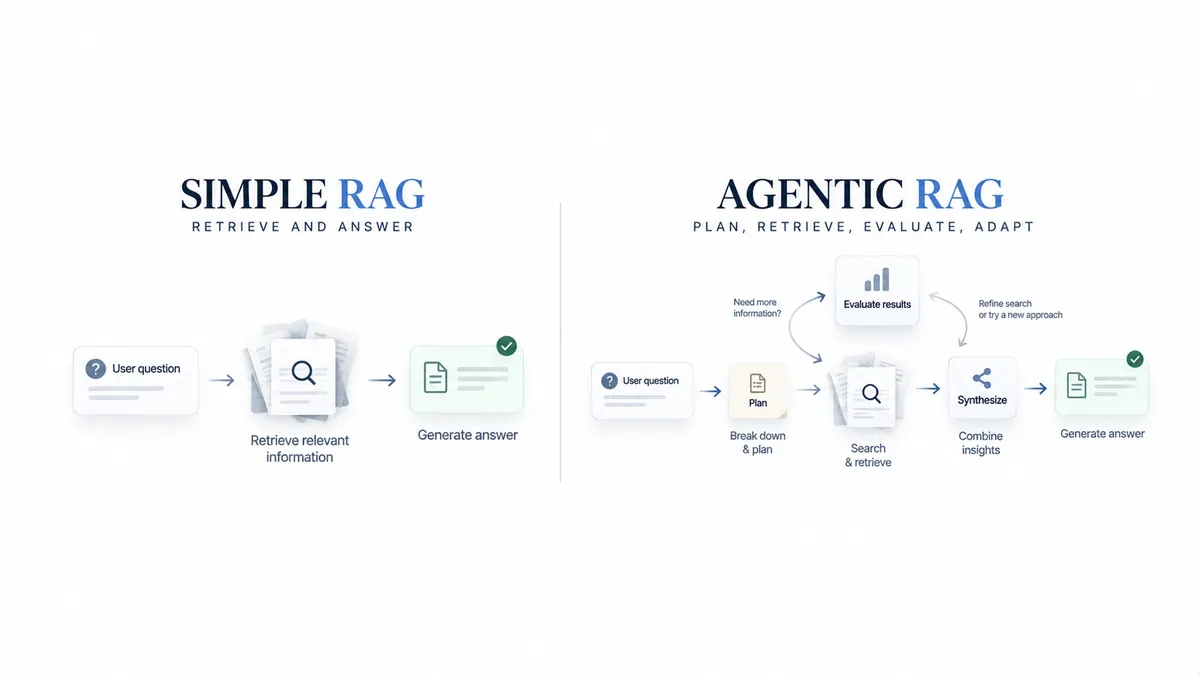
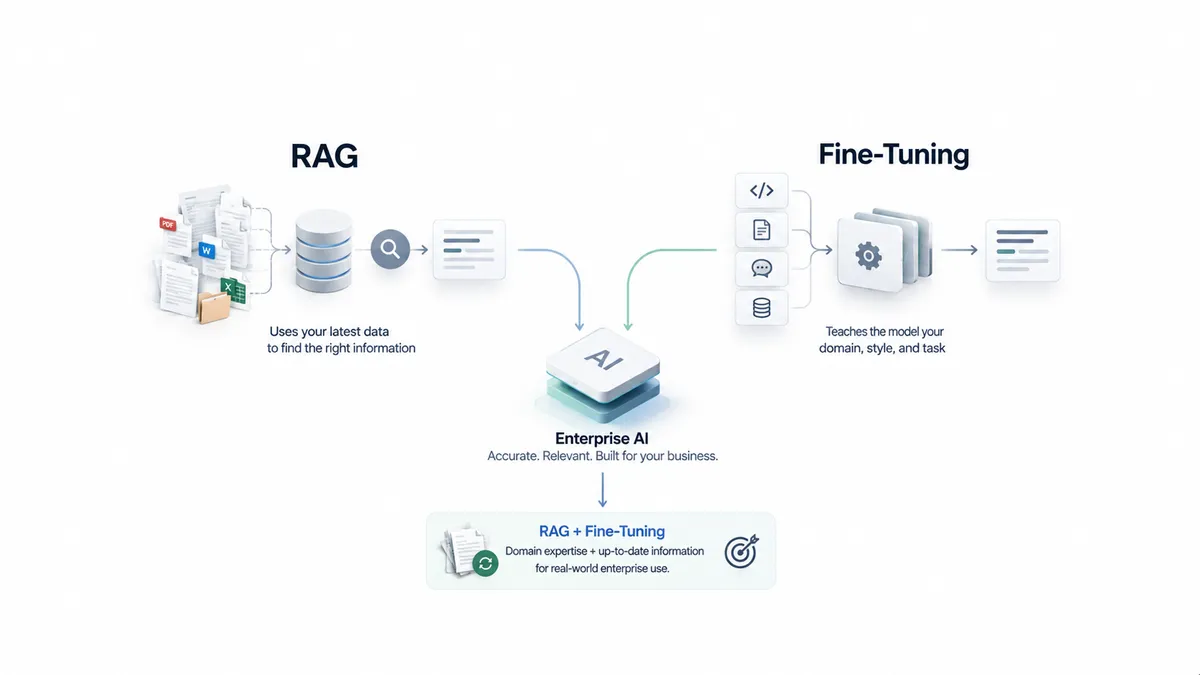
RAG plays an important role in both AI agents and agentic systems. Language models alone have fixed knowledge cutoffs and limited access to private or rapidly changing information. Retrieval supplies relevant external knowledge at the moment it is needed.
In a basic AI agent retrieval often happens once or a few times during a task. The agent decides it needs information issues a search or database query receives the results and continues. The retrieved material is inserted into the context so the model can ground its next actions or responses.
In more agentic setups retrieval becomes part of an ongoing loop. The system may retrieve information revise its plan retrieve again based on new questions and continue this cycle across many steps. Some designs allow the agent to decide what to store from retrieved material for later use creating a form of external memory.
RAG does not by itself make a system agentic. It is a supporting capability. How retrieval is planned timed and integrated into longer sequences of reasoning and action determines whether the overall system behaves more like a simple agent or a more autonomous agentic one.
Poor retrieval quality remains a common source of failure in both cases. If the wrong documents are fetched or the right documents are poorly chunked the agent or agentic system will reason from incomplete or misleading information. Strong retrieval design therefore remains foundational no matter how advanced the surrounding architecture becomes.
Real World Examples
A customer support system that reads a ticket looks up the customer record checks order status and drafts a reply is a clear example of an AI agent. It uses tools in a focused loop to complete a defined task. Human review may still be required for sensitive cases but the core workflow is automated and bounded.
A coding assistant that receives a feature request explores the codebase writes tests implements changes runs the tests and iterates based on failures also fits the AI agent pattern. The scope stays within one development task and the tools are limited to the development environment.
An agentic example would be a system given a broader business objective such as monitoring a set of competitors and producing a weekly strategy briefing. The system would need to decide which sources to check how often to check them how to summarize findings how to detect meaningful changes and when to escalate something unusual to a human. It would maintain state across days or weeks and adapt its focus as the competitive landscape shifts.
Another agentic illustration is a research assistant tasked with exploring an open ended scientific question. It would generate hypotheses design information gathering steps run analyses revise its understanding and continue for an extended period while keeping track of what has already been tried and what remains uncertain.
These examples show the spectrum rather than a hard divide. Many production systems today sit closer to the AI agent end because reliability evaluation and cost control are easier to manage when the scope stays limited.
Choosing between AI Agent and Agentic AI
Choose a focused AI agent when the task is well defined the success criteria are clear and the required tools are known in advance. Support workflows document processing code generation within a known repository and structured data lookup all fit this pattern well. The engineering investment stays reasonable and the risk of unexpected behavior remains lower.
Consider a more agentic approach when the objective is broader the environment is changing and the system needs to maintain context and adapt over longer periods. Strategic monitoring multi stage research projects and complex operational coordination can benefit from greater autonomy provided the organization is ready to invest in evaluation oversight and recovery mechanisms.
In practice many teams start with simpler agents and gradually add agentic capabilities as they gain confidence in the underlying components. Adding planning loops richer memory and multi agent coordination only after the basic retrieval and tool use layers are solid usually produces better results than beginning with a fully agentic design.
Cost latency and reliability should guide the decision. Agentic systems consume more tokens take longer to complete tasks and create more opportunities for error. The extra capability is valuable only when the problem truly requires it.
Common Mistakes
One frequent mistake is treating every tool using system as fully agentic. Marketing language often blurs the line. A system that calls a few APIs in sequence is still an AI agent even if it is labeled agentic. Expecting long horizon autonomy from a short horizon design leads to disappointment.
Another mistake is underestimating the difficulty of evaluation. Testing a simple agent on a fixed set of examples is already challenging. Evaluating an agentic system that plans and adapts over many steps is considerably harder. Without strong evaluation it is easy to overestimate reliability.
A third mistake is neglecting retrieval quality while focusing on planning and memory. Sophisticated agent loops cannot compensate for consistently poor retrieved context. The foundation still matters.
A fourth mistake is giving agentic systems access to powerful tools without corresponding controls. The more autonomy a system has the more important it becomes to limit the blast radius of mistakes and to keep humans in the loop for high stakes decisions.
Avoiding these mistakes begins with honest assessment of the actual behavior of the system rather than the labels applied to it.
Current Limitations of Both
AI agents remain limited by the quality of the underlying language model the reliability of the tools they call and the design of the retrieval layer. They can fail when the task falls outside the patterns they were tested on or when tool outputs are ambiguous.
Agentic systems face all of those limitations plus additional challenges. Long horizon planning is still imperfect. Memory systems can reinforce incorrect conclusions. Coordination between multiple components introduces new failure modes. Cost and latency grow quickly with the number of steps. Evaluation methods for open ended agentic behavior are still maturing.
Neither approach is immune to the broader issues that affect large language models including hallucination residual bias and sensitivity to prompt wording. Retrieval and tool use reduce some of these problems but do not eliminate them.
Progress continues on all these fronts. Better models improved retrieval techniques stronger evaluation benchmarks and more robust memory designs are active areas of work. The practical systems that deliver value today tend to stay within carefully scoped boundaries even as research explores more ambitious agentic designs.
Conclusion
AI agents and agentic AI exist on a continuum rather than as two completely separate categories. An AI agent gives a language model the ability to use tools and take actions within a defined scope. Agentic AI aims for greater autonomy longer planning horizons and richer adaptation over time.
Retrieval Augmented Generation supports both by supplying external knowledge when it is needed. The surrounding architecture determines how that knowledge is used across one step or many.
For most practical applications today a well designed AI agent with solid retrieval and clear tool boundaries delivers reliable value at manageable cost. Fully agentic systems become attractive when the problem truly requires extended independent operation and the organization is prepared to handle the extra complexity of evaluation oversight and recovery.
The question is not which label sounds more advanced. It is what level of autonomy planning and continuity the specific problem requires and whether the current technology can meet that requirement with acceptable reliability. Clear answers to that question lead to better systems and fewer disappointed expectations.
Author

Abhilasha is the Co-Founder of Neuradynamics, where she helps businesses turn Generative AI into practical, growth-focused solutions. Passionate about AI innovation, automation, and digital transformation, she writes about emerging technologies, scalable AI systems, and real-world applications across industries including EdTech, E-commerce, and automotive.