Best AI Chatbot for Small Business Customer Service
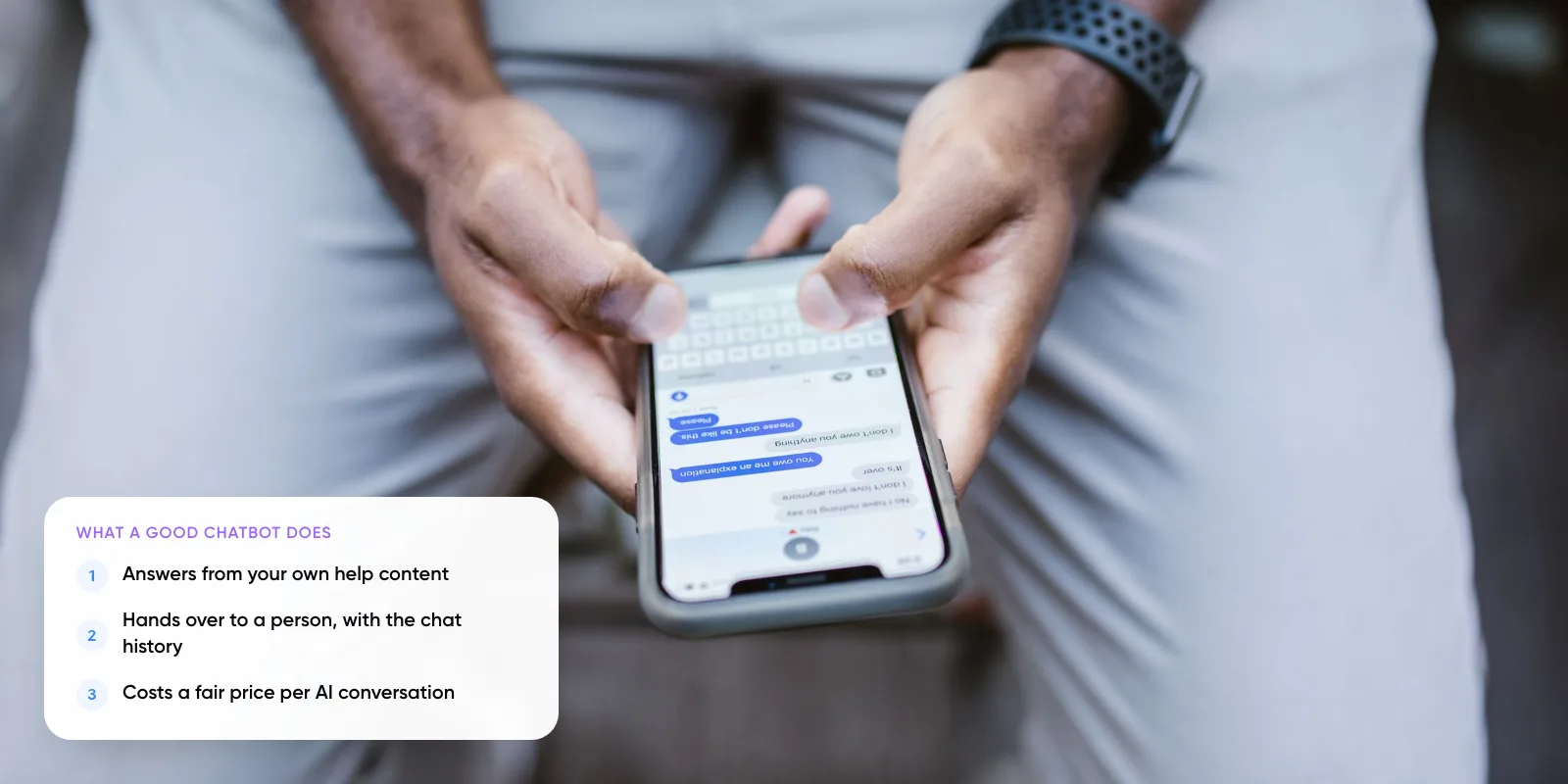
The best chatbot for customer service at a small business answers your common questions from your own content, hands over cleanly to a person and stays affordable at your monthly volume.
For most small teams in 2026, the shortlist is Crisp, Tidio, Intercom Fin, Chatbase, Zoho SalesIQ and Freshdesk. Which one wins depends on how many AI conversations you expect and which channels your customers use.
1. What Makes a Good Customer Service Chatbot for a Small Business?
Small businesses are already using them. In a Talkdesk survey of 400 US small business owners published in October 2025, ~51% had added AI to customer service, and ~74% of those used AI-powered chatbots. Almost all of them planned to keep or grow their human teams, which suggests chatbots are taking routine questions rather than replacing staff.
Key takeaways
- Price the AI per conversation, not per seat. AI costs range from about $0.05 a conversation (Crisp) to $0.99 (Intercom Fin).
- Pick an AI chatbot that answers from your own help content, not a scripted flow bot, if your questions vary.
- Check the handover. The cheapest plans often can’t pass a chat to a person with the history attached.
- Vendor resolution rates use the vendor’s own definition of “resolved”. Measure your own in a two-week trial.
Four things matter more than the feature list:
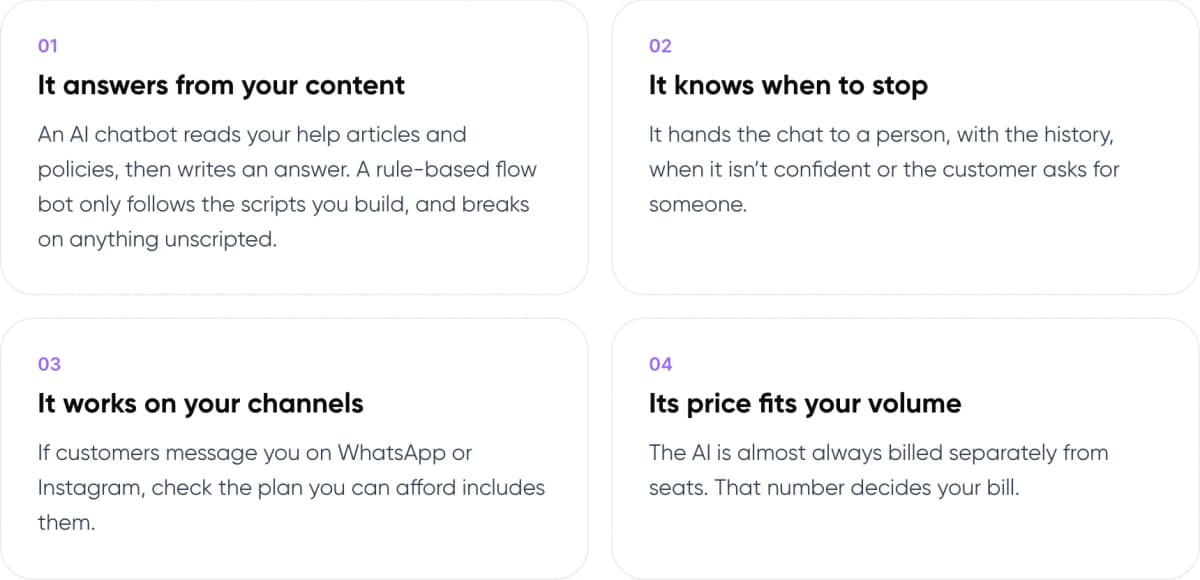
- It answers from your content. An AI chatbot reads your help articles and policies, then writes an answer. A rule-based flow bot only follows the scripts you build, and breaks on anything unscripted.
- It knows when to stop. It hands the chat to a person, with the history, when it isn’t confident or the customer asks for someone.
- It works on your channels. If customers message you on WhatsApp or Instagram, check the plan you can afford includes them.
- Its price fits your volume. The AI is almost always billed separately from seats. That number decides your bill.
Note: A “conversation” is not the same as a “message”. Chatbase, for example, charges in message credits, and each AI reply uses one or more credits depending on the AI model. A single conversation can use several.
2. How Do These Chatbots Charge for AI?
There are three models, and they behave very differently as you grow.
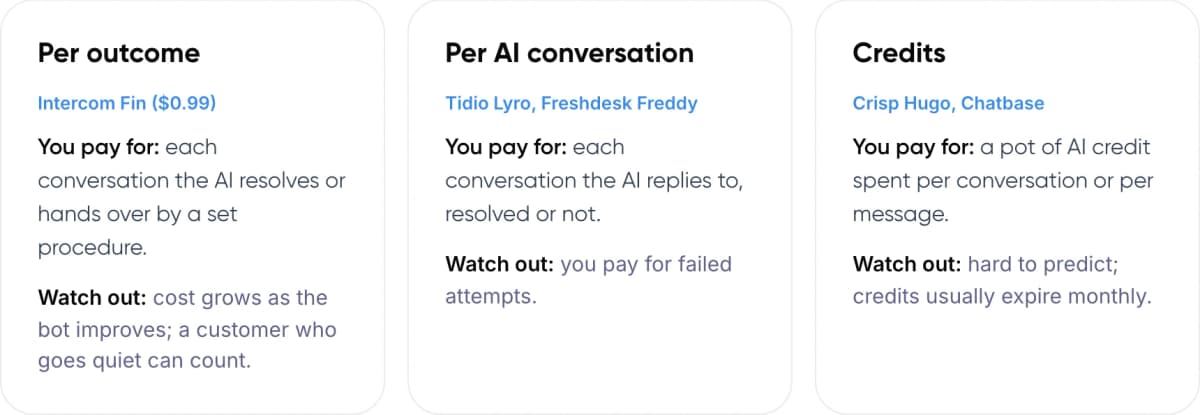
- Per outcome · Intercom Fin ($0.99). You pay for: each conversation the AI resolves or hands over by a set procedure. Watch out: cost grows as the bot improves; a customer who goes quiet can count.
- Per AI conversation · Tidio Lyro, Freshdesk Freddy. You pay for: each conversation the AI replies to, resolved or not. Watch out: you pay for failed attempts.
- Credits · Crisp Hugo, Chatbase. You pay for: a pot of AI credit spent per conversation or per message. Watch out: hard to predict; credits usually expire monthly.
In our view, per-outcome pricing is fairest when you’re starting, because you only pay when the AI does something useful. Credit pricing is cheapest at low volume, but check how fast the credits run down before you rely on it.
3. Which Is the Best Chatbot for Customer Service on a Small Budget?
We priced each tool for the same small business: two people answering chats, about 300 customer chats a month, and the AI handling about 200 of them, on monthly billing.
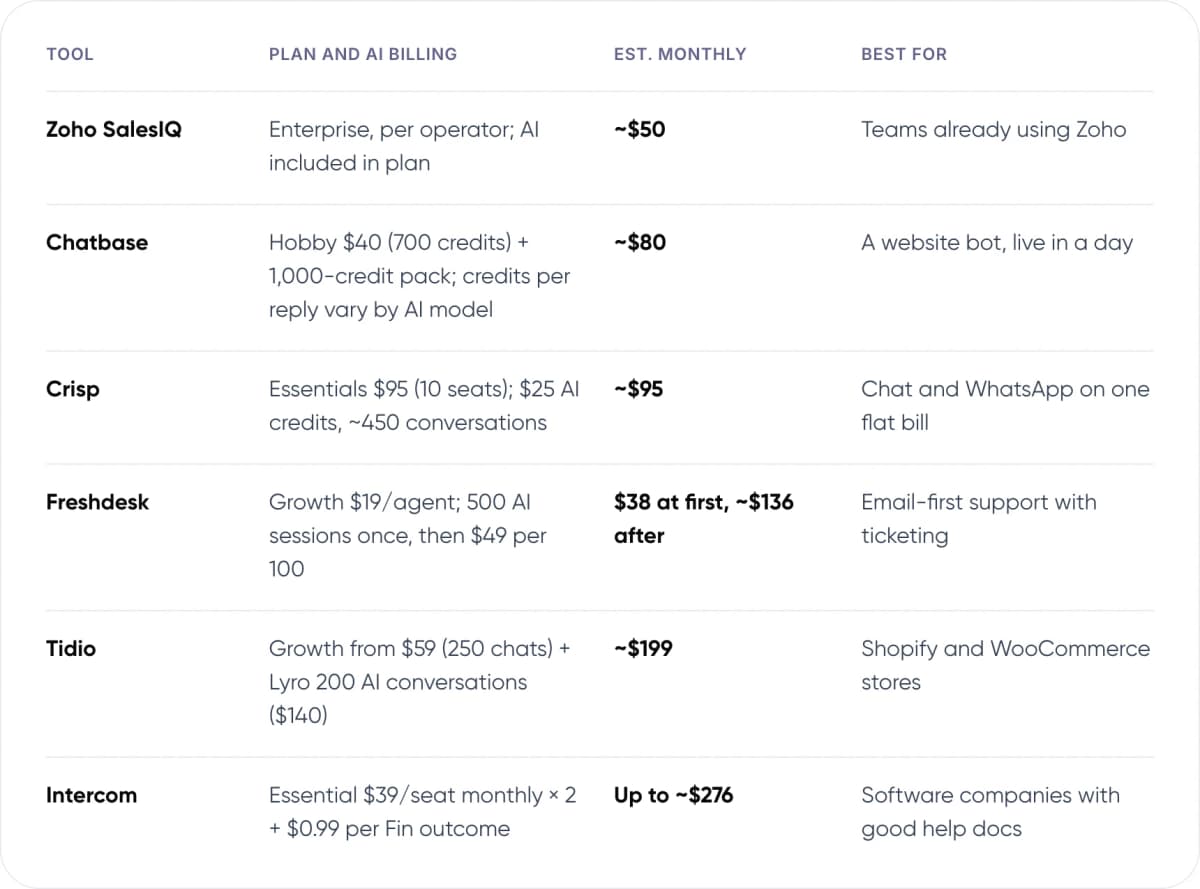
- Zoho SalesIQ — Plan and AI billing: Enterprise, per operator; AI included in plan. Est. monthly: ~$50. Best for: Teams already using Zoho.
- Chatbase — Plan and AI billing: Hobby $40 (700 credits) + 1,000-credit pack; credits per reply vary by AI model. Est. monthly: ~$80. Best for: A website bot, live in a day.
- Crisp — Plan and AI billing: Essentials $95 (10 seats); $25 AI credits, ~450 conversations. Est. monthly: ~$95. Best for: Chat and WhatsApp on one flat bill.
- Freshdesk — Plan and AI billing: Growth $19/agent; 500 AI sessions once, then $49 per 100. Est. monthly: $38 at first, ~$136 after. Best for: Email-first support with ticketing.
- Tidio — Plan and AI billing: Growth from $59 (250 chats) + Lyro 200 AI conversations ($140). Est. monthly: ~$199. Best for: Shopify and WooCommerce stores.
- Intercom — Plan and AI billing: Essential $39/seat monthly × 2 + $0.99 per Fin outcome. Est. monthly: Up to ~$276. Best for: Software companies with good help docs.
Our estimates from list prices reported September to November 2026. Crisp’s $25 of credits covers about 450 AI conversations by Crisp’s own estimate. Intercom assumes every AI conversation ends in a billable outcome, the worst case.
Tip: Run the same scenario with your own numbers. Count last month’s chats, guess how many have a written answer, and price your top two tools at that volume.

4. The 6 Tools, One by One
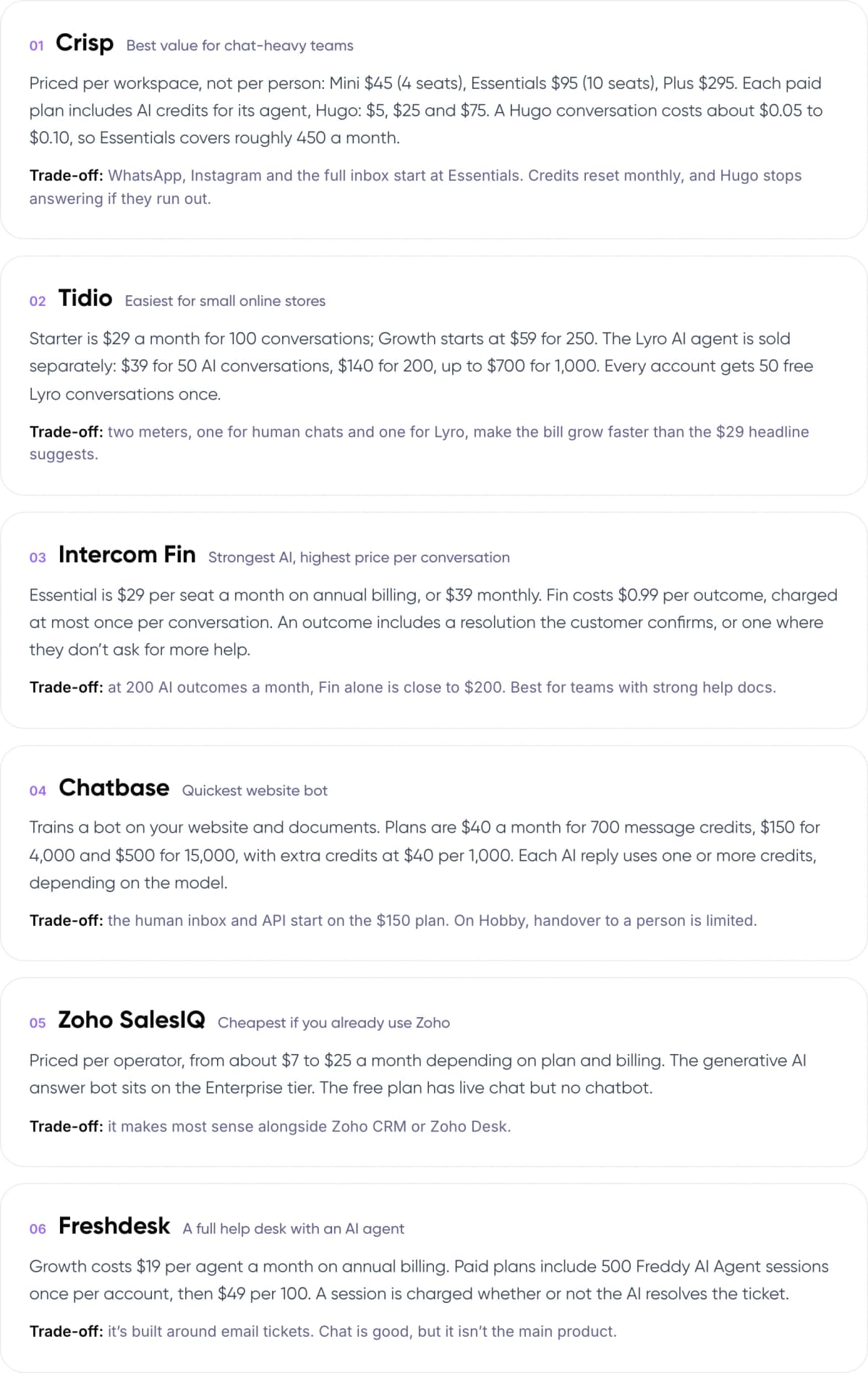
Crisp
Best value for chat-heavy teams
Priced per workspace, not per person: Mini $45 (4 seats), Essentials $95 (10 seats), Plus $295. Each paid plan includes AI credits for its agent, Hugo: $5, $25 and $75. A Hugo conversation costs about $0.05 to $0.10, so Essentials covers roughly 450 a month.
Trade-off: WhatsApp, Instagram and the full inbox start at Essentials. Credits reset monthly, and Hugo stops answering if they run out.
Tidio
Easiest for small online stores
Starter is $29 a month for 100 conversations; Growth starts at $59 for 250. The Lyro AI agent is sold separately: $39 for 50 AI conversations, $140 for 200, up to $700 for 1,000. Every account gets 50 free Lyro conversations once.
Trade-off: two meters, one for human chats and one for Lyro, make the bill grow faster than the $29 headline suggests.
Intercom Fin
Strongest AI, highest price per conversation
Essential is $29 per seat a month on annual billing, or $39 monthly. Fin costs $0.99 per outcome, charged at most once per conversation. An outcome includes a resolution the customer confirms, or one where they don’t ask for more help.
Trade-off: at 200 AI outcomes a month, Fin alone is close to $200. Best for teams with strong help docs.
Chatbase
Quickest website bot
Trains a bot on your website and documents. Plans are $40 a month for 700 message credits, $150 for 4,000 and $500 for 15,000, with extra credits at $40 per 1,000. Each AI reply uses one or more credits, depending on the model.
Trade-off: the human inbox and API start on the $150 plan. On Hobby, handover to a person is limited.
Zoho SalesIQ
Cheapest if you already use Zoho
Priced per operator, from about $7 to $25 a month depending on plan and billing. The generative AI answer bot sits on the Enterprise tier. The free plan has live chat but no chatbot.
Trade-off: it makes most sense alongside Zoho CRM or Zoho Desk.
Freshdesk
A full help desk with an AI agent
Growth costs $19 per agent a month on annual billing. Paid plans include 500 Freddy AI Agent sessions once per account, then $49 per 100. A session is charged whether or not the AI resolves the ticket.
Trade-off: it’s built around email tickets. Chat is good, but it isn’t the main product.
Pricing pages: Crisp · Tidio · Intercom · Chatbase · Freshdesk
Warning: WhatsApp has its own costs. Since 1 October 2026, Meta charges per message for WhatsApp service replies beyond a free monthly allowance. That bill sits outside your chatbot tool.
Not sure which tool fits your volume? Send us last month’s chat count and your channels.
5. Customer Service Chatbot Examples
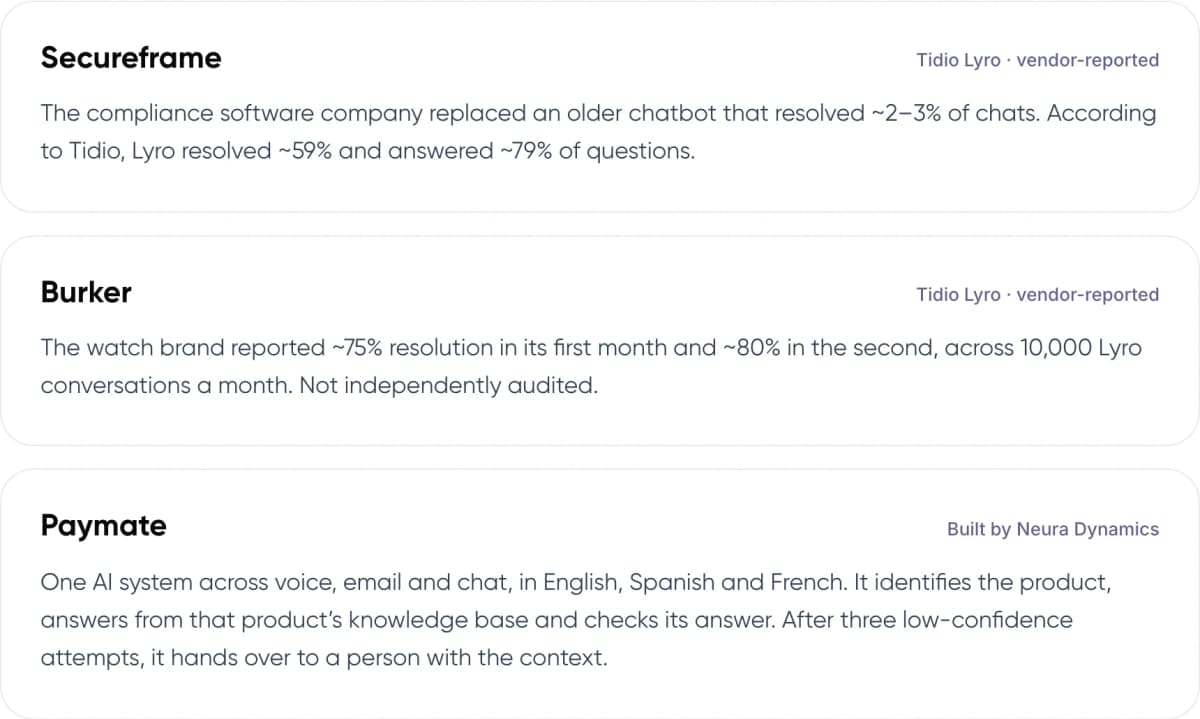
- Secureframe (Tidio Lyro · vendor-reported): The compliance software company replaced an older chatbot that resolved ~2–3% of chats. According to Tidio, Lyro resolved ~59% and answered ~79% of questions.
- Burker (Tidio Lyro · vendor-reported): The watch brand reported ~75% resolution in its first month and ~80% in the second, across 10,000 Lyro conversations a month. Not independently audited.
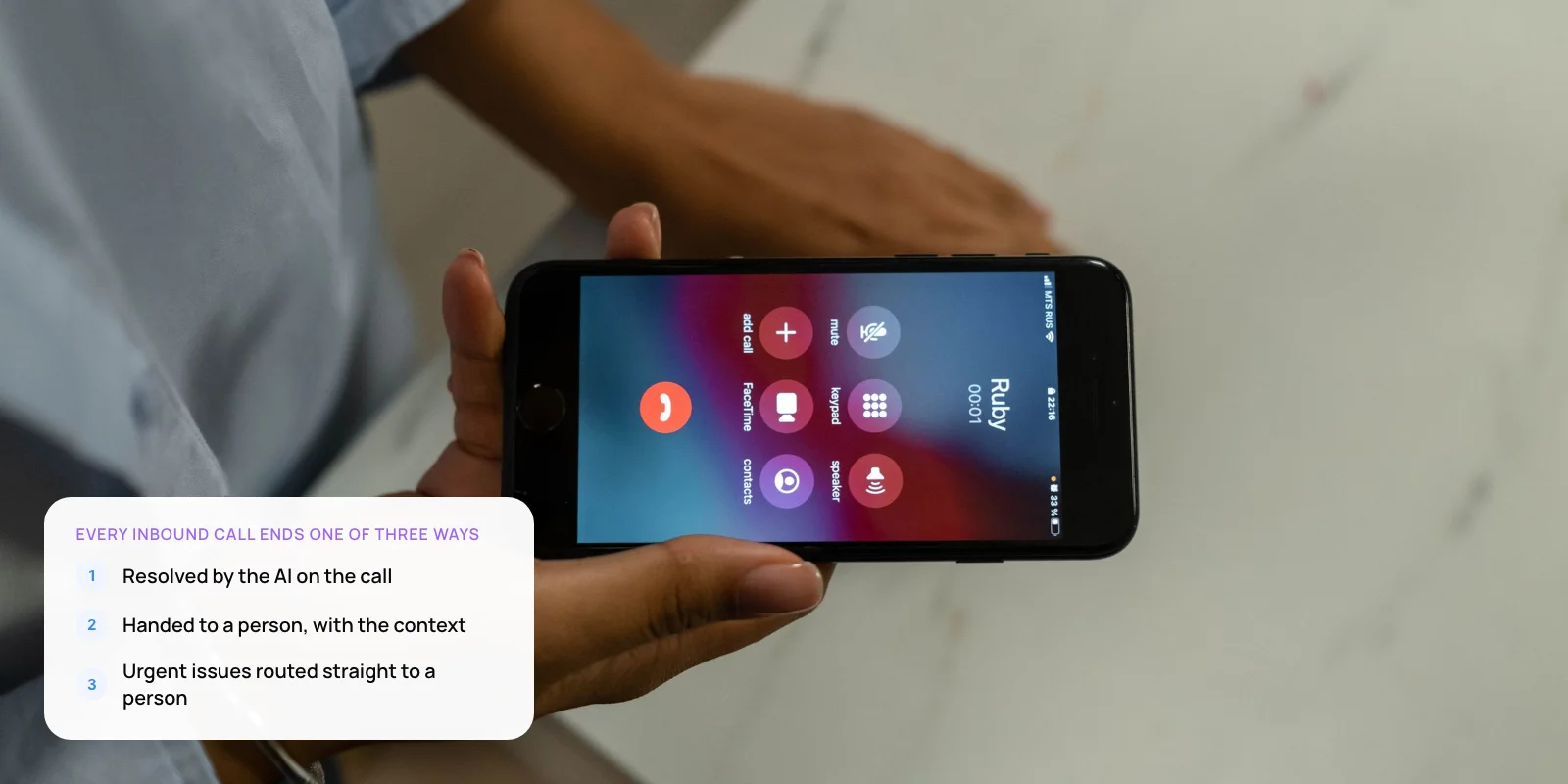
- Paymate (Built by Neura Dynamics): One AI system across voice, email and chat, in English, Spanish and French. It identifies the product, answers from that product’s knowledge base and checks its answer. After three low-confidence attempts, it hands over to a person with the context.
Sources: Tidio Secureframe case study · Tidio customer examples · Paymate case study
Note: Tidio counts a chat as resolved when the AI answered and the visitor didn’t ask for a person. That definition is generous, so measure your own rate the same way before comparing.
6. How to Choose in Five Steps
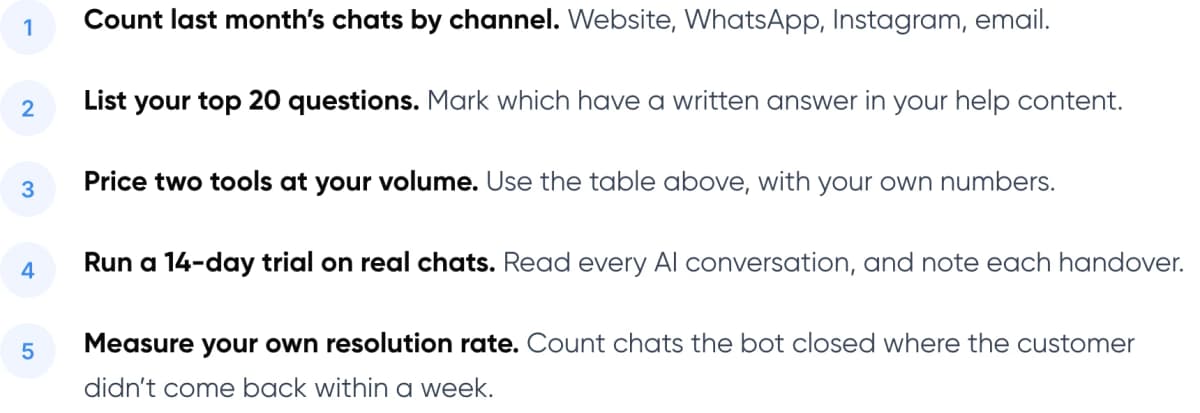
- Count last month’s chats by channel. Website, WhatsApp, Instagram, email.
- List your top 20 questions. Mark which have a written answer in your help content.
- Price two tools at your volume. Use the table above, with your own numbers.
- Run a 14-day trial on real chats. Read every AI conversation, and note each handover.
- Measure your own resolution rate. Count chats the bot closed where the customer didn’t come back within a week.
Before the trial, fix your top 20 help articles. Every tool here answers from your content, so a weak help centre makes every bot look bad. Our guide on stopping a support chatbot from giving wrong answers covers the groundwork.
7. When Should You Build Your Own?
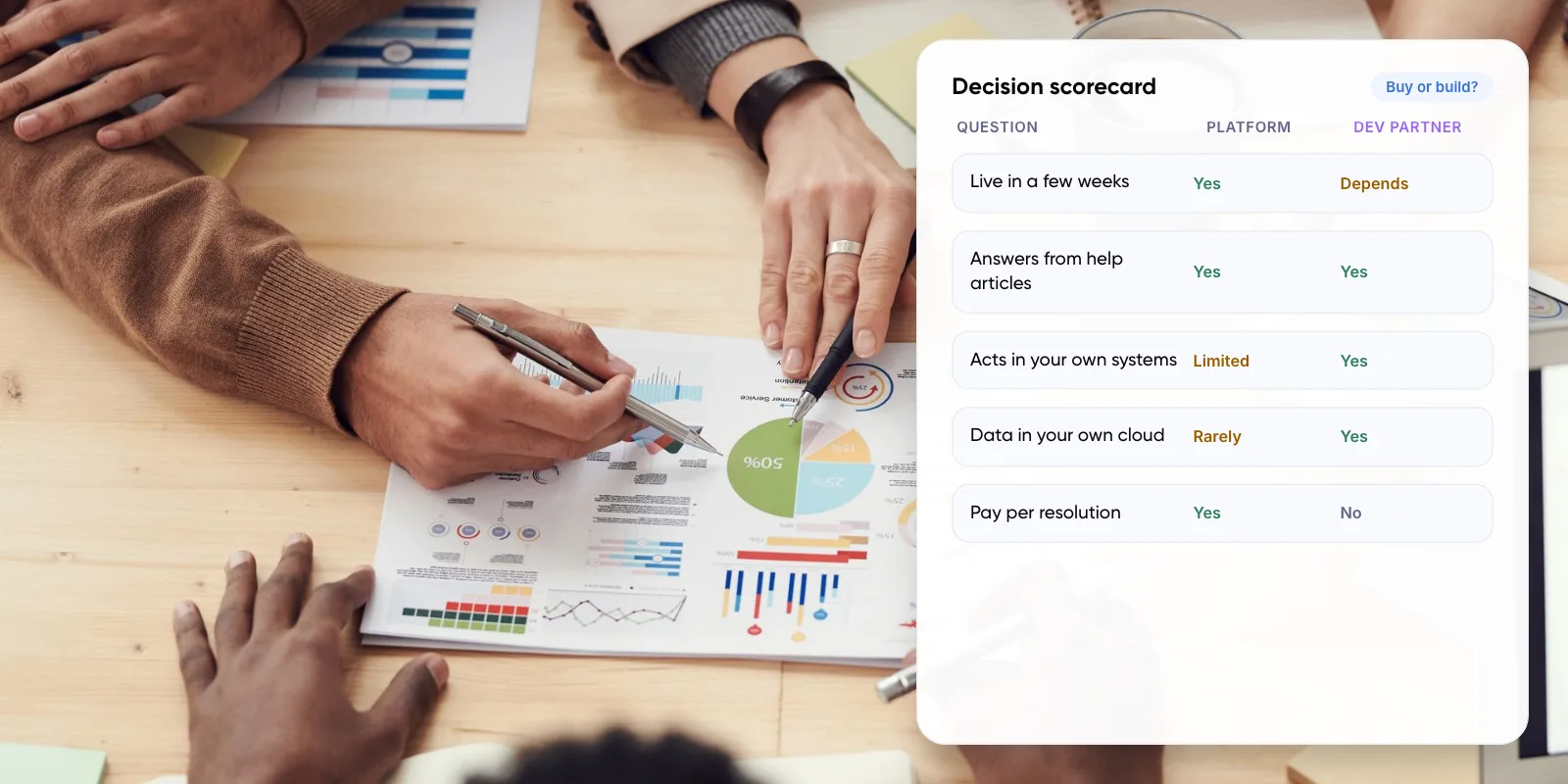
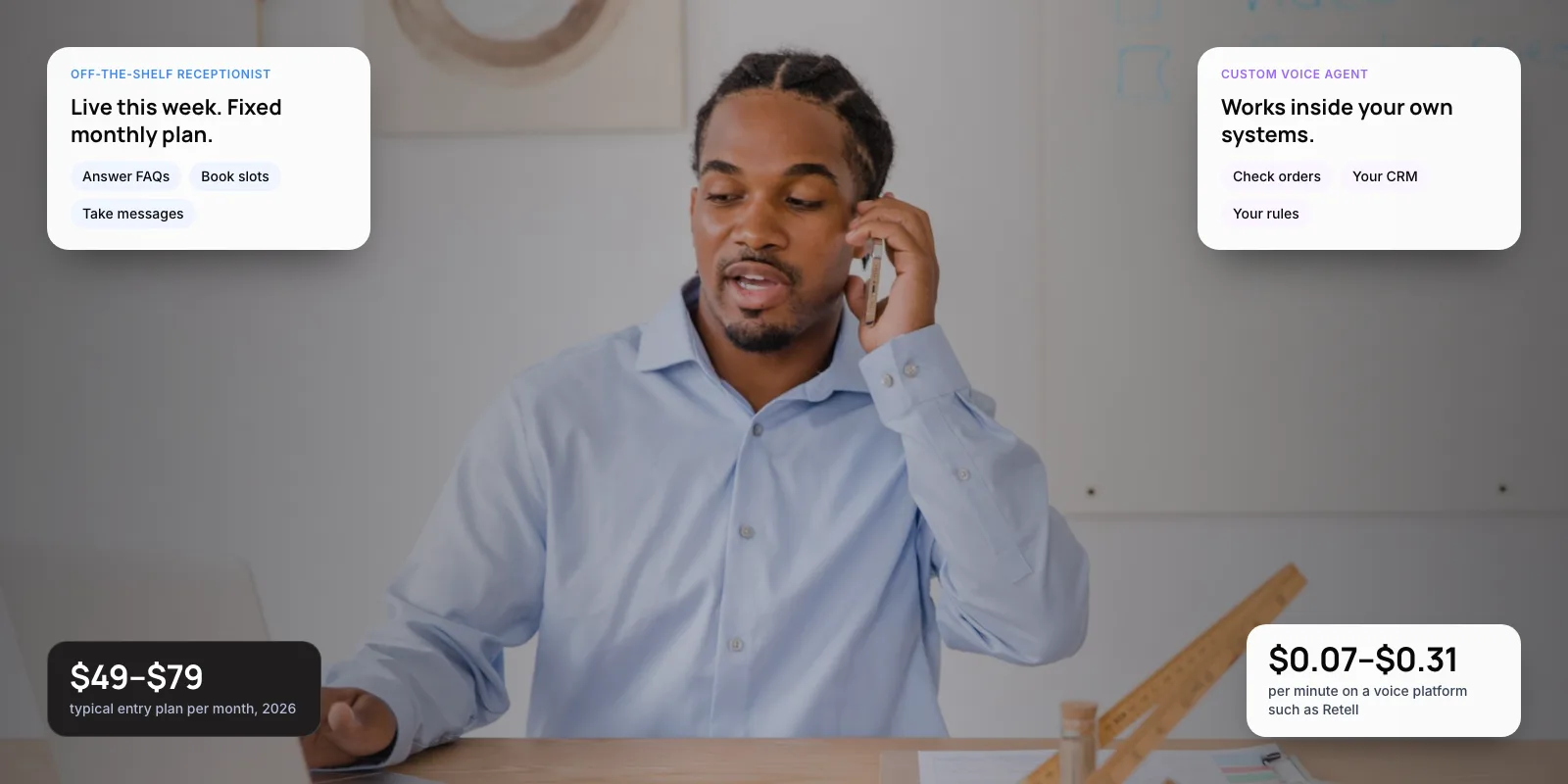
Off-the-shelf tools are the right start for most small businesses. They stop fitting when the bot needs live data from your own systems, when you support several products from one inbox, or when per-conversation fees pass what a custom build would cost.
That was Paymate’s situation: several products, three channels and three languages. A custom system let one AI identify the product and answer from the right knowledge base, which an off-the-shelf widget couldn’t do. Our AI customer support agent cost guide compares build and buy in detail.
8. Frequently Asked Questions
What is the best AI chatbot for customer service for a small business?
It depends on your volume and channels. In our view, Crisp is the best value for chat and WhatsApp on one flat bill. Tidio suits online stores. Intercom Fin has strong AI but costs $0.99 per outcome. Price your top two at your real monthly volume, then run a 14-day trial on real chats.
Is there a free AI chatbot for customer service?
Not one that stays free with AI. Tidio gives 50 Lyro conversations once. Chatbase has a small free allowance for testing. Crisp’s and Zoho SalesIQ’s free plans have live chat but no AI agent. Treat free tiers as trials and budget for a paid plan once you go live.
How much does a customer service chatbot cost?
For a small business handling about 200 AI conversations a month, expect roughly $80 to $280 a month in 2026, based on our estimates from list prices. The seat price is rarely the main cost. The AI usage fee, billed per outcome, conversation or credit, usually decides the bill.
What are the pros and cons of automated customer service?
The pros are instant answers at any hour, fewer repeat questions for your team and consistent replies. The cons are wrong answers when the bot isn’t grounded in your content, frustration when there’s no route to a person and usage fees that grow with volume. Clear handover rules reduce most of the risk.
Can a chatbot answer customers on WhatsApp?
Yes. Crisp, Tidio, Chatbase, Zoho SalesIQ and Freshdesk all connect to WhatsApp, usually on mid-tier plans or above. Meta also charges per message for service replies beyond a free allowance since 1 October 2026, so model that cost separately, especially in India and the UAE.
9. Next Step
The best chatbot for customer service is the one whose AI pricing matches your monthly volume and whose handover works on your channels. Count last month’s chats this week, list your top 20 questions, and trial your top two tools on real conversations.
Need more than an off-the-shelf bot?
Our AI customer support automation service builds custom chatbots that reach your order data and hand over cleanly.
Author