AI Customer Support for Edtech Platforms: Answering Student and Parent Queries
AI customer support works well for edtech platforms because most student and parent questions repeat: login problems, class schedules, fee dates, refunds and certificates. An AI assistant can answer these at any hour using your help content and account data, and pass the rest to a person.
This guide covers which queries to automate, which to keep human, how children’s data rules apply, and a step-by-step setup.
1. Why Does Edtech Support Need AI?
Edtech support has two audiences with different needs. Students ask practical questions, often late at night before a deadline. Parents ask about fees, progress and safety, usually on WhatsApp or email. Both expect a quick answer, and peaks come at predictable times: admissions, exam weeks and fee due dates.
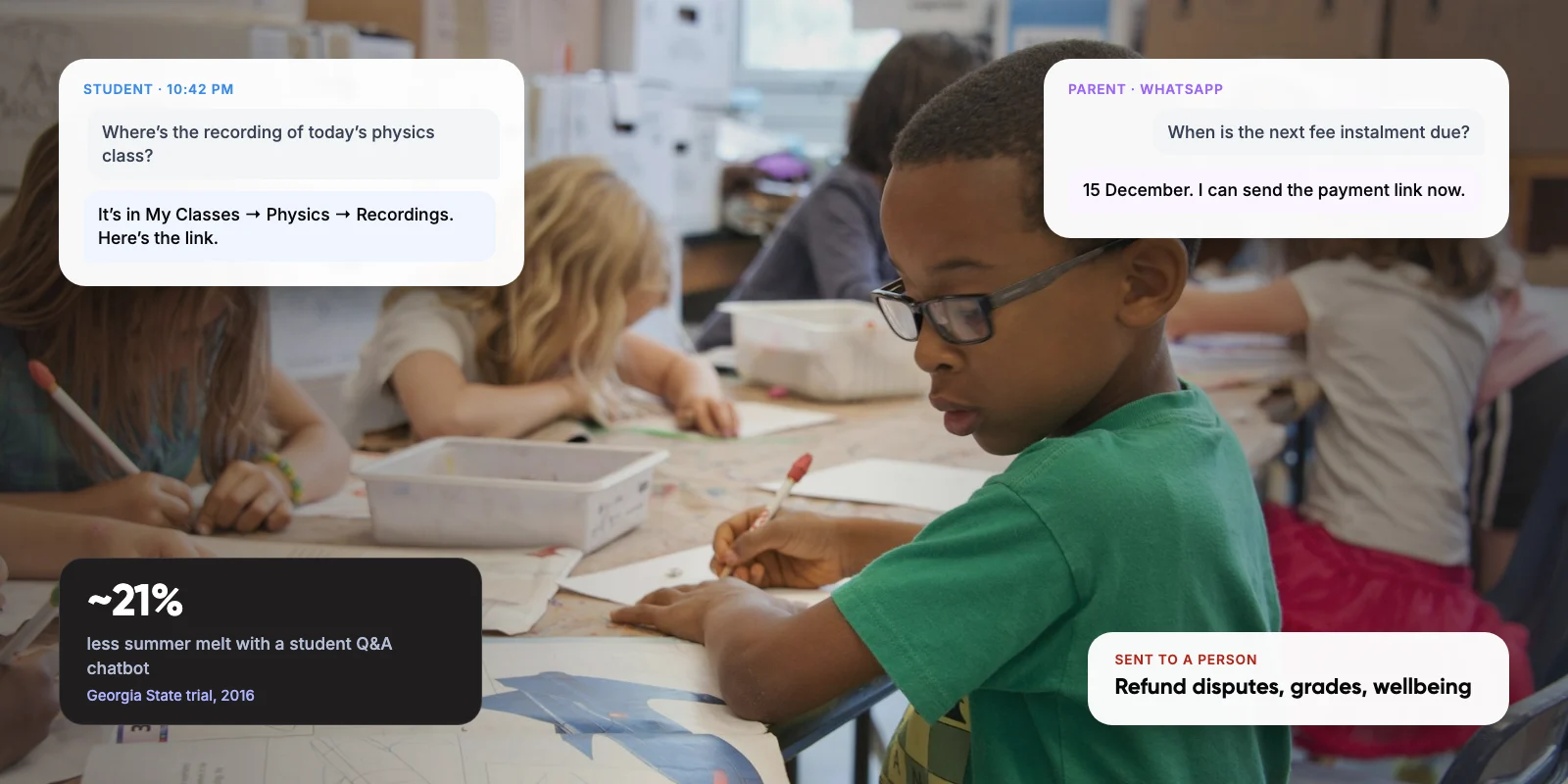
The best-known evidence comes from higher education. In 2016, Georgia State University used a texting assistant called Pounce to answer incoming students’ questions about enrolment tasks. In a randomised trial, it delivered over 200,000 answers in one summer. Students with access were 3.3 percentage points more likely to enrol, a ~21% reduction in “summer melt” (admitted students who never show up). Pounce was simpler than today’s AI assistants, but the lesson holds: fast answers to routine questions changed what students did.
Key takeaways
- Most edtech questions repeat: logins, schedules, fees, refunds and certificates. These suit AI customer support.
- Georgia State’s student Q&A chatbot cut summer melt by ~21% in a 2016 randomised trial.
- Keep refund disputes, grade appeals and anything about a student’s wellbeing with trained staff.
- Many users are minors: India’s DPDP Rules and the US COPPA rule require verifiable parental consent.
2. What Do Students and Parents Ask?
The questions differ by audience. Planning for both from the start avoids an assistant that sounds right to students but confuses parents.
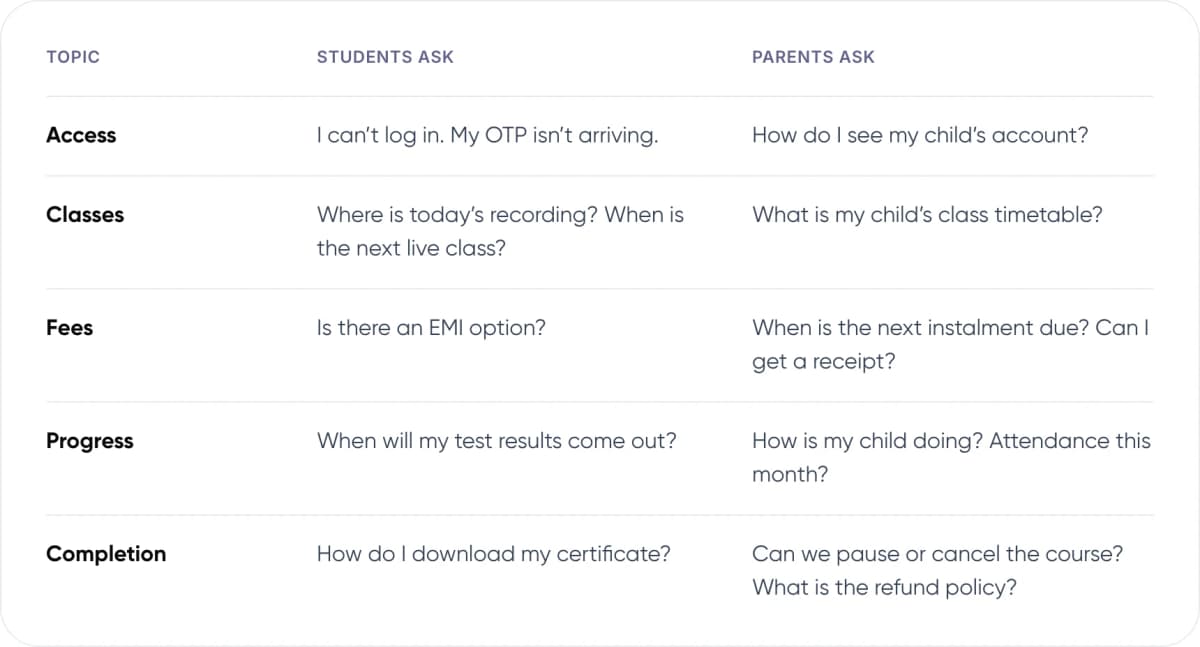
- Access — Students ask: I can’t log in. My OTP isn’t arriving. Parents ask: How do I see my child’s account?
- Classes — Students ask: Where is today’s recording? When is the next live class? Parents ask: What is my child’s class timetable?
- Fees — Students ask: Is there an EMI option? Parents ask: When is the next instalment due? Can I get a receipt?
- Progress — Students ask: When will my test results come out? Parents ask: How is my child doing? Attendance this month?
- Completion — Students ask: How do I download my certificate? Parents ask: Can we pause or cancel the course? What is the refund policy?
In our view, parents need a slightly different tone: more formal, with clear dates and amounts, and no learning-platform jargon such as “cohort” or “module unlock”.

3. What Should AI Customer Support Handle, and What Should It Not?
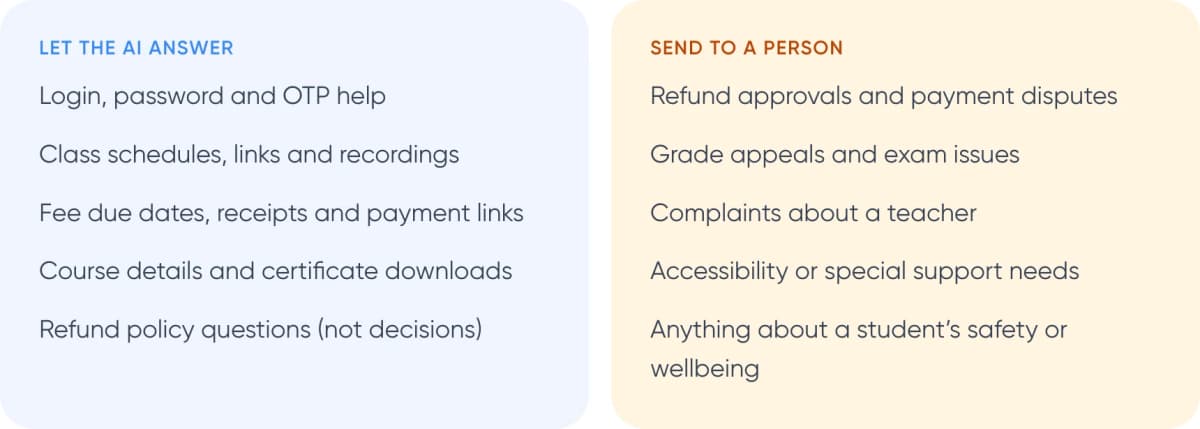
Let the AI answer
- Login, password and OTP help
- Class schedules, links and recordings
- Fee due dates, receipts and payment links
- Course details and certificate downloads
- Refund policy questions (not decisions)
Send to a person
- Refund approvals and payment disputes
- Grade appeals and exam issues
- Complaints about a teacher
- Accessibility or special support needs
- Anything about a student’s safety or wellbeing
Always offer a clear way to reach a person. Gartner’s 2026 survey found ~87% of customers say access to a human agent is essential when a company uses generative AI for service.
Warning: If a student mentions self-harm, bullying or abuse, the assistant should stop, share your helpline details and alert a trained staff member immediately. Write and test this rule before launch.
4. Which Channels Should You Cover?
Meet each audience where it already talks to you. Students usually use in-app chat or the website. In India and the Gulf, many parents use WhatsApp. To use it for support you need the WhatsApp Business Platform, and messages you send first, such as fee reminders, must use templates approved by Meta.
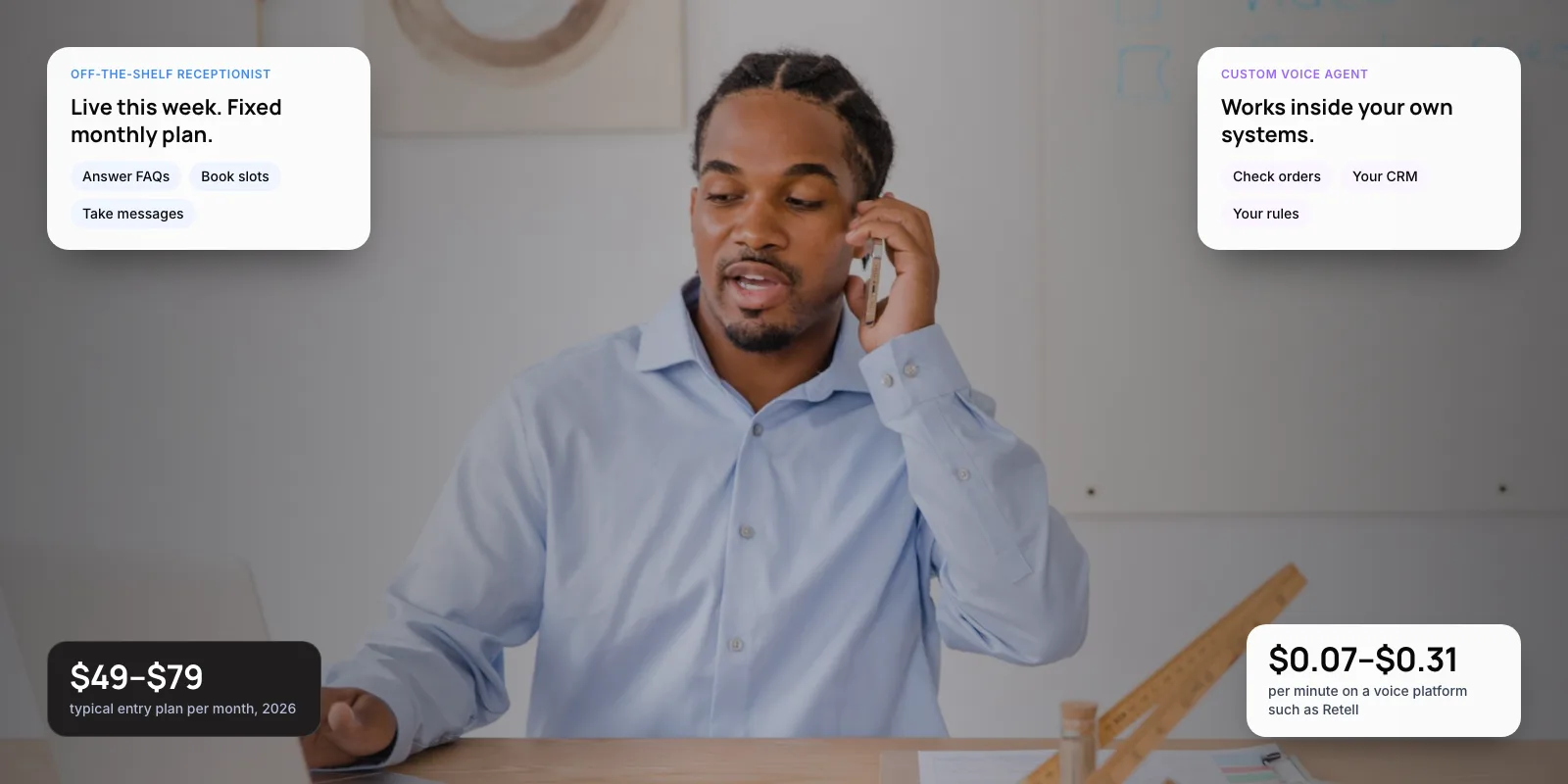
Voice matters during admissions, when parents call to ask about courses and fees. An AI phone agent can answer the common questions and book a counselling call. Whichever channels you use, connect them to one record per student so a parent’s WhatsApp question and a student’s chat sit in the same history.
Planning AI support for students and parents? We can map your queries with you.
5. What About Children’s Data and Consent?
Many edtech users are minors, so data rules are stricter. In India, the Digital Personal Data Protection Act treats anyone under 18 as a child. The DPDP Rules, notified in November 2025, require verifiable parental consent before processing a child’s data. They also bar behavioural monitoring and targeted advertising aimed at children.
In the US, the FTC’s COPPA rule requires verifiable parental consent before collecting personal information from children under 13. For your assistant, this means: verify who is asking before sharing account details, avoid storing more than the conversation needs, and don’t use chats with minors to target promotions.
Note: Some DPDP obligations take effect in phases, and the Rules give certain educational institutions limited exemptions from the consent requirement. Confirm with your legal team which apply to your platform and when.
6. How Do You Set It Up? 6 Steps
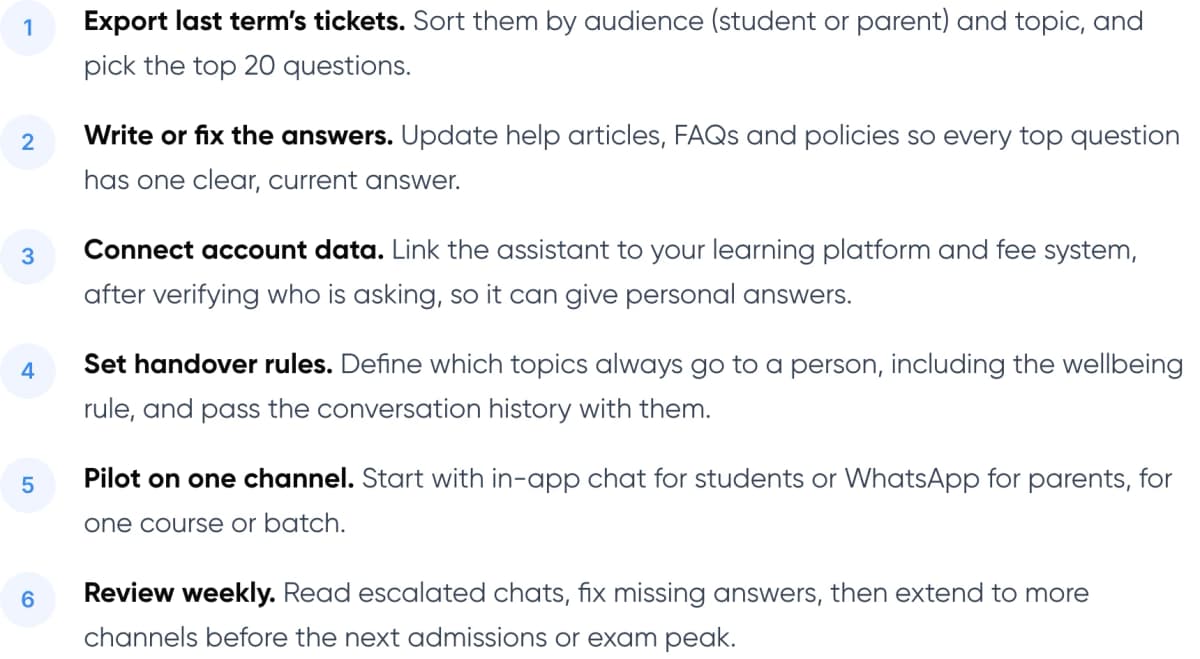
- Export last term’s tickets. Sort them by audience (student or parent) and topic, and pick the top 20 questions.
- Write or fix the answers. Update help articles, FAQs and policies so every top question has one clear, current answer.
- Connect account data. Link the assistant to your learning platform and fee system, after verifying who is asking, so it can give personal answers.
- Set handover rules. Define which topics always go to a person, including the wellbeing rule, and pass the conversation history with them.
- Pilot on one channel. Start with in-app chat for students or WhatsApp for parents, for one course or batch.
- Review weekly. Read escalated chats, fix missing answers, then extend to more channels before the next admissions or exam peak.
For how the assistant looks up course and account data reliably, see our guide to agentic RAG for customer service.
7. How Do You Measure Whether It Works?
Track a few numbers separately for students and parents. Track the share of conversations resolved without a person, satisfaction after each chat, and repeat contacts within seven days. Together they show how much the assistant covers, how good its answers are, and whether problems were actually solved.
Also watch the business outcomes support affects: on-time fee payments, course completion and refund requests. Georgia State measured enrolment rather than chat volume, which is what made its result meaningful. Read a sample of escalated chats each week and add any missing answers to your help content.
8. Frequently Asked Questions
What can AI customer support do for an edtech platform?
It can answer repeat questions from students and parents at any hour, such as login help, class schedules, fee dates, receipts and certificate downloads. Connected to your systems, it can give personal answers like a child’s next instalment date, and pass complex issues to staff with the conversation history.
Is there evidence that chatbots help students?
Yes. In a 2016 randomised trial at Georgia State University, a texting assistant answered over 200,000 questions from incoming students. Those with access were 3.3 percentage points more likely to enrol, a ~21% reduction in summer melt. The system was simpler than today’s AI assistants.
Do we need parental consent to use AI support with students?
Often, yes. India’s DPDP Rules require verifiable parental consent before processing data of anyone under 18, with some exemptions for educational institutions. In the US, COPPA requires it for children under 13. Check with your legal team which rules apply to your users.
Should parents and students get the same assistant?
They can use the same system, but plan answers for each audience. Parents usually ask about fees, progress and safety, and prefer WhatsApp or email with clear dates and amounts. Students ask about access, classes and deadlines, often through in-app chat.
What should the assistant never handle alone?
Refund approvals, payment disputes, grade appeals, complaints about teachers and anything about a student’s safety or wellbeing. For wellbeing concerns, the assistant should share helpline details and alert trained staff straight away. Gartner’s 2026 research found ~87% of customers say access to a human is essential.
9. Conclusion
AI customer support suits edtech because student and parent questions repeat and peak at predictable times. Let the assistant handle logins, schedules, fees and certificates, and keep refunds, grades and wellbeing with people. Start by exporting last term’s tickets and sorting them by audience and topic; the top 20 become your first set of answers.
For an example of our multichannel support work, see Paymate. If you’re planning AI support for your platform, our AI customer support automation service covers planning, building and running it.
Author