The Chargeback Whisperer: Using AI Support to Stop Disputes Before They Hit Your Bank
Most chargebacks start as a question nobody answered. A customer sees a charge they don’t recognise, can’t reach you fast, and taps “dispute” in their banking app instead.
AI customer support can answer that question in seconds, on any channel, before the bank gets involved. This guide shows where it helps, what it costs you not to, and how to set it up.
1. Why Do Most Chargebacks Start as Support Problems?
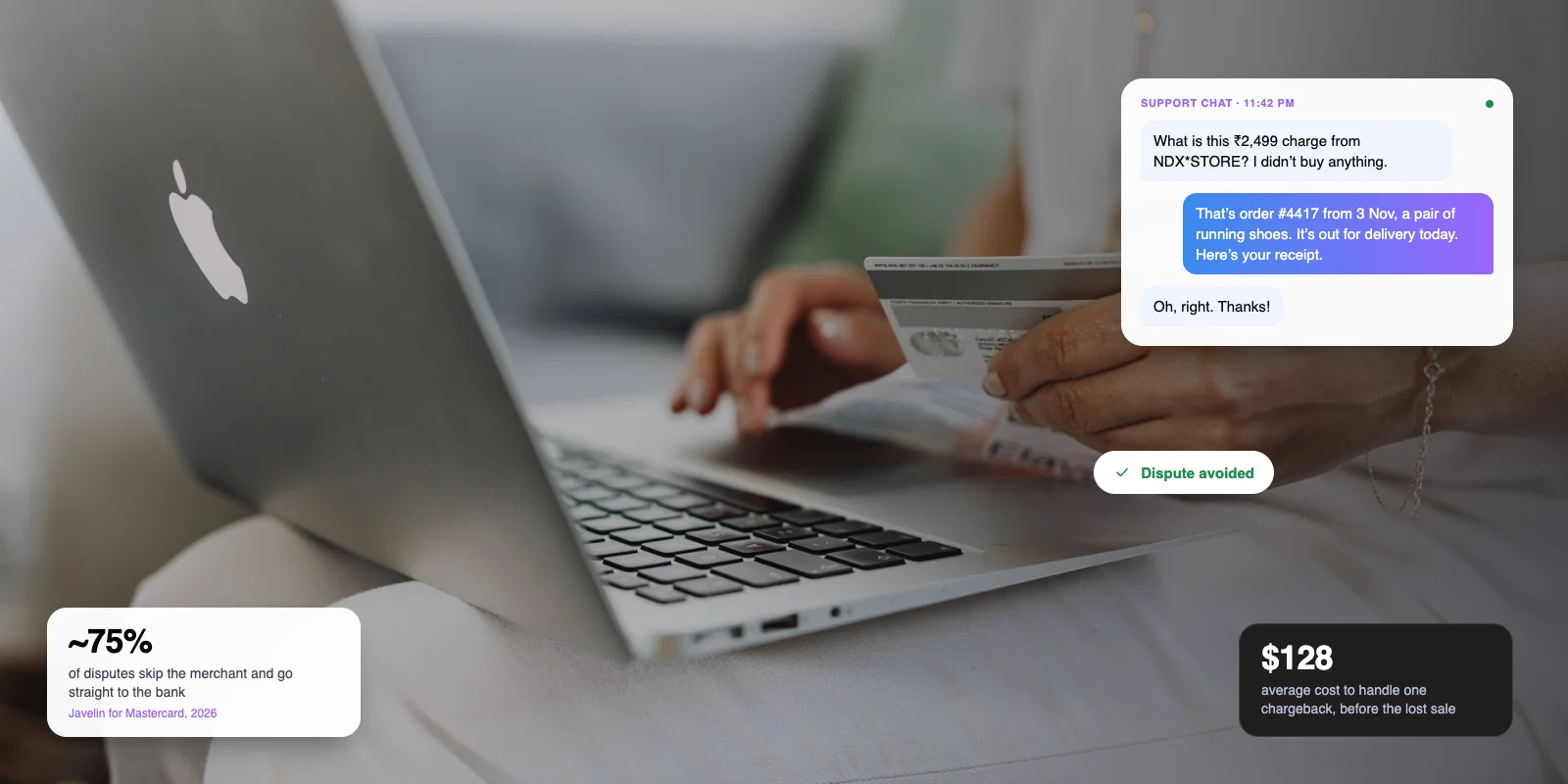
A chargeback is a refund the customer’s bank forces through, taking the money back from you. Most begin with confusion, not crime. Javelin’s January 2026 study for Mastercard found customers skip the merchant and go straight to their bank in ~75% of disputes.
When customers do contact the merchant first, the merchant resolves ~75% of cases. Simply answering the question settles ~44%, and a refund or replacement settles another ~31%. Javelin estimates that if every customer called the merchant first, chargeback volume could fall by ~50–60%.
So the real job is to be faster and easier to reach than the bank’s “dispute” button. That is where AI customer support helps.
Key takeaways
- In ~75% of disputes, customers go to their bank without contacting the merchant first (Javelin, 2026).
- When customers do contact the merchant, ~75% of disputes are resolved there.
- Each chargeback costs about $128 to handle, on top of the lost sale.
- AI customer support answers the common causes of disputes in seconds, on every channel.
2. What Does a Chargeback Really Cost You?
A chargeback costs more than the sale. You lose the money, often the product, and you pay to handle the case. That handling alone averages $82 in staff time plus $46 in third-party fees, according to the 2026 Javelin white paper for Mastercard.
- $128 — average handling cost per chargeback ($82 internal + $46 third-party) (Javelin for Mastercard, 2026)
- 261M — chargebacks expected worldwide in 2025 (Mastercard & Datos Insights, 2025)
- ~45% — of merchant chargebacks classed as fraud (Mastercard & Datos Insights, 2025)
The volume is growing. Mastercard’s 2025 State of Chargebacks report, based on Datos Insights research, expects global chargeback value to rise from $33.8 billion in 2025 to $41.7 billion in 2028. Merchants classed ~21% of their chargebacks as first-party fraud, where the real cardholder disputes a genuine purchase.
3. Why Does the 2026 Visa Rule Change Matter?
Visa watches every merchant’s dispute levels through a programme called VAMP. Each month it divides your fraud reports and disputes by your settled online card sales. On 1 April 2026, the “excessive” merchant limit dropped from ~2.2% to ~1.5% in the US, Canada, Europe and Asia Pacific, according to the Merchant Risk Council (2026).
The limit applies once you reach 1,500 fraud reports and disputes in a month. Merchants above it can be fined for each one, and your payment processor may set a stricter limit of its own. Ask your processor for its number.
Note: VAMP counts each dispute, whatever its value. Ten small “I don’t recognise this” disputes hurt your ratio as much as ten large ones. Fast answers to small questions matter.
4. How Does AI Customer Support Stop a Dispute?
An AI support agent connected to your order, payment and shipping systems can answer the common reasons for disputes on its own. It works on chat, WhatsApp, email and voice, at any hour. The table shows what it does for each trigger.
- Unrecognised charge — What the AI agent does: Matches the card details to the order and sends the receipt, item and date. · Data it needs: Orders, payment records
- Item not received — What the AI agent does: Shares live tracking, and opens a replacement or refund if the parcel is lost. · Data it needs: Courier tracking
- Subscription renewed — What the AI agent does: Explains the renewal and cancels or refunds it if your policy allows. · Data it needs: Billing system
- Refund not showing — What the AI agent does: Confirms when the refund was sent and when the bank should show it. · Data it needs: Refund records
- Charged twice — What the AI agent does: Checks for a duplicate or a pending hold and reverses the duplicate. · Data it needs: Payment gateway
- Damaged or wrong item — What the AI agent does: Collects a photo, then starts a return or replacement. · Data it needs: Returns process
For the technical side of connecting an agent to your data, see our guide to agentic RAG for customer service.
Want to know which of your disputes AI could have answered? We can review them with you.
5. What If the Customer Has Already Called the Bank?
AI support only works if the customer talks to you. For the ~75% who go to the bank first, the card networks offer tools that share your order details with the bank. The same order data your AI agent uses can feed them.
- Your AI support agent Answers questions on chat, WhatsApp, email and voice before the customer goes to the bank.
- Order Insight (Visa) and Consumer Clarity (Mastercard) Show your order details to the bank’s staff, or in the customer’s banking app, when they ask about a charge. This only works with banks that have joined.
- Pre-dispute alerts Ethoca Alerts and Verifi CDRN tell you a dispute has started, so you can refund before it becomes a chargeback.
- Rapid Dispute Resolution (Visa) Refunds qualifying disputes automatically, using rules you set.
These tools do work. Mastercard reports a ~15–20% deflection rate for merchants in its First-Party Trust programme. Like your AI agent, they are only as good as the order data you send them.
6. How to Set Up AI Support for Chargeback Prevention
- Sort last quarter’s disputes by reason. Your processor’s dashboard lists a reason code for each one.
- Fix your billing descriptor. Make the name on the card statement match your brand, and add a support link or number.
- Connect the AI agent to your data. At minimum: orders, payments, shipping and refunds.
- Write clear refund rules. Decide what the agent can refund alone and what needs a person.
- Put support where customers look. Add the chat link to receipts, shipping emails and your order page.
- Send a reminder before renewals. Email or message customers a few days before a subscription charges.
- Track your dispute rate monthly. Compare it to your processor’s limit and to Visa’s ~1.5% VAMP threshold.
To estimate what fewer disputes and faster answers are worth to you, try our free AI ROI Calculator.
7. When Should AI Not Handle a Dispute?
In our view, AI should answer questions and process routine refunds, but it should not argue with a customer about fraud. If someone says their card was stolen, the agent should block further orders and pass the case to a person straight away.
In India, this matters for a legal reason. Under the RBI’s 2017 customer liability circular, a customer carries zero liability for an unauthorised transaction caused by a third-party breach if they report it to their bank within 3 working days. Holding them up in a chat helps no one.
Warning: Don’t use AI to make refunds harder to get. A customer who feels blocked will go to the bank, and you will pay the chargeback fees on top of the refund.
8. Frequently Asked Questions
Can AI customer support really reduce chargebacks?
It can reduce the disputes caused by confusion, delays and unanswered questions. Javelin’s 2026 study for Mastercard found merchants resolve ~75% of disputes when customers contact them first. AI support makes that first contact faster. It will not stop true third-party fraud, where a stolen card is used.
What is friendly fraud?
Friendly fraud, or first-party fraud, is when the real cardholder disputes a genuine purchase. Sometimes it is deliberate. Often the customer forgot the purchase or didn’t recognise the name on their statement. In Mastercard’s 2025 report, merchants classed ~21% of their chargebacks as first-party fraud.
What is the Visa VAMP threshold in 2026?
Since 1 April 2026, Visa flags merchants as excessive at a VAMP ratio of ~1.5% in the US, Canada, Europe and Asia Pacific, down from ~2.2%. The ratio counts fraud reports and disputes against settled card-not-present sales, and applies once a merchant has at least 1,500 such events in a month.
What is the difference between a refund and a chargeback?
A refund is money you choose to return to the customer. A chargeback is forced by the customer’s bank, and you also pay fees and handling costs. Mastercard and Javelin put those costs at about $128 per chargeback in 2026. Chargebacks also count towards your card network dispute ratio.
Should the AI agent ever refuse a refund?
It should follow your written policy, and pass unclear or high-value cases to a person. In our view, it should never block a customer who reports fraud. A customer who feels stuck will call their bank, and the resulting chargeback will cost more than the refund.
9. Conclusion
Most chargebacks can be stopped by answering the customer before the bank does. AI customer support makes that possible at any hour, on every channel, using the order data you already have. Start by pulling last quarter’s disputes and marking which ones a fast, accurate answer would have prevented.
To see a support system we built for a payments company, read our Paymate omnichannel support case study, or explore our AI customer support automation services.
Author