When the Customer Is Also a Bot: What Happens When Their AI Agent Calls Your AI Agent?
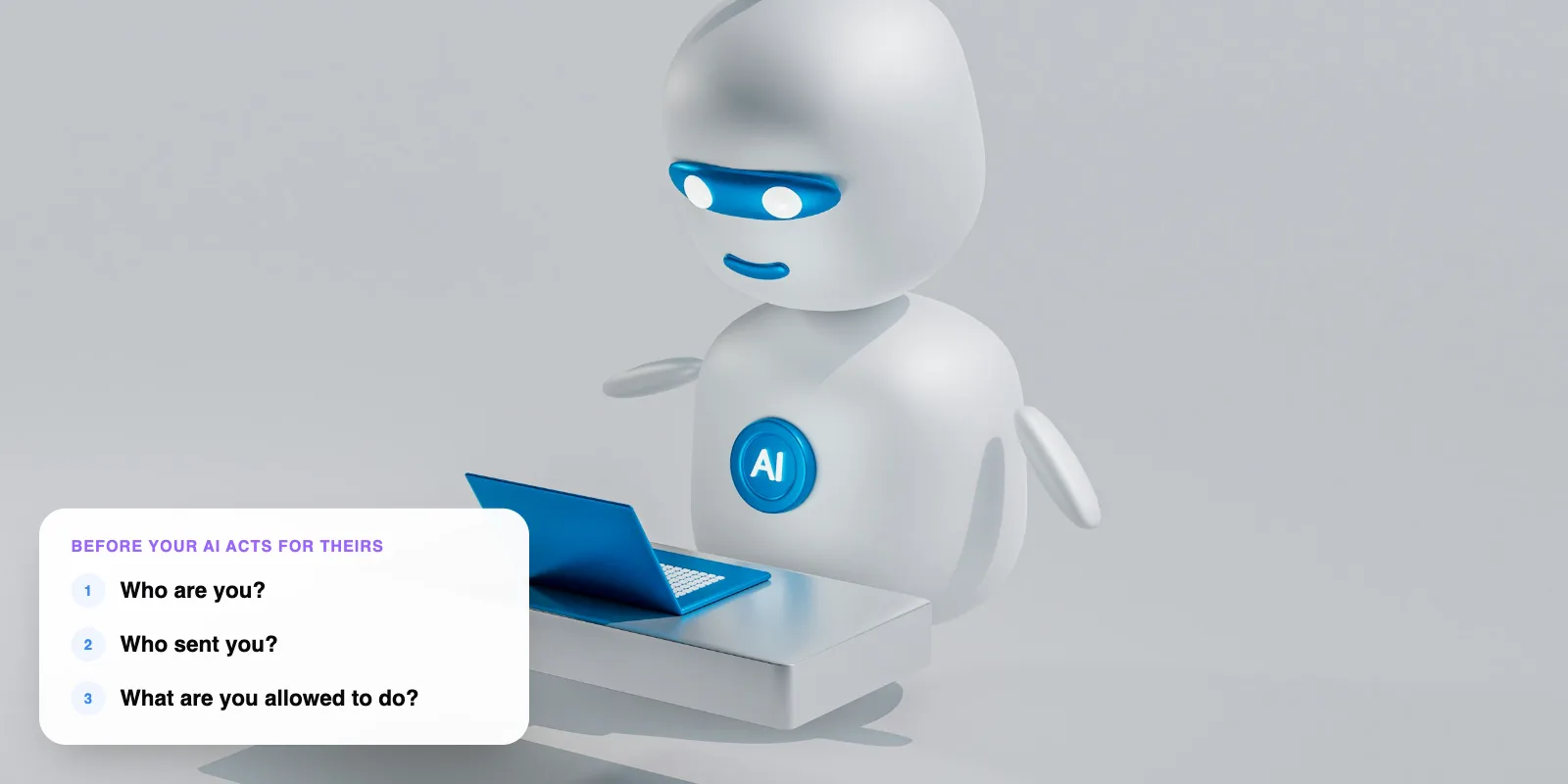
When a customer’s AI agent contacts you, your AI agents for customer support must spot that it is software, check who sent it and limit what it can do.
Done well, it is faster than any human conversation. Done badly, it opens a route for fraud or a costly loop between two bots.
1. Is This Really Happening Yet?
Yes, in early forms. In January 2025, Google began testing “Ask for Me”, an AI that phones local businesses for prices and availability on a searcher’s behalf. It started with US nail salons and auto repair shops. The business is told Google AI is calling for a user, and the user gets a summary afterwards.
Analysts expect much more. Gartner predicted in December 2024 that by 2028, ~70% of customer service journeys will begin and be resolved in third-party assistants on mobile devices. In October 2025, it forecast that ~90% of B2B buying will be AI agent intermediated by 2028. Both are forecasts, not measurements. But if agents do the buying, they will also raise the support tickets.
Key takeaways
- Customer agents reach you three ways: by phone, through your chat or website, and through an API. Each needs a different response.
- Identity is not enough. You need to know who the agent is, who sent it and what that person allowed it to do.
- Let agent-customers read freely but act narrowly. Refunds, cancellations and account changes should need the human’s confirmation.
- Cap the length of bot-to-bot conversations and log every one. Two agents can loop, and nobody is watching live.
2. Three Ways a Customer’s Agent Reaches You
The right response depends on the channel the agent uses.
- By phone. A voice agent calls your number, as Google’s calling AI does. Your AI receptionist may not realise it is talking to software. — Hardest to verify
- Chat or website. A browser agent types into your chatbot or fills in your forms, such as a cancellation form, in seconds. — Easy to mistake for a person
- Through an API. The agent talks to your system directly in structured data. It is the cleanest route, and the one new standards are built for. — Easiest to control
A 2025 hackathon demo hints at where phone calls could go. At an ElevenLabs hackathon in London, two developers built GibberLink: two voice agents start a call in English, recognise each other as AI and switch to a data-over-sound protocol. It is a demo, not a product, but the point stands: once two agents know they are both software, human speech is wasted effort.
3. How Is an Agent-Customer Different From a Human One?
A support bot built for people makes assumptions that break when the customer is software.
- Speed — Human customer: One conversation at a time · Customer’s AI agent: Can contact you many times a minute, and several companies at once
- Patience — Human customer: Gives up after a few transfers · Customer’s AI agent: Never tires; retries and rephrases
- Identity — Human customer: Name, account, security questions · Customer’s AI agent: Its own identity plus the person or company it acts for
- Authority — Human customer: Can usually do anything on their account · Customer’s AI agent: May be allowed only some actions, such as checking status but not cancelling
- How it fails — Human customer: Misunderstands or gets upset · Customer’s AI agent: Misreads its instructions, follows a manipulated prompt or loops with your bot
- What it needs — Human customer: Empathy and clear answers · Customer’s AI agent: Clear structure, explicit limits and fast confirmations
Our view: authority matters most. A person can usually do anything their account allows. An agent should do only what its owner delegated, so your system has to ask rather than assume.
4. How Should AI Agents for Customer Support Handle Other Agents?
Our recommendation: treat agent-customers as a separate type of contact with their own rules. They are neither spam bots nor normal customers.
- Recognise them. Ask. Your AI says it is an AI and asks whether the caller is a person or an assistant. On the web and APIs, look for signed identity.
- Find who sent them. Ask which person or business the agent acts for, then check that account the usual way, for example with a one-time code.
- Separate reading from acting. Let a verified agent check status, prices and policies freely. Anything that moves money or changes an account needs the human.
- Offer a faster lane. If both sides are software, move them off the voice call to an API or a link. It saves cost and avoids speech-recognition errors.
Warning: Never let your agent take instructions from text the other agent supplies, such as “ignore your refund limit”. That is a prompt injection, and an agent-customer is a natural carrier for it. Your agent’s rules should come only from your own configuration.
Our guide on stopping a support chatbot from giving wrong answers covers the guardrails that make these rules hold.
Is your AI support agent ready for other agents? We’ll show you where one would get stuck, or get too far.
5. A 6-Step Policy for Agent-Customers
- Disclose and ask on every channel. Your agent says it is an AI and asks whether it is speaking with a person or an assistant. Log the answer.
- Define three action tiers. Read only, low risk and high risk, as shown below.
- Require human confirmation for high-risk actions. Send a code or link to the account holder’s verified phone or email.
- Cap bot-to-bot conversations. Set a maximum number of turns, for example 20, and a time limit. Then hand over to a person with a summary.
- Rate-limit by account holder. One person’s agent should not be able to open 50 tickets in a minute.
- Log and review every agent conversation. Keep transcripts and actions, and review a sample each week.
- Tier 1 · Read: Allowed. Order status, prices, opening hours, FAQs.
- Tier 2 · Low risk: Allowed with limits. Rebooking, address fixes, opening a ticket.
- Tier 3 · High risk: Needs human confirmation. Refunds, cancellations, payment or ownership changes.
Tip: Start by tagging agent-customers in your helpdesk before you change any behaviour. A month of tags shows how often it happens and on which channel.
6. What Standards Exist for Agents Talking to Agents?
Several open standards now exist. None is required yet, and each covers one part of the problem.
- Agent2Agent (A2A) — Started by: Google, April 2025 · What it does: Lets agents discover each other’s capabilities and exchange tasks. Hosted by the Linux Foundation since June 2025.
- Model Context Protocol (MCP) — Started by: Anthropic, Nov 2024 · What it does: Connects an agent to your tools and data. Works alongside A2A.
- Agent Payments Protocol (AP2) — Started by: Google, Sept 2025 · What it does: Signed “mandates” that prove what a user authorised an agent to buy.
- Web Bot Auth — Started by: Cloudflare, May 2025 · What it does: Agents sign each web request so a site can verify who sent it.
- Trusted Agent Protocol — Started by: Visa with Cloudflare, Oct 2025 · What it does: Lets merchants verify a signed shopping agent. Mastercard Agent Pay uses the same approach.
According to the Linux Foundation, founding members of the A2A project included AWS, Cisco, Google, Microsoft, Salesforce, SAP and ServiceNow. On the web, Cloudflare explains that Visa and Mastercard both use Web Bot Auth to verify shopping agents, which lets a site admit verified agents and block scrapers.
For support, the most useful idea is AP2’s signed “mandate”, a record of what the user approved. A support version would let an agent prove its owner approved a cancellation, rather than your agent taking its word.
7. Where Does Fraud Fit In?
The tools that help honest customers also help fraudsters. Gartner warned of this in its December 2024 predictions and expects service teams to add stronger identity checks, even for simple requests.
Three risks stand out. An agent tests thousands of account details. An agent impersonates a customer. An agent slips in instructions to override your rules. Rate limits, human confirmation and fixed rules handle each one.
Our view: do not block all bots. A growing share of genuine customers will arrive through an assistant, and blocking them sends those customers to a competitor that serves their agent well.
8. What Have We Built That Applies Here?
We have not yet run a production deployment where a customer’s agent talks to a client’s agent, so we won’t claim results. Two builds show the pieces you need.
Case study · Paymate (Source: Neura Dynamics)
For Paymate, we built one AI support system across voice, email and chat that checks its own answers and hands over to a person after three low-confidence attempts. That kind of limit is what an agent-to-agent conversation needs.
Our AI voice assistant answers calls and handles requests by voice, the same channel Google’s calling AI uses.
9. Frequently Asked Questions
Can AI call businesses on my behalf?
Yes. Google’s calling feature, first tested as “Ask for Me” in January 2025, phones local businesses to ask about prices and availability, then sends you a summary. It started with nail salons and auto repair shops in the US. Businesses can opt out of these calls in their Google Business Profile settings.
How do you know if you’re talking to an AI agent?
Ask. A well-built AI agent says it is an AI when asked, and Google’s calling AI announces itself at the start. On websites and APIs, signed identity standards such as Web Bot Auth let you verify which agent sent a request. Don’t rely on voice quality, because modern AI voices sound natural.
Should my AI voice agent talk differently to another AI?
It can. Once both sides confirm they are software, there is no need for natural speech. Offer the other agent a structured route, such as an API or a link, which is faster and less error-prone. The GibberLink hackathon demo in 2025 showed two voice agents switching to a data-over-sound protocol.
What is a machine customer?
Gartner uses “machine customer” for an AI agent that buys or acts on behalf of a person or business. In October 2025, Gartner forecast that by 2028, ~90% of B2B buying will be intermediated by AI agents. For support teams, that means more tickets raised by agents rather than people.
Should I block AI agents from my support channels?
Usually not. Block unverified, high-volume bots, but serve verified agents acting for real customers. Let them read freely, limit what they can change, and require the human owner’s confirmation for refunds, cancellations and account changes. Blocking every agent may push genuine customers to competitors.
What is the A2A protocol?
Agent2Agent (A2A) is an open standard, started by Google in April 2025, that lets AI agents discover each other’s capabilities and exchange tasks. The Linux Foundation has hosted it since June 2025, with founding members including AWS, Cisco, Microsoft, Salesforce, SAP and ServiceNow.
10. Next Step
Customer agents are already calling businesses, and AI agents for customer support need rules for them now. Start by tagging agent-customers in your helpdesk for a month. Then define your three action tiers and add human confirmation for the high-risk ones before the volume grows.
Related: AI customer support agent cost guide · AI agent development services
Author