About the news
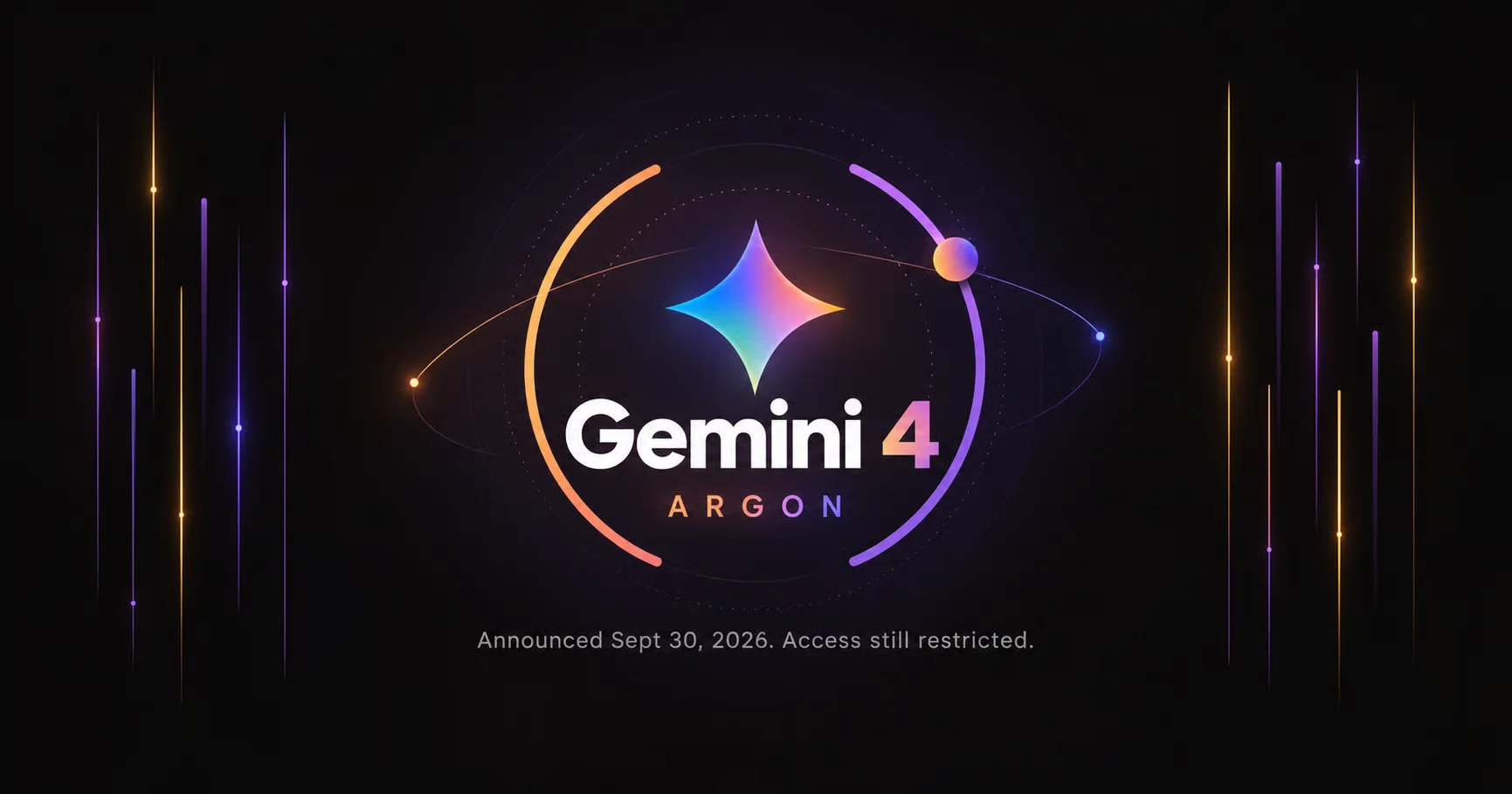
On September 30, 2026, Google DeepMind announced Gemini 4 Argon, its new frontier model. The company describes it as built to sustain deep reasoning across complex, long-horizon workflows in software engineering, enterprise knowledge work such as legal and finance, and cybersecurity defense.
Argon is currently rolling out to a set of trusted cyber defenders through Google’s Fairwind Program. Google is taking a phased approach and is participating in the U.S. government’s voluntary process for pre-release model access while it gathers feedback and strengthens guardrails. Broader availability for developers, enterprises, and consumers is planned “as soon as possible,” starting with paid API customers and Google AI Ultra subscribers.
A key technical change is the expansion of the model’s output token limit to 1 million tokens, up from the previous 64,000. Google says this gives the model more headroom to think through longer, multi-step problems in a single trajectory. Introductory pricing is set at $2 per million input tokens and $10 per million output tokens, with a 95% discount on cached input tokens. After the introductory period the rates rise to $4 and $20 respectively.
Google reports that Argon is already in use internally by thousands of employees and has shown strong results on long-horizon software engineering benchmarks, including a 77.9% score on DeepSWE v1.1.
Why it matters
Most current frontier models still struggle when agent workflows stretch over many steps or require sustained context. By raising the output limit to one million tokens and training specifically for long-horizon tasks, Google is targeting one of the clearest remaining gaps in agentic performance.
The initial focus on cybersecurity defenders through Fairwind also signals a deliberate safety posture. Google is releasing the model first to a vetted group and is coordinating with government pre-release processes before wider access. This approach reflects the industry’s growing recognition that highly capable long-horizon models need careful containment before they reach general users.
For teams building agents that must plan, execute, and revise over extended periods - whether in coding, research, or knowledge work, Argon represents a new option optimized for exactly that style of work.
What to watch next
The most immediate question is when broader access will open. Google has not given a firm date for the next phase (paid API and AI Ultra). How quickly the model moves from Fairwind testers to general developers will determine its near-term impact.
It will also be worth watching how Argon performs in independent long-horizon evaluations once more users can run it, and how Google’s guardrails evolve based on feedback from the early cyber-defense cohort. If the model delivers consistent reliability on multi-step agent tasks at the promised price point, it could become a strong alternative for production agent systems that need sustained reasoning rather than short, single-turn responses.