


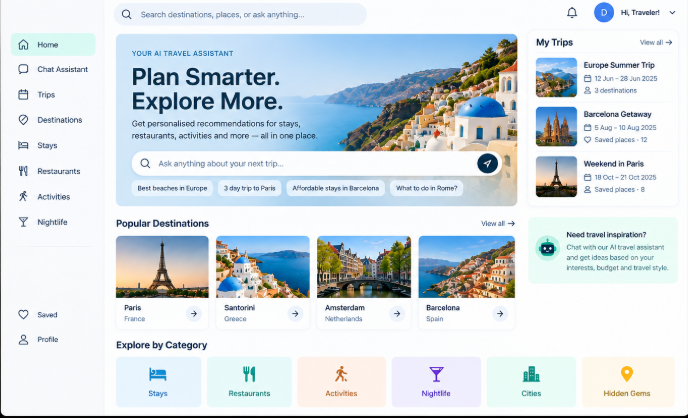
FlexTrip Travel is an AI travel assistant that helps students discover stays, restaurants, activities, and destinations through smart, conversational travel planning.
Project overview
FlexTrip Travel helps students simplify planning a trip by bringing stays, restaurants, activities, and nightlife into one conversational experience. It transforms a static travel system into a more flexible solution for discovering destinations, comparing options, and refining travel plans through natural conversations.
Challenges
Static, fragmented data: Stays, restaurants, activities, and nightlife were stored across inconsistent Excel files, making reliable recommendations difficult to generate. Frequent redeployments: Every content update required a code deployment, making the system difficult and time-consuming to maintain. No conversational context: The old chatbot treated every question independently, preventing natural follow-ups and continuous travel assistance. Limited query intelligence: Every request used the same monolithic prompt, making it difficult to understand different user intents and return relevant results.
Project objective
Create a reliable foundation by replacing fragmented spreadsheet data with a structured, database-backed system. Enable intelligent conversations so students can ask follow-up questions, refine travel plans, and receive more relevant responses. Deliver scalable travel assistance with intelligent query routing, destination comparisons, and real-time information capabilities.
Our solution
Centralized the data: Migrated fragmented Excel records into a structured, reliable database. Built an intelligent agent: Created a system that routes each request to the right workflow and retrieves only relevant information. Enabled real-time assistance: Added web search for queries such as weather and flight checks. Introduced persistent conversations: Enabled users to continue, refine, and compare their travel plans within the same conversation.
Our approach
Cleaned the existing data: Reviewed legacy travel data, resolved inconsistencies, and created a reliable foundation for future recommendations. Rebuilt the conversation flow: Created dedicated paths for searches, real-time questions, comparisons, and unclear requests. Added contextual conversations: Enabled users to continue, refine, and build on previous questions without starting over. Refined through real usage: Improved the system based on real user interactions, addressing misspellings, ambiguity, and response accuracy.
How FlexTrip Travel works
Ask Naturally: Students ask questions about destinations, stays, restaurants, activities, or other travel needs in their own words. Understand the Request: The system identifies the intent and determines what information is needed to answer the request. Find Relevant Information: It gathers the appropriate destination data, uses real-time web information when needed, and can compare information across multiple destinations. Respond and Refine: FlexTrip Travel delivers a relevant response while maintaining conversation context, allowing students to ask follow-ups, refine their travel plans, or clarify their needs.
Technical architecture & implementation
Structured data foundation: Reworked inconsistent legacy data into a normalized structure that could be reliably accessed and maintained. Modular request routing: Designed separate workflows to handle destination searches, real-time queries, multi-destination comparisons, and unclear requests. Context-aware processing: Created a persistent session layer that retains conversation context and summarizes longer interactions to keep responses efficient. Resilient data handling: Added fuzzy location matching and retained the legacy data path as a fallback to maintain operational continuity. Continuous delivery and refinement: Followed a Kanban workflow with weekly client updates, followed by post-launch iteration to improve handling of ambiguous user requests.
Key capabilities
Personalized discovery: Helps students find relevant stays, restaurants, activities, and places to explore based on their needs. Destination comparisons: Brings information from multiple destinations together, making it easier to evaluate different options. Real-time guidance: Provides timely information for queries such as weather and flight checks. Conversational assistance: Supports follow-up questions and personalized recommendations throughout the planning a trip process.
Business impact
Under 2 weeks: Core AI travel chatbot delivered and made live. Weeks 3–4: Dedicated post-launch iteration improved handling of ambiguous queries. 1,000-line monolith replaced: Moved to a modular architecture with clearer separation of services. Zero deployments for content updates: Destination listings can be updated directly without engineering involvement.