How to Hire an AI Engineer Team in 2026: Skills, Costs & Red Flags
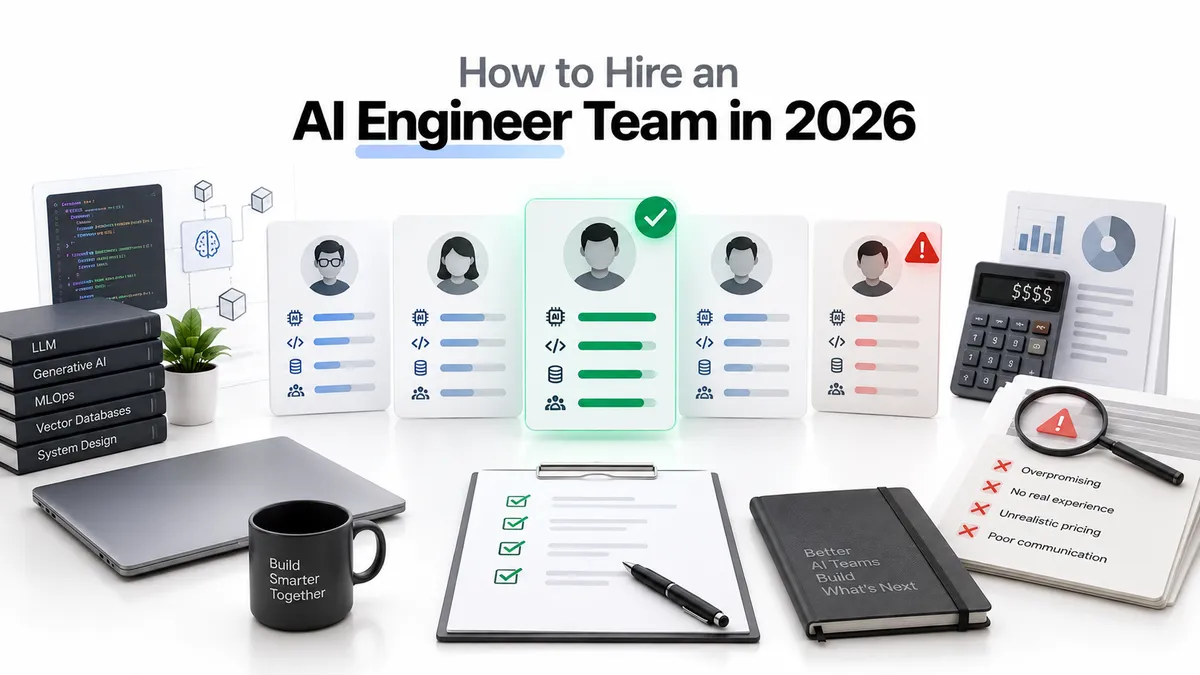
To hire a capable AI engineer team in 2026, you need:
An ML Engineer to build, train, and fine-tune models
A Data Engineer to build and maintain the data pipelines AI depends on
An AI/LLM Integration Engineer to connect AI models to your product or workflows
An MLOps Engineer to deploy, monitor, and maintain models in production
An AI Product Manager or Consultant to align the team's output with business goals
For most SMBs and startups, a team of 2-4 specialists covering these roles through a mix of full-time hires and on-demand talent is sufficient to ship a production-grade AI system.
Not ready to build a full team?NeuraDynamics' On-Demand AI Talent gives you access to senior AI engineers without full-time hiring commitments.
Why Hiring AI Talent Is Harder Than It Looks in 2026
The demand for AI engineers has outpaced supply significantly. Every company from enterprise to early-stage startup is competing for the same pool of experienced AI talent.
The result: inflated salaries, overstated CVs, and candidates who know the theory but have never shipped a production AI system.
Hiring the wrong AI engineer does not just waste salary; it costs you months of misdirected development, technical debt that is expensive to undo, and a delayed product that missed its market window.
This guide gives you the skills to look for, the questions to ask, and the red flags to walk away from.

The Core Roles in an AI Engineer Team
Not every AI project needs the same team. But these are the roles that cover the full lifecycle of a production AI system:
ML Engineer
The ML Engineer designs, trains, and evaluates machine learning models. They translate a business problem into a model architecture and own the quality of the model's output.
Must-have skills:
- Python (PyTorch or TensorFlow)
- Model training, evaluation, and fine-tuning
- Familiarity with foundation models- GPT, LLaMA, Mistral, Claude
- Experiment tracking (MLflow, Weights & Biases)
- Understanding of RAG pipelines and vector databases
Experience signal to look for: Has deployed at least one model to a production environment - not just a Kaggle competition or research paper.
Data Engineer
AI is only as good as the data feeding it. A Data Engineer builds and maintains the pipelines that collect, clean, transform, and store data in a format the model can use.
Must-have skills:
- SQL and Python
- ETL pipeline design (Airflow, dbt, or similar)
- Cloud data platforms (AWS, GCP, or Azure)
- Data quality frameworks and monitoring
- Experience with structured and unstructured data sources
Experience signal to look for: Has built a pipeline that handles real-world messy data and not just clean demo datasets.
AI/LLM Integration Engineer
This role has emerged as a distinct specialty in 2025–2026. The LLM Integration Engineer connects AI models, whether fine-tuned or API-based, to real product surfaces and business workflows.
Must-have skills:
- LangChain, LlamaIndex, or equivalent orchestration frameworks
- API integration (REST, GraphQL)
- Prompt engineering and prompt management
- Vector database implementation (Pinecone, Weaviate, Chroma)
- Understanding of context window management and retrieval strategies
Experience signal to look for: Has built a multi-step agentic workflow or RAG system that went into production use.
MLOps Engineer
Building the model is only half the job. The MLOps Engineer deploys it, monitors its performance, manages infrastructure costs, and ensures the system does not degrade over time.
Must-have skills:
- Model deployment (Docker, Kubernetes, cloud ML services)
- CI/CD pipelines for ML systems
- Model monitoring, drift detection, performance alerts
- Cost optimization for inference at scale
- Security and compliance for AI systems
Experience signal to look for: Has managed a model in production long enough to see and fix performance degradation or drift.
AI Product Manager or Consultant
Technical talent without strategic direction builds impressive demos that never ship. An AI PM or consultant translates business goals into engineering requirements and keeps the team focused on outcomes, not just outputs.
Must-have skills:
- Ability to define AI use cases with measurable success criteria
- Understanding of AI capabilities and limitations, knows what is buildable
- Experience working with cross-functional teams
- Comfort with ambiguity and iterative development
- Ability to communicate AI concepts to non-technical stakeholders

What AI Engineers Cost in 2026
Salary and engagement costs vary significantly by market, experience level, and engagement model.
Full-time hire (India-based):
- ML Engineer: ₹18–45 LPA
- Data Engineer: ₹15–35 LPA
- LLM Integration Engineer: ₹20–50 LPA
- MLOps Engineer: ₹18–40 LPA
Full-time hire (US-based):
- ML Engineer: $130,000–$220,000
- Data Engineer: $110,000–$180,000
- LLM Integration Engineer: $140,000–$230,000
- MLOps Engineer: $130,000–$200,000
On-demand / fractional engagement:
- Senior AI Engineer: $80–$150/hour
- AI Consultant: $100–$200/hour
- Full project engagement (MVP scope): $20,000–$80,000 depending on complexity
Before committing to full-time hires, it is worth asking whether you actually need to. Full-time AI engineers come with significant overheads — salaries, benefits, onboarding time, and the ongoing risk of a wrong hire that sets your project back by months. For most startups and SMBs, on-demand AI talent is a smarter starting point. You get access to senior, battle-tested engineers exactly when you need them, without the long-term cost commitment. It is faster to get started, easier to scale up or down, and far less expensive when the scope of your AI work is still evolving. Once your product is validated and your AI requirements are stable, a full-time hire makes more sense — but there is rarely a good reason to start there.
8 Skills Every AI Engineer Must Have in 2026
Beyond role-specific skills, these are the baseline competencies the market now expects from any serious AI engineer:
- Python proficiency — non-negotiable across every AI role
- LLM literacy — hands-on experience with at least one major foundation model API
- RAG implementation — retrieval-augmented generation is now a standard production pattern
- Cloud fluency — AWS, GCP, or Azure; AI systems live in the cloud
- Version control for ML — Git for code, plus experiment tracking for models
- Evaluation and testing — knowing how to measure whether an AI system is actually working
- Security awareness — prompt injection, data leakage, and model access controls
Communication — ability to explain AI behaviour and limitations to non-technical stakeholders

Red Flags to Watch for When Hiring AI Engineers
This is where most companies get it wrong. The AI talent market is full of candidates who interview well but cannot deliver.
Red Flag 1: Only Academic or Research Experience
A candidate with five publications but no production deployments is a researcher, not an engineer. Production AI systems deal with messy data, latency constraints, integration complexity, and real users. Research environments do not.
Ask: "Tell me about the last AI system you deployed to production. What broke and how did you fix it?"
Red Flag 2: Vague Answers About Model Evaluation
Any experienced AI engineer should be able to tell you how they evaluated their model — precision, recall, F1, BLEU, ROUGE, or task-specific benchmarks. Vague answers like "it performed well" are a serious warning sign.
Ask: "What metrics did you use to evaluate model performance on your last project, and why did you choose those over alternatives?"
Red Flag 3: No Awareness of Hallucination and Failure Modes
In 2026, any engineer working with LLMs must have a clear understanding of hallucination, prompt injection, context window limitations, and model drift. Candidates who cannot speak to these topics have not shipped real LLM systems.
Ask: "How did you handle hallucination risk in a production LLM application? What guardrails did you implement?"
Red Flag 4: Over-Reliance on a Single Framework
Engineers who can only work with one framework, only PyTorch, only LangChain, only OpenAI are a risk. The AI tooling landscape changes faster than any other area of software. Adaptability is more valuable than framework loyalty.
Ask: "What would you do if the primary framework your system depends on was deprecated tomorrow?"
Red Flag 5: No Understanding of Cost and Latency
AI systems are expensive to run at scale. An engineer who has never thought about inference cost, token optimisation, or caching strategies has never owned a production system used by real users.
Ask: "How did you manage inference costs on your last LLM deployment? What optimisations did you implement?"
Red Flag 6: Cannot Explain Their Work to a Non-Technical Audience
AI engineers who cannot communicate clearly with product managers, business stakeholders, or clients become bottlenecks. If a candidate cannot explain what their last project did in two plain-English sentences, they will struggle to work in any cross-functional environment.
Frequently Asked Questions
How long does it take to hire a qualified AI engineer in 2026? For a senior ML or LLM engineer in a competitive market, the average hiring cycle is 6–12 weeks longer if you require niche expertise like fine-tuning specific model families or MLOps at scale. On-demand AI talent can be onboarded in 1–2 weeks.
Do we need to hire AI engineers full-time or can we use freelancers? Both models work depending on project scope. For a defined AI product build or MVP, an on-demand engagement with a specialist team is typically faster and more cost-effective. For ongoing AI operations model monitoring, retraining, continuous improvement a full-time hire or retained partner makes more sense.
What is the difference between an AI engineer and a data scientist? A data scientist focuses on analysis, experimentation, and insight generation finding patterns in data. An AI engineer focuses on building systems, deploying models, managing pipelines, and integrating AI into products. In 2026, the most valuable profiles combine both, but the distinction still matters when defining roles.
Should a startup hire an AI engineer before validating their product? Not usually. Validating a product idea with a lightweight MVP, using existing APIs and minimal custom model work is a better first step. Once the use case is validated, hiring or engaging a specialist AI engineer to scale the system makes far more sense.
What is the minimum AI team size to ship a production-grade AI product?For most startup or SMB use cases, a team of two, one ML/LLM Integration Engineer and one Data Engineer supported by an AI consultant for architecture decisions, is enough to ship a focused production AI system. Complexity scales with the team.
Build Your AI Team the Right Way with NeuraDynamics
Hiring AI engineers is expensive, slow, and high-risk when done without the right framework. The wrong hire costs months of development time and significant budget and in a market moving as fast as AI, that delay has real business consequences.
NeuraDynamics has helped startups, SMBs, and enterprise teams across EdTech, Healthtech, Fintech, and eCommerce build and deploy production-grade AI systems with the right talent, the right architecture, and the right strategy from day one.
What we offer:
- On-Demand AI Talent - Access senior ML engineers, LLM specialists, Data Engineers, and MLOps experts without the cost and delay of full-time hiring. Onboard in days, not months.
- Generative AI Consulting Services - From use case validation to architecture design to deployment, we bring senior AI consulting expertise to every engagement.
- MVP Development Services - Ship your first AI product in weeks, not months. Validate before you scale.
- Intelligent Automation Services - Automate your highest-impact processes with AI-powered workflows built by specialists who have done it before.
Whether you need a single senior AI engineer for a 12-week sprint, a full delivery team for an end-to-end product build, or a consulting partner to define your AI strategy NeuraDynamics has the model that fits.
Talk to a NeuraDynamics AI Expert Today!
Author

Himanshu is the Founder of Neuradynamics and a seasoned Full Stack Developer with 15+ years of experience in application development, cloud infrastructure, automation, and scalable digital solutions. With expertise across Python, Django, AWS, Azure, and AI-powered systems, he shares practical insights on modern technology, software architecture, and digital transformation.